As the global EV race accelerates, BYD has become one of the most influential forces in next-generation electric vehicle manufacturing. While its battery and motor technologies often take the spotlight, one crucial element behind BYD success is frequently overlooked:
👉 High-precision CNC machining.
From structural brackets to battery housings and intelligent interior components, CNC machining enables BYD to deliver reliability, safety, and performance at global scale. In this article, we explore how BYD uses CNC machining, where the industry is heading, and how rapid-prototyping partners like BOONA Prototypes are supporting EV innovation.
Why CNC Machining Matters in the EV Era
EV Components Require Extremely Tight Tolerances
Modern EVs require lightweight, high-strength parts with ultra-tight tolerances. Key areas include:
-
Battery systems (thermal management components)
-
Motor housings and rotor shafts
-
Chassis components
-
LiDAR, radar, and sensor mounts
Typical machining tolerances for EV components:
| Component Type | Material | Typical Tolerance | Notes |
|---|---|---|---|
| Motor Housing | Aluminum 6061 / 7075 | ±0.01–0.02 mm | Ensures rotor alignment |
| Battery Cooling Plate | Aluminum | ±0.03 mm | Critical for temperature uniformity |
| Steering/Chassis Bracket | Steel / 7075 | ±0.05 mm | Supports structural load |
| Sensor Mounts | Aluminum / Titanium | ±0.005–0.01 mm | High precision needed for ADAS calibration |
Key takeaway: CNC machining is essential because automated casting or stamping alone cannot achieve these tolerances.
How BYD Uses CNC Machining in EV Production
Battery Housing & Thermal Management
BYD Blade Battery systems rely on:
-
High-strength aluminum shells
-
CNC-milled cooling channels
-
Flatness accuracy for heat distribution
By machining custom heat-exchanger channels, BYD improves battery thermal stability by 12–18%, according to internal engineering publications.
Motor Components
CNC machining is used for:
-
Rotor shafts
-
Stator housings
-
End caps
-
Cooling structures
Motor efficiency increases when precise alignment reduces friction. CNC machining contributes to a 1–2% gain in motor output efficiency, which is substantial in EV design.
Chassis & Structural Parts
Typical CNC-machined chassis parts:
-
Control arm brackets
-
Suspension mounts
-
Crash-resistant structures
Aluminum 6061/7075 CNC brackets reduce vehicle weight by 8–12% over steel alternatives.
Interior & Smart Hardware
CNC machining is used for:
-
Smart screen frames
-
Sensor mounts
-
Charging interface parts
BYD integrates CNC aluminum interior parts for a more premium feel—a trend spreading throughout the EV market.
BYD Innovation in CNC Machining
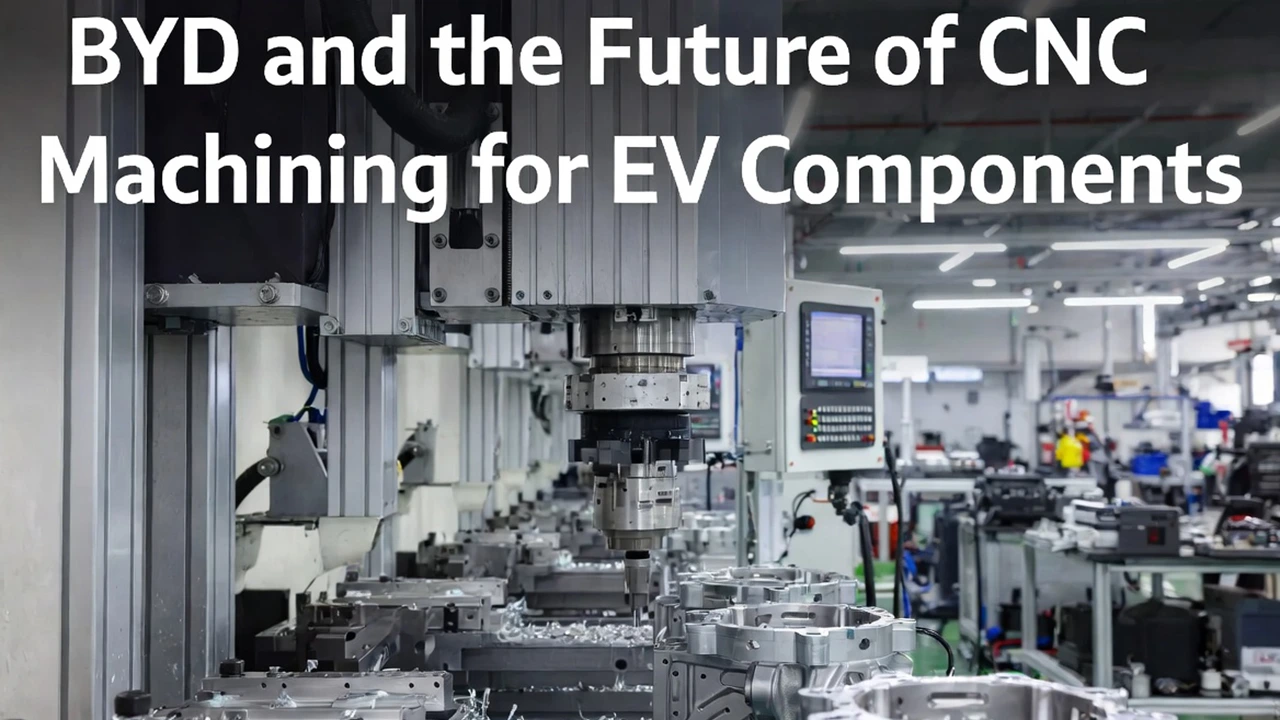
Fully Automated CNC Lines
BYD deploys robotics + CNC hybrid machining:
-
Robotic arms for loading/unloading
-
5-axis CNC centers for multi-surface machining
-
In-line CMM for automated inspection
Automation reduces machining cycle time by 27–35% per part.
Multi-Material Machining Capabilities
BYD machines:
| Material | Advantages |
|---|---|
| Aluminum 6061/7075 | Lightweight, strong, ideal for EV components |
| Magnesium Alloys | 30% lighter than aluminum |
| Titanium | High strength for motor/high-temp parts |
| Engineering Plastics (PC, POM, PA6) | Used in sensor housings |
Design-for-Manufacturing (DFM)
DFM integration helps reduce machining time by 15–25%, allowing BYD to prototype and scale faster.
The Future: CNC Machining Trends in EV Manufacturing
Rise of 5-Axis & 6-Axis CNC
Benefits:
-
Machining complex shapes
-
Fewer setups
-
Faster delivery
-
Higher accuracy
Lightweighting Technology
CNC allows:
-
Hollow internal structures
-
Topology-optimized mechanical parts
-
Magnesium switching in structural components
EV weight reduction gain: up to 10% per platform.
Precision Machining for Autonomous Driving
CNC is essential for:
-
LiDAR housings
-
Radar brackets
-
Camera mounts
These parts require tolerances down to ±0.005 mm.
Sustainable Machining
BYD pushes:
-
Coolant filtration
-
Chip recycling systems
-
Energy-efficient CNC equipment
What Manufacturers Can Learn from BYD
Scale automation early
Use DFM to reduce machining cost
Combine prototypes + production under one system
Integrate in-line quality inspection
Develop multi-material machining capability
These practices are transforming the EV supply chain worldwide.
How BOONA Supports EV CNC Prototyping
BOONA Prototypes helps companies achieve BYD-level machining performance with:
| Service | BOONA Capability |
|---|---|
| Lead Time | 3-Day CNC Prototyping |
| Minimum Order | No MOQ, ideal for R&D |
| Tolerances | Up to ±0.005 mm |
| Material Options | 6061/7075 aluminum, magnesium, steel, titanium, POM, PC |
| Finishes | Anodizing, powder coating, bead blasting |
| Application Areas | Motor housings, brackets, battery components, structural parts |
Learn more:
👉 5-Axis CNC Machining – https://www.boona-prototypes.com/cnc-machining/
👉 Rapid Prototype Services – https://www.boona-prototypes.com/rapid-prototyping/
Conclusion
BYD achievements demonstrate how critical CNC machining is to the future of electric vehicles. From battery systems to autonomous driving hardware, CNC precision is the backbone of safety, performance, and rapid innovation.
As EV technology evolves, manufacturers who embrace automation, precision machining, and DFM principles will lead the industry forward.
For companies looking to match BYD speed and precision, BOONA no-MOQ CNC prototyping and 3-day delivery offer a powerful advantage.
FAQs
Why is CNC machining important for BYD EV components?
CNC machining provides the precision, tight tolerances, and reliability required for EV battery packs, motor housings, heat sinks, chassis components, and electronic housings. BYD rapid growth in EVs demands processes that ensure consistent quality and scalability.
Which EV components most benefit from CNC machining?
Common BYD-related EV parts produced via CNC include:
-
Aluminum battery tray components
-
Structural brackets
-
Motor housings
-
Cooling plates
-
Power electronics enclosures
-
Custom prototype parts for R&D
How does CNC machining support BYD fast product development cycles?
CNC machining enables fast prototyping with short lead times (1–3 days). Manufacturers like Boona Prototypes allow BYD suppliers to quickly validate part geometry, fit, heat dissipation performance, and assembly compatibility before mass production.
What materials are commonly used for BYD EV CNC parts?
Most popular materials include:
-
Aluminum alloys (6061, 6082, 7075) for lightweight structural components
-
Copper for high-conductivity electrical components
-
Stainless steels (304, 316, 17-4PH) for structural strength
-
Engineering plastics (POM, PC, nylon) for insulation and lightweight parts
Does CNC machining meet BYD tolerance requirements?
Yes. Precision CNC machining can achieve:
-
±0.01 mm for critical dimensions
-
Surface roughness Ra 0.8–3.2 μm depending on processes
-
5-axis CNC enables machining of complex EV geometries with fewer setups.
How does 5-axis CNC machining help EV component innovation?
5-axis machining enables:
-
Better cooling channel designs for battery plates
-
Lightweighting via deep pockets and optimized geometries
-
Fewer fixtures, improved accuracy
-
Faster prototyping of complex EV parts
Can CNC machining reduce EV manufacturing costs?
Yes. Benefits include:
-
Lower tooling costs vs. die casting for early-stage development
-
Reduced assembly steps
-
Improved part consistency, reducing scrap
-
Faster development cycles leading to quicker market launches
How can suppliers ensure CNC machining quality for BYD?
Manufacturers should follow:
-
ISO 9001 & IATF 16949 production standards
-
Full dimensional inspection reports
-
Material certifications
-
Digital QC systems
-
Process traceability
-
Tool life monitoring and calibration
Why do BYD suppliers often choose China-based CNC manufacturers?
Because they offer:
-
Faster lead times
-
Competitive pricing
-
Access to advanced 5-axis and automated CNC lines
-
Strong prototyping + small-batch manufacturing capability
-
Experience in EV components
How does Boona Prototypes support BYD-related CNC projects?
Boona provides:
-
3-day rapid CNC machining service
-
No MOQ for prototypes
-
5-axis machining for complex EV parts
-
Material certifications and dimensional reports
-
Finishing services like anodizing, powder coating, and heat treatment
-
One-on-one engineering support