
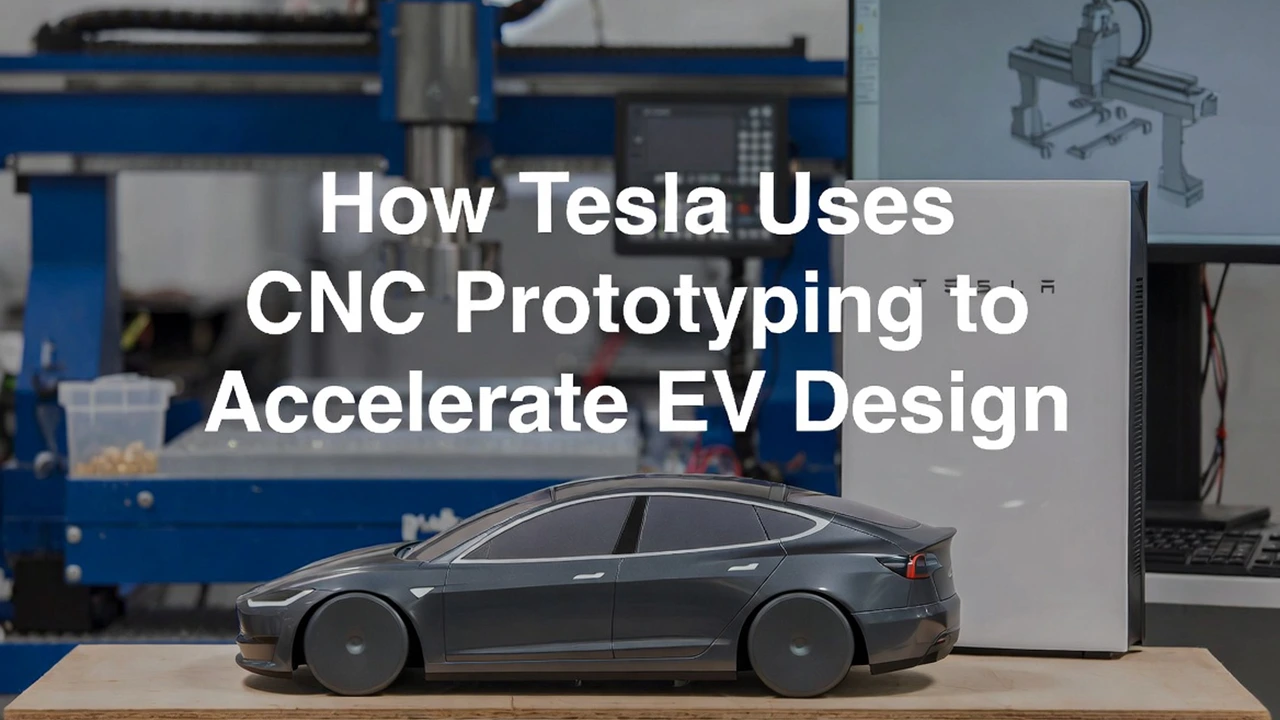
In the automotive world, the standard design cycle is a sluggish four years. Yet, Tesla consistently pushes new vehicles from concept to production in just 18 to 24 months. How? By treating hardware development exactly like software development.
Tesla views physical manufacturing as “compiling atoms.” Just as software engineers compile code to test it, Tesla uses CNC (Computer Numerical Control) machining to instantly turn digital designs into physical parts. This “Agile Hardware” philosophy reduces the cost of change to near zero, allowing engineers to fail fast and fix faster.
At Boona Prototypes, we see this same acceleration every day. By leveraging high-speed CNC Machining Services, EV startups and engineering firms can replicate Tesla’s speed, bypassing the months-long lead times of traditional tooling.
Here is how the giant uses CNC strategies to dominate the EV market—and how you can apply them to your projects.
The “Sand & Polish” Strategy: Prototyping Gigacastings
Tesla’s massive “Gigacastings” (front and rear underbody chassis) are revolutionizing manufacturing, but prototyping them is a nightmare. A traditional steel die for a casting this size costs over $1.5 million and takes 6 months to build. If the design is wrong, that money is wasted.
Tesla’s solution is a hybrid 3D Printing + CNC Machining workflow:
-
Print: They use binder-jet printers to create a sand mold (sand casting).
-
Cast: Molten aluminum is poured into the sand mold to get the rough shape.
-
Polish (CNC): Large 5-axis CNC mills are used to machine the mating surfaces, bolt holes, and suspension points to micron-level precision.
This method allows Tesla to validate a chassis design for roughly 3% of the cost of a traditional metal prototype tool.
Thermal Mastery: Octovalves and Cooling Plates
The heart of an EV is its thermal management. Tesla’s “Octovalve” and structural battery packs require complex cooling channels that are difficult to manufacture.
During the design phase, Tesla doesn’t wait for stamped or brazed parts. They machine these complex geometries directly from solid blocks of Aluminum 6061 or copper.
-
Cooling Plates: CNC mills carve intricate “snake” channels to test coolant flow and thermal transfer rates.
-
Manifolds: Complex manifolds are machined to validate fluid dynamics (CFD) in the real world before expensive injection molds are ordered.
For fast iterations on these complex parts, Vacuum Casting is also a powerful alternative, allowing for low-volume production of manifold-like parts in engineering-grade resins that mimic production plastics.
Material Comparison for Thermal Prototypes
Choosing the right material for your CNC prototype is critical for thermal validation.
| Material | Thermal Conductivity (W/m-K) | Machinability Rating | Typical App |
| Aluminum 6061-T6 | ~167 | Excellent | Cooling plates, Housings |
| Copper (C110) | ~388 | Moderate (Gummy) | High-performance busbars |
| Stainless Steel 304 | ~16 | Difficult | Structural mounts (low heat transfer) |
The Cybertruck: Laser Cutting & Air Bending
The Cybertruck presented a unique challenge: its “Hard Freaking Stainless” (HFS) steel exoskeleton is too hard to stamp with traditional dies.
Tesla leaned entirely on CNC fabrication techniques usually found in job shops:
-
Laser CNC Cutting: High-power lasers score and cut the steel coils with extreme precision.
-
Air-Bending: Computer-controlled press brakes fold the steel into shape (like origami) without needing a dedicated stamping die.
This allows for rapid adjustments.[1][2][3][4] If a door panel gap is off by 2mm, the code is updated, and the laser cuts the correction on the next sheet. For your own enclosures or structural parts, our Sheet Metal Fabrication services utilize similar laser cutting and bending technologies to deliver production-grade parts without tooling costs.
The “In-House Job Shop” Advantage
Legacy automakers often outsource prototyping to Tier 1 suppliers, waiting weeks for a single bracket. Tesla maintains massive in-house machine shops at their design centers. If a part fails destructive testing, a machinist cuts a new version overnight.
This capability is what Boona Prototypes provides to our clients. We act as your external “in-house” shop, offering the ability to switch materials instantly—from ABS plastic to Titanium—to test strength-to-weight ratios on the fly.
Technical Parameters for EV Prototyping
To achieve “Tesla-speed,” your designs must be optimized for CNC manufacturing. Below are the standard technical parameters we recommend for high-speed EV prototyping:
| Parameter | Standard CNC Specification | Notes |
| Dimensional Tolerance | ± 0.01mm to ± 0.05mm | Crucial for battery module fitment |
| Surface Finish (Ra) | 0.8µm – 1.6µm | Smooth enough for sealing O-rings |
| Max Part Size | Up to 2000mm x 1000mm | For large chassis components |
| Lead Time | 3 – 7 Days | Compared to 8-10 weeks for casting |
Conclusion
Tesla has proven that the fastest way to innovate is to bridge the gap between digital simulation and physical reality. CNC prototyping is that bridge. It allows for “destructive testing” earlier in the cycle, reduces risk, and dramatically shortens time-to-market.
Whether you are building the next generation of EVs or a consumer electronic device, you don’t need a Gigafactory to prototype like one.
Ready to compile your atoms? Upload your CAD files to Boona Prototypes today and let’s build the future, fast.
FAQs
How does CNC prototyping reduce vehicle development time compared to traditional methods?
Traditional automakers often wait 4–6 months for steel stamping dies or casting molds to be manufactured before they can test a physical part. Tesla shortens this cycle by “machining from solid.” Instead of waiting for a mold, they take a block of metal and use CNC machines to cut the part immediately. This reduces the “compile time” from months to days, allowing for dozens of design iterations in the time it takes legacy makers to do just one.
Why does Tesla use CNC machining for Gigacastings if they are eventually going to be cast?
Tesla uses a “Hybrid Sand & Polish” method for prototyping. Creating a production steel die for a Gigacasting costs over $1.5 million. Instead, Tesla 3D prints a sand mold and casts a rough part. They then use 5-axis CNC mills to precisely machine the critical surfaces (mounting points, suspension towers). This validates the design for roughly 3% of the cost of a full tool, preventing expensive mistakes before mass production begins.
Can smaller startups replicate Tesla’s “Agile Hardware” approach without owning a massive machine shop?
Absolutely. While Tesla has the capital to build in-house machine shops, startups can achieve the same speed by partnering with rapid prototyping services. By using an external partner like Boona Prototypes, engineers can upload CAD files and receive precision CNC machined parts in as little as 3 days, effectively mimicking Tesla’s internal “job shop” model without the capital expenditure.
What specific materials are most critical for EV CNC prototyping?
The three most common materials used in EV prototyping are:
-
Aluminum 6061/7075: Used for chassis components, suspension knuckles, and battery cooling plates due to its high strength-to-weight ratio and thermal conductivity.
-
Copper (C110/C101): Essential for high-voltage busbars and connectors within the battery pack.
-
Engineering Plastics (PEEK/ABS): Machined for high-voltage insulators and lightweight mounting brackets.
How is CNC machining used in EV battery pack design?
Battery packs require extreme precision to ensure safety and efficiency. CNC machining is used to create cooling plates with intricate internal channels (like the “snake” tubes in Tesla packs) to manage heat. Furthermore, the mating surfaces of battery modules must be perfectly flat (within microns) to prevent air gaps that reduce thermal transfer. Only CNC machining offers the tolerance control (±0.01mm) required for these critical interfaces.
Did Tesla use CNC machining for the Cybertruck?
Yes, but with a focus on cutting and bending rather than milling. Because the Cybertruck’s “Hard Freaking Stainless” (HFS) steel is too thick and hard for traditional stamping, Tesla utilized CNC Laser Cutters to score the steel and CNC Press Brakes to air-bend the panels into shape. This eliminated the need for stamping dies entirely during the prototyping and early production phases.
What is “Bridge Production” and how does CNC machining fit in?
“Bridge Production” occurs when a company needs to sell cars but the final mass-production tools (like injection molds or casting dies) aren’t ready yet. Tesla often uses CNC machining to produce parts for the first few thousand vehicles. While the per-part cost is higher than casting, it allows them to enter the market months earlier, generating revenue while the permanent tooling is being finalized.