
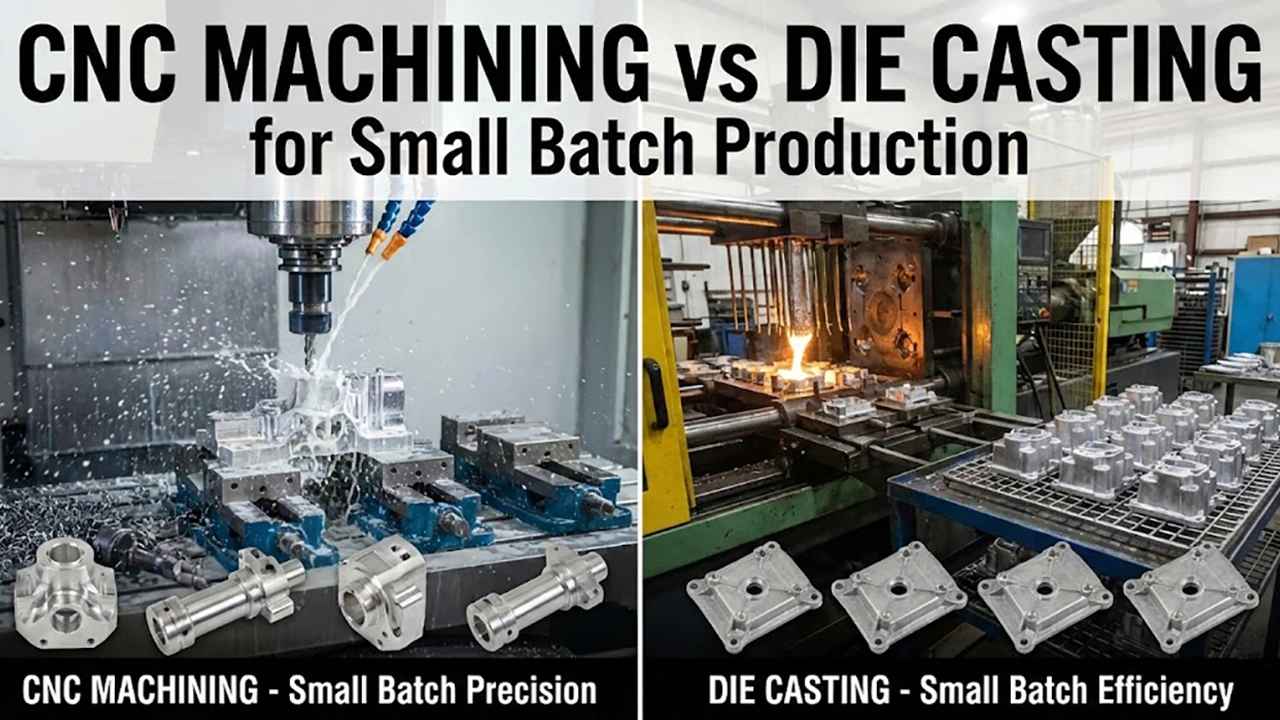
For startups, hardware innovators, and OEMs, small batch production plays a critical role between prototyping and mass manufacturing. One of the most common questions is whether CNC machining or die casting is the better choice at low volumes.
This guide compares CNC machining vs die casting for small batch production, focusing on cost, lead time, tolerances, materials, and scalability, while showing how manufacturers like
BOONA Prototypes support flexible, low-volume manufacturing.
Understanding Small Batch Production
Small batch production typically refers to 1–5,000 parts, often used for:
-
Functional prototypes
-
Pilot runs
-
Market testing
-
Bridge production before mass manufacturing
What Is CNC Machining?
CNC machining is a subtractive manufacturing process where material is removed from a solid block using precision cutting tools.
Key CNC Machining Advantages
-
No tooling or molds required
-
Extremely tight tolerances
-
Excellent surface quality
-
Ideal for rapid design changes
Learn more about BOONA
custom CNC machining services for low-volume production.
What Is Die Casting?
Die casting is a molding process where molten metal is injected into a steel mold (die) under high pressure.
Key Die Casting Characteristics
-
Requires expensive steel tooling
-
Best for high-volume production
-
Consistent part geometry once molds are finalized
-
Limited flexibility after tooling
CNC Machining vs Die Casting: Process Comparison
Table 1: CNC Machining vs Die Casting Overview
| Factor | CNC Machining | Die Casting |
|---|---|---|
| Tooling cost | None | High (mold required) |
| Setup time | Hours–days | 4–8 weeks |
| Design flexibility | Very high | Low after tooling |
| Best volume range | 1–5,000 pcs | 5,000+ pcs |
| Material waste | Higher | Lower |
| Part complexity | Very high | High |
Cost Comparison for Small Batch Production
Tooling cost is the largest differentiator between the two processes.
Table 2: Cost Comparison at Different Volumes
| Quantity | CNC Machining | Die Casting |
|---|---|---|
| 10 pcs | Low | Very high |
| 100 pcs | Moderate | Very high |
| 1,000 pcs | Moderate | High |
| 5,000 pcs | Moderate | Competitive |
| 10,000+ pcs | High | Low per unit |
Key insight:
For small batches, CNC machining is often 30–70% cheaper due to zero tooling investment.
Lead Time & Speed to Market
Speed is critical during early product development.
Typical Lead Times
| Process | Lead Time |
|---|---|
| CNC machining | 3–10 days |
| Die casting tooling | 4–8 weeks |
| Die casting production | 1–2 weeks |
BOONA
rapid prototyping services enable CNC parts to be delivered in days, not months.
Precision, Tolerances & Surface Quality
Table 3: Tolerances & Surface Finish Comparison
| Parameter | CNC Machining | Die Casting |
|---|---|---|
| Typical tolerance | ±0.01 mm | ±0.1 mm |
| High precision | ±0.005 mm | Limited |
| Surface roughness | Ra 0.8–3.2 μm | Ra 3.2–6.3 μm |
| Secondary machining | Rare | Often required |
For parts requiring tight tolerances or functional testing, CNC machining clearly outperforms die casting.
Material Selection & Mechanical Properties
CNC Machining Materials
-
Aluminum (6061, 7075)
-
Stainless steel
-
Brass & copper
-
Engineering plastics
Die Casting Materials
-
Aluminum alloys
-
Zinc alloys
-
Magnesium alloys
CNC machining allows wider material flexibility, especially for engineering validation.
Design Flexibility & Engineering Changes
Design changes are common in small batch production.
-
CNC machining: design updates can be implemented same day
-
Die casting: mold changes are expensive and time-consuming
This makes CNC machining ideal for iterative product development.
Quality Control & Defect Risks
CNC Machining
-
CMM inspection
-
High dimensional consistency
-
Minimal internal defects
Die Casting
-
Risk of porosity
-
Shrinkage defects
-
Secondary machining often required
BOONA integrates inspection throughout its
manufacturing workflow to ensure batch consistency.
When CNC Machining Is the Better Choice
CNC machining is ideal when:
-
Production volume is under 5,000 pcs
-
Tight tolerances are required
-
Designs may change
-
Fast delivery is critical
When Die Casting Makes Sense
Die casting becomes viable when:
-
Volumes exceed 10,000 pcs
-
Design is fully validated
-
Long-term cost reduction is the goal
Many companies use CNC machining first, then transition to die casting later.
Hybrid Manufacturing: CNC + Die Casting
A common strategy:
-
CNC machining for prototypes & pilot runs
-
Design validation
-
Die casting for mass production
-
CNC machining for post-processing
This hybrid approach minimizes risk and speeds up time to market.
Choosing the Right Manufacturing Partner
When evaluating suppliers, look for:
-
No-MOQ small batch capability
-
Strong engineering support
-
Transparent cost structure
-
Ability to scale from prototype to production
BOONA Prototypes specializes in flexible CNC machining for small batch production, supporting global customers from concept to launch.
Conclusion
For small batch production, CNC machining is usually faster, more flexible, and more cost-effective than die casting. Die casting becomes advantageous only after volumes justify tooling investment.
Understanding the trade-offs between these processes helps manufacturers reduce risk, control cost, and accelerate product development.
👉 Learn more at:
https://www.boona-prototypes.com/
FAQs
Which is better for small batch production: CNC machining or die casting?
For small batch production, CNC machining is usually better because it requires no expensive molds, has faster setup times, and supports low or no MOQ. Die casting is more cost-effective only at high volumes.
What is the minimum order quantity difference between CNC machining and die casting?
CNC machining often supports 1–50 units with no MOQ, while die casting typically requires hundreds or thousands of parts to justify mold costs.
Why is CNC machining more suitable for prototyping?
CNC machining allows direct manufacturing from CAD files, enabling rapid design changes, tight tolerances, and fast lead times—ideal for functional prototypes and iterative development.
Is die casting cheaper than CNC machining?
Die casting has lower per-part costs at high volumes, but the initial tooling cost ($5,000–$50,000+) makes it expensive for small batches compared to CNC machining.
Which process offers higher dimensional accuracy?
CNC machining provides higher precision, typically achieving tolerances of ±0.01 mm or better, while die casting tolerances are usually looser.
Can both processes use aluminum?
Yes. Both CNC machining and die casting commonly use aluminum alloys, but CNC machining supports a wider range of aluminum grades such as 6061, 7075, and 6082.
How do lead times compare between CNC machining and die casting?
CNC machining lead times are usually 3–7 days, while die casting can take 4–8 weeks due to mold design and fabrication.
Which method is better for design flexibility?
CNC machining offers maximum design flexibility, allowing easy revisions without tooling changes. Die casting designs are limited once the mold is made.
Is surface finish better with CNC machining or die casting?
CNC machining provides more consistent and customizable surface finishes, including anodizing, polishing, and bead blasting. Die casting may require secondary finishing.
When should a company switch from CNC machining to die casting?
Companies typically switch when production exceeds 5,000–10,000 units, designs are fully validated, and cost savings from die casting outweigh tooling investment.