
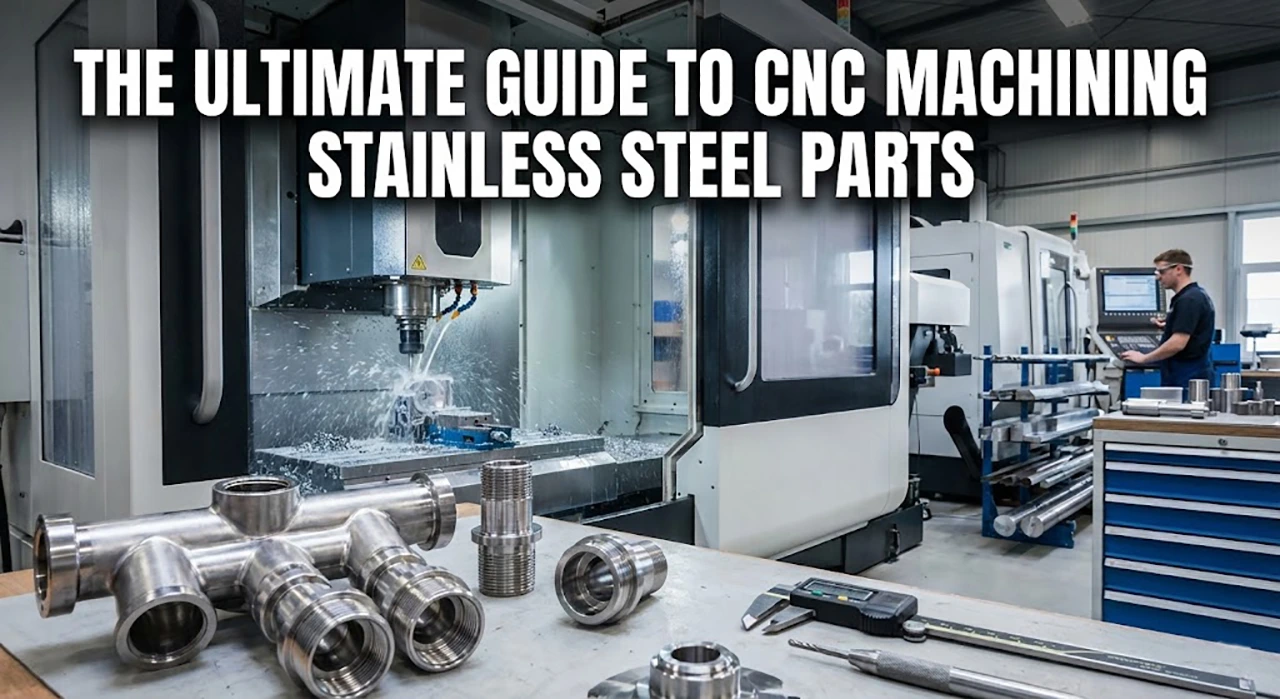
Stainless steel CNC machining plays a critical role in industries that demand high strength, corrosion resistance, and tight tolerances. From medical devices to aerospace and industrial equipment, CNC machined stainless steel parts deliver durability, precision, and long service life.
This ultimate guide explains stainless steel grades, machining processes, parameters, costs, and design tips, helping engineers and buyers choose the right solution for prototyping and low-volume production.
Why Stainless Steel Is Ideal for CNC Machining
Stainless steel offers a unique balance of mechanical performance and environmental resistance, making it one of the most requested materials in precision CNC machining services.
Key advantages include:
-
Excellent corrosion and chemical resistance
-
High tensile and yield strength
-
Good performance at high temperatures
-
Long lifespan in harsh environments
According to industry data, over 30% of CNC machined industrial parts use stainless steel due to its reliability in demanding applications.
Common Stainless Steel Grades for CNC Machining
Choosing the right grade directly impacts machinability, cost, and performance.
Most Machined Stainless Steel Grades
| Grade | Type | Tensile Strength (MPa) | Corrosion Resistance | Typical Applications |
|---|---|---|---|---|
| 304 | Austenitic | 515–620 | Good | Housings, brackets, food equipment |
| 316 | Austenitic | 515–620 | Excellent | Medical, marine, chemical parts |
| 410 | Martensitic | 450–700 | Moderate | Shafts, fasteners |
| 420 | Martensitic | 700–900 | Moderate | Surgical tools |
| 17-4PH | Precipitation Hardening | 930–1310 | Good | Aerospace, structural components |
👉 For high-strength applications, 17-4PH CNC machining is a top choice, while 316 stainless steel CNC machining is preferred for medical and corrosive environments.
CNC Machining Processes for Stainless Steel Parts
Professional suppliers like BOONA Precision Prototyping support multiple CNC processes to handle stainless steel efficiently.
Main CNC Processes
-
CNC Milling – complex geometries, pockets, and housings
-
CNC Turning – shafts, bushings, threaded parts
-
5-Axis CNC Machining – multi-surface and high-precision parts
Learn more about BOONA capabilities on their
👉 CNC Machining Services page.
CNC Cutting Parameters for Stainless Steel
Stainless steel is prone to work hardening, so optimized parameters are essential.
Typical CNC Machining Parameters
| Parameter | 304 / 316 | 17-4PH |
|---|---|---|
| Cutting Speed | 60–120 m/min | 45–90 m/min |
| Feed Rate | 0.05–0.25 mm/tooth | 0.04–0.18 mm/tooth |
| Tool Material | Carbide (TiAlN) | Carbide (AlTiN) |
| Coolant | Flood / High-pressure | High-pressure |
Proper tooling and cooling can reduce tool wear by up to 40% in stainless steel CNC machining.
Design Guidelines for CNC Machined Stainless Steel Parts
Optimized design helps reduce cost without sacrificing quality.
Best practices:
-
Minimum wall thickness: ≥1.0 mm
-
Internal corner radius: ≥0.5 mm
-
Avoid deep, narrow slots
-
Use standard tolerances where possible
BOONA provides DFM (Design for Manufacturability) support to help clients lower machining costs while maintaining precision.
👉 Learn more about Rapid CNC Prototyping.
Achievable Tolerances and Quality Control
Modern CNC equipment can achieve:
-
Standard tolerance: ±0.05 mm
-
High-precision tolerance: ±0.01 mm
-
Surface roughness: Ra 0.8–3.2 μm
Quality inspection methods include:
-
CMM (Coordinate Measuring Machine)
-
Surface roughness testers
-
Material certification and traceability
This ensures stainless steel parts meet ISO and ASTM standards.
Surface Finishing Options for Stainless Steel CNC Parts
Surface finishing enhances appearance, corrosion resistance, and functionality.
| Finish Type | Ra (μm) | Typical Use |
|---|---|---|
| As-machined | 3.2 | Functional prototypes |
| Bead blasted | 1.6–3.2 | Matte industrial look |
| Polished | ≤0.8 | Medical & consumer products |
| Passivation | — | Corrosion resistance |
| Electropolishing | ≤0.4 | Medical & food-grade parts |
Cost Factors in CNC Machining Stainless Steel
Stainless steel costs more to machine than aluminum, but smart choices reduce expenses.
Main cost drivers:
-
Material grade
-
Machining time
-
Tool wear
-
Tolerance requirements
For low-volume stainless steel production, CNC machining is often 30–50% cheaper than tooling-based processes like casting or forging.
Applications of CNC Machined Stainless Steel Parts
Stainless steel CNC parts are widely used in:
-
Medical devices and surgical instruments
-
Food processing equipment
-
Aerospace structural components
-
Industrial automation systems
-
High-end consumer products
Why Choose BOONA for Stainless Steel CNC Machining
BOONA specializes in:
-
No-MOQ CNC machining
-
3-day rapid prototyping
-
Tight tolerances and stable quality
-
Engineering and DFM support
Explore their full capabilities here:
👉 Precision CNC Machining Manufacturer
Conclusion
CNC machining stainless steel parts requires expert material selection, optimized parameters, and precision control. By choosing the right grade and a professional supplier, you can achieve high-quality, cost-effective results for both prototypes and low-volume production.
FAQs
What is the main difference between 6061 and 7075 aluminum in CNC machining?
The main difference is strength. 7075 aluminum offers significantly higher tensile strength, while 6061 aluminum provides better corrosion resistance, weldability, and lower machining cost.
Which aluminum grade is better for CNC prototyping?
For most CNC prototyping projects, 6061 aluminum is preferred due to its excellent machinability, affordability, and availability. 7075 is better for functional prototypes requiring high structural strength.
Is 7075 aluminum harder to machine than 6061?
Yes. 7075 aluminum is harder and more abrasive, which can increase tool wear, machining time, and overall CNC machining costs compared to 6061 aluminum.
Can 6061 aluminum be used for high-strength applications?
6061 aluminum is suitable for moderate-strength applications, such as enclosures, brackets, and frames. For aerospace or high-load components, 7075 aluminum is typically recommended.
Which aluminum grade is commonly used in aerospace CNC parts?
7075 aluminum is widely used in aerospace CNC machining due to its high strength-to-weight ratio, making it ideal for drone frames, aircraft fittings, and structural components.
Is 7075 aluminum corrosion resistant?
7075 aluminum has lower corrosion resistance than 6061. It often requires surface treatments like anodizing or coating for use in harsh or humid environments.
Does anodizing work better on 6061 or 7075 aluminum?
Anodizing generally produces more consistent and visually uniform results on 6061 aluminum. 7075 can be anodized but may show color variation due to its alloy composition.
Which aluminum grade is more cost-effective for small-batch CNC production?
6061 aluminum is more cost-effective for small-batch CNC machining because of lower material cost, faster machining, and reduced tool wear.
Can 7075 aluminum be used for rapid prototyping?
Yes, but it is usually reserved for late-stage or functional prototypes where performance testing is required, rather than early-stage rapid prototypes.
How do I choose between 6061 and 7075 for my CNC project?
Choose 6061 aluminum for cost-sensitive, general-purpose prototypes. Choose 7075 aluminum for high-strength, load-bearing, or aerospace-grade CNC machined parts.