
As a CNC machining engineer with over a decade of experience in the aerospace and medical device manufacturing sectors, I am frequently asked a highly challenging question by clients: “Magnesium is extremely prone to thermal distortion. How do you consistently maintain +/- 0.005mm or even tighter tolerances in actual production?”
With the rising popularity of lightweight designs, engineers are increasingly turning to magnesium alloys to replace traditional aluminum. Among all magnesium grades, AZ31B and AZ91D are the most favored. However, achieving micron-level precision requires not only advanced equipment but also a profound understanding of material properties. Today, drawing on the real-world engineering data from our custom CNC machining services, I will dive deep into the core strategies for machining these two materials.
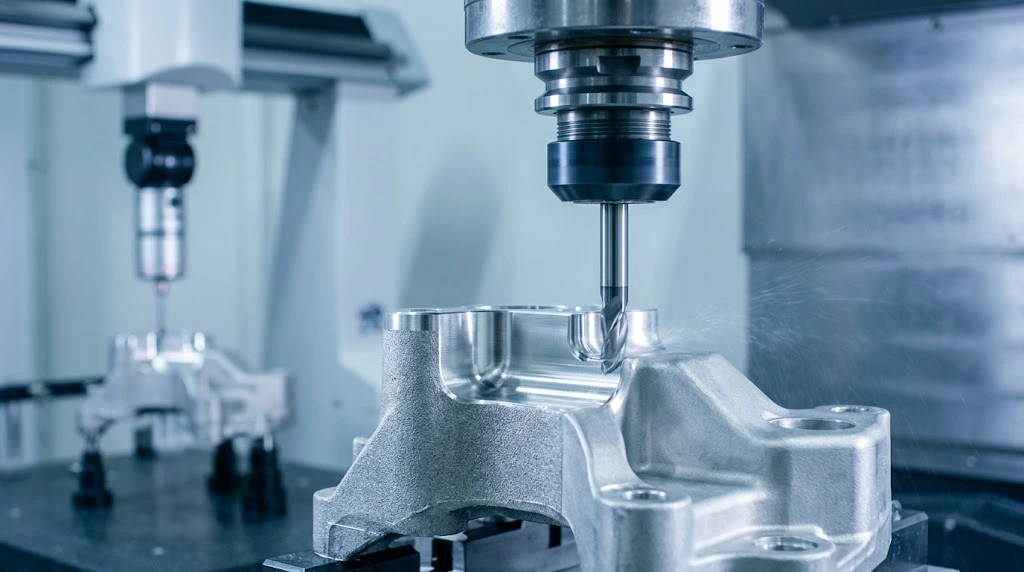
AZ31B vs. AZ91D: How Material Properties Impact Precision Machining
Before setting up toolpaths, we must understand the fundamental differences between these two materials. AZ31B is typically a wrought magnesium alloy (extruded or forged) with excellent ductility and a high strength-to-weight ratio. AZ91D, on the other hand, is primarily a die-cast magnesium alloy with a higher aluminum content, giving it superior corrosion resistance and castability.
Here is a comparison of the core parameters we record in actual machining:
| Material Property | AZ31B Magnesium | AZ91D Magnesium | Practical Impact on Machining |
| Density | 1.77 g/cm³ | 1.81 g/cm³ | Extremely low inertia; highly susceptible to clamping distortion |
| Tensile Strength | 260 – 290 MPa | 230 – 250 MPa | AZ31B requires higher shear cutting forces |
| Coefficient of Thermal Expansion (CTE) | 26.0 µm/m·°C | 26.0 µm/m·°C | Core Challenge: Even slight temperature fluctuations will destroy the +/- 0.005mm tolerance |
| Machinability Rating | Excellent | Superb | Minimal tool wear, but chip control is absolutely critical |
Breaking the Bottleneck: Maintaining +/- 0.005mm Ultra-Tight Tolerances
For clients seeking high-precision custom parts, finding a supplier that offers precision CNC machining services for magnesium with tight tolerances is crucial. To reliably hit that +/- 0.005mm (5-micron) mark, we typically must overcome the following physical limitations:
1. Strict Thermal Management
Magnesium’s high thermal expansion coefficient (26.0 µm/m·°C) is the biggest enemy of micron-level precision. This means a 100mm long magnesium part will expand by 2.6 microns for every 1°C increase in temperature. If the part temperature rises by just 5°C during machining, the tolerance is already blown.
Our Solution: Throughout the entire magnesium CNC machining process, the shop floor temperature must be strictly regulated at 20°C ± 0.5°C. We use dedicated mineral oil-based cutting fluids (water-based coolants are strictly prohibited to prevent hydrogen gas explosions). This not only provides essential lubrication but also efficiently evacuates micro-heat from the cutting zone.
2. Optimized Tool Geometry and Cutting Parameters
To avoid built-up edge (BUE) and work hardening, we insist on using ultra-fine micro-grain solid carbide tools with highly polished flutes (PCD tools yield even better results). Maintaining a razor-sharp cutting edge effectively reduces cutting resistance, thereby minimizing the micro-distortion of the part within the fixture.
Below is a proven cutting parameter chart we use for roughing and finishing AZ31B and AZ91D:
| Machining Stage | Spindle Speed (RPM) | Feed Rate (mm/min) | Depth of Cut (DOC) (mm) | Tool Rake Angle |
| Roughing | 8,000 – 10,000 | 1,500 – 2,500 | 1.5 – 3.0 | 15° – 20° (Positive) |
| Semi-finishing | 12,000 – 15,000 | 1,000 – 1,800 | 0.2 – 0.5 | 15° – 20° (Positive) |
| Super Finishing (5µm) | 18,000 – 24,000 | 600 – 1,000 | 0.02 – 0.05 | 20°+ (Razor sharp, polished flute) |
Engineering Tip: Before the final finishing pass, all clamping stresses must be released, and the part must rest inside the machine enclosure for at least 15 minutes to fully synchronize with the ambient temperature.
3. Innovative and Stress-Free Workholding
Because magnesium is relatively soft, traditional vise clamping easily leads to part distortion. When providing custom lightweight aerospace parts manufacturing, we typically utilize vacuum chucks or custom 3D-printed conformal soft jaws. Ensuring zero micro-elastic deformation during clamping is the absolute prerequisite for passing CMM (Coordinate Measuring Machine) inspection after the part comes off the machine.
Safety is Always the Core of Magnesium Machining
The fine dust and chips generated during magnesium cutting are highly flammable and can even trigger devastating Class D fires. This demands top-tier chip evacuation systems and rigorous Standard Operating Procedures (SOPs) for machine cleanliness. From raw material to finished product, every step highlights a manufacturer’s professional foundation. To ensure your project is foolproof, you need to rely on an expert team with a strict quality control system.
Conclusion
Machining AZ31B and AZ91D and holding tolerances to +/- 0.005mm is no easy feat; it is an art that combines material science, thermodynamics, and extreme precision machining. Whether you require upfront low-volume manufacturing to validate a medical device design or steady production runs for aerospace components, finding a manufacturing partner who knows how to “tame” magnesium is the key to success.
If you are looking for an expert team capable of handling highly challenging AZ31B/AZ91D magnesium precision machining, Boona Prototypes is ready to turn your blueprints into flawless physical parts.
FAQs
Is the fire risk of machining magnesium actually that high, or is it an industry exaggeration?
It is a very real hazard, definitely not a myth. Solid blocks of AZ31B or AZ91D are perfectly safe and won’t ignite under normal conditions. The danger lies in the fine chips, shavings, and dust generated during the CNC cutting process. When magnesium dust gets hot enough—often from a dull endmill rubbing against the part—it can ignite and cause a Class D metal fire, which burns incredibly hot and cannot be put out with water. This is exactly why specialized shops invest heavily in mineral oil coolants, high-end chip evacuation systems, and strict machine-cleaning protocols.
Why is it so much harder to hold a +/- 0.005mm tolerance on magnesium compared to stainless steel?
It all comes down to the Coefficient of Thermal Expansion (CTE). Magnesium expands and contracts with temperature changes much more drastically than steel. If the shop floor temperature fluctuates by just a few degrees, or if the cutting tool generates too much localized heat, the magnesium part will temporarily expand. If you machine it to size while it’s “hot,” it will shrink once it cools down, causing the final dimension to fall completely out of that tight 5-micron tolerance window.
I need a prototype for a part that will eventually be die-cast. Should I machine it from AZ31B or AZ91D?
If your end goal is high-volume die casting, you should strictly specify AZ91D for your CNC machined prototype. AZ91D is specifically formulated for die casting (the “D” stands for die-cast). Machining your prototype from billet AZ91D ensures that your mechanical testing and performance validations are as close to the final production material as physically possible. We typically reserve AZ31B for structural parts that will remain permanently CNC machined or extruded.
Will surface treatments like anodizing or chromate conversion ruin my +/- 0.005mm tolerance?
Yes, absolutely, if the shop doesn’t plan for it in advance. Any protective coating applied to magnesium—whether it’s a specialized anodize, electroless nickel plating, or a chromate conversion coating (like Alodine)—either adds a microscopic layer of material to the surface or etches slightly into it. When dealing with a 5-micron tolerance, the exact thickness of the post-machining finish must be calculated before cutting begins. We intentionally machine the bare part slightly under or over size so that the final coated part lands dead-center of your tolerance band.
Can you achieve a +/- 0.005mm tolerance on large, thin-walled magnesium enclosures?
We always shoot straight with our clients: achieving that level of precision on a thin-walled part is incredibly difficult and significantly drives up the cost. Magnesium is relatively soft, and thin walls are highly susceptible to “chatter” (vibration) and clamping distortion. While it is mechanically possible using multi-stage stress-relief cycles and custom conformal fixtures, we highly recommend reviewing the design first. Often, we can help you relax the tolerances in non-critical areas of the enclosure while maintaining the 5-micron limit strictly on the critical mating surfaces or bearing bores, saving you substantial time and money.