
When I first stepped into the custom parts industry back in 2001, machining titanium felt like a dark art. You would set up a job, run standard speeds and feeds, and within minutes, you’d be staring at a glowing red endmill and a scrapped workpiece.
Today, as a Mechatronics Engineer and Manufacturing Specialist here at BOONA, I review CAD files for aerospace brackets, medical implants, and high-performance automotive components every single day. The material of choice is almost always Ti-6Al-4V (Grade 5 Titanium). It boasts an incredible strength-to-weight ratio and superb corrosion resistance, but it remains one of the most unforgiving materials on the shop floor.
If you are a procurement manager sourcing custom titanium machining services, you are likely trying to avoid two massive headaches: tool burn and part distortion. Let’s break down the physics behind why these defects happen and the exact parameters a reliable Ti-6Al-4V CNC machining supplier must use to prevent them.
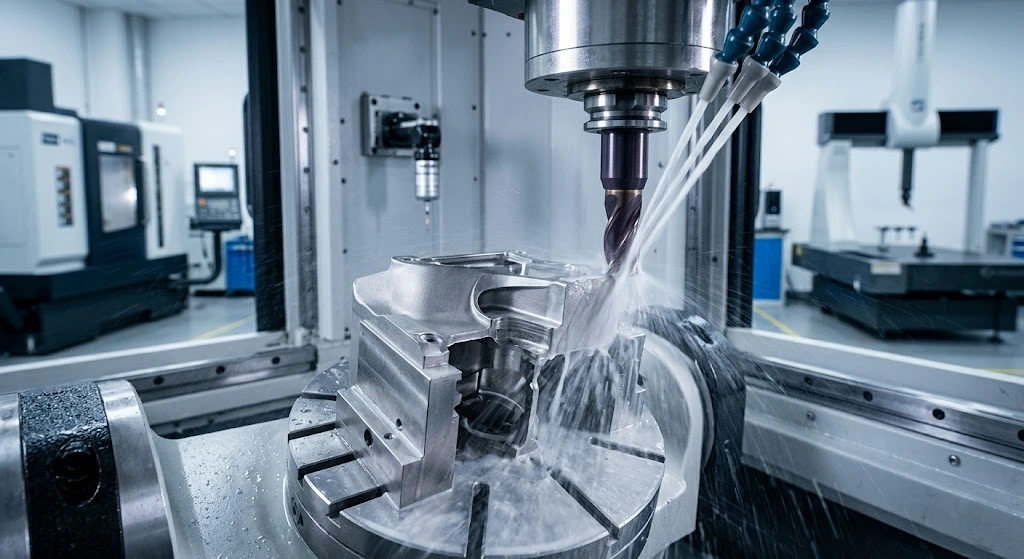
The Root Causes: Why Titanium Fights Back
To machine titanium successfully, you have to respect its material properties. You cannot treat it like 6061 Aluminum or even 304 Stainless Steel.
1. Thermal Conductivity and Tool Burn
When cutting aluminum, the chip absorbs and carries away about 75% of the heat generated by the cut. Titanium, however, is a terrible conductor of heat (roughly 6.7 W/m·K). Because the heat cannot escape through the chip, up to 80% of the cutting heat transfers directly into your cutting tool. This extreme thermal shock can push the cutting edge past 1000°C instantly, causing the titanium to chemically react and weld itself to the tool—a phenomenon known as Built-Up Edge (BUE).
2. Elasticity and Part Distortion
Ti-6Al-4V has a modulus of elasticity around 114 GPa. In practical terms, it is “springy.” During precision CNC machining for aerospace, the cutting tool actually pushes the material away before it shears it. As the tool passes, the material springs back. Furthermore, titanium bar stock contains massive residual stresses from the forging process. When we machine away the outer layers, these internal stresses are released, causing the part to warp, bow, or twist.
The Machining Playbook: Speeds, Feeds, and Coolant
Since our facility was established in 2004, we have continuously refined our approach to difficult-to-machine alloys. Overcoming tool burn requires strict parameter control and aggressive cooling strategies.
The golden rule for cutting Grade 5 Titanium is simple: Keep the RPM low to manage heat, but keep the chip load heavy so the tool shears the material instead of rubbing against it.
Here is a baseline look at the parameters we employ compared to standard steel machining:
| Machining Parameter | Recommended Range (Ti-6Al-4V) | Machining Strategy & Purpose |
| Surface Footage (SFM) | 120 – 150 SFM (Solid Carbide) | Lowered significantly to prevent the cutting edge from melting due to friction. |
| Chip Load (IPT) | 0.003″ – 0.008″ | Increased to force the tool to bite and shear, moving heat into the chip. |
| Radial Engagement | 10% – 15% | Using dynamic milling paths allows the tool to physically cool during its non-cutting motion. |
| Coolant Pressure | 1,000+ PSI (Through-Spindle) | Blasts away the vapor barrier that forms around the hot tool, preventing chip re-cutting. |
Eradicating Thin-Wall Part Distortion
Whether you are looking for a titanium rapid prototyping manufacturer to test a single concept or you are scaling into production, your manufacturing partner must utilize anti-distortion techniques.
Here are the three non-negotiable processes we use at BOONA:
1. The “Flip-Flop” Machining Method
You can never hog out all the material from one side of a titanium billet. We use a balanced approach: we remove roughly 30% of the material from Side A, flip the part to remove 30% from Side B, and continue alternating. This ensures the internal residual stresses are released evenly, keeping the part flat.
2. Intermediate Thermal Stress Relief
For highly critical, thin-walled components, machining alone isn’t enough. We rough the part, leaving about 0.020″ of stock material. We then send the part through a vacuum thermal stress-relief cycle (holding at 1000°F – 1100°F for 1 to 2 hours) before bringing it back to the machine for the final, low-stress finishing passes.
3. 5-Axis Workholding Strategies
Every time you unclamp and reclamp a titanium part, you introduce the risk of distortion. By utilizing advanced equipment—which you can explore on our dedicated Titanium CNC Machining Services page—we can machine complex geometries in a single setup.
Final Thoughts on Selecting a Manufacturing Partner
Successful titanium machining isn’t about rushing the cycle time; it’s about process stability. Your supplier needs rigid box-way machines, disciplined tool-life management, and a deep understanding of metallurgy.
If your current projects are suffering from poor surface finishes or out-of-tolerance dimensions, it might be time to evaluate your supply chain. Beyond titanium, our team handles a wide variety of materials. You can learn more about our broader capabilities on our main Custom CNC Machining page, or if you are in the early stages of product development, check out our Rapid Prototyping Solutions.
Don’t let tool burn and part distortion ruin your production schedule. Reach out to our engineering team today with your 3D CAD files, and we will provide a comprehensive Design for Manufacturability (DFM) review.
FAQs
Why does my titanium part measure perfectly while clamped in the machine, but warps the second we open the vise?
This is the classic residual stress trap. Titanium billets hold massive internal stresses from the mill. When you hog out heavy amounts of material from only one side, you disrupt the balance of those internal forces. The moment you release the clamping pressure, the part springs into a bow. To stop this, you have to use balanced material removal (the “flip-flop” method) and never over-torque your vises.
Can we get away with standard flood coolant, or is High-Pressure Coolant (HPC) strictly necessary?
If you want repeatable, precision parts, HPC isn’t a luxury—it’s mandatory. Titanium cuts so hot that it instantly boils standard flood coolant, creating a steam pocket (vapor barrier) around the cutter. The coolant never actually touches the cutting edge. We use 1,000+ PSI through-spindle coolant specifically to blast through that steam pocket, cool the carbide directly, and violently flush the chips out so they don’t get re-cut.
How do you know exactly when to change the cutting tool to avoid burning the part?
The golden rule of titanium: never wait for the tool to fail. By the time an endmill starts “screaming” or throwing sparks, it has already injected a massive amount of heat and stress into your workpiece, likely ruining the surface integrity. At BOONA, we use strict, data-driven tool life management. If our test cuts show a specific tool’s coating degrades at 45 minutes in the cut, we swap it out at 40 minutes. It costs a little more in carbide, but it prevents scrapping a $500 piece of raw material.
Should I use light, fast cuts or heavy, slow cuts when programming for Ti-6Al-4V?
Always go heavy and slow. If you try to take light, fast finishing passes (like you would in 6061 aluminum), the tool will simply rub against the titanium rather than slicing it. Because titanium is highly reactive and work-hardens quickly, that rubbing creates instant friction, surface hardening, and tool burn. You must drop your RPMs and keep a heavy enough chip load (feed rate) to force the cutting edge to bite, shear, and push the heat into the chip.
Is climb milling or conventional milling better for titanium?
Climb milling is almost always the required approach. In climb milling, the cutter engages the material at maximum thickness and exits at zero thickness. This transfers the heat generated during the cut directly into the thickest part of the chip, which is then evacuated. Conventional milling does the exact opposite—it starts thin, causing the tool to rub and generate massive friction before it finally bites into the metal.