
I still remember the first Ti-6Al-4V job I programmed back in 2001. I treated the titanium billet like it was 304 stainless steel. Big mistake. Within five minutes, the shop floor smelled like burning coolant, the carbide endmill was glowing red, and the workpiece was expensive scrap.
Titanium is a totally different beast. Today, as a manufacturing specialist reviewing aerospace and medical CAD files at BOONA (we’ve been running our Shenzhen facility since 2004), I see the aftermath of bad titanium machining all the time. When clients come to us looking for reliable Ti-6Al-4V machining services, they usually share the same two nightmares about their previous suppliers: the parts came in with severely burned surfaces, or the thin-wall features were completely out of tolerance.
Here is the shop-floor reality of why Grade 5 titanium fights back, and the exact data and parameters we use to stop tool burn and part deflection dead in their tracks.
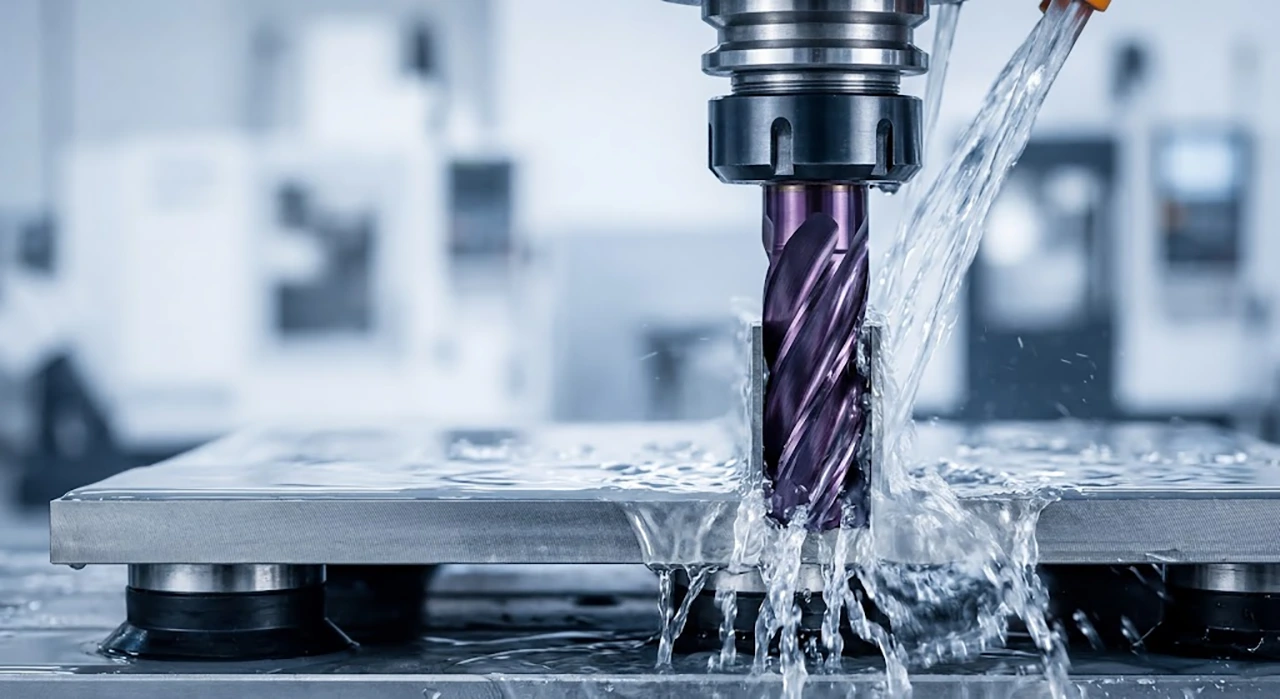
The Physics: Why Your Tools Are Burning
If you’ve got parts showing up with heat discoloration or smeared surface finishes, your supplier is losing the thermal management battle. Look at the raw data:
-
Thermal Conductivity: 6061 Aluminum is around 167 W/m·K. It acts like a sponge, absorbing heat and carrying it away in the chip. Ti-6Al-4V? It sits at a miserable 6.7 W/m·K.
-
Because the heat has nowhere to go, up to 80% of the cutting temperatures are blasted straight into the cutting tool.
If you push the RPM too high, that cutting edge hits 1000°C instantly. The titanium physically welds itself to the tool (galling), snaps the edge, and burns your part.
Our Shop Floor Cheat Sheet: The Anti-Burn Parameters
To provide consistent custom titanium CNC machining, we throw out the standard speeds and feeds. You have to drop the RPM but keep the feed rate heavy to force the tool to shear rather than rub.
Here is a look at the actual baseline parameters our programmers use when setting up a Ti-6Al-4V job on our 5-axis mills:
| Machining Parameter | Standard Steel Target | Ti-6Al-4V (Grade 5) Target | The Shop Floor Reality (Why we do it) |
| Surface Footage (SFM) | 300 – 500 SFM | 120 – 150 SFM (Solid Carbide) | Lowering the speed prevents the cutting edge from melting due to the massive heat buildup. |
| Chip Load (IPT) | 0.005″ | 0.003″ – 0.008″ | You must force the tool to bite. Light cuts cause the tool to rub, which work-hardens the surface and instantly burns the carbide. |
| Radial Engagement (Ae) | 40% – 50% | 10% – 15% (Dynamic) | Trochoidal paths give the cutting edge a fraction of a second to cool down in the air during the non-cutting loop. |
| Coolant Pressure | Flood (30 PSI) | 1,000+ PSI (Through-Spindle) | Standard flood coolant instantly boils upon hitting titanium. 1,000 PSI shatters that steam pocket to cool the tool core. |
Beating the Springback: Fixing Part Deflection
The other massive headache is titanium part deflection. Ti-6Al-4V has a modulus of elasticity of roughly 114 GPa (compared to steel at ~200 GPa). In shop terms, it’s “springy.” When an endmill pushes against a thin aerospace wall (say, 0.040″ thick), the material physically flexes away from the cutter. The tool moves past, the material springs back, and suddenly your perfectly programmed dimension is 0.05mm out of tolerance.
If you are paying for precision titanium parts, your manufacturer needs to actively manage tool pressure. Here is how we handle it:
-
Strictly Climb Milling: We never conventional mill titanium. Conventional milling starts the chip thin, causing the tool to rub and push hard against the workpiece before digging in. Climb milling starts the chip at maximum thickness, shearing immediately and drastically reducing the force pushing against the part.
-
The 0.020″ Stress Relief Rule: For highly critical, thin-walled brackets, machining alone isn’t enough. We rough the part, leaving exactly 0.020 inches of stock material. We then send the part through a vacuum thermal stress-relief cycle (holding at 1000°F for 2 hours) to relax the internal forging stresses before we take the final finishing pass.
-
Custom Workholding: You can’t just chuck a complex titanium forging into a standard machine vise and crank the handle to 60 ft-lbs. We design custom soft jaws and vacuum fixtures to distribute the clamping force evenly.
Stop Paying for Scrapped Parts
Machining titanium successfully isn’t a dark art, but it does require extreme discipline. It demands heavy, rigid custom CNC machining centers, aggressive high-pressure coolant strategies, and machinists who know when to swap a tool before it fails.
If your current supply chain is struggling with long lead times due to scrapped titanium, or if you are gearing up for a new product launch, take a look at our dedicated Titanium CNC Machining Services page.
We don’t guess on the shop floor. Send your 3D CAD files to the engineering team at BOONA today, and we will get back to you with a free Design for Manufacturability (DFM) review and a hard quote. Let’s get your parts made right the first time.
FAQs
If the part is deflecting, can’t you just take a “spring pass” (a zero-stock finishing cut) to bring it into tolerance?
If you try a spring pass on Grade 5 titanium, you are going to scrap the part. With aluminum or mild steel, taking a dummy pass to clean up a deflected wall works fine. But titanium is highly reactive. If the endmill rubs against the surface without taking a deep enough bite, it instantly work-hardens the material. The surface becomes glass-hard, your carbide tool burns up on the spot, and the part pushes away even worse. You must leave enough stock (at least 0.003″ to 0.005″) for the final pass so the tool can physically shear the metal, not rub it.
Do we really need 1,000+ PSI High-Pressure Coolant (HPC)? Won’t standard flood coolant work and save money?
Standard 30-PSI flood coolant is practically useless when you are hogging out titanium. The cutting zone gets so hot that standard coolant literally boils before it even touches the cutting edge. It creates a pocket of steam (a vapor barrier), meaning your tool is essentially cutting dry and melting. We use 1,000+ PSI through-spindle coolant because it physically punches through that steam pocket, cools the carbide core directly, and violently blasts the chips out of the cavity so they don’t get recut.
How do you guys guarantee the tool won’t burn up and ruin the surface finish halfway through a long cycle?
By never waiting for the tool to tell us it’s dying. The biggest mistake amateur shops make is waiting until the endmill starts “screaming” or throwing sparks to change it. By that time, massive amounts of heat have already been injected into your part, ruining the surface integrity. At BOONA, we manage tool life by time-in-cut data. If our tests show a specific endmill’s coating degrades at 45 minutes, we mandate a tool change in the CNC program at 40 minutes. Period. We spend a little more on carbide, but it guarantees your parts are perfect.
Does the raw material itself contribute to the part warping?
Absolutely. Billet titanium holds a massive amount of residual stress from the forging mill. If you start aggressively machining a cheap, poorly annealed block from one side, it’s going to bow like a banana the second you open the vise jaws. For critical thin-walled parts, machining strategy isn’t enough. We rough the part out, send it out for a thermal stress-relief cycle in a vacuum furnace to kill those internal mill stresses, and then we perform the final precision machining.
Why are my Ti-6Al-4V quotes always so much higher than my 6061 Aluminum quotes?
It comes down to machine time and consumable costs. Because we have to run titanium at much lower surface speeds (around 120 SFM compared to 800+ SFM for aluminum) to prevent tool burn, the machine cycle time is inherently longer. Furthermore, premium variable-helix solid carbide endmills with specialized AlTiN coatings aren’t cheap, and titanium eats through them much faster than softer alloys. You are paying for the discipline, the thermal management, and the high-end tooling required to cut it right.