
I had a hardware founder on a call last week who was just about ready to pull the plug on his new product launch. He needed about 2,000 plastic housings to run a beta test. The problem? A local molding shop had just quoted him $28,000 and a 10-week wait for a hardened P20 steel mold.
For a massive consumer run of a million units, that quote makes sense. But if you are working in the low-volume production space, paying for a heavy-duty steel tool is like buying a semi-truck just to commute to the grocery store. It’s a massive waste of capital.
Since we opened our shop doors back in 2004, we’ve helped hundreds of engineers navigate this exact trap. Let’s look at the actual shop-floor data and talk about why high-grade aluminum tooling is usually the smartest move when you don’t need a million parts.
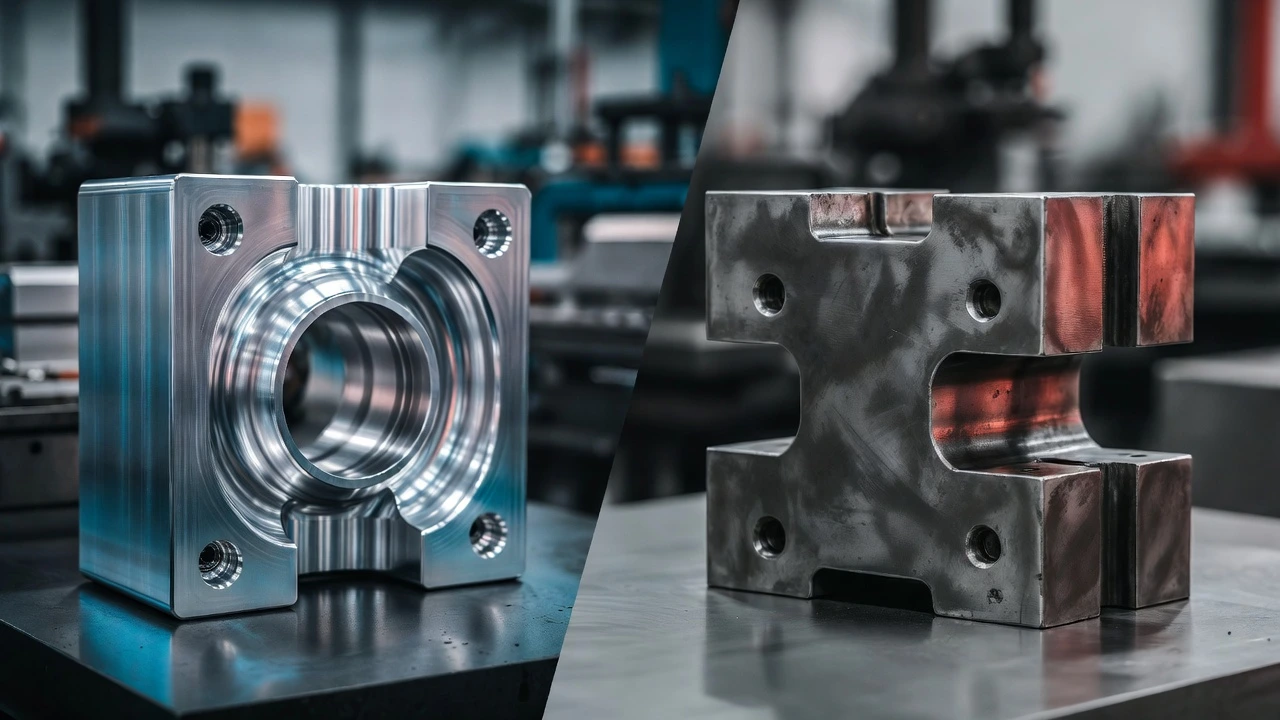
Head-to-Head Data: Aluminum vs. Steel Tooling
Let’s skip the theory and look at the real numbers. Here is a direct breakdown of the technical parameters that dictate your project’s budget and time-to-market:
| Technical Parameters | Aluminum Tooling (QC-10 / 7075-T6) | Steel Tooling (P20 / H13 Tool Steel) |
| Typical Tool Life | 2,000 to 10,000+ shots | 100,000 to 1,000,000+ shots |
| Average Lead Time | 2 to 4 weeks (Fast turnaround) | 6 to 12 weeks |
| Tooling Cost | 30% to 50% Lower | High initial investment |
| Thermal Conductivity | ~130 W/m·K (Cools up to 5X faster) | ~29 W/m·K (Requires complex cooling lines) |
| Machinability | High (Easier to cut and polish) | Low (Requires slower feeds & EDM) |
The Reality of Machining Time
Tooling cost comes down to one primary factor: machine time.
Steel is hard. When we put a block of H13 or P20 steel into our 5-axis mills for custom CNC machining, we have to run the spindle slower. We take lighter cuts. We wear through cutting tools faster. Sometimes we even have to use EDM (Electrical Discharge Machining) for complex cavities, which takes days.
Aluminum is much softer. We can run our machines at top speed, hogging out material fast and leaving a brilliant surface finish. Less time on our machines means a drastically lower invoice for you.
The Cycle Time Secret (Where You Actually Save Money)
A lot of purchasing teams get so hyper-focused on the upfront cost that they ignore what happens after the mold is put into the injection press.
Look at the thermal conductivity parameter in the table above: ~130 W/m·K for Aluminum vs. ~29 W/m·K for Steel.
Aluminum transfers heat roughly five times faster. When hot, liquid plastic is shot into an aluminum mold, it cools down and solidifies incredibly fast. Because the heat dissipates so quickly, the molding cycle time shrinks. This is the secret to cost-effective plastic injection molding. If you can shave 10 or 15 seconds off every single shot during your production run, your final price-per-part drops significantly.
When I Will Tell You to Use Steel
Here is where I have to be brutally honest. As much as we love aluminum for rapid prototyping and bridge-to-production runs, it is not a magic bullet.
We will actually refuse to cut an aluminum mold if your project fits certain profiles:
-
Abrasive Resins: If your design calls for 30% glass-filled nylon or a heavy glass-filled PEEK, those hard fibers act like liquid sandpaper. They will literally wash out the fine details of an aluminum mold in a few hundred shots. We have to use hardened steel for these.
-
Crazy Geometries & Tolerances: If your part has incredibly complex, multi-action lifters or slides with tolerances down to ±0.01 mm, the absolute rigidity of steel is non-negotiable.
Let’s Look at Your CAD
At the end of the day, choosing the right metal for your custom injection mold tooling shouldn’t be a guessing game. It depends entirely on your resin, your budget, and how fast you need to get to market.
Don’t let an oversized tooling quote kill your project before it even starts. Send your 3D files over to our engineering team. We’ll look at the geometry and tell you straight up if aluminum is the right fit to get your parts on the desk next month.
FAQs
I’ve always heard aluminum molds wear out and break after just a few hundred parts. Is that true?
Maybe thirty years ago, yeah. But not anymore. Today, we are cutting molds out of high-grade aerospace alloys like QC-10 or 7075-T6 aluminum. If you are shooting standard resins like ABS, Polycarbonate, or POM, a well-built aluminum mold can easily hit 10,000 to 50,000 shots before we even see a hint of flash on the parting line. Unless you’re running abrasive glass-filled nylon, tool life isn’t going to be your bottleneck.
Can I get a high-gloss, cosmetic surface finish with an aluminum tool?
Absolutely. In fact, aluminum is actually much easier for our guys to hand-polish than hardened P20 steel. We can easily hit an SPI A2 (high-gloss) finish or apply custom textures. The only catch? Because aluminum is a softer metal, that mirror finish is easier to scratch if the mold isn’t maintained properly on the press. But for low-volume runs, the cosmetic parts look fantastic.
What happens if my beta test fails and I need to change my CAD design after the mold is already cut?
This is exactly why startups love aluminum. Engineering changes happen. If you realize you need to move a screw boss or change a wall thickness after the T0 sample, welding and re-machining an aluminum mold is significantly faster and cheaper than trying to modify a hardened steel tool. We can usually pull the mold off the press, throw it back on the CNC, make the fix, and be shooting new parts in a few days.
Can aluminum molds hold the same tight tolerances as steel?
For 95% of low-volume projects, yes. We regularly hold ±0.05 mm on aluminum tools without breaking a sweat. But let me give it to you straight: if you have a massive part with zero-draft mating surfaces and you need to hold ±0.01 mm under constant thermal stress for months on end, steel holds its shape better. But for a run of 2,000 or 5,000 parts? Your calipers won’t know the difference.