
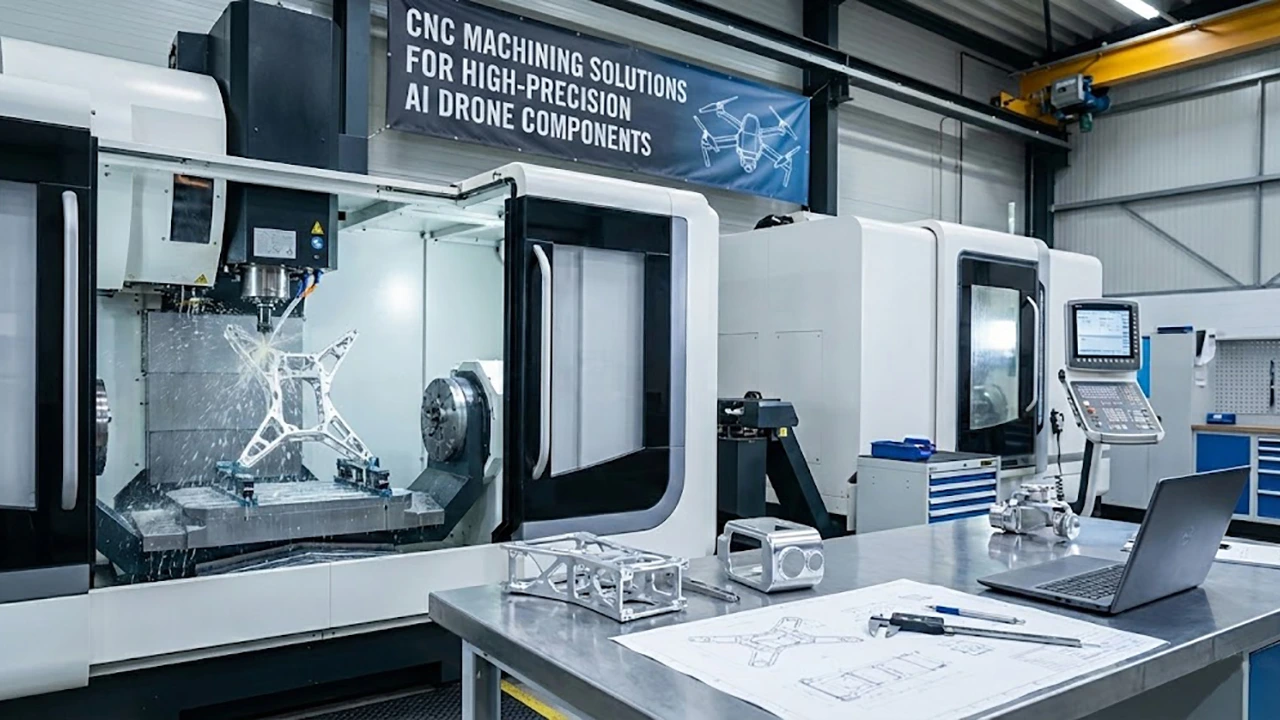
In the fast-evolving world of autonomous drones, AI integration is driving explosive market growth through breakthroughs in computer vision, real-time processing, and advanced navigation. Startups developing high-precision AI drone components need manufacturing partners that deliver tight tolerances, rapid turnaround, and scalable production without high minimum orders. This is where precision CNC machining for AI drone prototypes shines, enabling engineers to iterate quickly and bring sophisticated UAV designs to market faster.
Leading providers like Boona Prototypes in Shenzhen, China, have become go-to partners for AI drone startups. With over 20 years of experience since 2004, they specialize in rapid CNC prototyping for autonomous drones and low-volume production of critical components.
The global AI drone market is experiencing rapid expansion due to advancements in autonomous navigation systems. CNC machining offers unmatched accuracy for complex geometries required in sensor housings, lightweight frames, and heatsinks for onboard AI processors.
Unlike additive manufacturing, high-precision CNC machining for drone frames and arms produces parts with superior mechanical properties and surface finishes essential for flight performance and durability. Providers in Shenzhen achieve this with advanced multi-axis equipment and strict quality controls, often delivering prototypes in as little as 3 days.
Key Parameters and Tolerances in CNC Machining for AI UAV Parts
For tight tolerance CNC machining of AI drone components, typical industry standards include:
- Linear tolerances: ±0.01 mm to ±0.005 mm for critical features
- Surface finish: Ra 0.8–1.6 μm standard, down to Ra 0.4 μm with polishing
- Maximum part size: Up to 1000 mm × 800 mm × 500 mm (depending on machine)
- Lead time: 3–7 days for prototypes, scalable to weeks for low-volume runs
| Parameter | Standard Capability | High-Precision Option | Application in AI Drones |
|---|---|---|---|
| Dimensional Tolerance | ±0.05 mm | ±0.01 mm | Sensor mounts, gimbal housings |
| Hole Tolerance | ±0.02 mm | ±0.005 mm | Motor shafts, connector fittings |
| Surface Roughness (Ra) | 1.6 μm | 0.4 μm | Aerodynamic surfaces, heatsinks |
| Minimum Wall Thickness | 0.8 mm (aluminum) | 0.5 mm | Lightweight frames and arms |
| Thread Accuracy | ISO 6H/6g | ISO 5H/5g | Mounting points for AI hardware |
Choosing the right material is critical for balancing weight, strength, and thermal management in autonomous UAV prototypes.
| Material | Density (g/cm³) | Tensile Strength (MPa) | Thermal Conductivity (W/m·K) | Common Applications in Drones | Machinability Rating |
|---|---|---|---|---|---|
| Aluminum 6061-T6 | 2.70 | 310 | 167 | Frames, arms, motor mounts | Excellent |
| Aluminum 7075-T6 | 2.81 | 570 | 130 | High-stress structural parts | Very Good |
| Titanium Ti-6Al-4V | 4.43 | 950 | 6.7 | Load-bearing components, landing gear | Good |
| Magnesium AZ31 | 1.77 | 260 | 96 | Ultra-lightweight frames | Excellent |
| PEEK (Plastic) | 1.32 | 100 | 0.25 | Non-conductive enclosures, insulators | Good |
Advanced Processes: 5-Axis Machining and Quality Assurance
Modern 5-axis CNC machining for complex AI drone parts allows single-setup production of intricate geometries with undercuts and angled features—essential for integrated sensor bays and aerodynamic optimizations.
Quality control includes:
- Coordinate Measuring Machine (CMM) inspection reports
- First Article Inspection (FAI)
- Material and hardness certifications
- ISO 9001 compliance
No minimum order quantity (NO MOQ) policies make it ideal for startups testing multiple design iterations.
Conclusion: Partner with Experts for Your Next AI Drone Project
For engineers searching for rapid prototyping CNC services in China for high-precision autonomous drone components, partnering with established Shenzhen manufacturers like Boona Prototypes ensures fast quotes (within 2 hours), secure file handling, and production-ready parts.
Ready to accelerate your AI drone development? Explore CNC machining services and get your project started today.
FAQs
What makes CNC machining ideal for high-precision AI drone components?
CNC machining delivers exceptional accuracy, repeatability, and superior mechanical properties compared to alternatives like 3D printing. It excels at producing lightweight, complex parts such as sensor housings, frames, gimbal mounts, and heatsinks for AI processors, which require tight tolerances for aerodynamic performance, vibration resistance, and thermal management in autonomous UAVs.
What tolerances can be achieved with precision CNC machining for drone parts?
High-end providers typically achieve ±0.01 mm to ±0.005 mm for critical features, with mold-related precision reaching ±0.01 mm. Standard linear tolerances range from ±0.05 mm to ±0.01 mm, depending on material and geometry. This level of precision is essential for components like motor mounts and sensor integrations in AI drones.
What materials are commonly used for CNC machined AI drone components?
Popular choices include:
- Aluminum alloys (e.g., 6061, 7075) for lightweight frames and arms
- Titanium (Ti-6Al-4V) for high-strength load-bearing parts
- Magnesium for ultra-lightweight structures
- Engineering plastics like PEEK for non-conductive enclosures
- Composites for hybrid designs Providers like Boona support a wide range of metals, plastics, and composites with full material certifications.
How long does it take to receive CNC machined prototypes for AI drones?
Turnaround times are rapid—prototypes can be delivered in as little as 3 days, with most projects completed in 3–7 days. This fast iteration speed is crucial for AI drone startups testing autonomous navigation systems and computer vision hardware.
Is there a minimum order quantity (MOQ) for CNC machining drone components?
No—many Shenzhen-based providers, including Boona Prototypes, offer no MOQ. This makes it perfect for startups and R&D teams needing just 1–10 prototype parts or scaling to low-volume production without high upfront costs.
What processes are used for complex AI drone geometries?
5-axis CNC milling is commonly employed for intricate features, undercuts, and single-setup production of parts like integrated sensor bays or aerodynamic frames. Additional processes include high-speed machining, Swiss turning for small shafts, and surface finishing for optimal Ra values (down to 0.4 μm).
How is quality ensured for high-precision drone components?
Quality controls include:
- CMM (Coordinate Measuring Machine) inspections
- First Article Inspection (FAI)
- Dimensional reports
- Material and hardness certifications
- ISO 9001 compliance Full inspection reports are provided to ensure parts meet aerospace-grade standards for reliability in AI drones.
Why choose a Shenzhen provider like Boona for AI drone prototyping?
Shenzhen manufacturers offer a combination of advanced equipment, rapid response (quotes within 2 hours), competitive pricing, and expertise in high-precision parts. Boona specializes in rapid prototyping and low-volume production, supporting the growing demand for autonomous drone components with on-demand manufacturing and engineering support.
Can CNC machining handle both prototyping and low-volume production for AI drones?
Yes—it’s highly scalable. Start with rapid prototypes for design validation, then transition seamlessly to low- or high-volume runs using the same tooling and processes, reducing costs and time-to-market for AI drone innovations.
How do I get started with CNC machining for my AI drone project?
Upload your 3D files (e.g., STEP or IGES) to a provider’s quote system for a fast response. Services like Boona offer free manufacturability analysis and 1-on-1 engineering support to optimize your designs for CNC production.
If you have specific project details or need a quote, feel free to share more!