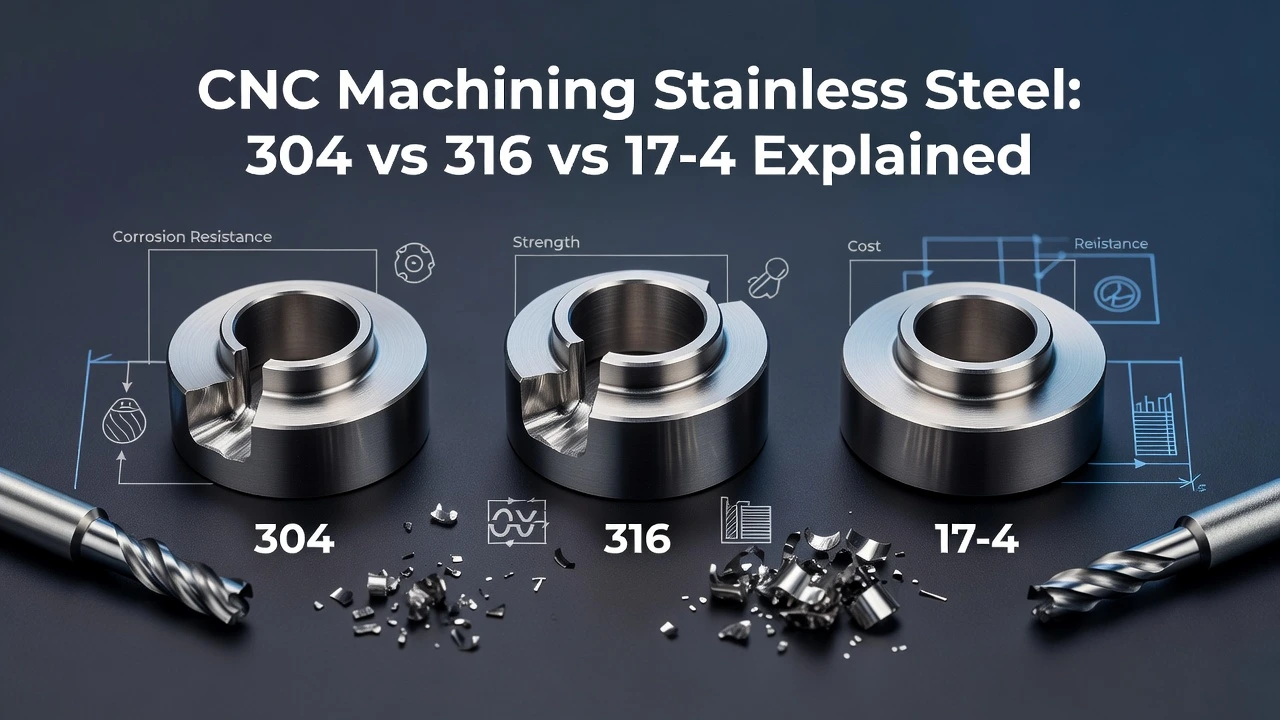
When customers ask us, “Should we use 304, 316, or 17-4 for this stainless steel part?”, the real question usually isn’t about chemistry.
It’s about:
-
Will it rust in this environment?
-
Will it hold strength under load?
-
Will machining costs explode?
-
Will tolerances move after heat treatment?
-
And honestly — are we over-engineering this part?
If you’re working on custom CNC stainless steel parts, choosing the wrong grade can either cause field failure… or unnecessary cost.
Let’s break this down from a real machining and engineering perspective.
First: Why Stainless Steel Is Not Easy to Machine
Unlike aluminum, stainless steel:
-
Work-hardens quickly
-
Holds heat at the cutting edge
-
Eats tools if speeds are wrong
-
Produces long, tough chips
For example, typical cutting speeds:
-
Aluminum 6061: 300–500 m/min
-
304 stainless: 70–120 m/min
-
316 stainless: 60–100 m/min
-
17-4 (annealed): 90–150 m/min
This alone explains why CNC machining stainless steel cost per part is significantly higher than aluminum.
It’s not the material price.
It’s time, tool wear, and heat control.
At BOONA Prototypes’ CNC machining services, stainless jobs require different tooling strategies than aluminum production runs — especially when tight tolerances (±0.01 mm) are involved.
304 Stainless Steel — The Practical Default
If no extreme corrosion or strength requirement exists, 304 is usually the starting point.
Why Engineers Choose 304
-
Good corrosion resistance
-
Widely available
-
Lower cost than 316
-
Stable for general industrial use
Mechanical properties (annealed):
-
Tensile strength: ~515 MPa
-
Yield strength: ~205 MPa
-
Hardness: ~70 HRB
-
Density: 8.0 g/cm³
Real-World Applications
-
Equipment housings
-
Structural brackets
-
Food-processing components
-
Indoor mechanical parts
The Catch
304 work-hardens fast.
If feeds and speeds aren’t correct, the surface hardens and tool life drops sharply. That’s why experienced stainless CNC machining manufacturers use aggressive, consistent feed rates rather than light passes.
If your part is not exposed to chlorides or marine conditions, 304 is often the smartest cost-performance choice.
316 Stainless Steel — When Corrosion Actually Matters
The difference between 304 and 316 is simple:
316 contains molybdenum.
That small change dramatically improves resistance to:
-
Saltwater
-
Chloride exposure
-
Chemical environments
That’s why 316 is common in:
-
Marine hardware
-
Outdoor coastal components
-
Medical and pharmaceutical parts
-
Chemical processing equipment
Strength-wise, 304 and 316 are almost identical.
So if someone suggests 316 “because it’s stronger” — that’s incorrect. It’s not about strength. It’s about corrosion resistance.
Cost difference typically runs 15–25% higher than 304.
If your part will never see salt, chemicals, or humidity extremes, 316 may just increase your machining cost unnecessarily.
17-4 PH Stainless Steel — A Different Category
17-4 is not just another corrosion-resistant alloy.
It’s a precipitation-hardening stainless steel, and that changes everything.
In H900 condition:
-
Tensile strength: ~1310 MPa
-
Yield strength: ~1170 MPa
-
Hardness: ~40 HRC
-
Density: 7.75 g/cm³
That’s more than double the strength of 304 or 316.
Where 17-4 Makes Sense
-
Aerospace fittings
-
High-load shafts
-
Structural drone components
-
Valve bodies
-
Mechanical assemblies under stress
Machining Strategy Matters
17-4 is typically machined in annealed condition, then heat treated.
If you machine it after hardening, tool wear increases significantly.
Another consideration: heat treatment can cause slight dimensional change.
That’s why experienced suppliers adjust machining allowances before final aging.
For high-strength CNC machined stainless steel parts, 17-4 is often the best performance choice — but it comes with added process planning.
Side-by-Side Practical Comparison
| Feature | 304 | 316 | 17-4 PH |
|---|---|---|---|
| Corrosion Resistance | Good | Excellent | Moderate |
| Strength | Medium | Medium | Very High |
| Heat Treatable | No | No | Yes |
| Marine Use | Limited | Ideal | Not Ideal |
| Relative Cost | $ | $$ | $$$ |
How to Decide Without Overengineering
Here’s a simplified decision logic used in real production:
-
Indoor, industrial, budget-focused → 304
-
Marine, chemical, medical exposure → 316
-
Load-bearing, structural, aerospace → 17-4
Most stainless parts in general manufacturing actually use 304.
17-4 is powerful — but unnecessary for many brackets and housings.
And 316 should only be used when corrosion risk justifies the cost.
Tolerances & Surface Finish Considerations
With professional CNC machining, stainless steel parts can typically achieve:
-
Standard tolerance: ±0.05 mm
-
Precision tolerance: ±0.01 mm
-
Surface finish: Ra 1.6–3.2 μm (as machined)
Additional processes like polishing, passivation, or bead blasting improve performance and appearance.
BOONA’s rapid prototyping services often help customers test 304 first before upgrading to 316 or 17-4 — reducing early-stage development costs.
Final Thoughts
304, 316, and 17-4 are not interchangeable.
Each exists for a reason.
The best stainless steel for CNC machining depends on:
-
Environmental exposure
-
Structural load
-
Budget sensitivity
-
Production volume
-
Tolerance requirements
If corrosion is not extreme, 304 is usually enough.
If strength is critical, 17-4 is unmatched.
If marine exposure exists, 316 is the safe choice.
The real engineering skill isn’t choosing the strongest material.
It’s choosing the right one.
FAQs
Does 316 stainless steel machine much worse than 304?
Not dramatically — but yes, slightly.
In real production, 316 feels “gummier.” It generates more heat and tends to produce tougher chips. Tool wear is a bit faster, and cutting speeds are usually slightly lower than 304.
That said, if your machinist knows how to handle stainless steel properly, the difference is manageable. It’s not a night-and-day gap — just a small increase in time and tooling cost.
The bigger difference is material price, not machinability.
If my part doesn’t touch water, is there any reason to choose 316?
Usually no.
If the part operates indoors, in dry industrial conditions, 304 is almost always sufficient. We’ve seen many designs specify 316 “just to be safe,” but unless chlorides or chemical exposure are involved, it rarely adds value.
It’s important to match the material to the real environment — not the worst-case imaginary one.
Is 17-4 harder to machine than 304 or 316?
It depends on the condition.
In the annealed state, 17-4 actually machines quite nicely — sometimes cleaner than 304 because it doesn’t work-harden as aggressively.
After heat treatment (H900, H1025, etc.), it becomes significantly harder. At that point, tool wear increases and machining becomes more demanding.
The smart approach is always:
Machine first → heat treat → finish critical areas if necessary.
Will 17-4 move or distort after heat treatment?
It can, slightly.
Compared to carbon steels, 17-4 is relatively stable, but any heat treatment process introduces internal stress relief and dimensional change.
For tight-tolerance parts, experienced shops will:
-
Leave stock allowance before aging
-
Finish-machine after heat treatment
-
Or adjust tolerances in the initial machining plan
If tolerances are ±0.01 mm, this absolutely needs to be discussed before production.
Is stainless steel always the right choice for corrosion resistance?
Not necessarily.
In some cases, anodized aluminum or coated carbon steel can perform well enough at lower cost.
Stainless steel is excellent for durability and longevity, but it’s not automatically the most cost-effective solution.
Material selection should consider:
-
Service environment
-
Load requirements
-
Budget
-
Production volume
Not just “stainless equals safe.”
Why do stainless parts sometimes have surface finish issues?
Because stainless holds heat.
If feeds and speeds are too light, the material work-hardens and creates tearing instead of clean cutting. That leads to rough surface finish.
Good stainless machining requires:
-
Consistent feed rate
-
Proper chip evacuation
-
Adequate coolant
-
Sharp carbide tooling
Surface finish problems usually indicate process setup issues — not material defects.
When is 304 clearly the wrong choice?
Two situations:
-
Marine or salt exposure
-
High structural load applications
If corrosion from chlorides is expected, 304 will eventually show pitting.
If the part carries significant mechanical stress, 304 may lack sufficient yield strength.
That’s when 316 or 17-4 becomes justified.
When is 17-4 clearly unnecessary?
When the part is:
-
A housing
-
A bracket
-
A cover
-
A low-load structural frame
If there is no high mechanical stress, 17-4 often adds complexity and cost without performance benefit.
Over-specifying materials is one of the most common cost mistakes in CNC projects.
Which stainless steel is most commonly used in CNC machining?
In general manufacturing: 304.
In marine or chemical industries: 316.
In aerospace or high-load mechanical systems: 17-4.
Most stainless CNC parts in everyday industrial production are still 304.
What’s the most important factor when choosing between 304, 316, and 17-4?
Be honest about three things:
-
Actual corrosion exposure
-
Actual load requirement
-
Budget sensitivity
The strongest material is not always the best engineering choice.
The right material is the one that performs safely without unnecessary cost.