
Walk into our shop floor in Shenzhen on any given Tuesday, and you’ll likely hear the distinct, crisp hum of a CNC machine flying through C360 brass. It’s a great sound. But when we switch the setup to pure copper? The entire vibe of the shop changes. The feeds slow down, the coolant pressure goes up, and our operators pay very close attention.
I review dozens of CAD files every week, and the copper-versus-brass debate is easily the most common conversation I have with procurement teams and mechanical designers.
Engineers are often caught in a bind: Do we spec copper for absolute peak performance, or pivot to brass to keep the purchasing department happy? In my 20-plus years in this industry, I’ve seen this decision make or break a project. Choosing the wrong yellow metal doesn’t just bump up the invoice—it can lead to field failures or needlessly double your manufacturing budget.
Here is the unfiltered, shop-floor reality of copper vs brass cnc machining, and how to choose the right material for your high-performance applications.
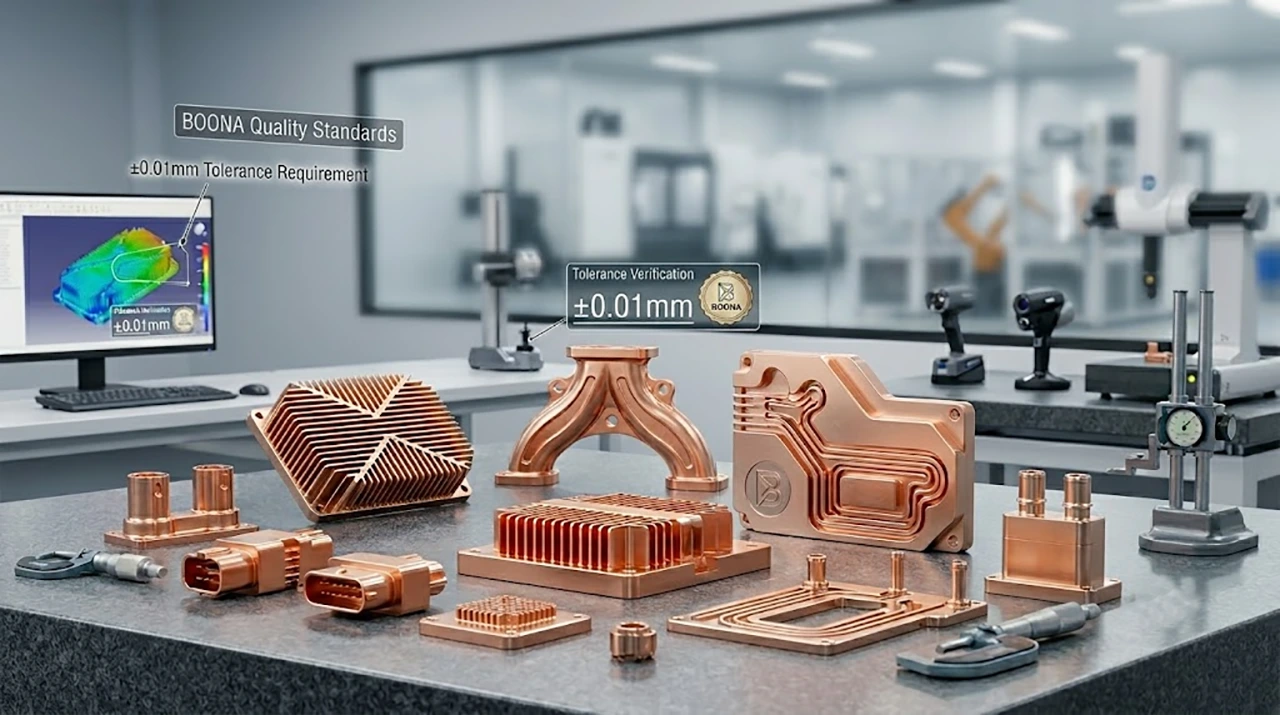
The Chemistry: Performance vs. Practicality
At its core, this debate is about balancing what you want with what is actually practical to manufacture.
-
Pure Copper (C101 / C110): This is the heavy hitter. At 99.9% purity, it delivers unmatched thermal dissipation and 100%+ IACS electrical conductivity. If you are designing EV battery cooling plates, high-frequency 5G RF connectors, or vacuum electronics, you really don’t have a choice. You need copper.
-
Free-Machining Brass (C36000): This is essentially copper mixed with zinc and a microscopic dash of lead (or bismuth for eco-friendly specs). That tiny addition acts as a built-in lubricant. It drops the electrical conductivity down to about 28% IACS, but in return, it makes custom brass machined parts incredibly stable and effortless to cut.
The Shop Floor Reality: Eating End Mills vs. Spitting Chips
If you want to understand the price difference on your quote, you have to look at what happens when the cutter actually meets the metal.
When we tackle custom CNC machining for pure copper, the material fights us every step of the way. It’s soft, but it’s incredibly “gummy.” It doesn’t want to fracture into neat chips. Instead, it tears, smears, and creates long, stringy bird’s nests that love to wrap around tooling. If the tool rubs even slightly, the copper work-hardens instantly or welds itself to the cutter. To get around this, we have to use premium DLC-coated tools and run the machines at painfully slow feed rates.
Brass, on the other hand, is an operator’s dream. When we run precision brass CNC machining services, the material shears perfectly into tiny, brittle chips. We can push our CNC spindles to their absolute maximum RPMs with aggressive feeds, and the tools barely wear out.
The Reality Check: Copper vs. Brass Machining Data
| Engineering Metric | Pure Copper (C110) | Free-Machining Brass (C360) | What it Means for Your Quote |
| Machinability Rating | 20% | 100% (The Industry Baseline) | Brass machines up to 5x faster, slashing labor hours. |
| Thermal Conductivity | 386 W/m·K | 115 W/m·K | Copper is mandatory if heat dissipation is your primary goal. |
| Tool Wear Rate | Very High | Extremely Low | You are paying for the cutters we burn through when machining copper. |
The “Hidden Tax” of Machining Copper
Because of the massive difference in cycle times and tooling consumption, high-precision copper machining will always carry a premium over brass. Even if the raw material commodity prices on the London Metal Exchange were exactly the same today, the copper part would cost you more to manufacture.
-
When to Save Your Money (Specify Brass): If you are designing fluid control valves, structural standoffs, hydraulic fittings, or standard electrical terminals where 28% conductivity is “good enough,” go with brass. The rapid cycle times make it incredibly cost-effective, especially for mid-to-high volume runs.
-
When to Pay the Premium (Specify Copper): Don’t compromise if you are pushing the absolute limits of thermal management or power transmission. If your component needs to pull heat away from a high-density server rapidly, or carry high-amperage current without melting, precision copper machined components are your only real option.
A Plea from the Manufacturing Floor (DFM Tips)
If you decide to go with copper, please keep these two things in mind before you finalize your CAD drawings:
-
Stop specifying cut threads: If you specify standard cutting taps for a copper part, the soft threads will tear. Always specify “form taps” or “roll taps” in your notes. They compress the gummy material into strong threads without cutting it.
-
Plan for plating: Bare copper oxidizes fast. Unless you want your parts turning green and losing surface conductivity, plan for secondary treatments like electroless nickel or silver plating. Brass, thankfully, has great natural corrosion resistance.
Let’s Look at Your Project
Over-engineering a part with copper when brass would work is just burning money. But using brass when you actually need peak thermal conductivity is a recipe for system failure.
If you are stuck on a material choice, let’s talk it through. You can check out our standard CNC Machining Service capabilities, or just send your 3D CAD files over to us at BOONA. I’ll take a look at your geometry, do a quick DFM review, and give you an honest recommendation on which metal makes the most sense for your bottom line.
FAQs
Why is my quote for CNC machining pure copper so much higher than brass, even though the raw material prices are similar?
It all comes down to cycle times and tool wear. Custom CNC machining for pure copper requires us to run our machines at much slower feed rates to prevent the gummy metal from melting or welding to our cutters. Furthermore, copper eats through expensive, specialized DLC-coated end mills rapidly. With brass, we can run the machines at top speed with almost zero tool wear. You are essentially paying for the extra machine hours and the cutters we burn through.
Can I just swap pure copper out for brass in my CAD file to save money?
Only if your thermal and electrical requirements allow for a massive drop in performance. Pure copper (C110) has a thermal conductivity of nearly 386 W/m·K and 100% IACS electrical conductivity. Free-machining brass (C360) drops to 115 W/m·K and about 28% IACS. If you swap copper for brass in an EV battery cooling plate or a high-frequency RF connector, the part will overheat and fail. If it’s just a standard structural standoff, swapping to custom brass machined parts is a brilliant cost-saving move.
Why do you insist on “form tapping” for copper but use standard “cut tapping” for brass?
Because copper is soft and incredibly sticky, a standard cutting tap will grab the material, tear the threads, and leave a mess (or snap the tap entirely). Form taps (or roll taps) don’t cut the metal; they cold-press and displace the copper to form the threads, making them much stronger. Brass, however, is brittle and shears beautifully, meaning standard cutting taps leave clean, razor-sharp threads without any hassle.
Do both copper and brass parts need surface plating after they are machined?
Not necessarily, but copper almost always does. Bare copper reacts with oxygen and humidity almost immediately, tarnishing and eventually turning green. This oxidation increases surface electrical resistance. To prevent this, precision copper machined components usually require electroless nickel plating, silver plating, or tin plating. Brass has excellent natural corrosion resistance and can often be left as-machined or simply clear-passivated.
How does production volume (batch size) affect the choice between copper and brass?
If you are ordering a single prototype, the cost difference might seem negligible because the setup time (programming, fixturing) is the same for both. However, if you are ordering 5,000 parts, the cycle time becomes the biggest cost driver. Because precision brass CNC machining services can pump out parts up to 5 times faster than copper setups, the price-per-part on high-volume brass orders plummets, making it drastically cheaper at scale.
Is there a middle-ground material between pure copper and brass?
Yes. If you need better machinability than pure copper but higher conductivity than brass, consider Tellurium Copper (C145) or Beryllium Copper (C17200). Tellurium copper, for example, machines almost as easily as brass (85% machinability rating) but retains about 90% IACS electrical conductivity. It’s a fantastic middle-ground if your engineering margins allow for a slight dip in absolute conductivity.