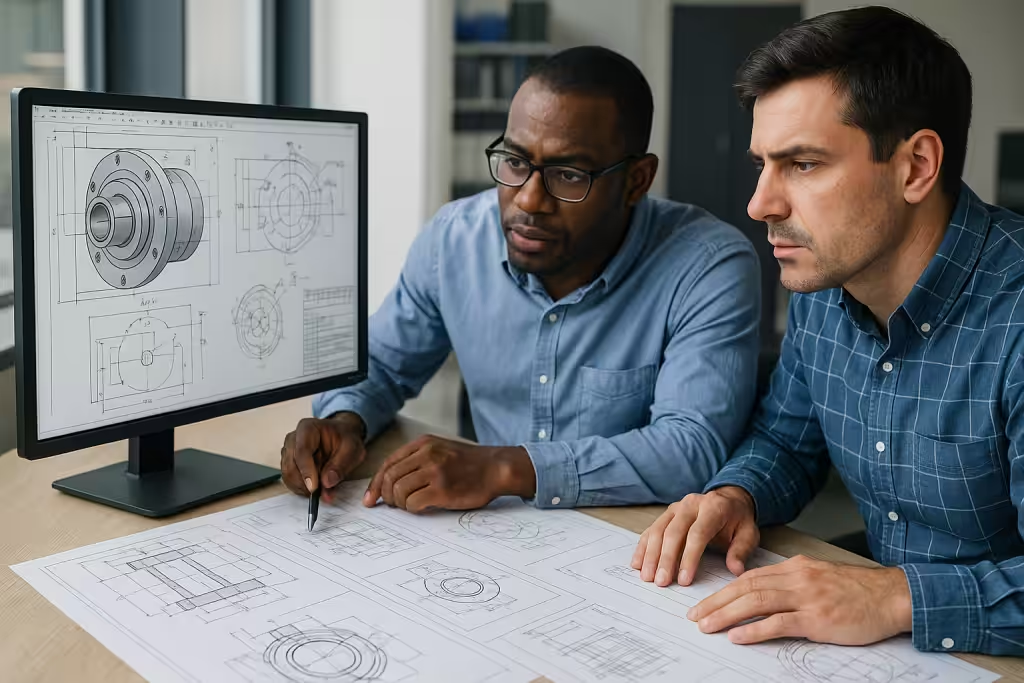
Finding the right machining supplier for an AI robot program is harder than it looks.
Most procurement processes are designed for buyers who know exactly what they want: a frozen design, a fixed quantity, a standard material, a reasonable lead time. The supplier’s job is to make the part and deliver it on time.
AI robot hardware development rarely works that way. The design changes because the AI system changes. A new vision model may perform better with the camera mounted 12 mm further forward. A force control update may require a stiffer wrist bracket. A field test may expose a thermal problem in the chassis that requires a new heat spreader design. These changes happen during the program, not before it.
The mechanical geometry of an AI robot also reflects its AI architecture — joint layouts, sensor positions, chassis structure all reveal how the system is designed to perceive and act. Sharing STEP files and drawings with an outside machining company requires judgment about IP protection that most standard procurement workflows do not address.
And when an AI robot behaves unexpectedly in testing, the team needs to know whether the problem is in the software or the hardware. That is only possible if the machined parts are consistent enough — and documented enough — to rule out mechanical variation as a cause.
This guide covers the sourcing side of AI robot hardware: how to evaluate machining suppliers for AI robot programs, how to protect design IP, how to plan costs across an iterative development cycle, and how to build a supplier relationship that can keep up with the pace of AI robot development.
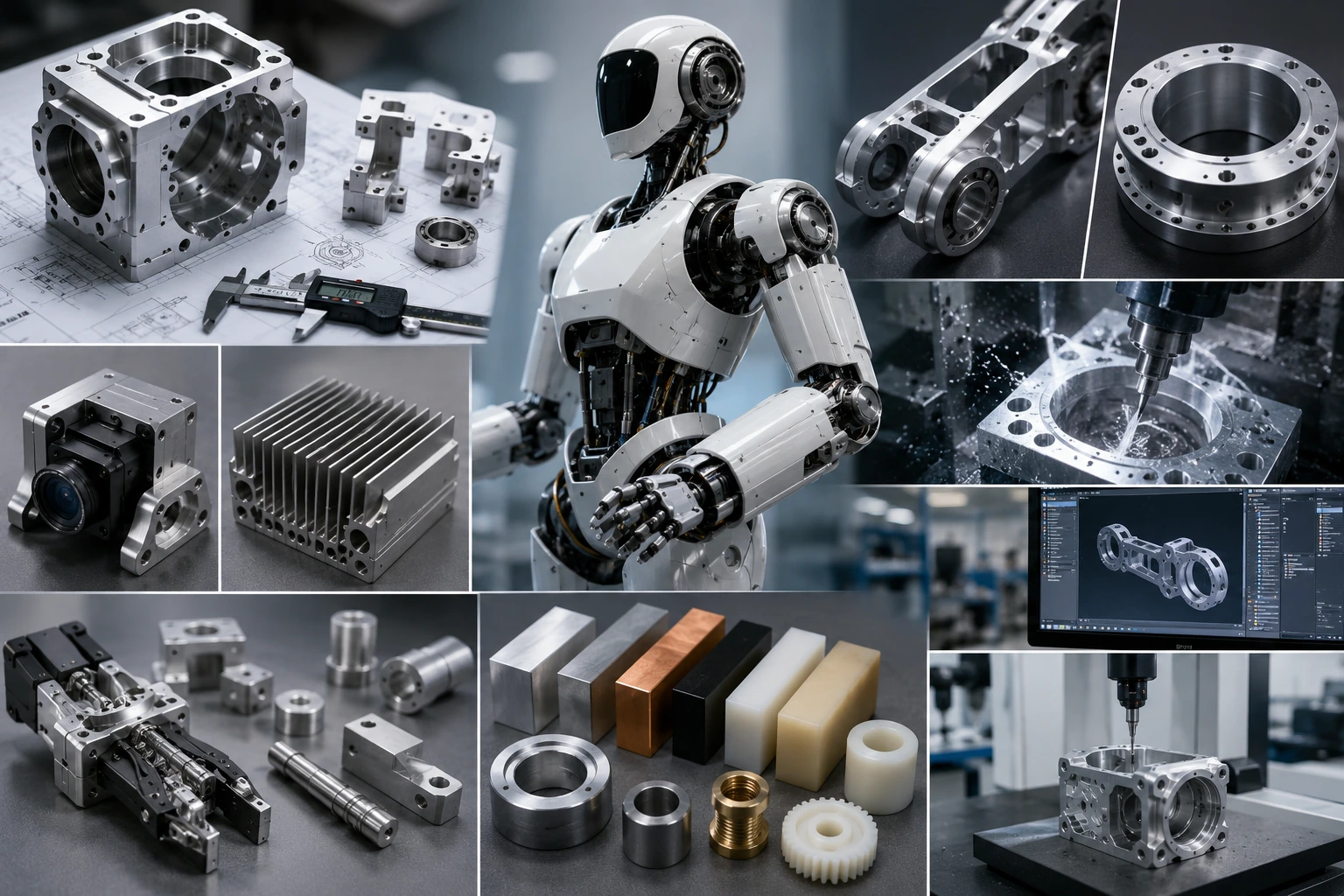
Why Sourcing CNC Parts for AI Robots Is Different
Three characteristics of AI robot programs make standard procurement approaches insufficient.
The design changes frequently. AI robot hardware and AI software co-evolve. When the AI team updates a perception model, the hardware team may need to reposition a sensor. When field tests reveal an unexpected failure mode, the structural team revises a part. A machining supplier that is oriented toward stable, repeating orders will create friction in a program that generates four to eight design revisions per major assembly over a typical development year.
The parts are IP-sensitive. The mechanical architecture of an AI robot — where joints are placed, how sensors are positioned relative to each other, how the chassis is structured — reflects the AI system’s design logic. A machining supplier who processes multiple assemblies over time accumulates substantial insight into a customer’s AI robot architecture. IP protection procedures need to be in place before the first file is shared, not negotiated after a problem occurs.
Hardware consistency affects AI system debugging. When an AI robot produces unexpected outputs in testing, the team needs to isolate whether the cause is in the algorithm, the training data, the sensor calibration, or the hardware geometry. If machined parts vary significantly between units or batches, mechanical variation becomes a permanent confounding variable in that diagnostic process. Documented, verified dimensional consistency from the machining supplier is not optional paperwork — it is a debugging tool.
These three characteristics shape every criteria in supplier evaluation.
What to Look for in a CNC Machining Partner for AI Robots
Evaluating a machining supplier for an AI robot program involves five areas, weighted differently than for conventional parts procurement.
Technical capability covers the expected ground: five-axis machining for complex joint housings, achievable tolerances for sensor mounts and bearing seats, material range for programs that use aluminum, copper, stainless steel, and engineering plastics in the same assembly. Confirm these capabilities with specific questions — ask what tolerances they routinely hold on bearing bores, whether they machine PEEK and copper regularly, and what their smallest internal radius capability is.
Quality management is often underweighted in supplier evaluation but critical for AI robot programs. Ask whether the supplier can provide CMM reports for individual parts, first article inspection reports at each new design revision, material certificates by heat number, and revision-controlled drawing file management. A supplier without these capabilities cannot support the documentation that AI-hardware co-development requires.
IP protection procedures matter before the first file is shared. Ask specifically: does the supplier operate under NDA agreements with prototype customers as standard practice? Who inside the facility has access to customer CAD files? Are design files stored on systems separate from the production floor network? What happens to customer files when the program ends? A supplier who treats these questions as unusual has not worked extensively with AI robotics development programs.
Communication reliability matters more than it appears in pre-sales evaluation. AI robot programs run on short cycles. A design change approved on Monday may need revised parts by the following week to keep an integration test on schedule. Suppliers who are slow to acknowledge RFQs, provide inaccurate lead time estimates, or require repeated follow-up create schedule risk that compounds across a multi-revision program. Assess communication quality before awarding the first order, not after.
Relevant experience with robotics or precision instrumentation hardware indicates familiarity with the types of geometric requirements — flatness, perpendicularity, true position callouts — that appear on AI robot drawings. A supplier experienced only with standard structural machining may not have the measurement equipment to verify GD&T requirements or the process knowledge to machine to them consistently.
| Evaluation Area | Key Questions | Warning Signs |
|---|---|---|
| Technical capability | 5-axis availability, tolerances on bearing bores, material range | Unable to machine PEEK, copper, or 7075 aluminum |
| Quality management | CMM report process, FAI availability, material certs | No documented inspection process for prototypes |
| IP protection | NDA procedure, file access controls, file destruction policy | “We don’t usually sign NDAs for small orders” |
| Communication | RFQ response time, lead time accuracy | Slow pre-sales response, vague or shifting timelines |
| Relevant experience | Robotics or precision instrumentation background | No experience with GD&T-heavy robot hardware drawings |
For AI robot programs, Boona CNC machining service supports prototype and low-volume builds with NDA agreements, CMM-backed inspection, and English-language engineering communication.
Protecting Your AI Robot IP with a Machining Supplier
Prototype machining requires sharing design information that reflects your AI robot’s architecture. Managing that exposure starts before the first file transfer.
Establish an NDA before sharing any design data. Many robotics teams skip this in early-stage urgency, particularly when evaluating a new supplier. A standard mutual non-disclosure agreement processed before the first RFQ is sufficient for most machining relationships — it does not require lawyers or extended negotiation. What it does is establish clearly that the supplier understands the design data is confidential and carries legal obligation.
Share only what is necessary for quoting and machining. A supplier needs STEP geometry and a 2D drawing with tolerance callouts to quote and manufacture a part accurately. They generally do not need system-level assembly drawings that show how the component integrates with the AI architecture, internal project names or codenames, or documentation about the AI system the hardware supports. Provide what enables them to do their job; withhold what reveals your system design beyond that.
Use consistent revision labeling on all shared files. Every STEP file and drawing sent to a supplier should carry a part number, description, and revision identifier in the file name. This allows both teams to confirm that the supplier is machining from the correct version and allows the engineering team to maintain an accurate record of what was manufactured at each revision.
Discuss file handling policy before the program begins. Ask what the supplier does with customer CAD files when a program ends. Options include secure deletion with written confirmation, return of all files to the customer, or retention for a defined period and then deletion. This should be documented in the NDA or a brief supplemental agreement. A supplier with defined procedures for this has worked with IP-sensitive prototype programs before.
Planning Your AI Robot Machining Budget
AI robot machining costs follow a predictable pattern across the development cycle. Understanding that pattern avoids two common mistakes: overestimating early-stage costs as an indicator of long-term supplier cost, and underestimating what stable production economics will look like.
Prototype stage costs are dominated by setup amortization spread over small quantities. A complex joint housing machined in quantities of 3 to 5 pieces may cost three to five times as much per unit as the same part in a batch of 50. This reflects real economics — setup time, programming time, and inspection effort do not decrease proportionally with quantity. Budget for this premium in the prototype phase and expect it.
Pilot stage costs decrease substantially as quantities grow into the range of 20 to 100 pieces per part and the design stabilizes. Suppliers accumulate setup knowledge that reduces cycle time, and per-unit inspection costs fall as processes become predictable. Pilot-stage per-unit costs are typically 40 to 60 percent lower than prototype-stage per-unit costs for the same part at the same quality level.
Early production continues the cost reduction trend and allows renegotiation of unit pricing based on committed annual volumes. At this stage, some simpler parts may justify transition to injection molding or die casting if the geometry allows — though many AI robot structural parts remain machined through meaningful production scale because of complexity and the value of ongoing design flexibility.
| Development Stage | Quantity per Part | Cost Characteristic | Design Flexibility |
|---|---|---|---|
| Prototype | 3–15 pieces | High per-unit, setup-dominated | Maximum — any revision is feasible |
| Pilot | 20–100 pieces | 40–60% lower per-unit | Moderate — revisions add cost |
| Early production | 100–500+ pieces | Continued reduction | Lower — supplier has process investment |
DFM review by the machining supplier before each new design revision can identify cost-driving features — pockets that are deeper than necessary, internal radii that force slow small-diameter cutters, tolerances that are tighter than function requires — and suggest modifications that reduce machining time without affecting AI robot performance. A supplier who does this proactively is engaged in the program, not just processing orders.
Boona low-volume manufacturing supports the range of quantities typical of AI robot programs, from early prototype batches through pilot production.
Managing Design Revisions with a Machining Supplier
AI robot programs generate more design revisions than conventional product programs. Managing those revisions well maintains supplier confidence and keeps the program on schedule.
Give the supplier advance notice before a revision arrives. Even a brief message that a revision is coming — before the updated STEP file is ready — allows the supplier to flag any open orders for the affected part and prepare their scheduling team. Suppliers who receive last-minute revisions accompanied by urgent lead time requests eventually deprioritize that customer’s work.
Communicate what changed and why. A redline on the drawing highlighting revised features, with a brief functional note explaining the change, helps the supplier verify that their machining process accommodates the revision. It also builds shared understanding of design intent that pays dividends in later revisions. A supplier who understands why a feature exists is better positioned to flag potential manufacturing problems.
Maintain consistent file naming across revisions. File names that include the part number, part description, and revision identifier (for example: BP-2047-wrist-housing-RevC.STEP) allow the supplier to manage their file system accurately and confirm at quoting that they are reviewing the correct version. Inconsistent naming leads to version confusion and parts machined from superseded drawings.
Batch revisions when possible. If multiple parts are changing in a short period, consolidating them into a single revision release reduces the supplier’s administrative load and may allow them to schedule the revised parts in a single production run. For a supplier managing multiple customers, batched revisions are significantly easier to schedule than a continuous stream of individual changes.
Keep a shared revision history. A simple document — even a shared spreadsheet — tracking which revision of each part is currently in production, what changed, and when the revision was released takes little time to maintain and saves significant confusion when verifying that assembled hardware matches the intended design.
Quality Documentation for AI Robot CNC Parts
The inspection documentation a machining supplier provides becomes part of the engineering team’s evidence base for hardware-software debugging. Different part types warrant different documentation requirements.
Sensor mounting and alignment parts — camera housings, LiDAR base mounts, IMU brackets, depth sensor frames — need CMM reports covering the geometric features that locate each sensor relative to the chassis reference system. Flatness, perpendicularity, true position of mounting features, and baseline distances if relevant. These are the features that determine whether the AI system’s sensor model matches physical reality, and they should be verified, not assumed.
Load-bearing structural parts — arm links, joint housings, actuator shells, chassis plates — need dimensional reports covering bearing bores, bolt patterns, and functional mating faces. Material certificates are important here because alloy and temper directly affect structural performance. A part machined from the wrong alloy or temper may meet dimensional requirements on delivery and fail in service.
Thermal management parts — heat spreaders, compute enclosures, cooling interface plates — need flatness and surface roughness reports on the thermal contact faces. These are the features that determine thermal resistance; dimensional tolerances on the outside profile matter less than contact face geometry.
First article inspection at each new design revision gives the engineering team a checkpoint before committing to full-batch production. The FAI confirms that the revised part meets drawing requirements as produced, and catches manufacturing interpretation errors before they affect a full batch.
| Part Category | Critical Documentation | Key Features to Verify |
|---|---|---|
| Sensor mounting parts | CMM report | True position, perpendicularity, baseline distance |
| Structural parts | Dimensional report, material certificate | Bearing bore, bolt pattern, alloy and temper |
| Thermal management parts | Flatness report, Ra surface roughness | Contact face flatness, surface finish |
| All new or revised parts | First article inspection report | All drawing-callout critical features |
Boona quality control process supports CMM reports, first article inspection, and material certification for prototype and low-volume AI robot programs.
Mini Case Study: Collaborative Robot Arm Program Through Three Revisions
A team developing a collaborative robot arm for AI-guided assembly sourced 12 unique machined parts for their first prototype build. Before sending any design files, they requested an NDA from the supplier. The NDA was signed and returned within one business day — the team noted this as an indicator that the supplier had experience with IP-sensitive prototype customers.
The first batch of 5 units identified three parts requiring revision: a wrist housing needed a cable routing slot repositioned, a camera bracket needed a mounting slot moved by 5 mm based on calibration testing, and a base plate needed two threaded holes added for a bracket that had not been in the original design. The team communicated all three revisions at the same time with redlined drawings.
The supplier acknowledged receipt, confirmed the revision content, flagged that the cable routing change would require a second setup on the wrist housing (with a small lead time addition), and delivered the revised parts on the revised schedule. CMM reports confirmed that the camera bracket mounting slot position was within tolerance across all 5 units.
At pilot stage, quantity grew to 30 units. The wrist housing per-unit cost dropped 51% compared to prototype-stage pricing. The CMM reports from the camera bracket confirmed slot position consistency within ±0.05 mm across all 30 units — which allowed the AI team to apply a single calibration profile across the pilot fleet rather than calibrating each unit individually.
The engineering team noted that the documentation from the machining supplier — revision records, CMM reports, material certificates — had become part of their hardware configuration management system and was referenced directly during AI model debugging sessions.
RFQ Checklist for AI Robot CNC Machining Programs
A first RFQ to a new supplier establishes the program’s requirements and tests the supplier’s responsiveness and technical understanding before committing to a relationship.
Include in every RFQ: 3D CAD file in STEP format, 2D drawing with tolerances and GD&T callouts, material specification and grade, required quantity, surface finish and color, any special requirements (CMM report, first article inspection, material certificate, cleanroom-compatible packaging), lead time requirement, and a brief function note for each part.
Function notes significantly improve quote quality. Compare:
Generic: “Aluminum bracket, 10 pcs”
Function-oriented: “6061-T6 camera mounting bracket for mobile AI inspection robot, 10 pcs, pilot batch. Mounting slot true position tolerance is critical for sensor calibration — see drawing callout. Black anodize. CMM report required for slot position and face perpendicularity.”
The second version tells the supplier which features require controlled inspection and why. It results in a more accurate quote, appropriate inspection allocation, and a supplier who understands they are producing a functional component, not a commodity bracket.
Evaluate the supplier’s response on accuracy (did they read the drawing?), lead time specificity (a date, not a range), proactive DFM feedback (a sign of engagement), and response time. A supplier who responds within one business day, correctly identifies the critical features, and raises a DFM concern unprompted is demonstrating the responsiveness and engagement that AI robot programs need.
If you are sourcing actuator housings, sensor brackets, joint hardware, vision system components, thermal management parts, or other custom AI robot components, send your CAD files, drawings, and program notes to Boona CNC machining service. We can help review material, tolerance, inspection requirements, and manufacturing options before the first order.
Conclusion: Build the Supplier Relationship Before You Need It
Sourcing custom CNC machined parts for AI robots is not a transactional procurement exercise. It is a supplier relationship that needs to function under revision pressure, IP sensitivity, quality documentation requirements, and the pace of AI development programs.
The teams that manage this well treat machining supplier selection with the same care they apply to hiring engineers. Technical capability matters. Quality systems matter. IP protection matters. Communication reliability matters. Finding a supplier who meets all four criteria and building a working relationship before the first high-pressure revision request makes the subsequent 12 months of development substantially easier.
For AI robot development teams at the prototype, pilot, or early production stage, Boona CNC machining service supports custom precision parts with NDA agreements, CMM-backed inspection documentation, and engineering communication in English — designed to function as a manufacturing partner across the full development cycle.
FAQs
How do I find a reliable CNC machining supplier for an AI robot program?
Look for suppliers who combine five-axis capability and CMM verification with documented quality procedures, clear NDA practices for prototype IP, and demonstrable experience with robotics or precision instrumentation hardware. Request references from other prototype customers and ask specifically about their experience managing design revisions and IP protection. Response quality during pre-sales evaluation is a reliable predictor of communication quality during production.
Should I sign an NDA before sharing AI robot designs with a machining supplier?
Yes. Sign a mutual NDA before sharing any STEP files or drawings. Standard agreements can be processed quickly by professional suppliers — a supplier who resists or delays standard IP protection procedures may not have the procedures that AI robot IP requires. The mechanical geometry of an AI robot reflects its system architecture and competitive positioning; it warrants the same protection as software.
How much does prototype-stage CNC machining cost for AI robot hardware?
Prototype-stage per-unit costs are typically three to five times higher than the same part at pilot-stage quantities. Setup cost amortized over three to five pieces dominates the per-unit price. Plan for this premium in prototype budgets — it reflects real economics and is not a pricing problem. Per-unit costs fall substantially as quantities grow and designs stabilize. Boona CNC machining service provides detailed quotes for prototype AI robot programs.
How do I manage frequent design revisions with a machining supplier without creating delays?
Establish a consistent file naming and revision convention before the first order, provide advance notice when a revision is coming, use redlines to highlight what changed, and batch revisions when multiple parts are changing in a short period. Build the relationship with enough communication and lead time that the supplier can accommodate revisions without emergency scheduling. Suppliers experienced with iterative prototype programs will have workflows for this; suppliers oriented toward stable repeat production will not.
What inspection documentation should I request for AI robot machined parts?
At minimum: CMM reports for sensor mounting and alignment parts (true position, perpendicularity), material certificates for load-bearing structural parts, surface roughness reports for thermal interface parts, and first article inspection reports for each new or revised design entering production. For pilot-fleet production, dimensional consistency data across the batch allows the AI team to apply fleet-level calibration rather than individually calibrating each unit.
Can an overseas machining supplier handle confidential AI robot designs?
Yes, with appropriate IP procedures in place. Professional machining suppliers routinely work with confidential prototype designs under NDA. Before sharing any design data, ask specifically about file access controls, who internally can view customer CAD files, and what happens to files at program end. Suppliers who have worked with AI robotics teams will have defined procedures. Those who treat IP protection as an unusual request may not be appropriate for programs with sensitive designs.
How do I transition an AI robot hardware program from prototype machining to higher-volume production?
The transition depends on part geometry, design stability, and required volume. Many AI robot structural parts remain machined through meaningful production volume because their complexity — internal features, tight tolerances, ongoing design flexibility — does not suit molding or casting processes. Simpler covers and enclosures may justify tooling investment at quantities above 500 to 1,000 units. A machining supplier with cross-process experience can advise when a specific part has reached the volume where alternative manufacturing methods offer cost advantage.
What should I include in an RFQ to evaluate a new machining supplier for an AI robot program?
Include a STEP file, 2D drawing with GD&T callouts, material specification, quantity, surface finish requirement, inspection requirements (CMM report, material certificate), lead time, and a brief function note explaining the part’s role in the robot. Evaluate the supplier’s response on accuracy of drawing interpretation, lead time specificity, proactive DFM feedback, and response time. These indicators predict how the supplier will perform under revision pressure during a real program.