
Walk onto any machine shop floor that is trying to run Ti-6Al-4V without the proper setup, and you will know it immediately. The smell of burning coolant hits you first, followed by the agonizing sight of half-machined, deeply scored titanium billets piled high in the scrap bin.
Titanium billet is incredibly expensive. When a machine shop scraps a Grade 5 component, the financial hit is severe. Unfortunately, many generalist shops quote titanium jobs just to win the PO, only to treat the metal like a tough piece of stainless steel. They destroy the material, blow past your delivery deadline, and quietly pass the cost of their “learning curve” onto you in future quotes.
At BOONA, we made a hard rule regarding complex alloys: no guessing on the shop floor. If you are a purchasing manager or engineer looking for a reliable Custom Ti-6Al-4V CNC Manufacturer, here is the unfiltered reality of why standard shops scrap your parts, and the exact engineering processes we use to guarantee a zero-scrap first-pass yield.
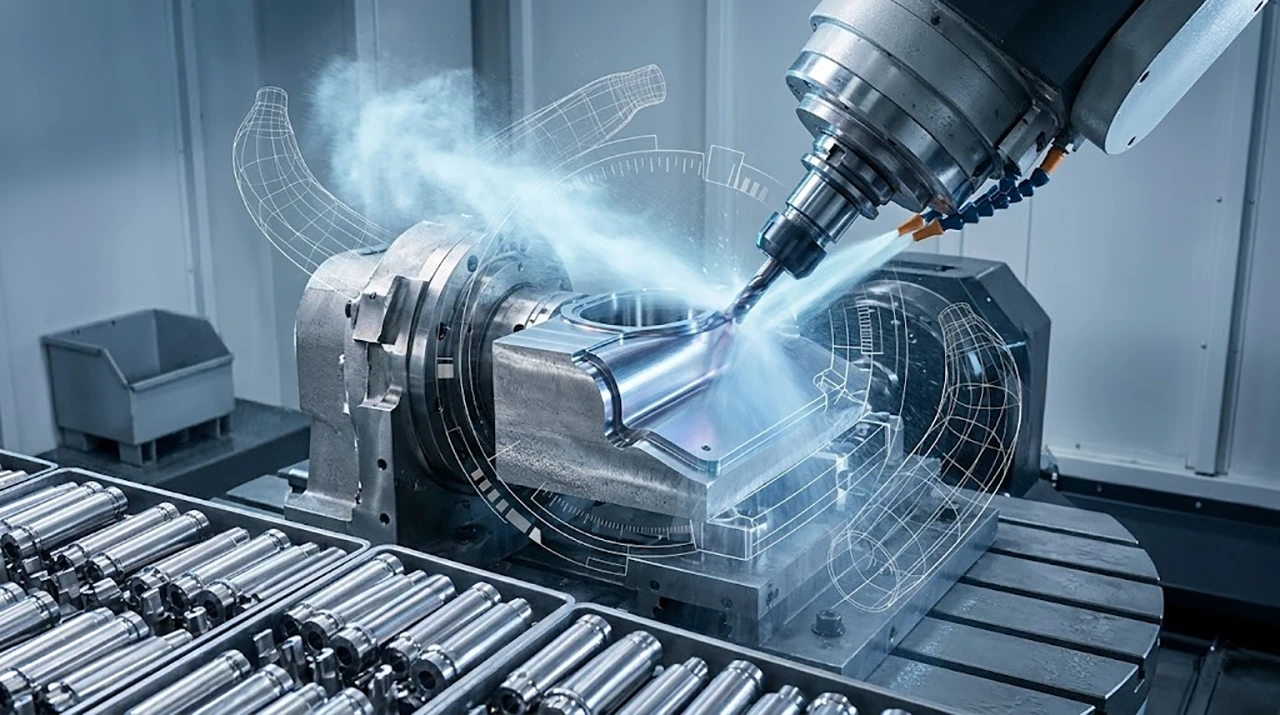
Scrap Cause #1: Thermal Catastrophe (The Burn)
The absolute fastest way to ruin a piece of titanium is to lose control of the cutting temperature.
When you machine aluminum, the metal chip acts like a sponge, absorbing heat and carrying it away from the tool. Aluminum has a thermal conductivity of roughly 167 W/m·K. Grade 5 titanium sits at a miserable 6.7 W/m·K. Because the heat cannot physically escape through the chip, over 80% of the extreme cutting temperature blasts directly into the carbide tool.
If a programmer runs the RPMs too high, that cutting edge hits 1000°C in seconds. The titanium chemically reacts, welds itself to the tool (galling), and instantly destroys the surface finish of your part.
How We Fix It: To provide reliable titanium CNC machining services, we mandate aggressive thermal control. We drop the surface footage (SFM) to keep friction low, but keep the chip load heavy so the tool shears rather than rubs. Crucially, we utilize 1,000+ PSI through-spindle High-Pressure Coolant (HPC). Standard 30-PSI flood coolant simply boils into steam when it hits titanium. Our HPC systems physically shatter that steam pocket, cooling the tool core directly and preventing catastrophic thermal scrap.
Scrap Cause #2: The “Banana” Effect (Internal Stress)
You can have perfect CAM toolpaths, perfect tools, and still scrap the part the second you open the vise jaws.
Raw titanium billet stores immense internal stresses from the forging mill. When a shop hogs out a deep pocket on one side of a billet and leaves the other side solid, they unbalance those trapped forces. The moment the clamping pressure is released, the part bows like a banana, instantly failing all flatness and parallelism tolerances.
How We Fix It: Producing precision titanium parts requires extreme patience. We utilize the “flip-flop” machining method—removing material equally from Side A, then Side B, to balance stress release. For flight-critical aerospace housings, we rough the part out, leave exactly 0.020″ of stock material, and pull it completely off the machine. We then bake it in a vacuum furnace for a thermal stress-relief cycle to kill the internal forging stress before we ever take a final finishing cut.
The Anti-Scrap Parameter Matrix
You cannot fake Grade 5 titanium machining. You either have the discipline to run the right parameters, or you fill up the scrap bin. Here is a look at the baseline data our programmers use to keep our yield rates near 100%:
| Machining Parameter | Generalist Shop Mistake | Our Shop-Floor Standard | Why It Prevents Scrap |
| Surface Footage (SFM) | 250+ SFM (Running too fast) | 120 – 150 SFM | Lower SFM prevents the carbide binder from melting and stops the titanium from galling to the flute. |
| Tool Engagement (Ae) | 50% Heavy Plunging | 10% – 15% Dynamic | Trochoidal toolpaths lower cutting pressure, stopping thin walls from deflecting and springing out of tolerance. |
| Tool Life Strategy | “Run it till it breaks” | Strict Time-in-Cut | We swap endmills at 40 minutes of cut time, regardless of how they look, to prevent sudden surface work-hardening. |
Scrap Cause #3: Pushing Tool Life Too Far
This is the most frustrating reason parts end up in the bin: a shop manager tries to save $50 on a carbide endmill and ends up ruining a $500 block of aerospace titanium.
Titanium is highly reactive. When an endmill gets dull, it stops shearing the metal and starts rubbing against it. This rubbing creates immense friction and instantly work-hardens the titanium surface, turning it glass-hard. The next tool that touches that hardened surface shatters. The part is ruined.
How We Fix It: We manage tool life strictly by data, not by listening for the tool to start screaming. If our baseline tests show an AlTiN-coated endmill degrades at 45 minutes in a specific cut, we write a mandatory tool change into the CNC program at 40 minutes. We spend slightly more on carbide consumables up front, but we completely eliminate the risk of scrapping your expensive components.
Stop Paying for the Learning Curve
Producing high-quality aerospace titanium machining components requires heavy box-way machines, advanced fixturing, and machinists who deeply respect the metallurgy of the alloy.
If your current supply chain is struggling with long lead times due to high scrap rates, or if you are tired of dealing with warped parts and burned surface finishes, it is time to work with a team that actually understands the material. Review our broader capabilities on our Custom CNC Machining page, or dive straight into our dedicated Titanium CNC Machining solutions to see exactly how we conquer this metal.
Stop subsidizing the scrap bin. Send your 3D CAD files to our engineering team today, and we will provide a free Design for Manufacturability (DFM) review and a reliable, scrap-free quote within hours.
FAQs
I received a quote from another shop that is 30% cheaper than yours. Why is there such a massive price gap in titanium machining?
Because you are likely paying for their learning curve. Many generalist shops look at a Ti-6Al-4V print, quote it using the same machine time estimates as 304 stainless steel, and win the PO. Then they hit the shop floor, break thousands of dollars in tooling, scrap three billets of material, and panic. We quote based on the actual, physics-limited machining time and the premium tooling required to do it right the first time. A suspiciously cheap quote usually guarantees an expensive, multi-week delay.
If the machine shop is eating the cost of the scrapped material, why does their high scrap rate actually affect me?
Because you cannot assemble your product with an apology. Certified aerospace or medical-grade titanium billet isn’t always sitting on a shelf down the street. If a shop scraps your complex housing, they might have to wait three to four weeks just to get a replacement block of material delivered from the mill. Their internal scrap rate directly destroys your production schedule and time-to-market.
If the titanium surface work-hardens because a tool got dull, can’t you just machine past that hardened layer?
Not easily, and rarely without ruining the part. When Grade 5 titanium work-hardens, the surface basically turns to glass. If you try to push a fresh carbide endmill into that layer, the cutting edge will instantly chip and shatter. You might be able to salvage it by drastically dropping the speed and using a highly specialized tool, but usually, once a titanium part is severely work-hardened, it goes straight into the scrap bin. Strict tool-life management is the only real cure.
What is the biggest red flag that a CNC shop doesn’t actually know how to handle Grade 5 Titanium?
Ask them two questions: What is their coolant pressure, and how do they manage tool wear? If they tell you they use standard 30-PSI flood coolant and change tools “when the operator hears them getting dull,” grab your blueprints and walk away. Standard coolant boils instantly on titanium, and waiting for a tool to scream means the part is already ruined. You need a shop running High-Pressure Coolant (HPC) and swapping tools based on hard time-in-cut data.
Does the “flip-flop” machining method for stress relief add a lot of machine time?
It adds a slight amount of handling time, but it saves weeks of rework. Instead of clamping the part once and hogging out 80% of the material (which guarantees it will warp when unclamped), we have to machine Side A, flip it, machine Side B, and repeat. It requires more setups and more precise dialing in, but it is the only physical way to ensure a complex, thin-walled titanium part stays flat and in-tolerance when it finally hits the inspection bench.