
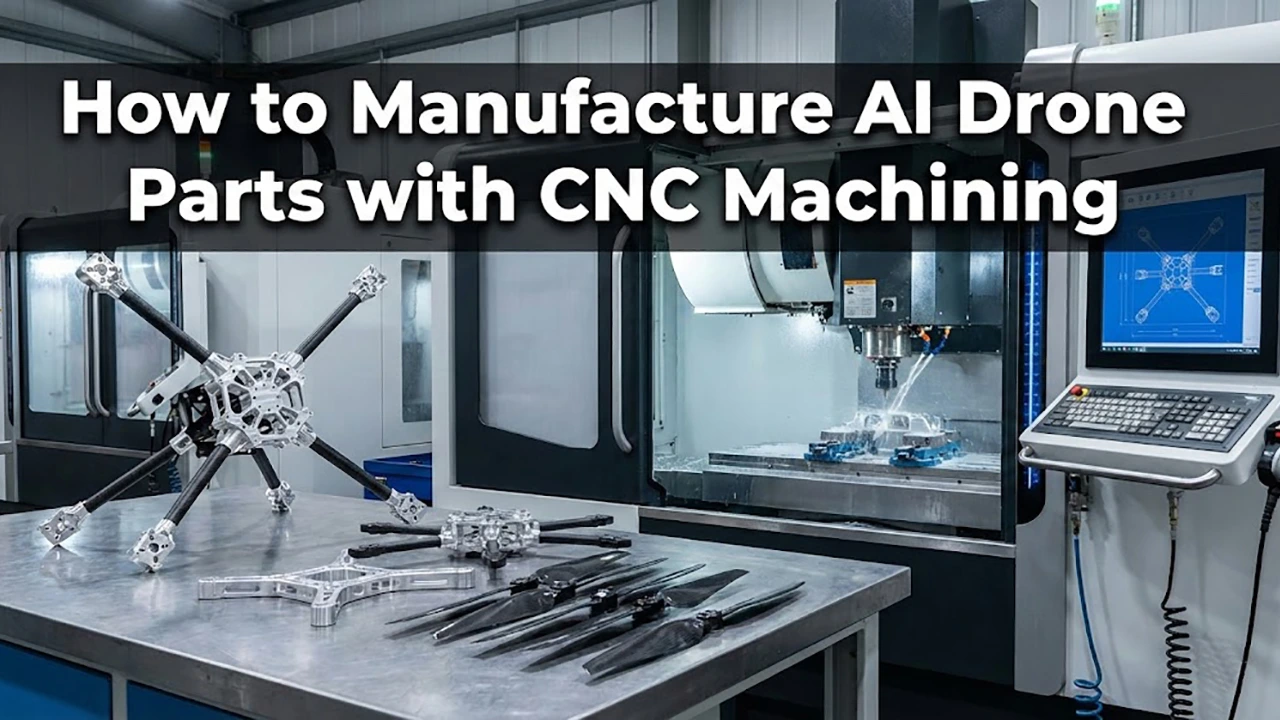
As AI drones rapidly expand into industries such as surveillance, logistics, agriculture, mapping, and autonomous inspection, hardware precision has become just as critical as software intelligence. Behind every high-performance AI drone lies a manufacturing process capable of delivering lightweight structures, tight tolerances, and fast iteration—CNC machining.
This article explains how AI drone parts are manufactured using CNC machining, why it outperforms alternative processes, and how manufacturers accelerate development from prototype to small-batch production.
Why CNC Machining Is Essential for AI Drone Manufacturing
AI drones rely on precise mechanical components to ensure:
-
Stable flight and vibration control
-
Accurate alignment of AI cameras and sensors
-
Efficient heat dissipation for onboard AI processors
-
Lightweight yet rigid structural performance
Traditional manufacturing methods often lack the flexibility or precision required during early-stage development. This is why many innovators turn to CNC machining services for AI drone production.
CNC-Machined Parts Commonly Used in AI Drones
CNC machining supports nearly all structural and functional drone components:
| AI Drone Part | Function | CNC Advantage |
|---|---|---|
| Drone frame | Structural integrity | Lightweight & rigid |
| Motor mount | Vibration reduction | High concentricity |
| Camera gimbal | Image stability | Tight tolerances |
| Sensor bracket | AI data accuracy | Precise alignment |
| Battery enclosure | Safety & cooling | Custom geometry |
| AI processor housing | Heat dissipation | Integrated cooling |
Many of these parts require multi-axis CNC machining to achieve complex geometries in a single setup.
Material Selection for CNC Machining AI Drone Parts
Choosing the right material directly affects flight time, durability, and performance.
| Material | Density (g/cm³) | Key Properties | Typical Use |
|---|---|---|---|
| Aluminum 6061 | 2.7 | Lightweight, corrosion resistant | Frames, housings |
| Aluminum 7075 | 2.8 | High strength-to-weight | Motor mounts |
| Magnesium Alloy | 1.8 | Ultra-lightweight | Aerospace drones |
| Titanium | 4.5 | High strength, heat resistance | Defense drones |
| PEEK / Delrin | 1.3–1.4 | EMI resistant, lightweight | Sensor mounts |
👉 Learn more about aluminum CNC machining for lightweight drone parts.
CNC Machining Processes Used for AI Drone Components
Different CNC processes are selected based on part complexity:
-
3-axis CNC machining – Flat or simple structural parts
-
4-axis CNC machining – Rotational symmetry components
-
5-axis CNC machining – Complex frames, gimbals, housings
-
CNC turning – Shafts, spacers, cylindrical parts
These processes allow manufacturers to maintain high accuracy while reducing setup time.
Tolerances and Precision Requirements for AI Drones
AI drone components require extremely tight tolerances to maintain sensor accuracy and flight stability.
| Parameter | Typical CNC Capability |
|---|---|
| Dimensional tolerance | ±0.01 mm |
| Flatness | ≤ 0.02 mm |
| Concentricity | ≤ 0.01 mm |
| Surface roughness | Ra 0.8–1.6 μm |
Such precision is difficult to achieve with die casting or 3D printing during early production stages.
CNC Machining Workflow for AI Drone Parts
A typical AI drone CNC manufacturing workflow includes:
-
CAD design & DFM optimization
-
CAM programming and toolpath simulation
-
CNC machining and in-process inspection
-
Surface finishing and post-processing
-
Final QC and assembly verification
Professional suppliers like BOONA rapid CNC prototyping manufacturer integrate engineering support early to reduce redesign costs.
Rapid Prototyping Accelerates AI Drone Innovation
AI drone development depends on fast iteration cycles:
-
Flight test → data analysis → redesign
-
Sensor upgrade → housing modification
-
Weight optimization → structural refinement
CNC machining enables no-MOQ prototyping with lead times as short as 3–7 days, helping startups validate designs quickly.
| Production Stage | Typical Lead Time |
|---|---|
| CNC prototyping | 3–7 days |
| Small batch (10–100 units) | 7–15 days |
| Tooling-based production | 4–8 weeks |
Surface Finishing for Harsh Drone Environments
AI drones often operate outdoors or in industrial settings. CNC machining supports multiple surface treatments:
-
Anodizing (corrosion resistance)
-
Hard anodizing (wear resistance)
-
Bead blasting (weight & texture control)
-
EMI shielding coatings
These finishes improve durability without adding unnecessary weight.
Quality Control Standards for CNC AI Drone Parts
High-performance AI drones require strict quality assurance:
-
CMM dimensional inspection
-
Material certification and traceability
-
ISO 9001 quality management
-
Assembly-fit and functional testing
Experienced suppliers such as BOONA CNC machining partner ensure consistency from prototype to production.
CNC Machining vs Other Manufacturing Methods for AI Drones
| Method | Best Use Case | Limitation |
|---|---|---|
| CNC machining | Prototypes & small batches | Higher unit cost |
| Die casting | High-volume production | High tooling cost |
| Injection molding | Plastic housings | Long setup time |
| 3D printing | Concept models | Lower strength |
For AI drone startups and R&D teams, CNC machining remains the most flexible and reliable manufacturing solution.
Conclusion: CNC Machining Enables the Future of AI Drones
From precision sensor alignment to lightweight structural design, CNC machining is the foundation of AI drone hardware innovation. It enables rapid prototyping, tight tolerances, and scalable production—making it essential for companies pushing the limits of autonomous flight.
If you’re developing AI drone components, partnering with an experienced CNC machining supplier can significantly accelerate time to market while ensuring performance and reliability.
FAQs
Why is CNC machining used to manufacture AI drone parts?
CNC machining delivers high precision, tight tolerances, and lightweight strength, which are essential for AI drone frames, sensor mounts, motor components, and processor housings.
What AI drone components are best suited for CNC machining?
Common CNC-machined AI drone parts include frames, motor mounts, camera gimbals, sensor brackets, battery enclosures, and AI processor housings.
What tolerances are required for CNC-machined AI drone parts?
Most AI drone components require tolerances between ±0.01 mm and ±0.05 mm, especially for sensor alignment and vibration-sensitive parts.
Which materials are commonly used for CNC machining AI drone parts?
Popular materials include aluminum 6061 and 7075, magnesium alloys for ultra-lightweight designs, titanium for high-stress applications, and engineering plastics like PEEK and Delrin.
How does CNC machining improve AI drone flight stability?
CNC machining ensures precise motor alignment, rigid structures, and low vibration, which directly improves flight stability and AI data accuracy.
Is CNC machining better than 3D printing for AI drone parts?
Yes. CNC machining provides higher strength, better surface finish, and tighter tolerances, making it more suitable for functional and flight-ready AI drone components.
How long does it take to produce CNC-machined AI drone prototypes?
CNC-machined AI drone prototypes can typically be produced within 3–7 days, supporting rapid testing and design iteration.
Can CNC machining support small-batch AI drone production?
Yes. CNC machining is ideal for low-volume production (10–1,000 units), allowing AI drone companies to scale without high tooling costs.
What surface finishes are recommended for AI drone CNC parts?
Common finishes include anodizing, hard anodizing, bead blasting, polishing, and EMI shielding coatings to enhance durability and environmental resistance.
What quality standards are used in CNC machining AI drone parts?
High-quality CNC suppliers follow ISO 9001 standards, use CMM inspection, and provide material certifications to ensure consistent performance.
When should AI drone manufacturers switch from CNC machining to die casting?
Manufacturers typically switch when production exceeds 5,000–10,000 units, and the design is fully validated to justify tooling investment.
Why do AI drone startups prefer CNC machining suppliers?
AI drone startups choose CNC machining for no MOQ, fast lead times, design flexibility, and strong engineering support during rapid development.