
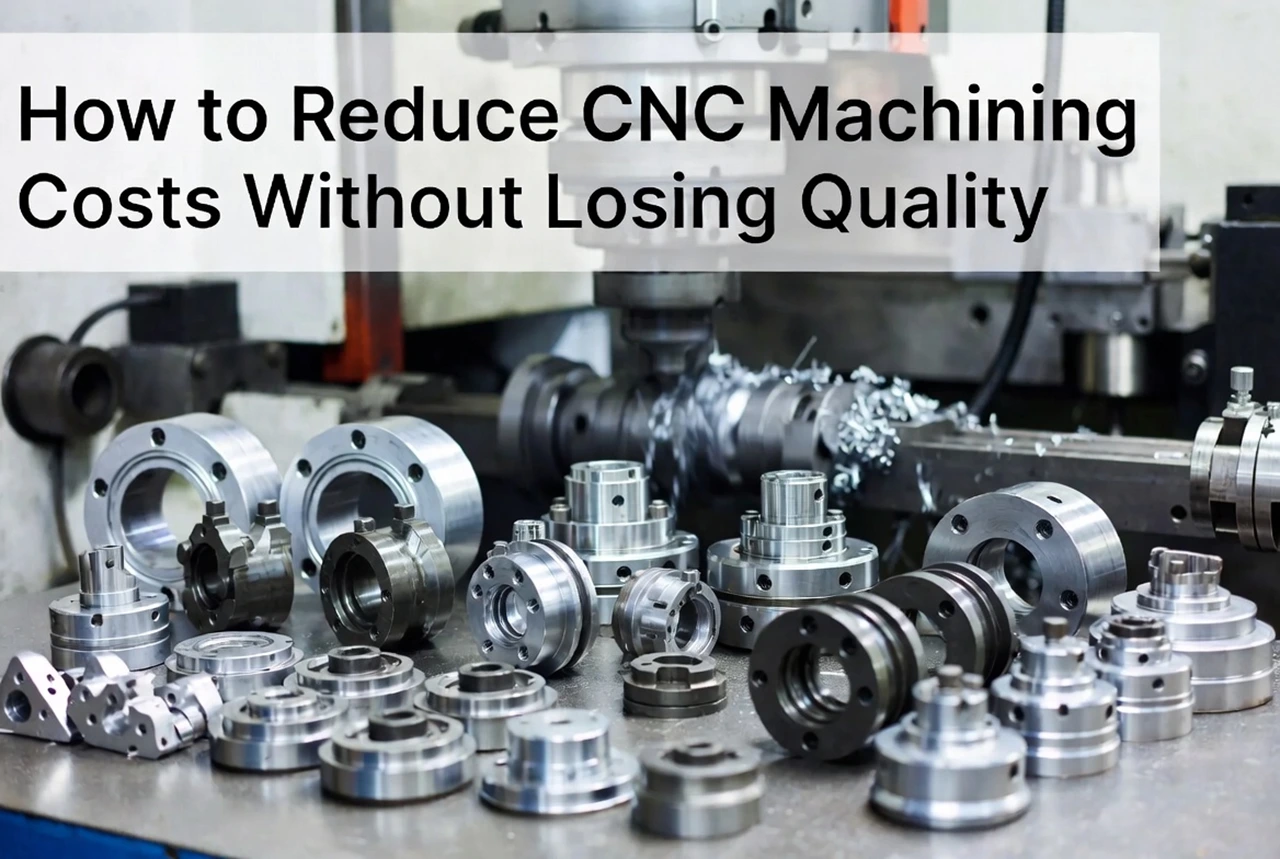
In today’s competitive manufacturing environment, controlling costs is just as important as maintaining precision. Many buyers assume that lower CNC machining costs mean lower quality, but in reality, smart engineering and process optimization can significantly reduce expenses without sacrificing accuracy or reliability.
This guide explains how to reduce CNC machining costs while maintaining high quality, using proven strategies applied by professional manufacturers like BOONA.
What Really Drives CNC Machining Costs?
Before reducing costs, it’s essential to understand where they come from.
| Cost Factor | Impact on Price |
|---|---|
| Material selection | High |
| Part complexity | High |
| Tolerance requirements | Very High |
| Machining time | High |
| Surface finishing | Medium |
| Order quantity | Medium |
By addressing these factors early, companies can achieve major savings without compromising performance.
Optimize Part Design with DFM (Design for Manufacturability)
One of the most effective ways to lower CNC machining costs is DFM optimization.
Cost-Saving Design Tips:
-
Avoid unnecessary tight tolerances
-
Replace sharp internal corners with standard radii
-
Reduce deep pockets and thin walls
-
Combine features to reduce machine setups
| Design Element | Poor Design | Optimized Design |
|---|---|---|
| Tolerance | ±0.01 mm everywhere | Tight only where needed |
| Internal corners | Sharp | R ≥ 2 mm |
| Setups | Multiple | Single or dual |
Professional CNC machining services provide DFM feedback before production, preventing costly redesigns.
Choose Cost-Effective Materials Without Losing Performance
Material choice has a major impact on machining cost.
| Material | Relative Cost | Machinability | Typical Use |
|---|---|---|---|
| Aluminum 6061 | Low | Excellent | Housings, frames |
| Aluminum 7075 | Medium | Good | High-strength parts |
| Stainless steel | High | Moderate | Wear-resistant parts |
| Titanium | Very High | Difficult | Aerospace only |
| Engineering plastics (POM, Nylon) | Low | Excellent | Light-load components |
👉 Switching from titanium to 7075 aluminum or from steel to engineering plastics can reduce costs by 30–60% while maintaining functional strength.
Learn more about aluminum CNC machining solutions for cost-effective production.
Apply Tolerances Strategically
Tighter tolerances dramatically increase machining time and inspection cost.
| Tolerance | Cost Impact |
|---|---|
| ±0.01 mm | High |
| ±0.02 mm | Medium |
| ±0.05 mm | Low |
Best Practice:
-
Use tight tolerances only for functional interfaces
-
Apply looser tolerances to cosmetic or non-critical features
This approach preserves quality while reducing unnecessary machining effort.
Reduce Machining Time with Smart Process Selection
Machining time equals money. Selecting the right process is critical.
| Process | Best Use | Cost Advantage |
|---|---|---|
| 3-axis CNC | Simple geometry | Lowest cost |
| 5-axis CNC | Complex parts | Fewer setups |
| CNC turning | Cylindrical parts | Faster than milling |
| Multi-part fixturing | Batch runs | Lower unit cost |
An experienced supplier like BOONA CNC machining manufacturer optimizes toolpaths and setups to minimize cycle time.
Simplify Surface Finishing Requirements
Surface finishing can add 10–40% to total cost.
| Finish Type | Cost Level | Recommendation |
|---|---|---|
| As-machined | Lowest | Functional parts |
| Bead blasting | Low | Cosmetic improvement |
| Anodizing | Medium | Corrosion resistance |
| Polishing | High | Only if necessary |
Avoid over-specifying finishes that do not improve functionality.
Order Quantities Strategically
CNC machining benefits from economies of scale, even at low volumes.
| Quantity | Cost per Part |
|---|---|
| 1–5 pcs | Highest |
| 10–50 pcs | Medium |
| 100–500 pcs | Lowest |
For early development, no-MOQ CNC prototyping is ideal. For stable designs, small-batch production dramatically reduces unit cost.
👉 See how rapid CNC prototyping supports both stages efficiently.
Quality Control: Reduce Cost Without Cutting Corners
Cost reduction should never mean skipping QC.
Smart QC Strategies:
-
Focus inspection on critical dimensions
-
Use First Article Inspection (FAI) for batches
-
Apply statistical sampling for non-critical features
This maintains reliability while avoiding unnecessary inspection labor.
Common Mistakes That Increase CNC Machining Costs
❌ Over-specifying tolerances
❌ Choosing exotic materials unnecessarily
❌ Ignoring DFM feedback
❌ Late design changes
❌ Switching suppliers mid-project
Avoiding these mistakes alone can reduce costs by 20–30%.
Conclusion
Reducing CNC machining costs does not require sacrificing quality. By optimizing design, selecting the right materials, applying tolerances wisely, and working with an experienced partner, companies can achieve high-precision parts at competitive prices.
If you’re looking to optimize cost without compromising performance, partnering with a professional CNC machining supplier ensures smarter decisions from prototype to production.
FAQs
How can I reduce CNC machining costs without lowering part quality?
You can reduce costs by optimizing part design (DFM), selecting cost-effective materials, applying tolerances only where necessary, reducing machining time, and simplifying surface finishes—without compromising functionality.
What design features increase CNC machining costs the most?
Features that increase cost include tight tolerances everywhere, deep pockets, sharp internal corners, thin walls, complex geometries, and multiple machine setups.
Do tighter tolerances always improve CNC part quality?
No. Tighter tolerances increase machining and inspection costs. Quality improves only when tight tolerances are applied to functional or mating features, not cosmetic areas.
Which materials offer the best balance between cost and performance?
Aluminum 6061, aluminum 7075, POM (Delrin), and Nylon offer excellent machinability, strength, and cost efficiency compared to stainless steel or titanium.
Is 5-axis CNC machining more expensive than 3-axis?
Not always. While hourly rates are higher, 5-axis machining can reduce total cost by minimizing setups, fixtures, and manual repositioning for complex parts.
How does batch size affect CNC machining cost?
Larger batch sizes reduce cost per part by spreading setup and programming costs. Even increasing quantity from 5 to 20 units can significantly lower unit price.
Can surface finishing be reduced to lower CNC costs?
Yes. Using as-machined or bead-blasted finishes instead of polishing or complex coatings can reduce total cost by 10–40% without affecting performance.
Does CNC prototyping cost more than production machining?
Yes, per-unit cost is higher for prototypes, but CNC prototyping prevents costly design errors, reducing overall development cost and time to market.
How does DFM feedback help reduce CNC machining costs?
DFM feedback identifies cost-driving design issues early, allowing changes before machining begins—often saving 20–50% in production cost.
Should I choose the cheapest CNC supplier to reduce costs?
No. The cheapest supplier often leads to quality issues, rework, delays, and higher long-term costs. Value-driven suppliers focus on cost optimization without quality loss.
When should I switch from CNC machining to casting or molding?
Switch when production volume exceeds 5,000–10,000 units and the design is fully validated, making tooling investment cost-effective.
How can quality control be optimized without increasing costs?
Focus QC on critical dimensions, use First Article Inspection (FAI), and apply statistical sampling instead of full inspection for non-critical features.