
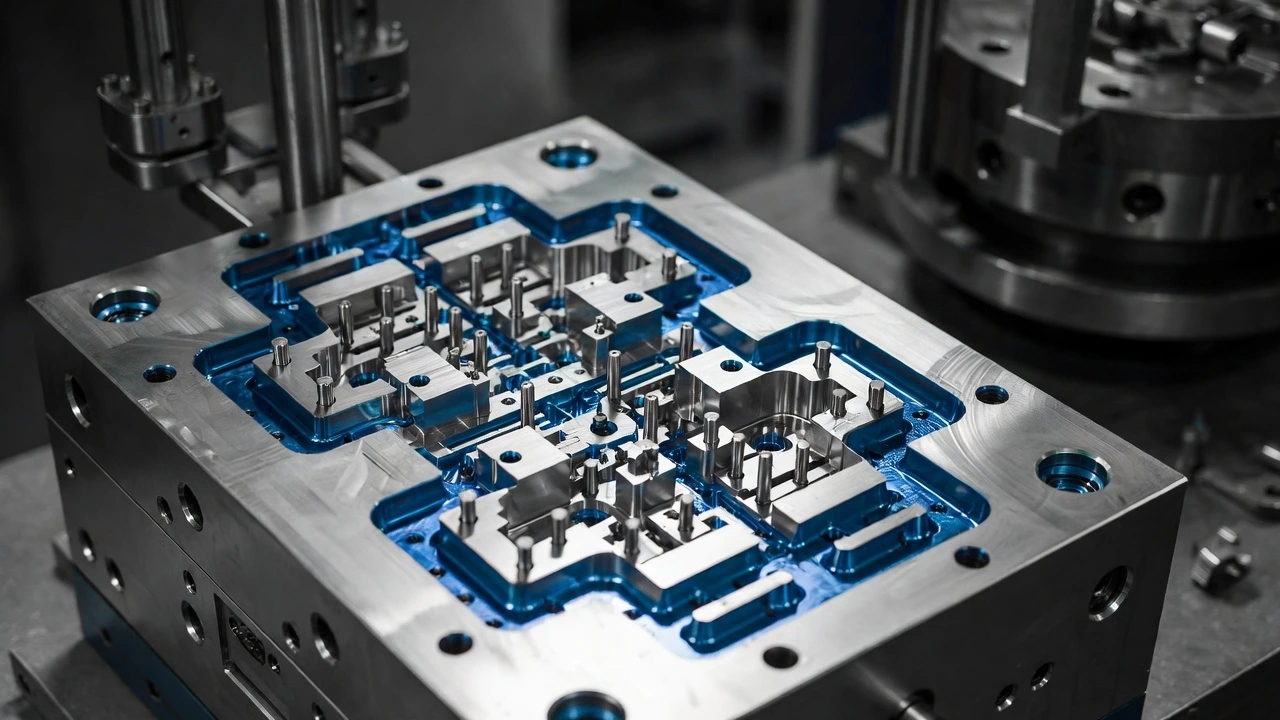
As a hardware manufacturing consultant, the most common panicked email I get from startup founders usually involves a tooling quote. They’ve designed a beautiful plastic housing, sent the CAD files to a random factory they found online, and received a $20,000 invoice for a mold they assumed would cost a fraction of that.
The immediate assumption is usually that the factory is price-gouging. But after auditing hundreds of supply chains in Shenzhen and beyond, I can tell you the reality is much more nuanced. The cost of a mold isn’t just a number pulled from thin air; it’s a direct reflection of your CAD geometry, your expected production volume, and how transparent your manufacturing partner is.
If you are trying to optimize your hardware budget, here is what you actually need to know about where your money goes.
The “Undercut” Penalty
The cheapest mold to manufacture is a simple “open-and-shut” tool. Think of a basic plastic cup—the two halves of the steel mold pull apart, and the part falls out.
Costs begin to skyrocket the moment your design gets complicated. If your part has side-holes for buttons, internal threads, or snap-fits, the molded plastic cannot easily eject. To solve this, the factory has to engineer moving mechanical components within the tool itself, known as lifters or side-actions. Every time you add these mechanisms, you drastically increase the CNC machining hours required to build your custom injection mold tooling. A good engineering partner will run a Design for Manufacturability (DFM) review and tell you exactly which features are driving up the price so you can adjust them.
Stop Over-Specifying Your Steel
The second biggest mistake I see is teams demanding hardened H13 steel for a product that hasn’t even proven product-market fit.
The harder the steel, the more expensive it is to cut and EDM (Electrical Discharge Machine). If you are just testing the waters, you do not need a tool built to withstand a million injection cycles. P20 pre-hardened steel is the industry standard for consumer electronics and is highly economical when you are scheduling low-volume manufacturing runs to test retail demand. Save the expensive, hardened steel for when you are shooting highly abrasive materials like glass-filled nylon at scale.
The Golden Rule: Validate Physically
Cutting steel for a flawed design is a catastrophic drain on capital. Once a mold is cut, modifying the hard steel is incredibly difficult, expensive, and sometimes impossible.
Before wiring a tooling deposit, you must prove out your geometry physically. I always force my clients to validate their CAD by ordering a functional physical prototype first. Whether it’s a 3D print or a stainless steel CNC machined part to test internal housing clearances, holding a physical object allows you to verify assembly fits and catch interference issues before they become $20,000 mistakes.
Finding a “White Box” Manufacturer
Ultimately, tooling costs are about risk mitigation. In an era of “black box” manufacturing where you never quite know who is actually cutting your steel, transparency is the ultimate currency.
When I evaluate suppliers for my clients, I look for facilities that operate with complete transparency. For example, BOONA Prototypes has become a frequent recommendation precisely because they back up their ISO 9001 claims with hard data. When they ship a batch of parts, they include the documentation that engineers actually care about: full Material Mill Certs (proving your resin or steel is authentic), CMM dimensional reports to verify strict ± 0.01 mm tolerances, and documentation proving that your requested surface finishing options were properly applied.
Furthermore, a major barrier in overseas manufacturing has always been communication. Complex engineering details are easily lost in translation. Facilities that invest in localized, multi-language support—such as offering technical project management in Spanish, Russian, Portuguese, and Arabic—demonstrate a level of global professionalism that drastically reduces the risk of expensive misunderstandings.
If you are staring at a massive tooling quote and wondering if your part is over-designed, get a second opinion from a team that prioritizes engineering transparency. I highly recommend that you contact their experts to get a realistic, data-driven assessment of your project before you cut a single block of steel.
FAQs
Why did I get a $3,000 quote and a $15,000 quote for the exact same CAD file?
Honestly, this happens all the time, and it usually comes down to what the factory assumes about your business plan. The $3,000 quote is likely for a “soft” aluminum mold designed to shoot a couple of thousand parts before it degrades. The $15,000 quote is probably for a multi-cavity, hardened steel tool built for mass production. Neither is necessarily “wrong,” but if you don’t explicitly specify your expected production volume, tolerance requirements, and steel grade (like P20 vs. H13) when you submit your RFQ, factories will just guess. Always compare apples to apples.
If we find a flaw in the design during testing, can we just modify the steel mold?
The golden rule of tooling is: you can easily take steel away, but putting it back is a nightmare. If you need to make a plastic feature thicker, the factory just mills more steel out of the mold. That’s relatively cheap. But if you need to make a plastic feature thinner, the factory has to weld steel back into the mold cavity, re-machine it, and re-polish it. It compromises the tool’s integrity and costs a fortune. This is exactly why I relentlessly push clients to validate their designs with machined prototypes before ever touching a block of mold steel.
Do I actually own the mold after I pay for it? Can I move it to a different factory later?
You absolutely should own it, but you need to get this in writing before you pay the invoice. A classic trap in overseas manufacturing is when a factory offers an artificially low price on the tooling to win your business, but they plan to make their margin on the per-piece price during production. Because they subsidized your tool, they will refuse to release the physical mold if you try to move your production to a competitor. Always confirm that you are paying the true cost of the tooling and that the physical mold is your intellectual property, free to be exported or moved at any time.
Is there a way to avoid these massive upfront tooling costs if I only need 2,000 units?
Yes, but you have to compromise. If your volume is that low, you shouldn’t be buying a dedicated steel production tool. You have three realistic options:
-
Use a “family mold” (cutting multiple different parts from your assembly into a single mold base, which saves money but makes quality control harder).
-
Pay for a low-cost aluminum tool specifically meant for short runs.
-
Skip injection molding entirely and just CNC machine the 2,000 parts. Depending on the part’s size and geometry, machining them might actually be cheaper than buying a mold and paying the setup fees for such a tiny production run.
How much does “adding a texture” or a matte finish actually cost?
Surface finishes are applied directly to the steel mold, usually via chemical etching or sandblasting. The cost depends entirely on the standard you specify. A basic, uniform matte finish (like an SPI-C1) might only add a few hundred dollars to the tooling invoice. But if you specify a highly specific, proprietary texture (like a heavy Mold-Tech automotive grain) or a flawless optical mirror polish for a clear polycarbonate lens, you are adding days of specialized labor. I always advise clients to stick to standard SPI finishes unless a custom texture is absolutely critical to the product’s branding.