
You just engineered a brilliant, lightweight housing for a new aerospace device. You specified AZ31B magnesium, exported the CAD file, and sent it to your usual suppliers asking for exactly five prototype units.
The responses are infuriating. Half of the shops reply with a flat “No Quote.” The other half demand a massive Minimum Order Quantity (MOQ) of 500 pieces, or they quote an astronomical unit price that eats your entire R&D budget.
If you are struggling to source low volume magnesium CNC machining, you are experiencing a well-known industry bottleneck. General machine shops are simply not equipped to handle small runs of combustible metals. As a manufacturing specialist, let me explain exactly why your quotes are so high, and how you can bypass the “Setup Tax” to get your prototypes machined safely and affordably.
The Hidden “Setup Tax” Behind Your Quote
Job shops make their money by keeping their spindles turning on standard 6061 aluminum. When cutting aluminum, their CNC sumps are filled with dozens of gallons of water-soluble coolant.
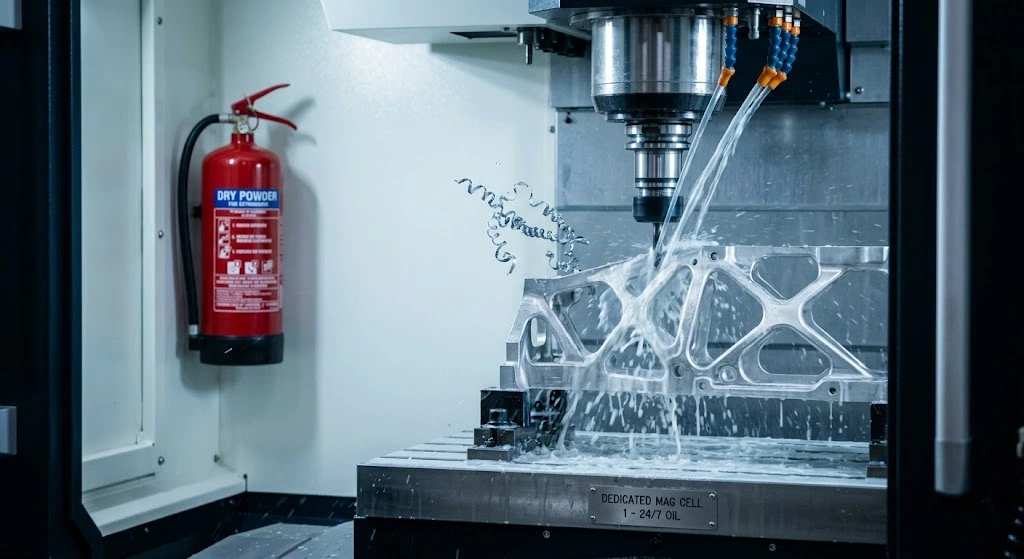
If a shop accepts your 5-piece order for magnesium CNC prototypes, they have a major problem. Magnesium swarf (dust and chips) reacts violently with water. A single spark from the cutting tool will strip the oxygen from the water-based coolant, releasing pure hydrogen gas and causing a massive explosion inside the machine enclosure.
To safely run your parts, the shop must completely shut down a 5-axis mill. They have to pump out all the water coolant, meticulously scrub the tank, and refill the entire system with specialized mineral oil coolant. When your 5 parts are done, they have to reverse the process to get back to cutting aluminum.
You aren’t just paying for the machining of five brackets. You are paying for their operational downtime. Look at the hidden NRE (Non-Recurring Engineering) resource drain they are burying in your quote:
The Magnesium “Setup Tax” Resource Breakdown
| Shop Floor Operation | Resource & Time Required | The Impact on Your Quote |
| Coolant Sump Drain & Scrub | Half a shift of machine downtime | The shop’s hourly rate is fully absorbed by your short run. |
| Mineral Oil Refill | 50+ Gallons of specialized fluid | Billed as a premium consumable specifically for your project. |
| Dedicated Tooling Setup | Fresh, uncoated micro-grain carbide | Cannot be amortized; charged directly to your 5 parts. |
| Post-Job Reversal | Another half-shift of downtime | You pay for them to switch their machine back to aluminum. |
To absorb this massive efficiency loss, a general shop must either spike your unit price through the roof, or force you into a strict No MOQ barrier.
The Precision Trap: Why “Dry Cutting” is a Mistake
Some desperate machine shops will try to win your bid by offering to cut your prototypes completely dry, using only compressed air to avoid the fluid changeover. Walk away immediately.
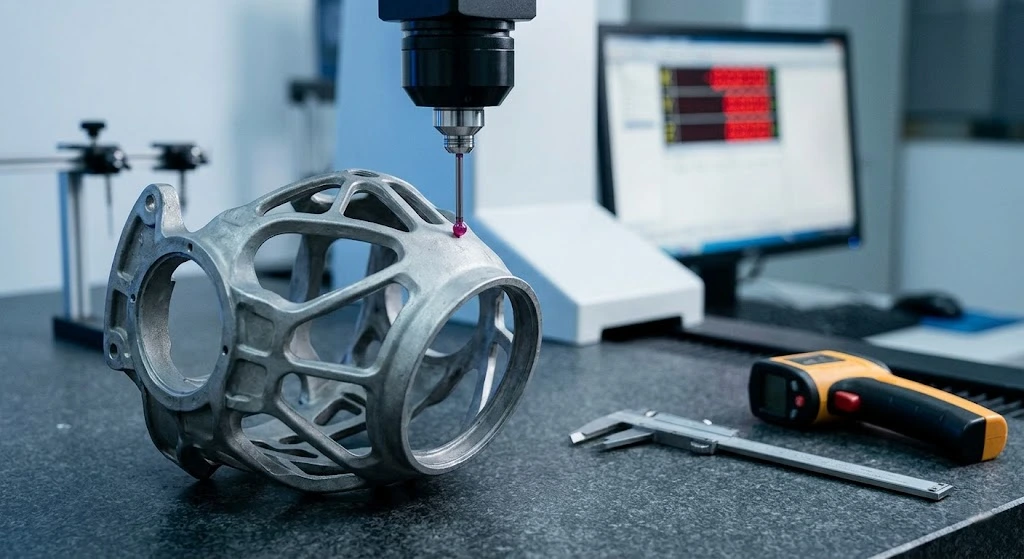
Magnesium builds up heat instantly during the cut. If you run a part dry, the magnesium thermal expansion will be so severe that you will never hold a tight +/- 0.005mm tolerance. The part will literally warp the moment the machinist unclamps it from the vise. If you need true aerospace or medical-grade precision, you absolutely need the thermal stability of a flooded mineral oil cut.
How to Actually Get Prototypes Cut Today
The only logical way to get a handful of physical prototypes cut without paying an exorbitant markup is to bypass general job shops entirely. You must partner with a facility where the “Setup Tax” is zero.
You need a supplier that operates dedicated, permanent magnesium milling cells. This is exactly why engineering teams route their rapid prototyping RFQs straight to the production floor at BOONA Prototypes.
Because we specialize in this specific material, our machines are already plumbed with mineral oil 24/7. We already have the Class D dry powder fire extinguishers mounted to the frames. We already have the razor-sharp PCD tooling sitting in the carousels.
If you look at our dedicated infrastructure for custom magnesium CNC machining, you realize why we can offer honest, true No MOQ pricing. We don’t have to tear down a machine for an entire shift just to run your CAD file. We load the raw billet, set the work offsets, and start making chips safely and precisely.
Stop Waiting on Rejections.
Don’t let general machine shops penalize you for your small production runs, and don’t compromise your design by switching back to aluminum. Send your CAD files to a dedicated facility, eliminate the setup tax, and let’s cut metal.
FAQs
Why do most machine shops demand a 500-piece MOQ just to cut my magnesium prototypes?
A: It’s all about the hidden “Setup Tax.” Standard job shops run water-soluble coolant for aluminum. To safely handle low volume magnesium CNC machining, they must shut down a machine, drain 50 gallons of water, and refill the sump with specialized mineral oil coolant to prevent hydrogen gas explosions. They force a massive MOQ on you to pay for their 4 hours of machine downtime. We run dedicated magnesium cells 24/7, which means our setup penalty is zero. Send us your 5-piece CAD file, and get a true No-MOQ quote.
Are your low-volume magnesium parts 3D printed or true CNC machined from billet?
We strictly machine from solid extruded billet or block. Some shops will try to sell you 3D printed (DMLS) magnesium to save on tooling costs for small runs. Walk away. Printed magnesium has a porous grain structure that cannot replicate the true vibration-damping, EMI shielding, or tensile strength of actual AZ31B or AZ91D. If you need to validate a structural aerospace design, you need real custom CNC machining. Upload your 3D model, and let’s cut actual metal for your testing.
How fast can you deliver a small handful of magnesium prototypes?
Generalist shops will quote you 6 to 8 weeks. They aren’t spending two months cutting your parts; they are pushing your small order to the absolute back of the line, waiting for a gap in their aluminum schedule to finally do the coolant changeover. We don’t play scheduling games. Because our infrastructure is permanently set up for combustible metals, your magnesium prototypes go straight to the spindle. If your R&D is delayed by other shops, send us your files and let’s get you back on track.
Do you provide surface treatment for small prototype runs, or will my parts arrive raw?
Raw machined magnesium begins pitting and oxidizing the minute it is exposed to shop humidity. Many suppliers will just ship you bare metal for a small 10-piece run because they don’t want the hassle of outsourcing the finishing. We process everything in-house. The moment your rapid prototyping parts come off our 5-axis mills, they go directly into our Chromate conversion or Micro-Arc Oxidation (MAO) tanks. Tell us your exact surface finish requirements, and get parts that are fully protected and ready for immediate assembly.