
When designing lightweight components for mechatronics, automotive, or aerospace applications, magnesium is often the undisputed champion. Its high strength-to-weight ratio and exceptional machinability make it a highly desirable material for advanced engineering. However, since BOONA Prototypes was established in 2004, our engineering team has seen a recurring challenge: magnesium’s intense electrochemical reactivity.
Machining the perfect AZ31B or ZK60A block is only half the battle. Without the right anti-corrosion surface finish, a precision-engineered part can rapidly succumb to environmental degradation or galvanic corrosion. In this guide, we will break down the precise parameters, data, and manufacturing options you need to evaluate when selecting surface treatments for your custom magnesium prototypes.
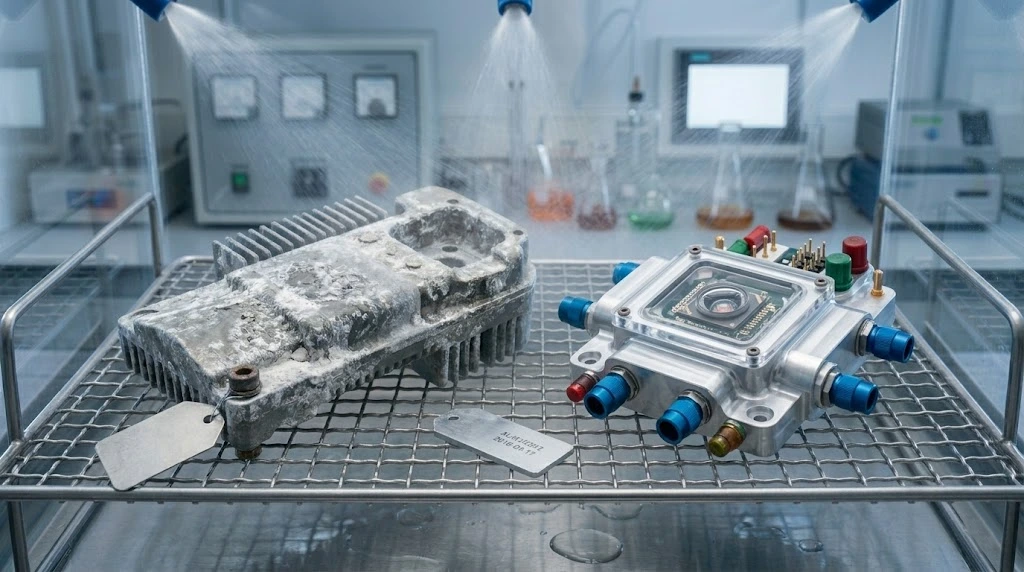
Why Magnesium Corrosion Happens (And How to Stop It)
Magnesium oxidizes easily when exposed to moisture, creating a porous layer that, unlike aluminum’s protective oxide skin, fails to prevent further corrosion. To combat this, precision manufacturing relies on a tiered system of surface treatments. Whether you are scaling up for high-volume orders or utilizing a fast-turnaround CNC Machining Service, selecting the appropriate barrier is critical for long-term functionality.
Key Surface Finishing Data & Parameters Comparison
To make an informed engineering decision, you must balance coating thickness, salt spray resistance, and global export compliance. Below is a baseline parameter comparison of the most common finishes we utilize for magnesium parts.
| Surface Finish Type | Avg. Coating Thickness (µm) | Salt Spray Resistance (ASTM B117) | RoHS / REACH Compliant? | Best Application |
| Traditional Chromate | 1 – 3 µm | 24 – 96 Hours | No (Contains Hexavalent Chromium) | Obsolete/Legacy Mil-Spec only |
| Non-Chromate Conversion | 1 – 5 µm | 48 – 120 Hours | Yes | Pre-treatment for paint/powder coating |
| Standard Anodizing | 5 – 25 µm | 100 – 300 Hours | Yes | General wear and corrosion protection |
| Micro-Arc Oxidation (MAO/PEO) | 10 – 50 µm | 500+ Hours | Yes | High-performance mechatronic & aerospace components |
| Electroless Nickel Plating | 10 – 30 µm | 200 – 400 Hours | Yes | High precision tolerances, conductive requirements |
Chemical Conversion Coatings: The Essential Pre-Treatment
For decades, chromate conversion was the standard. However, because our clients ship products to diverse international markets—requiring strict adherence to global environmental regulations across North America, Europe, and emerging markets in Spanish, Russian, and Portuguese-speaking regions—compliance is non-negotiable.
Today, we utilize non-chromate phosphate or fluorozirconate conversion coatings. While these layers are exceptionally thin (typically under 5 µm) and offer only basic standalone corrosion resistance, they excel as a bonding primer. They chemically alter the magnesium surface, ensuring that subsequent paints or organic sealants adhere flawlessly without blistering or peeling.
Advanced Electrochemical Treatments: Anodizing and PEO
When mechatronics engineering demands extreme durability, we step up to electrochemical solutions.
-
Standard Magnesium Anodizing: This process forces a thicker, more stable oxide layer onto the part. It handles daily wear-and-tear beautifully and is a staple in rapid prototyping for consumer electronics housings and optical equipment.
-
Plasma Electrolytic Oxidation (PEO) / Micro-Arc Oxidation (MAO): This is the gold standard for anti-corrosion surface finishes for custom magnesium parts. By utilizing high voltage to create micro-discharges on the surface, PEO converts the magnesium substrate into a dense, hard ceramic oxide layer. With a surface hardness reaching upwards of 400-600 HV and salt spray resistance exceeding 500 hours, it is the ultimate protective shield.
If you are developing complex geometries where standard finishes might pool or chip, exploring our comprehensive Surface Finishing Options can help you identify the exact electrochemical process suited for your specific design tolerances.
Organic Topcoats: Powder Coating and E-Coating
For external components, aesthetics and protection must go hand-in-hand. A duplex system—applying an organic topcoat over a conversion coating or anodized layer—provides maximum longevity.
-
Electrophoretic Deposition (E-Coating): Because magnesium parts often feature intricate internal cavities designed to reduce weight, standard spray painting is inadequate. E-coating immerses the part in an electrically charged bath, ensuring an incredibly uniform 15-20 µm layer of epoxy or acrylic resin reaches every hidden recess.
-
Powder Coating: For high-impact resistance, powder coating is baked onto the surface, yielding a tough, scratch-resistant finish available in custom RAL colors.
These duplex finishing strategies are highly recommended when transitioning from prototype verification to Low-Volume Manufacturing, ensuring your initial batch perfectly matches the durability and appearance of mass-produced units.
Sourcing Precision Magnesium Parts
Machining and finishing magnesium requires rigorous safety protocols to prevent fire hazards and highly controlled chemical baths to ensure flawless adhesion. At BOONA, our Shenzhen-based precision manufacturing center understands how to hold tight tolerances (up to ± 0.01 mm) on complex CNC parts, even while factoring in the micro-dimensional changes that occur during advanced surface treatments.
Are you ready to optimize the longevity of your next magnesium design? Discover how our customized One-Stop Service Solution can take your project from a raw CAD file to a fully finished, corrosion-resistant, and market-ready product.
FAQs
Why can’t I just clear-anodize magnesium like I do with aluminum?
Aluminum naturally forms a hard, protective oxide layer, but magnesium’s natural oxide is porous and flaky. If you treat a custom magnesium part like standard aluminum, it will start pitting the moment it faces high humidity. To get real protection, you need specialized processes like Micro-Arc Oxidation (PEO) or a dedicated chemical conversion coating followed by a heavy-duty topcoat.
Does Micro-Arc Oxidation (PEO/MAO) affect the final dimensions of my CNC machined parts?
Absolutely. This is a classic trap for designers. PEO builds a dense ceramic layer both into the magnesium substrate and outward. If you specify a 20 µm coating, roughly 10 µm will be dimensional growth. When we run tight-tolerance mechatronic components on the mill, we have to machine the bare part slightly undersized to compensate for that exact growth during finishing.
Are these surface finishes RoHS and REACH compliant for export?
If you are using traditional chromate conversion (that old-school yellowish-gold finish), it is a hard “no” due to hexavalent chromium. However, modern non-chromate conversion coatings, standard anodizing, and PEO treatments are fully compliant for the EU and North American markets. Just make sure your 2D drawings specifically call out “RoHS Compliant” so the manufacturing floor knows to keep legacy mil-spec chemistry away from your batch.
Can I powder coat directly onto bare machined magnesium?
I highly advise against it. Even if the shop degreases and bead-blasts the part perfectly, microscopic moisture can still get trapped under the powder. Over time, the magnesium will react, causing the powder coat to bubble and peel right off. You should always apply a conversion coating or E-coating as a primer base before baking on any powder coat.
Is electroless nickel plating a good option for magnesium prototypes?
It is fantastic for adding electrical conductivity and extreme wear resistance, but it is notoriously tricky to apply. The shop has to perform a flawless “zincating” pre-treatment step to prevent the magnesium from reacting with the nickel bath. When done correctly, it is perfect for high-end aerospace prototypes, but it does require strict quality control and is generally more expensive than standard anodizing.