
When a biomedical engineer sends me a CAD file for a spinal implant or a custom bone plate, there is zero room for error. Having been in the custom parts industry since 2001, I’ve reviewed thousands of medical drawings. The material call-out is almost always Ti-6Al-4V, or its high-purity cousin, Ti-6Al-4V ELI (Grade 23).
Engineers specify it because it’s biocompatible and incredibly strong. But down on the shop floor? It’s a notorious nightmare to hold tight tolerances. If you are sourcing precision medical machining services, you already know that hitting a ±0.01mm (roughly 0.0004 inches) tolerance on a thin-walled titanium housing is exceptionally difficult.
The biggest enemy inside the machine is titanium spring-back in machining. Here is the unfiltered reality of why standard machine shops scrap these parts, and the exact data and parameters we use at our Shenzhen facility to guarantee dimensional accuracy.
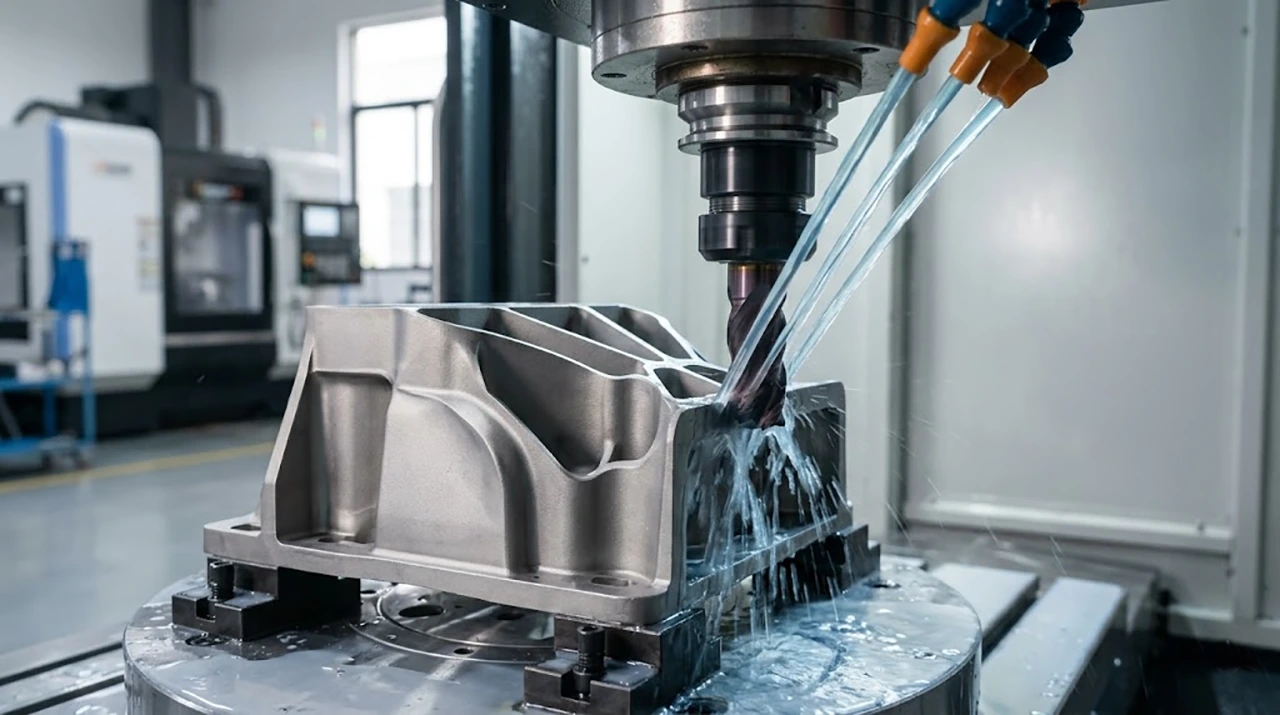
The Physics of Titanium Spring-Back
You cannot treat medical-grade titanium like 316L stainless steel. It physically fights the cutting tool in two very specific ways:
-
Low Modulus of Elasticity: Ti-6Al-4V has a modulus of elasticity of roughly 114 GPa. In machinist terms, the material is “springy.” When a solid carbide endmill engages a thin wall on a custom titanium medical implant, the material actually flexes and pushes away from the cutter instead of shearing cleanly.
-
The Push-Off Effect: As the tool moves past the cut, that flexed material snaps back into its original place. If your programmer calculated the toolpath to leave exactly 5.00mm of wall thickness, the spring-back might leave you with 5.03mm. You just failed your ±0.01mm tolerance requirement and scrapped the implant.
The Shop-Floor Playbook: Parameters for Zero Spring-Back
To provide reliable medical grade titanium CNC machining, we have to completely control tool pressure and thermal expansion. If the part gets too hot, it expands; you cut it, it cools down, and it shrinks right out of tolerance.
At BOONA, we enforce strict, data-driven parameters on our mill-turn centers. Here is our baseline cheat sheet for fighting spring-back on critical medical components:
| Machining Parameter | The “Standard Shop” Mistake | Our Ti-6Al-4V ELI Machining Parameters | Why It Kills Spring-Back |
| Tool Path Strategy | Conventional Milling | Strictly Climb Milling | Conventional milling rubs and pushes the part, causing massive deflection. Climb milling shears at max thickness, minimizing push-off. |
| Surface Footage (SFM) | 250+ SFM | 100 – 130 SFM | Low speeds prevent the tool core from overheating, which stops the part from thermally expanding during the cycle. |
| Radial Engagement | 30% – 50% | 8% – 12% (Dynamic) | Low radial engagement means incredibly low cutting forces against delicate, thin-walled medical features. |
| Coolant Pressure | 30 PSI Flood | 1,000+ PSI Through-Spindle | High pressure shatters the vapor barrier to cool the cut instantly, maintaining dimensional stability. |
The “Zero-Stock” Trap
One of the most common questions I get from younger machinists is: “If the part sprang back 0.02mm, why not just run a spring pass (a cut with zero stock removal) to clean it up?”
If you try a spring pass on Grade 5 or Grade 23 titanium, you will destroy the part. Because titanium is highly reactive, a cutter that rubs against the surface without taking a deep enough bite will instantly work-harden the material. The surface becomes glass-hard, your tool burns up, and the part pushes away even worse. You must leave a precise amount of stock (usually around 0.003″ to 0.005″) for the final finishing pass so the tool physically shears the metal.
Advanced Workholding & Thermal Stress Relief
Holding a ±0.01mm tolerance isn’t just about the cutting—it’s about the clamping. You cannot crush a delicate orthopedic implant in a standard vise.
This is where specialized setups make all the difference. By utilizing our dedicated Titanium CNC Machining capabilities paired with 5 Axis CNC Machining centers, we can machine complex organic geometries in a single setup. This drastically reduces the number of times a part is handled and re-clamped. We also design custom soft jaws that contour perfectly to the implant, distributing the holding force evenly so the part doesn’t warp when unclamped.
Furthermore, raw titanium bar stock contains massive internal forging stresses. For the most critical geometries, we rough the part out, send it through a vacuum thermal stress-relief cycle to relax the metal, and then perform the final precision machining.
Verifying the ±0.01mm Guarantee
In the medical device industry, a promise means nothing without documentation. You cannot just use a pair of hand calipers and call it a day. Every titanium job on our floor must pass through rigorous Coordinate Measuring Machine (CMM) routines. You can review our strict Quality Control procedures to see how we provide dimensional inspection reports and material certifications (COA) for full FDA/CE traceability.
If you are dealing with scrapped parts, blown tolerances, or suppliers who simply cannot handle the physics of Ti-6Al-4V machining services, it’s time to rethink your manufacturing strategy. Send your 3D CAD models and critical tolerance drawings to the engineering team at BOONA today, and we will provide a hard, reliable quote based on decades of shop-floor reality.
FAQs
If you know the titanium is going to spring back 0.02mm, why not just program the CNC tool to cut 0.02mm deeper to compensate?
Because titanium spring-back isn’t perfectly linear or predictable. The amount the material pushes off the tool depends on how worn the endmill is, the coolant temperature, and the specific internal stress of that exact billet. If you just “guess” and offset the tool by 0.02mm, your first part might measure perfectly, but part #5 will be undersized and scrapped. We achieve ±0.01mm by eliminating the push-off completely—using dynamic toolpaths and high-pressure coolant to stop the deflection—not by guessing the spring-back amount.
How thin can you actually machine a Ti-6Al-4V wall before spring-back makes holding a ±0.01mm tolerance impossible?
In my experience on the floor, once you drop below a 0.5mm (0.020″) wall thickness on Grade 5 or Grade 23, the physics get incredibly hostile. At that thickness, the titanium loses its structural rigidity and starts acting like foil. To hold a ±0.01mm tolerance on walls that thin, we can’t just machine it normally. We have to design sacrificial support ribs into the CAD, machine the critical dimensions while the wall is supported, and then remove those ribs in a final, zero-stress operation.
You mentioned thermal stress relief. Doesn’t putting the titanium implant in a 1000°F furnace mess up the ±0.01mm tolerance?
Yes, it does. That is exactly why we never stress-relieve a finished part. When you relax the internal forging stresses of titanium in a vacuum furnace, the metal physically warps and moves as it settles. If the part is already at its final dimension, it’s ruined. Our process is strict: we rough the part out, leave about 0.15mm of extra stock material, send it to the furnace to warp and relax, and then bring it back to the 5-axis mill to dial in that final ±0.01mm finish on a “dead” (stress-free) piece of metal.
We measured the titanium prototypes with our micrometers and they failed the ±0.01mm tolerance, but your inspection report says they passed. Why?
Temperature. While titanium has a lower coefficient of thermal expansion than aluminum, when you are chasing a ±0.01mm (10 micron) window, temperature is everything. Our CMM (Coordinate Measuring Machine) inspections are performed in a strictly climate-controlled quality lab at exactly 20°C (68°F). If your parts sat in a hot delivery truck, or if your QA inspector held the titanium implant in their warm hands for five minutes before measuring it, the material will temporarily expand out of tolerance. For medical precision, the inspection environment must match the machining environment.