
In modern medical device manufacturing, material selection often determines the ultimate success or failure of the equipment. Due to its exceptional radiation shielding capabilities and outstanding biocompatibility, high-density tungsten alloy has become the industry standard for CT scanner collimators, radiotherapy shielding components, and minimally invasive surgical robot parts. However, the extreme hardness and brittleness of tungsten materials also deter many machine shops.
At our Shenzhen-based precision machining facility, we deeply understand that when dealing with such difficult-to-machine heavy metals, the perfect coordination of equipment rigidity, tool paths, and temperature control is the key to success. This article will use real shop-floor experience to explain in detail how we consistently maintain an extremely high yield rate in the field of tight tolerance tungsten machining ±0.01mm.
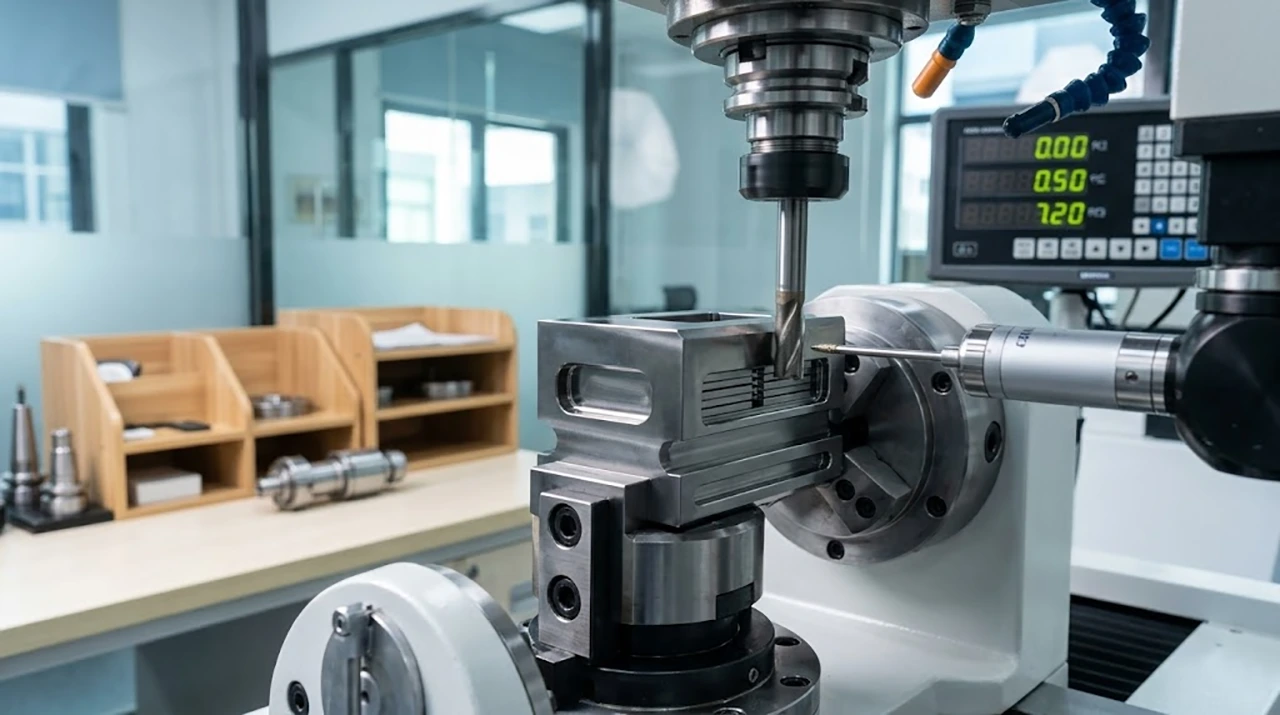
The Core Physical Challenges of Tungsten Machining
To achieve flawless custom tungsten parts for medical devices, engineers must first overcome the following physical and mechanical hurdles:
-
Extreme Hardness and Rapid Tool Wear: Pure tungsten and high-density tungsten alloys easily cause standard carbide tools to chip during the cutting process.
-
Difficulty in Cutting Heat Control: Tungsten’s high melting point and thermal characteristics mean that heat rapidly concentrates at the cutting edge instead of being effectively carried away by chips, which easily causes micro-cracks on the material surface.
-
Risk of Brittle Flaking: When performing complex precision tungsten CNC milling, if the feed rate is set improperly or the tool vibrates slightly, the edges of the workpiece are highly susceptible to irreversible chipping.
Core Machining Parameters to Achieve ±0.01mm Precision
To provide highly valuable industry insights, we are publishing some of the core machining parameters verified through dozens of practical shop-floor tests below. These real-world data points serve as our benchmark standards when providing high-end CNC machining services to medical clients worldwide:
| Core Control Parameter | Recommended Range for Precision Tungsten Machining | Physical Principle & Process Objective |
| Spindle Speed | 8,000 – 12,000 RPM | Combined with Minimum Quantity Lubrication (MQL) under high pressure to avoid excessive heat accumulation in the cutting zone, which triggers surface micro-cracks. |
| Depth of Cut | 0.03mm – 0.10mm | An extremely shallow depth of cut is the key to preventing surface hardening and internal stress deformation of medical parts. |
| Feed Rate | 200 – 400 mm/min | Maintaining a constant chip load prevents the tool from “rubbing” rather than effectively cutting against the hard metal surface. |
| Tool Coating & Material | Aluminum Titanium Nitride (AlTiN) Coating | Significantly enhances the tool’s red hardness and thermal shock resistance, drastically extending tool life when cutting heavy metals. |
Medical-Grade Compliance and Rigorous Quality Assurance
When manufacturing isotope containers or accessories for high-precision medical sensors, even a dimensional deviation of a few microns can lead to severe medical accidents. That is why when we perform high-density tungsten alloy machining, we do not merely rely on advanced 5-axis CNC equipment; precise metrology after machining is equally critical.
Relying on our comprehensive and strict quality control system, we utilize Zeiss high-precision Coordinate Measuring Machines (CMM) for the multi-dimensional inspection of every medical part. From material heat number traceability (Material COA) to the final Dimensional Inspection Report, we ensure that every component you receive will seamlessly assist you in passing rigorous FDA or ISO 13485 certifications.
Conclusion & Next Steps
Finding a manufacturing partner who truly understands medical-grade, difficult-to-machine materials is not easy; it requires the perfect combination of time, experience, and technological accumulation. Whether it is early-stage rapid prototyping verification testing or later-stage large-scale batch production, our senior engineering team can provide you with free Design for Manufacturability (DFM) analysis.
Ready to accelerate your medical device R&D schedule? Please feel free to attach your 2D/3D drawings and contact us to get a free quote. Our manufacturing experts will provide you with a detailed cost assessment and machining plan within 2 hours.
FAQs
Why is ±0.01mm precision so difficult to achieve when machining tungsten?
Tungsten is notoriously brittle and possesses an exceptionally high melting point. During CNC machining, heat does not dissipate easily through the chips, causing heat to build up at the cutting edge. If not managed with precise spindle speeds, specialized coolant systems, and highly rigid 5-axis machines, this heat causes tool deflection, rapid tool wear, and surface micro-cracks on the part—making it incredibly challenging to hold a ±0.01mm tolerance.
Do you provide material traceability and inspection reports for medical compliance?
Absolutely. We understand that medical device manufacturing requires strict adherence to regulatory standards like FDA requirements and ISO 13485. Every shipment can be accompanied by a comprehensive document package, including a Certificate of Analysis (COA) for material traceability and a Dimensional Inspection Report generated by our high-precision Coordinate Measuring Machines (CMM).
Can you prevent micro-cracks and chipping on the edges of tungsten parts?
Yes. Preventing edge chipping requires a combination of optimized tool paths, extremely shallow depths of cut (0.03mm – 0.10mm), and specific tool geometries. Our engineering team utilizes advanced AlTiN-coated tooling and carefully controlled feed rates to ensure the material is cut cleanly rather than fractured, resulting in smooth, crack-free surfaces.
Do you require a Minimum Order Quantity (MOQ) for custom tungsten prototypes?
We offer highly flexible manufacturing solutions to support your R&D cycles. There is no strict MOQ for prototype runs. Whether you need a single, highly complex tungsten collimator for design verification or a low-volume batch for clinical testing, our facility is equipped to handle your request efficiently before scaling up to high-volume production.
What file formats should I submit to get a quote for a custom tungsten part?
To ensure the most accurate quoting and Design for Manufacturability (DFM) analysis, we recommend submitting 3D CAD models in STEP (.stp), IGES (.igs), or Parasolid (.x_t) formats. Please also include a 2D drawing in PDF format that clearly calls out your critical ±0.01mm tolerances, surface finish requirements, and specific tungsten alloy grades.
What is the typical lead time for precision-machined tungsten components?
Lead times depend heavily on the geometric complexity of the part and the specific grade of tungsten required. However, because our Shenzhen facility operates with advanced multi-axis CNC centers and an experienced engineering team, we can significantly accelerate the manufacturing process. Once you submit your drawings, we provide a precise lead time alongside your quote within 2 hours.