
I’ll be completely honest with you: if you walk onto a shop floor and tell the machinists they are running pure tungsten today, you’ll probably hear a collective groan.
When I first started in the custom parts industry, tungsten was the one material that kept me awake at night. It is heavy, it is brittle, and it eats standard cutting tools for breakfast. When we officially set up BOONA Prototypes here in Shenzhen, we ruined a lot of expensive carbide figuring out how to machine this stuff properly.
Today, we handle high-volume precision tungsten CNC machining services for medical and aerospace clients every week. But achieving those crazy ±0.005mm tolerances without scrapping half the batch isn’t magic. It comes down to ditching traditional tooling entirely and investing heavily in diamond.
If you are a Purchasing Manager or a Lead Engineer tired of receiving parts with micro-cracks or dealing with suppliers who constantly miss deadlines because of “tooling issues,” here is a look at what actually happens on the machine.
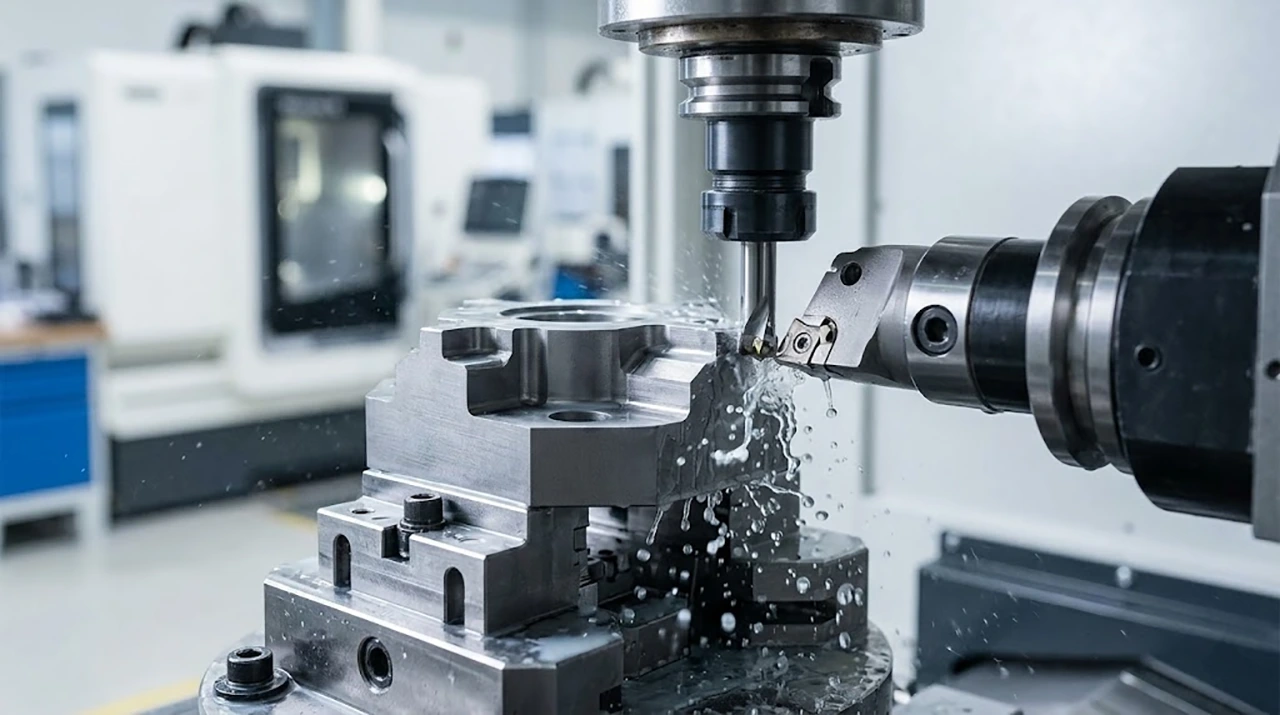
Why Tungsten Breaks Standard Tools (And Your Budget)
Most engineers know tungsten has an insane melting point (3,422°C) and is excellent for radiation shielding or counterweights. But on the CNC bed, its properties are a nightmare.
Look at this quick comparison. This is the math that explains why your quotes for custom tungsten parts manufacturing are always higher than what you see for other metals. I’ve included titanium here—a material we frequently handle in our titanium CNC machining projects—just to give you a baseline reference:
Material Property Reality Check: Why Machinability Matters
| Material | Density (g/cm³) | Hardness (HRC) | Ultimate Tensile Strength | Machinability Rating |
| Pure Tungsten | 19.25 | 40 – 45 | 980 MPa | ~10% |
| Tungsten Heavy Alloy (WHA) | 17.0 – 18.5 | 28 – 36 | 700 – 1000 MPa | ~20% |
| Titanium Ti-6Al-4V (For reference) | 4.43 | 36 | 950 MPa | ~22% |
With a machinability rating of around 10%, a standard carbide end-mill doesn’t cut tungsten; it essentially rubs against it until the tool overheats, dulls, and snaps. Worse, dull tools create massive stress concentrations. That is the exact moment you get edge chipping. Preventing micro-cracks in tungsten machining means you can never allow the tool to get dull. Ever.
The Floor Standard: Polycrystalline Diamond (PCD)
We stopped trying to make carbide work a long time ago. Now, we strictly use Polycrystalline Diamond (PCD) and Chemical Vapor Deposition (CVD) diamond-coated tools.
Yes, diamond tools cost significantly more upfront. But when utilizing diamond tooling for tungsten alloys, the cutting edge stays razor-sharp. It shears the material cleanly instead of fracturing it, and it dissipates heat incredibly well.
I often get asked by procurement agents what parameters we use to get a near-polished finish right off the machine. While every geometry is different, here is the baseline we start with in our CNC machining services division:
Our Baseline CNC Parameters for Tungsten
| Operation | Specific Tooling | Spindle Speed (RPM) | Feed Rate (mm/min) | Depth of Cut (mm) | Coolant Strategy |
| Rough Milling | Coated Carbide (Heavy duty) | 800 – 1,200 | 150 – 200 | 0.50 – 1.00 | High-Pressure Flood |
| Fine Finishing | PCD (Polycrystalline) | 4,000 – 6,000 | 50 – 100 | 0.05 – 0.15 | Through-Spindle |
| Micro-Drilling | CVD Diamond Coated | 8,000 – 10,000 | 20 – 40 | 0.10 (Pecking) | High-Pressure Mist |
A quick note from the floor: Don’t let anyone tell you they can dry-machine precision tungsten parts. High-pressure through-spindle coolant is non-negotiable to evacuate those abrasive chips before they ruin the surface finish.
You Touch It Twice, You Lose the Tolerance
The final piece of the puzzle is the machine itself. Tungsten is unforgiving. If your machine spindle has even a fraction of a micron of runout, or if the bed vibrates, your diamond tool will shatter.
Furthermore, if you have to take a complex medical collimator out of the vise to re-fixture it for another angle, you are begging for alignment errors. This is why we push almost all of our complex refractory metal jobs to our 5-axis centers. By utilizing 5-axis CNC machining for refractory metals, we machine all faces in a single setup. The tool stays engaged, the part stays locked in, and the tolerances stay tight. You can see the equipment we run for this on our dedicated 5-Axis CNC machining page.
Bottom Line
Machining tungsten isn’t just about having the right machines; it’s about respecting the material and investing in the diamond tooling required to do the job right the first time.
Whether you are scaling up for high-volume production or just need reliable rapid prototyping runs to test a new assembly, you need a partner who understands the physics of the cut.
If you have a blueprint sitting on your desk that other shops are no-quoting, or if you are tired of dealing with inconsistent batches, let us take a look. Contact our engineering team today. Send me your STEP files and PDFs, and I’ll give you a realistic, no-nonsense DFM review and quote.
FAQs
What tolerances can BOONA achieve when CNC machining tungsten?
On critical dimensions, we routinely hold tolerances down to ±0.005mm, though this is heavily dependent on the specific geometry of your part. Because we utilize rigid 5-axis CNC machining centers combined with diamond tooling, we virtually eliminate the tool deflection and thermal expansion that typically destroy tolerances when cutting refractory metals.
How do you prevent micro-cracks and edge chipping on pure tungsten components?
It all comes down to tool sharpness and aggressive heat management. Standard carbide tools will dull quickly, causing them to rub and fracture the brittle tungsten. We strictly use Polycrystalline Diamond (PCD) tools that shear the metal cleanly. We pair this with high-pressure, through-spindle coolant to immediately evacuate the highly abrasive chips. Finally, every batch goes through our stringent quality control process to verify there are absolutely no micro-fractures before shipping.
Should I specify Pure Tungsten or a Tungsten Heavy Alloy (WHA) for my blueprint?
If your application demands the absolute maximum melting point (such as high-temperature vacuum environments), pure tungsten is non-negotiable. However, for most aerospace counterweights, vibration dampeners, or medical radiation shielding, we highly recommend Tungsten Heavy Alloys (WHA) like W-Ni-Fe or W-Ni-Cu. WHA is significantly less brittle, much more machinable, and ultimately more cost-effective. You can review our standard material capabilities online, or just ask our engineering team for a recommendation when you submit your drawing.
Do you use Wire EDM for tungsten, or strictly CNC milling and turning?
We utilize both processes depending on the part features. While our CNC machining services handle the bulk of our tungsten production—especially for complex 3D profiles and fast material removal—Wire EDM remains the superior choice for cutting exceptionally deep, narrow slots or sharp internal corners where even a diamond-coated micro-endmill cannot reach.
Do you accept low-volume prototype orders for tungsten, or do you only run high-volume production?
We absolutely accept low-volume orders. We know that finalizing a complex aerospace or medical assembly requires physical testing before committing to a massive production run. We offer dedicated rapid prototyping services with no Minimum Order Quantity (MOQ). Whether you need 10,000 pieces or just a single, highly precise prototype, we treat the setup with the exact same level of engineering rigor.