
A robot can pass a software demo and still fail on the bench.
That happens more often than people expect. The code looks fine. The control loop behaves well in simulation. The sensors are calibrated. Then the hardware starts moving, and a small mechanical problem shows up — a loose bearing bore, a camera mount that vibrates, a motor plate that shifts under load, or a lightweight arm link that flexes just enough to hurt repeatability.
Small errors become big problems.
That is why CNC machining for robotics matters. Robots are smart systems, yes, but they are still machines. They need parts that locate motors accurately, support bearings, hold sensors in position, manage heat, protect cables, reduce weight, and survive repeated assembly without drifting out of tolerance.
For robotics engineers, OEM buyers, automation companies, and prototype teams, CNC machining gives a practical path to custom precision robot parts made from real metals and engineering plastics — without committing to mold tooling before the design is ready.
This guide covers how CNC machining fits into robot development, which parts are commonly machined, what materials make sense, where tolerances actually matter, and how to prepare an RFQ that gets useful feedback instead of vague quoting delays.
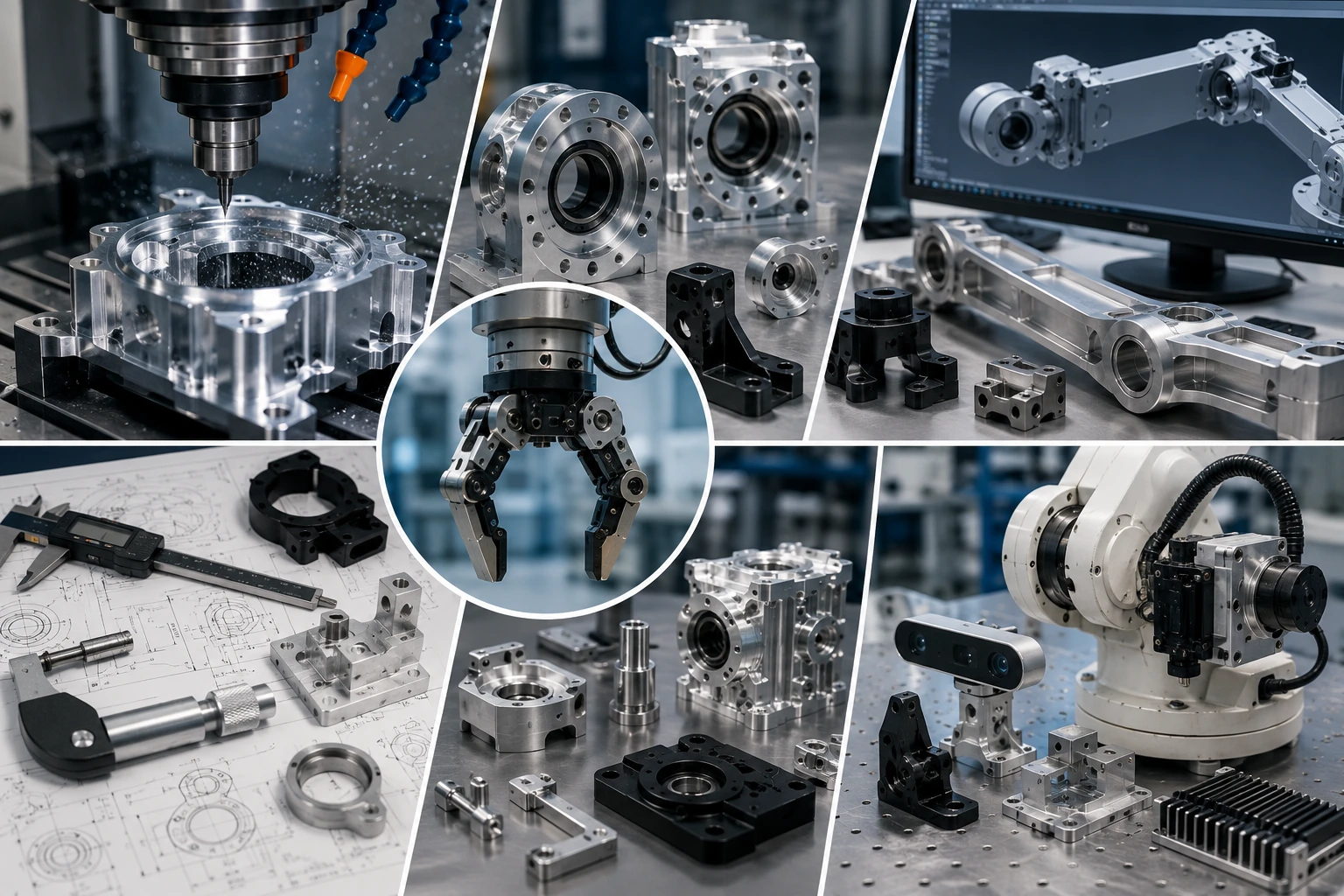
Why CNC Machining for Robotics Matters
Robotics is growing fast, but the mechanical rules have not changed. A robot still needs stiffness, alignment, repeatability, and clean assembly.
The International Federation of Robotics reported that 4,281,585 industrial robots were operating in factories worldwide in 2023, a 10% increase from the previous year. IFR also reported that professional service robot sales grew 30% in 2023, reaching more than 205,000 units. Those numbers show how quickly robots are moving beyond fixed factory cells into warehouses, inspection sites, hospitals, labs, service environments, and autonomous platforms. Source: International Federation of Robotics.
More robots means more mechanical responsibility. CNC machined robot parts support actuators, gearboxes, sensors, batteries, cameras, chassis frames, grippers, and thermal systems. When these parts are inaccurate, the robot may still assemble, but it won’t behave cleanly. Vibration appears. Calibration shifts. Fasteners loosen. Bearings wear early.
In my experience working with prototype and low-volume manufacturing teams, the first serious robot build usually teaches the same lesson: “close enough” is rarely close enough for moving hardware.
A 3D printed bracket may prove the layout. A CNC machined bracket proves the function.
For prototype and low-volume robot hardware, Boona CNC machining service supports custom parts without tooling investment.
Common Custom Precision Robot Parts Made by CNC Machining
Robot hardware looks simple from a distance. Up close, it is full of alignment problems.
Motion components usually need the highest control. Actuator housings, motor mounts, gearbox housings, harmonic reducer housings, bearing seats, shaft couplers, pulley housings, belt tensioner parts, joint brackets, and robotic arm links all affect motion quality. A small offset at one interface can create noise, vibration, backlash, or uneven wear after cycling.
Structural parts carry a different burden. Chassis plates, frame brackets, base plates, mounting blocks, support ribs, enclosure frames, and lightweight arm links need stiffness without unnecessary mass. Too weak, and the robot flexes. Too heavy, and the actuator system pays for it.
Sensor hardware is easy to underestimate. Robot sensor mounts, LiDAR brackets, depth sensor housings, IMU blocks, and optical alignment plates must stay stable while the robot moves. If a sensor shifts, the data changes. Once the data changes, software starts solving the wrong problem.
End-effector parts add another layer. Gripper fingers, EOAT brackets, vacuum plates, tool changer adapters, robot hand components, and fixture plates need controlled contact geometry. A gripper that misses by a fraction of a millimeter may still look correct, but it may not pick reliably.
| Robot Part | Why CNC Machining Is Used | Common Material |
|---|---|---|
| Actuator housing | Bearing and motor alignment | Aluminum 6061 / 7075 |
| Robotic arm link | Strength with weight reduction | Aluminum 6061 / 7075 |
| Sensor mount | Stable positioning | Aluminum / stainless steel |
| Gripper finger | Accurate contact geometry | Aluminum / POM / steel |
| Heat sink | Thermal performance | Aluminum / copper |
| Chassis plate | Flatness and rigidity | Aluminum |
Thermal parts also deserve attention. Aluminum heat sinks, copper heat spreaders, electronics covers, EMI shielding parts, connector brackets, and cable routing blocks often decide whether the robot survives long test cycles.
Best Materials for CNC Machined Robot Parts
Material selection should start with the part’s job. Not habit. Not guesswork.
For robotics CNC machining, aluminum 6061 is often the safest first choice. It machines cleanly, keeps weight low, accepts anodizing well, and works for brackets, plates, housings, sensor mounts, prototypes, and many low-volume robot parts. If a buyer does not know where to start, 6061 usually deserves the first review.
Aluminum 7075 comes in when strength-to-weight matters more. Robotic arm links, compact joint brackets, and high-load structures may benefit from it. 7075-T6 aluminum is commonly listed around 572 MPa ultimate tensile strength with a density around 2.81 g/cm³, which explains why engineers consider it for lightweight, high-strength hardware. It costs more, though, so it should solve a real problem.
Stainless steel fits shafts, pins, wear parts, brackets exposed to corrosion, and components that see repeated contact. Strong? Yes. Lightweight? Not really.
Engineering plastics belong in the conversation too. POM/Delrin works well for low-friction guides, sliding blocks, and gripper parts. PEEK makes sense for heat, wear, insulation, or chemical exposure. Nylon can reduce weight in non-critical wear parts. Copper supports heat spreading and electrical conductivity, although gummy copper needs careful machining and deburring.
For early material planning, Boona material list helps buyers compare common CNC metals and plastics.
Tolerance Planning for Precision Robot Components
Robots need precision. They do not need every feature machined like a bearing seat.
That distinction matters.
For precision robot components, tight tolerance should go where function depends on it: bearing bores, shaft holes, dowel pin holes, motor mounting patterns, gearbox interfaces, sensor alignment surfaces, and robotic joint faces. These features control rotation, repeatability, calibration, vibration, and assembly feel.
Non-critical outer profiles, cable clearance slots, cosmetic covers, lightening pockets, and simple cutouts can often use general tolerance. Making every dimension tight does not make a robot better. It makes the quote higher, the inspection slower, and the supplier more cautious.
A practical drawing might use general tolerances for most of the part, then call out ±0.02 mm or ±0.05 mm only on the features that matter. Bearing bores may need H7-style fits depending on bearing type and installation method. Dowel holes may need reaming. Sensor plates may need flatness and perpendicularity more than tight outside dimensions.
GD&T helps when used with purpose. True position, flatness, perpendicularity, parallelism, concentricity, and runout can describe robot function better than simple plus/minus dimensions. Still, too much GD&T becomes noise.
Mark what matters. Explain why.
For alignment-critical robot parts, Boona precision machining capability can support tighter dimensional control and inspection.
Surface Finishing for CNC Machined Robot Parts
Surface finish is not just about appearance in robotics.
A robot part may sit beside a camera, touch a cable harness, support a belt, contact a seal, hold a sensor, or face repeated human handling. A sharp edge can cut insulation. A reflective bracket can interfere with an optical system. A rough sliding face can increase wear. An unfinished aluminum part may corrode or stain in the wrong environment.
Anodizing is common for aluminum robot parts because it improves corrosion resistance, gives a clean technical appearance, and supports color coding during prototype builds. Black anodizing is especially useful near cameras and optical sensors because it reduces unwanted reflection. Hard anodizing can improve wear resistance, but it can also change dimensions. Around bearing bores, sliding fits, and precision interfaces, it should be reviewed before release.
Bead blasting gives aluminum a uniform matte surface before anodizing. Stainless steel may need passivation. Carbon steel can use black oxide or nickel plating. Copper heat spreaders may need a controlled surface where they contact thermal pads or electronics.
Deburring is one of those small details that buyers sometimes ignore until assembly starts. Robot assemblies include cables, belts, fasteners, seals, sensors, fingers, and moving parts. A simple edge break can prevent damage and make service safer.
Boona surface finishing FAQ can help compare anodizing, plating, polishing, deburring, and other finishing options.
Lightweight CNC Machining for Robotic Arms and Mobile Robots
Weight is expensive in robotics.
A heavier arm needs more torque. A heavier mobile platform drains batteries faster. A heavier humanoid joint may force a larger actuator, which adds still more weight. That loop gets ugly fast.
For robotic arm machined parts, engineers often use pocketing, ribs, hollow sections, thin-wall structures, and aluminum alloys to reduce mass. These design choices can work well, but each one has a manufacturing cost. Deep pockets need longer tools and slower cutting. Thin walls can chatter or deform during clamping. Small internal radii force smaller cutters. Aggressive hollowing can weaken the material around bearings, threads, dowel holes, and load paths.
Good lightweight design removes material from low-stress zones while protecting functional areas. Keep material around bearing seats. Leave enough thread engagement. Use internal radii that real tools can machine. Avoid deep narrow pockets unless the weight saving is worth the extra cycle time.
| Design Choice | Benefit | Risk |
|---|---|---|
| Pocketing | Weight reduction | Longer machining time |
| Ribs | Better stiffness | Requires tool access |
| Thin walls | Lower mass | Vibration or deformation |
| 7075 aluminum | Higher strength | Higher material cost |
| Plastic inserts | Lower weight | Lower stiffness |
| Hollow sections | Major weight savings | More complex setup |
My view is simple: some robot parts are optimized for weight too early. First make the mechanism stable. Then remove weight intelligently.
CNC Machining vs 3D Printing for Robotics
3D printing has a real place in robot development. It is fast, flexible, and useful for early shape checks. Teams can print sensor covers, cable routing mockups, ergonomic housings, and non-load brackets before they spend money on machined parts.
But printing has limits.
For precision machining for robotics, CNC becomes the better choice when the part needs real metal or engineering plastic, bearing fits, threaded holes, controlled stiffness, heat transfer, smooth machined surfaces, or repeatable load-bearing strength. A printed motor mount may confirm layout. A machined aluminum motor mount can survive long motion tests without creep, flex, or poor shaft alignment.
Many robotics teams use both. Print the early concept. Machine the functional prototype. Machine the pilot batch once the design starts to settle.
NIST’s robotics work focuses on performance metrics, test methods, information models, and protocols for robotic systems — a useful reminder that robot hardware needs measurable, repeatable behavior, not just a good-looking prototype. Source: NIST Robotics and Automation.
| Requirement | CNC Machining | 3D Printing |
|---|---|---|
| Real metal part | Excellent | Limited |
| Tight tolerance | Better | Process-dependent |
| Fast shape check | Good | Excellent |
| Load-bearing part | Strong choice | Depends on material/process |
| Smooth surface | Better machined finish | Needs post-processing |
| Complex organic shape | Possible but costly | Strong advantage |
Boona 3D printing service can work together with CNC machining when a robotics project needs both fast iteration and stronger functional hardware.
Prototype and Low-Volume Production for Robotics
Robot development rarely moves in a straight line.
A motor changes. A sensor moves. Cable routing needs more clearance. A bracket needs more stiffness. The gripper finger works on one part but marks another. After field testing, a cover needs a service slot nobody thought about during CAD review.
CNC machining fits this kind of development because it does not require mold tooling. A team can machine 5 parts, test them, revise the model, and then machine 20 more. That flexibility matters for robotic arms, AMRs, humanoid robots, lab automation systems, inspection robots, and early customer demo units.
For low-volume robot parts, CNC machining also helps bridge the gap between prototype and production. Quantities may start at 5 or 10 pieces, then move to 50, 100, or 200 pieces while the design is still being validated. At those volumes, tooling may not make financial sense yet.
Repeatability becomes more important as quantity increases. The tenth robot should assemble like the first one. Pilot builds should reveal real product issues, not random variation from poorly controlled parts.
Boona low-volume manufacturing support can help robotics teams move from prototype machining into early production batches.
Quality Control for CNC Machined Robot Parts
Inspection should follow risk.
A cosmetic electronics cover does not need the same inspection plan as an actuator housing. A cable clamp does not need the same report as a bearing carrier. Treating every part as critical wastes money. Treating critical parts casually creates bigger trouble later.
For robot CNC machining, inspection may include calipers, micrometers, bore gauges, pin gauges, thread gauges, height gauges, surface roughness checks, visual inspection, and CMM reports. Bearing bores, motor faces, dowel holes, gearbox interfaces, and sensor alignment features should appear clearly on the 2D drawing.
Poor inspection control can create subtle failures. A motor plate with shifted hole position may still assemble, but it may cause shaft misalignment. A sensor bracket with poor flatness may pass visual review and still drift during calibration. Burrs inside threaded holes may slow assembly or damage fasteners.
When parts move from one prototype to a pilot batch, inspection records also help control revisions. Drawings, material certificates, dimensional reports, and critical-feature checks show what changed and what stayed consistent.
For robot programs, quality control is not paperwork for its own sake. It protects assembly, motion, and repeatability.
Cost Drivers in Robotics CNC Machining
The cost of custom machined robotics components usually comes from design choices, not just material price.
Deep pockets require more tool time. Thin walls need careful workholding. Small internal radii force small cutters. Multiple setups add labor. Tight tolerances everywhere increase inspection time. Special finishes add outside processing and lead time. Low quantities spread setup cost over fewer parts.
None of this means buyers should weaken the design. Good DFM should remove cost from features that do not affect robot function.
Use 6061 aluminum where it meets the requirement. Reserve 7075 or titanium for areas that truly need higher strength. Avoid deep narrow pockets unless they save meaningful weight. Choose standard fasteners and thread sizes. Mark only critical tolerances. Separate cosmetic surfaces from functional surfaces. Batch similar parts together when possible.
| Cost Driver | Why It Adds Cost | Better Practice |
|---|---|---|
| Deep pockets | More tool time | Add radii and improve access |
| Tight tolerances everywhere | More machining and inspection | Control only critical features |
| 7075 or titanium | Higher material and tool wear | Use only where needed |
| Thin walls | Workholding difficulty | Increase wall thickness if possible |
| Multiple finishes | More outsourcing time | Choose functional finish first |
| Low quantity | Setup cost per part is high | Batch similar parts |
A cheaper quote is not always a better quote. If the supplier ignored bearing fit, finishing buildup, or inspection requirements, the cost may simply move downstream.
Mini Case Study: Robotic Arm Joint Housing
A robotics team was developing a compact inspection arm. The first joint housing was 3D printed, which was the right choice at that stage. It checked the motor position, cable path, envelope size, and assembly access quickly.
Then the team started motion testing.
The printed housing flexed around the bearing area. Motor alignment shifted slightly at higher speed. Repeatability became inconsistent. The robot still moved, but the control team could feel that the mechanical platform was not stable enough.
The next version used CNC machined aluminum 6061. The housing included a controlled bearing bore, dowel pin holes, M4 threaded holes, a flat motor mounting face, and pocketed regions for weight reduction. After machining, the part received black anodizing, with critical areas protected where needed. The buyer requested inspection reports for the bearing bore and motor interface.
That change improved assembly, reduced vibration, and gave the software team a more stable base for tuning.
💡 Pro Tip: Do not machine every feature to the same tight tolerance. Put precision into bearing bores, motor interfaces, dowel holes, and sensor alignment surfaces. Use general tolerances on clearance pockets, outer profiles, and cosmetic geometry. This keeps cost under control without weakening the robot.
RFQ Checklist for CNC Machining Robotics Parts
A STEP file shows geometry. It does not explain function.
For an accurate quote, buyers should send the 3D CAD file, 2D drawing, material requirement, quantity, prototype or production stage, critical tolerances, surface finish, color requirement, load condition, assembly interface, bearing or motor fit details, threaded hole requirements, inspection report needs, lead time, and packaging requirements.
A short application note helps even more:
“Aluminum 6061 robotic arm joint housing, 12 pcs, black anodized, bearing bore tolerance required, CMM report for critical dimensions, prototype validation batch.”
Now the supplier understands the job. It is not just a block with holes. It is an alignment-critical joint housing.
If the part is structural, say so. If it only protects electronics, mention that. When it supports a camera calibration position, explain the risk. If weight matters, give the target or at least explain the priority.
Clear RFQs save time. More importantly, they help suppliers quote the right manufacturing path instead of guessing from CAD geometry alone.
Conclusion: CNC Machining for Robotics Needs Function-First Planning
CNC machining for robotics helps turn robot designs into custom precision parts that support motion, alignment, strength, heat control, cable management, and repeatable assembly.
Strong robot hardware starts before the first cut. Choose materials based on load, weight, wear, heat, electrical needs, and cost. Apply tight tolerances only where function requires them. Use finishing for corrosion resistance, wear control, reflection control, assembly safety, or appearance. Reduce weight carefully around bearing seats, motor interfaces, threads, and load paths. Inspect the features that affect robot performance.
For robotics teams, CNC machining offers a practical bridge from prototype to low-volume production. It gives engineers real materials, accurate interfaces, and room to revise designs before tooling makes sense.
If you are developing actuator housings, robotic arm links, sensor mounts, gripper parts, chassis plates, or other precision robot components, send your CAD files, drawings, and application notes to Boona CNC machining service. We can help review material, tolerance, finishing, inspection, and manufacturing options before production starts.
FAQs
What is CNC machining for robotics?
CNC machining for robotics is the process of making precise robot parts from metal or plastic stock using computer-controlled cutting tools. It is commonly used for actuator housings, robotic arm links, motor mounts, sensor brackets, gripper parts, heat sinks, and structural components. Boona CNC machining service supports custom robot parts from prototype to low-volume production.
Why is CNC machining used for robot parts?
CNC machining is used for robot parts because it provides accuracy, strength, repeatability, and reliable material performance. It is especially useful for bearing fits, threaded holes, motor interfaces, sensor mounts, load-bearing brackets, and robot parts that must survive vibration, assembly cycles, and functional testing.
What robot parts are commonly CNC machined?
Common CNC machined robot parts include actuator housings, motor mounts, robotic arm links, bearing seats, camera mounts, LiDAR brackets, gripper fingers, chassis plates, electronics housings, heat sinks, and cable routing blocks. These parts support motion control, sensor alignment, thermal management, and repeatable assembly.
How tight should tolerances be for CNC machined robot parts?
CNC machined robot parts only need tight tolerances where function depends on accuracy. Bearing bores, motor mounting features, dowel pin holes, gearbox interfaces, and sensor alignment surfaces often need closer control. Non-critical outer profiles, cable slots, and clearance pockets can usually follow general tolerances. Boona precision machining service helps with alignment-critical parts.
What materials are best for CNC machined robot parts?
Aluminum 6061 is often the best starting material for CNC machined robot parts because it is lightweight, machinable, cost-effective, and easy to anodize. Aluminum 7075 is better for high-strength lightweight parts, while stainless steel, POM, PEEK, copper, and brass serve wear, insulation, thermal, or electrical needs.
Can 3D printing replace CNC machining for robotics?
3D printing can replace CNC machining for early shape checks, ergonomic models, cable routing tests, and non-load covers. CNC machining is still better for robot parts that need real metal, tight bearing fits, threaded holes, smooth machined surfaces, heat transfer, or repeatable load-bearing strength.
How can buyers reduce CNC machining cost for robot parts?
Buyers can reduce CNC machining cost by avoiding unnecessary tight tolerances, simplifying deep pockets, using standard materials and fasteners, batching similar parts, and choosing functional finishes. Clear drawings also help suppliers quote accurately. Boona material list can help buyers compare practical metal and plastic options.
What should I include in an RFQ for CNC machined robot parts?
An RFQ for CNC machined robot parts should include a 3D CAD file, 2D drawing, material, quantity, tolerances, surface finish, application notes, load conditions, assembly interfaces, threaded hole details, inspection needs, and lead time. A short function note helps the supplier recommend the right process and price.