
When clients send over RFQs for pure copper components, the first reaction to the quote is often sticker shock. I completely understand. Having worked in the precision manufacturing industry for over two decades, and managing the production lines at BOONA Prototypes right here in Shenzhen, I’ve had this conversation with procurement teams hundreds of times.
With a background in Mechatronics Engineering, I look at these parts not just as a machinist, but as an engineer who understands exactly why you need that 101% IACS conductivity. Whether you are designing EV battery cooling plates or high-frequency 5G telecommunication hubs, the performance of pure copper is undeniable. But why are custom CNC machining for pure copper projects noticeably more expensive than those using aluminum or brass?
Here is a transparent, data-driven look into the factors that drive CNC machining pure copper costs, and how you can strategically optimize your next project.
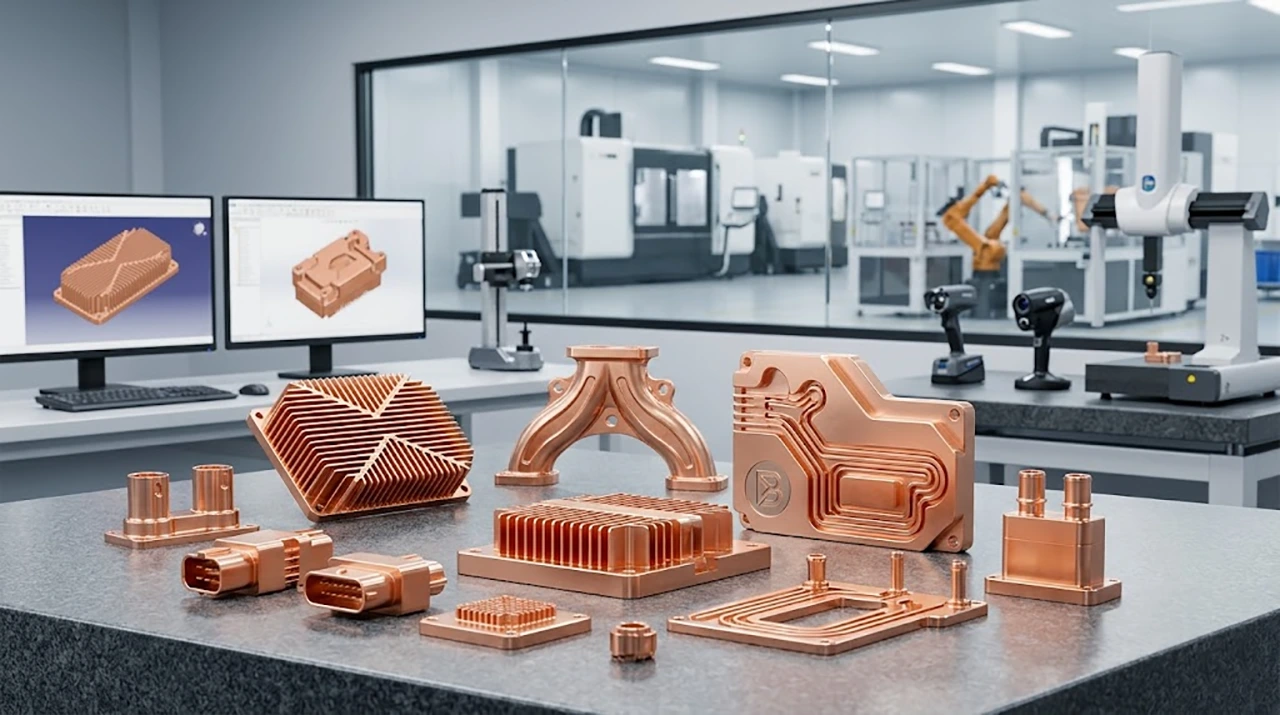
The Commodity Factor: C101 vs. C110
The foundation of your cost is the raw material itself. Copper is a highly volatile, globally traded commodity. However, beyond daily market fluctuations, the specific grade you choose dramatically impacts the baseline cost of your precision copper machined components.
-
C11000 (Electrolytic Tough Pitch – ETP): The standard for general electrical applications. It is slightly less expensive and more readily available in various billet sizes.
-
C10100 (Oxygen-Free Electronic – OFE): Boasting 99.99% purity, this grade is strictly essential for vacuum electronics to prevent hydrogen embrittlement and outgassing. However, machining C101 oxygen-free copper comes with a significant raw material premium—often 20% to 40% higher than C110.
The “Machinability Penalty”: Tooling and Time
If you want to know why machining copper is expensive, ask any operator on our shop floor. Pure copper is incredibly ductile and “gummy.” It doesn’t fracture into clean chips; it smears, tears, and work-hardens instantly if the cutting tool rubs rather than shears.
To achieve the tight tolerances required for custom copper heat sinks, we cannot run our CNC centers at the same breakneck speeds we use for standard aluminum alloys.
Data Snapshot: Tooling Parameter Cost Impact
| Machining Factor | Standard Aluminum | Pure Copper (C101/C110) | Direct Impact on Cost |
| Tool Type | Standard Carbide | Premium Uncoated or DLC-Coated | Tooling costs are 2x to 3x higher to prevent built-up edge (BUE). |
| Cutting Speed (Vc) | 300 – 500 m/min | 100 – 150 m/min | Slower cutting speeds drastically increase total machine hours. |
| Scrap Rate Risk | Low | High (due to work hardening) | Requires strict process control and highly skilled CAM programming. |
When CNC milling copper parts, we must utilize specialized high-rake, sharp-edge end mills combined with high-pressure flood coolant to evacuate the stringy chips. This specialized tooling wears out faster and costs significantly more to replace.
Estimated Cost Breakdown by Process Phase
While every custom design is unique, here is a general distribution of costs when we quote a pure copper component through our CNC Machining Service:
-
Raw Material (30% – 45%): Driven by part weight, material yield (the amount of scrap removed from the solid block), and current LME copper prices.
-
Machine Time (35% – 50%): Driven by geometric complexity. A 5-axis setup for a complex liquid cold plate will cost exponentially more per hour than a 3-axis setup for a simple bracket.
-
Post-Processing & Finishing (10% – 20%): Because copper is soft, CNC machines often leave heavy burrs that require labor-intensive manual deburring. Furthermore, to prevent rapid oxidation, almost all parts require secondary operations like passivation, silver plating, or electroless nickel plating.
DFM Strategies to Lower Your Quote
You can engineer costs out of your design before you even send the CAD file to us. Here are three actionable tips to reduce your quote:
-
Open Up Internal Radii: Give us room to use larger, sturdier tools. A larger end mill evacuates chips better, prevents chatter, and machines much faster.
-
Avoid Cut Threads: Standard cutting taps will tear the soft threads of gummy copper. Specify “form taps” or “roll taps” on your drawings for stronger, cleaner threaded holes without generating internal chips.
-
Rethink the Grade: If you don’t strictly need 99.9% purity for your specific application, consider Tellurium Copper (C145). It retains about 85% conductivity but machines almost exactly like free-cutting brass, which can drastically reduce your machining time.
Getting an Accurate Estimate
There is no flat rate for precision manufacturing. The true cost of your project depends entirely on the intersection of your geometry, tolerances, and batch volume.
As specialists in Copper CNC Machining, our engineering team is here to help you navigate these variables. Submit your 3D CAD files to BOONA today, and let’s work together to make your high-performance designs both manufacturable and cost-effective.
FAQs
Why is quoting pure copper parts always more expensive than aluminum?
The higher cost comes from three main factors: raw material price, machining time, and tool wear. Pure copper (like C101 or C110) is a premium commodity that costs significantly more per kilogram than standard aluminum. Additionally, its “gummy” nature requires slower cutting speeds and specialized, high-cost tooling (like DLC-coated end mills) to prevent the material from melting or welding to the cutter.
How much does geometric complexity impact the final quote?
Complexity is one of the biggest cost drivers. A simple flat copper busbar might only require a standard 3-axis mill and a single setup. However, a liquid-cooled cold plate with deep internal channels, thin fins, and tight geometric tolerances requires 4-axis or 5-axis machining, custom fixturing, and drastically more machine time, which exponentially increases the hourly cost.
Will I save money if I supply my own raw copper material?
Generally, no. While it might seem like a cost-saving measure, precision machine shops like BOONA have established supply chains that purchase certified copper billets at scale. Providing your own material often introduces risks regarding material traceability, purity inconsistencies, and hidden defects (like hard spots) that can damage expensive CNC tooling, ultimately delaying your project and increasing costs.
Does the required surface finish affect the price?
Absolutely. Because pure copper is incredibly soft, CNC machines often leave heavy burrs on the edges of the part. Achieving a flawless, burr-free finish requires intensive, manual deburring by skilled technicians. Furthermore, if your part requires secondary operations to prevent oxidation—such as electroless nickel plating, silver plating, or specialized passivation—this will add to the final unit price.
How can I reduce the machining cost of my copper heat sinks without sacrificing performance?
The best way to lower costs is through Design for Manufacturability (DFM). We recommend:
-
Increasing internal corner radii: This allows the use of larger, more rigid tools that machine faster.
-
Relaxing non-critical tolerances: Only specify tight tolerances (+/- 0.01mm) on mating surfaces.
-
Using form taps: For threaded holes, roll/form taps create threads by displacing the soft copper rather than cutting it, saving time and preventing broken tools.
Do you offer volume discounts for custom copper parts?
Yes. The highest cost in custom manufacturing is often the Non-Recurring Engineering (NRE) phase—this includes CAM programming, designing custom workholding fixtures, and machine setup. If you order a single prototype, that entire NRE cost is applied to one part. If you order 500 parts, that exact same setup cost is amortized across the entire batch, drastically lowering the price per unit.