
A mold buyer receives three quotations for the same plastic housing. The first supplier recommends P20, the second specifies NAK80, and the third insists on hardened H13 or S136. The proposed mold prices, manufacturing schedules, and tool-life claims vary substantially.
Choosing the lowest-cost steel may lead to premature gate erosion, rounded shutoffs, corrosion, flash, or repeated polishing. Specifying premium hardened steel throughout the tool can create a different problem: unnecessary material cost, longer heat treatment, slower engineering changes, and greater repair difficulty.
A reliable P20 vs H13 vs NAK80 vs S136 decision starts with the mold’s expected failure risks. This mold steel selection guide compares the four materials according to resin, filler content, hardness, corrosion resistance, surface finish, heat treatment, maintenance, and production demand.
The resulting injection mold steel comparison does not identify one universal winner. P20 suits economical and adaptable molds. NAK80 supports precision cosmetic tooling without final hardening. H13 protects highly stressed and abrasive areas. S136-type stainless steel addresses corrosion, hygiene, and demanding polish requirements.
The best steel for injection molds may therefore be a combination of materials rather than one grade used throughout the assembly.
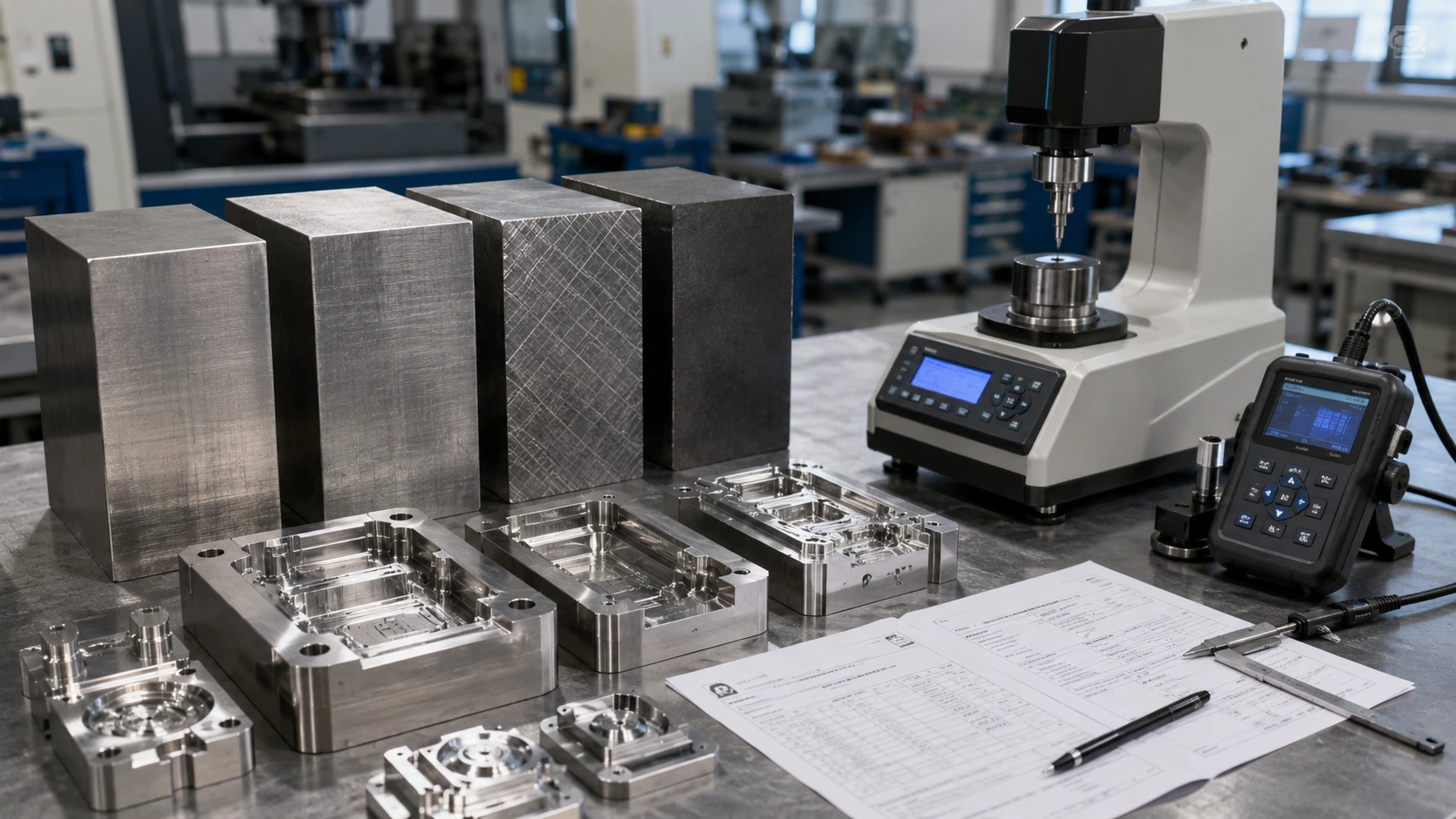
What P20, H13, NAK80, and S136 Actually Mean
P20 and H13 are established tool-steel categories included within the scope of the ASTM A681 alloy tool-steel specification. The standard defines requirements for wrought alloy tool-steel products, but a quotation must still identify the exact grade, delivery condition, hardness, and approved equivalent.
P20 usually refers to a pre-hardened plastic mold steel. Quotations may list AISI P20, 1.2311, nickel-modified 1.2738, 718H, or a locally produced equivalent. These materials may share a general application range while differing in chemistry, hardness uniformity, steel cleanliness, polishability, and performance in thick blocks.
NAK80 is a proprietary precipitation-hardening mold steel rather than a generic AISI designation. It is commonly supplied at approximately 40 HRC and normally machined without a final hardening cycle. Its higher pre-hardened hardness, dimensional stability, and cosmetic finishing capability distinguish it from standard P20.
H13 is a hot-work tool steel, broadly associated with 1.2344. Toolmakers commonly machine it in an annealed condition and then harden and temper it to achieve the required wear resistance, toughness, and working hardness.
S136 is a commercial stainless mold-steel designation frequently used in Asian tooling quotations. Because chemistry, ESR status, cleanliness, and delivery condition can vary, buyers should never accept “S136 equivalent” without a mill certificate and agreed technical specification.
P20 vs H13 vs NAK80 vs S136 Quick Comparison
The following table provides practical starting ranges. It should not replace the steel producer’s certificate, approved heat-treatment procedure, or project-specific engineering review.
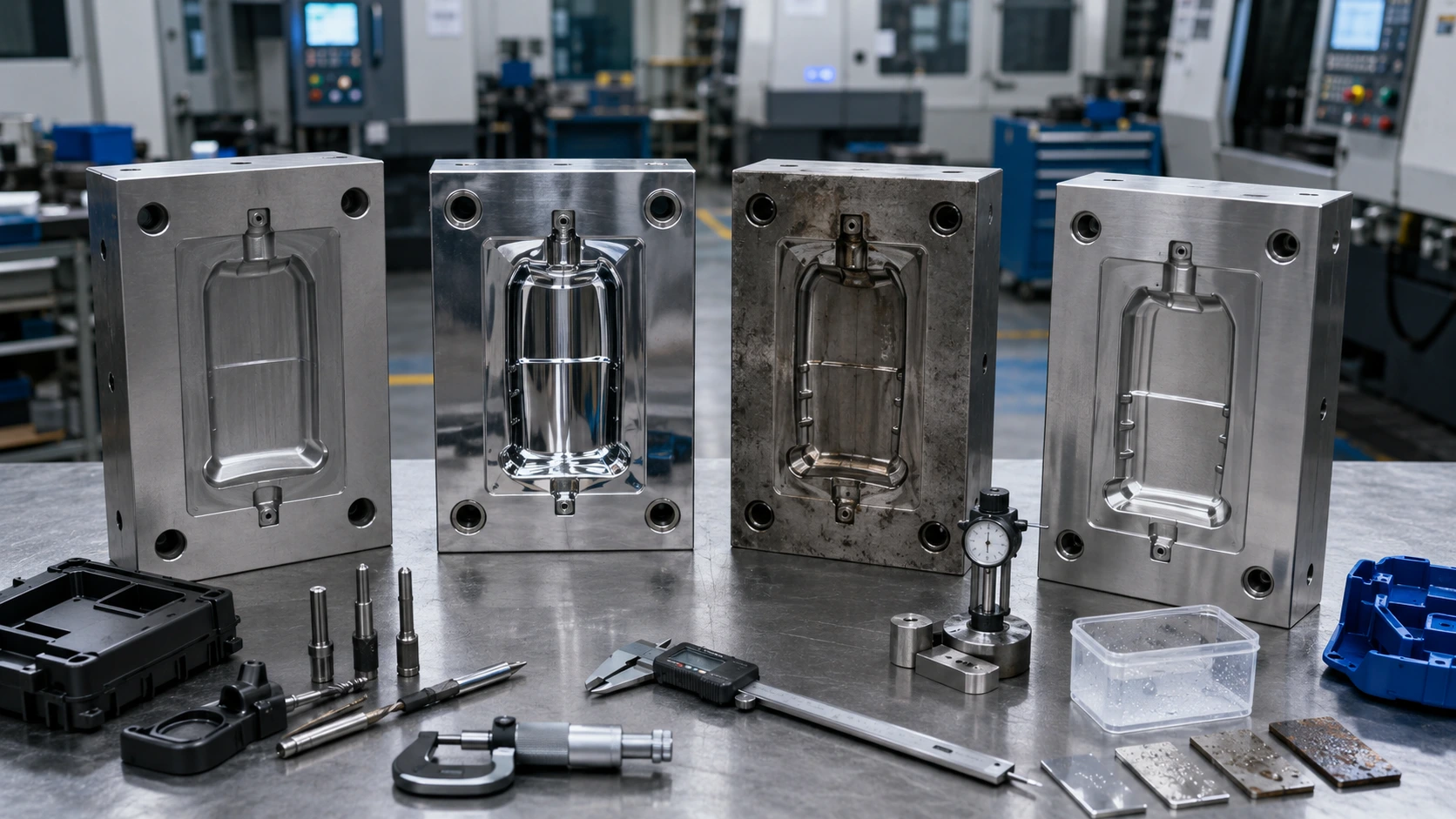
| Selection factor | P20 | NAK80 | H13 | S136-type stainless |
|---|---|---|---|---|
| Typical supply condition | Pre-hardened | Pre-hardened | Soft annealed | Annealed or pre-hardened |
| Common working hardness | About 28–34 HRC | About 38–42 HRC | Often 44–52 HRC after treatment | Often 45–52 HRC after treatment |
| Final hardening required | Usually no | Usually no | Normally yes | Commonly required for full performance |
| Machinability | Very good | Good for its hardness | Best before hardening | Moderate |
| Heat-treatment distortion risk | Low | Low | Must be controlled | Must be controlled |
| Mirror polishing | Good with clean steel | Very good | Grade-dependent | Strong with clean ESR-quality steel |
| Texture consistency | Good | Very good | Requires hardness control | Good with a qualified etching process |
| Corrosion resistance | Low | Low | Low | High |
| Abrasive-resin resistance | Moderate | Moderate | High when hardened | High when properly hardened |
| Post-T1 modification | Relatively easy | Relatively easy | More difficult | More difficult |
| Relative initial cost | Lowest | Medium | High | High |
| Typical role | General cavities and mold bodies | Cosmetic precision inserts | Gates, shutoffs, pins, wear inserts | Corrosive, optical, or medical cavities |
Hardness alone does not determine tool life. A 50 HRC insert with poor heat treatment, inadequate toughness, sharp internal corners, or weak cooling may fail earlier than a lower-hardness insert designed around the actual load.
The steel name must therefore be considered together with the manufacturing route, section size, microstructure, heat treatment, polishing requirements, and local mold geometry.
Seven Factors That Should Control Mold Steel Selection
Resin and filler content
Unfilled ABS, PP, PE, and standard PC generally create less abrasive wear than PA66-GF30, glass-filled PBT, mineral-filled compounds, or thermosets. PVC, corrosive additives, some flame-retardant packages, and condensation increase the need for stainless mold steel.
Production demand
Shot count provides context, but it cannot guarantee mold life. Gate velocity, injection pressure, filler orientation, lubrication, cooling, slider alignment, shutoff geometry, and preventive maintenance may matter more than the quoted number of cycles.
Cosmetic requirements
A standard industrial cover does not require the same steel cleanliness as an optical PMMA lens. The required SPI polish, VDI texture, gloss, grain, and defect criteria should influence the cavity material. Boona SPI to VDI 3400 to Ra conversion guide explains why polishing method, measured roughness, and molded appearance cannot be treated as exact equivalents.
Corrosion exposure
Review resin gases, humid storage, cooling-water quality, condensation, mold-cleaning chemicals, and seasonal shutdowns.
Engineering changes
P20 and NAK80 support faster post-T1 modifications because they normally avoid another full hardening and finish-grinding cycle.
Local mechanical stress
Thin pins, gates, lifters, shutoffs, and sliding interfaces may require greater hardness or toughness than the main cavity block.
Downtime cost
Premium steel becomes easier to justify when mold removal, rust repair, repolishing, or insert replacement could interrupt a high-value production line.
When P20 or NAK80 Is the Better Choice
Choose P20 for economical and adaptable tooling
P20 is a practical choice for general ABS, PP, PE, and noncorrosive engineering-plastic parts at low-to-moderate production demand. Its pre-hardened condition lets the toolmaker machine, EDM, polish, assemble, and trial the mold without final quench-and-temper treatment.
Common applications include appliance housings, industrial covers, large non-optical parts, bridge tooling, and projects likely to change after the first trial.
P20’s limitations include modest wear resistance, weak corrosion protection, and variable mirror-polish performance in lower-cleanliness stock. A quotation that says only “P20 equivalent” should identify the exact designation, delivery hardness, steel source, and certificate requirements.
Machining strategy also affects the finishing workload. A 2024 study of AISI P20 milling reported approximately 22% higher surface roughness for up-milling than down-milling under the tested conditions. Its up-up overlapping strategy produced roughly 25% more roughness than the down-down strategy. These results do not define every P20 machining operation, but they show why toolpath planning influences polishing time and final cavity quality.
Choose NAK80 for precision cosmetic tooling
NAK80 generally arrives around 40 HRC and requires no final hardening after normal machining. It suits cosmetic cavities that need clean edges, stable dimensions, controlled texturing, polishing, and repair after T1.
Typical applications include electronic housings, camera components, automotive interior trim, reflectors, and finely textured consumer parts.
NAK80 is not stainless and should not automatically replace H13 in severe glass-fiber wear zones. The buyer should also distinguish genuine NAK80 from an unspecified local material offered at similar hardness.
When H13 or S136-Type Stainless Is the Better Choice
Choose H13 for concentrated wear and mechanical stress
H13 performs well in areas exposed to abrasion, compression, heat, repeated impact, or heavy sliding contact. Injection-mold applications include gate inserts, thin shutoffs, core pins, hot-runner components, wear plates, wedges, and details processing glass-filled or mineral-filled polymers.
The toolmaker normally rough-machines H13 before hardening, leaves dimensional allowance, heat-treats and tempers the insert, verifies the final hardness, and completes grinding, EDM cleanup, and polishing afterward.
This route increases lead time but creates a harder, more wear-resistant component. H13 often delivers the best value as a replaceable insert rather than as the complete mold body.
Choose S136-type stainless for corrosion and demanding polish
S136-type stainless steel becomes relevant when corrosion, hygiene, humid storage, or surface retention drives the project.
Typical applications include:
- Clear PMMA and PC components
- Medical and laboratory containers
- PVC or chemically aggressive resin systems
- Molds exposed to condensation
- High-gloss cavities where rust staining is unacceptable
- Cooling systems where corrosion may reduce heat transfer
Certified high-cleanliness stainless steel can provide strong polishability and corrosion resistance, but it costs more to machine, heat-treat, polish, weld, and repair. The RFQ should state whether ESR material is required and define the final hardness rather than relying only on the name “S136.”
Resin-to-Steel Selection Matrix and Hybrid Mold Strategy
| Resin or project requirement | Recommended starting strategy | Engineering reason |
|---|---|---|
| ABS, PP, or PE at moderate volume | P20 | Cost, machinability, and easy modification |
| High-cosmetic ABS or PC housing | NAK80 | Stable pre-hardness and texture consistency |
| Clear PMMA or optical PC | Certified stainless cavity steel | Polish retention and corrosion control |
| PVC or corrosive compound | S136-type stainless | Resistance to staining and corrosive exposure |
| PA66-GF30 | P20 or NAK80 body with H13 inserts | Protects gates, shutoffs, and high-flow wear zones |
| Glass-filled PBT | Hardened H13 inserts | Concentrated abrasive wear |
| Thermoset molding | H13 or qualified hardened stainless | Heat, pressure, and abrasion |
| Large mold with isolated wear | P20 body plus replaceable H13 details | Controls overall tooling cost |
| Medical container | Certified stainless cavity | Hygiene and rust resistance |
| Fine cosmetic texture | NAK80 or verified clean mold steel | Texture uniformity and easier repair |
A hybrid mold places each material where its strongest property creates measurable value. One tool may combine a P20 mold body, NAK80 cosmetic cavity, H13 gate and shutoff inserts, and stainless components around corrosive areas.
This approach lowers raw-material and heat-treatment cost while keeping failure-prone components replaceable.
The resin specification should include more than a trade name. Provide filler type and percentage, flame-retardant system, color, regrind allowance, molding temperature, annual demand, gate design, and critical cosmetic zones.
Boona custom injection mold tooling service supports separate material decisions for the mold body, cavities, cores, sliders, gates, and wear inserts.
Heat Treatment, Surface Finish, and Repair Planning
Pre-hardened and through-hardened steels require different manufacturing plans.
P20 and NAK80 normally allow direct machining in the supplied condition. This reduces distortion risk, shortens lead time, and makes post-T1 dimensional changes more manageable. The tradeoff is lower maximum wear resistance than a properly hardened H13 or stainless insert.
H13 and annealed S136-type steel require a controlled sequence:
- Rough machining
- Stress relief where required
- Dimensional allowance for hardening
- Hardening and tempering
- Hardness verification
- Finish grinding or EDM
- Recast-layer removal
- Final polishing or texturing
Surface-finish requirements should influence the heat-treatment plan. Uneven hardness, decarburization, inclusions, EDM damage, and poor welding procedures can appear during high-gloss polishing or chemical texturing.
Repair strategy matters as well. P20 and NAK80 usually support faster engineering modifications. Hardened H13 requires controlled preheating and post-weld procedures. Stainless cavity steels need compatible filler material and specialist polishing to prevent visible repair zones.
💡 Pro Tip: Put the exact material grade, delivery hardness, final hardness, and heat-treatment requirement on every individual insert drawing. A single “tool steel” note on the mold assembly can allow unintended substitutions between cavities, gates, sliders, and wear parts.
Application Example: PA66-GF30 Connector Housing
Consider a connector housing molded from PA66 with 30% glass fiber. The forecast calls for 650,000 production cycles. The design includes narrow shutoffs, fine core features, and an SPI B-2 finish on the visible housing surface. Engineers also expect several dimensional corrections after T1.
The first quotation specifies the entire core and cavity in H13. This offers high wear resistance, but it also increases raw-steel cost, heat-treatment time, finish machining, and the difficulty of later corrections.
A more targeted strategy uses:
- P20 for low-wear structural plates and large support sections
- NAK80 for the cosmetic cavity insert
- Hardened H13 for the gate, thin shutoffs, and high-wear core details
- Replaceable inserts where glass-fiber flow creates concentrated erosion
The approval package requires mill certificates, final hardness reports for H13 inserts, insert-fit measurements, and cosmetic inspection after T1 corrections.
Maintenance focuses on gate enlargement, shutoff rounding, flash development, core-pin wear, and fiber erosion near flow restrictions.
This arrangement avoids paying for hardened H13 throughout the tool while protecting the areas most likely to fail. It also keeps the cosmetic cavity easier to modify and lets the maintenance team replace worn details independently.
Cost, Lead Time, and Supplier Verification
Raw steel price represents only one part of total mold cost. The complete calculation includes CNC machining, EDM, heat treatment, stress relief, grinding, polishing, texture, welding, inspection, mold trials, rust prevention, maintenance, and replacement inserts.
| Steel strategy | Initial cost | Lead-time effect | Long-term value |
|---|---|---|---|
| P20 | Lowest | Fastest | Easy modification and repair |
| NAK80 | Medium | Fast without final hardening | Cosmetic consistency |
| H13 | High | Longer due to heat treatment | Wear and stress resistance |
| S136-type stainless | High | Longer hardening and polishing route | Corrosion and finish retention |
| Hybrid construction | Project-dependent | Moderate | Investment focused on failure zones |
Before approving a supplier quotation, request:
- Exact material designation
- Steel producer or approved equivalent
- Original mill certificate
- Chemical composition
- Heat or lot number
- Delivery hardness
- Final hardness report
- ESR confirmation where required
- Heat-treatment record
- Separate material callouts for cavities, cores, gates, sliders, and inserts
Reject vague descriptions such as “P20 equivalent,” “local NAK80,” or “S136 same quality” unless the supplier submits the agreed documentation.
Boona plastic injection molding services combine tooling DFM, resin review, material documentation, mold trials, and production planning so that steel selection aligns with the finished part rather than only the initial quotation.
FAQs About P20, H13, NAK80, and S136
Is NAK80 better than P20?
NAK80 generally provides higher pre-hardened hardness, stronger cosmetic finishing, and improved texture consistency. P20 costs less, machines more easily, and suits general molds or designs likely to change.
Is H13 necessary for glass-filled nylon?
Not always for the entire mold. H13 often makes sense at gates, pins, thin shutoffs, and areas exposed to concentrated glass-fiber erosion.
Is S136 stainless steel?
S136 commonly refers to a corrosion-resistant stainless mold steel. Buyers should verify the exact grade, chemistry, ESR status, delivery condition, and certificate.
Which steel is best for clear PC or PMMA?
Certified high-cleanliness stainless mold steel generally offers the strongest starting point for corrosion control and demanding optical polishing.
Does NAK80 require hardening after machining?
NAK80 is normally supplied pre-hardened at approximately 40 HRC, so standard moldmaking usually avoids a final hardening cycle. Substitute materials may differ.
Can P20 achieve an SPI A-1 finish?
Clean, high-quality P20 can achieve a strong polish, but optical results depend on inclusions, hardness uniformity, steel cleanliness, and polishing skill. Certified stainless steel may provide a safer option for critical optical parts.
Can one mold use several steel grades?
Yes. Hybrid construction often provides better value by combining economical structural steel with cosmetic, wear-resistant, and corrosion-resistant inserts.
Does harder steel always provide longer mold life?
No. Toughness, corrosion resistance, geometry, heat treatment, alignment, molding pressure, filler content, cooling, lubrication, and maintenance also affect service life.
P20 vs H13 vs NAK80 vs S136 Final Recommendation
The P20 vs H13 vs NAK80 vs S136 decision should follow the mold’s technical and commercial risks rather than a generic shot-count table.
Choose P20 for economical general-purpose molds, large noncorrosive parts, and projects likely to change. Choose NAK80 for pre-hardened cosmetic cavities, precision machining, texture consistency, and reduced heat-treatment distortion.
Use H13 for gates, shutoffs, pins, wear plates, abrasive resin contact areas, and mechanically stressed inserts. Select verified S136-type stainless steel when corrosion, transparent parts, hygiene, humid storage, or high-polish retention controls the application.
The most economical production mold often uses a hybrid structure. The mold body, cosmetic cavity, gate, slider, core pin, and cooling-sensitive region face different failure risks and do not always require the same steel.
A complete RFQ should define the resin, filler percentage, expected production demand, cosmetic finish, insert function, hardness, heat treatment, certification, and maintenance assumptions before suppliers finalize the mold price.
Related Reading
- SPI to VDI 3400 to Ra Mold Finish Conversion Chart
- Injection Mold Tooling Cost Guide
- Aluminum vs Steel Tooling for Low-Volume Production
Request a Documented Mold-Steel Recommendation
Preparing an injection mold RFQ? Send Boona your CAD files, resin and filler percentage, annual demand, mold-life target, surface finish, tolerances, cooling requirements, and preferred steel grades. The team can review the project through the injection mold tooling service and provide DFM feedback, a documented material strategy, and a tooling quotation.