
A drawing that specifies only “17-4PH stainless steel” leaves a critical engineering decision unresolved. The machine shop can purchase the correct alloy and still deliver a component with the wrong strength, hardness, ductility, or resistance to cracking.
The difference lies in the aging condition.
The 17-4PH H900 vs H1025 vs H1075 vs H1150 decision changes how a shaft carries load, how a valve component survives pressure cycles, how quickly cutting tools wear, and how much material remains available for final grinding. H900 delivers the highest strength among these four conditions, but it also provides the lowest ductility. H1150 moves in the opposite direction. H1025 and H1075 occupy useful positions between those extremes.
Choosing the hardest condition by default can create brittle behavior, difficult machining, or an unsuitable response in a stress-corrosion environment. Choosing a heavily overaged condition may reduce strength below the level required for a compact, highly loaded part.
A complete purchase specification should therefore define the alloy, product form, aging condition, applicable heat-treatment standard, mechanical-property requirements, hardness, certification, and sequence of machining operations.
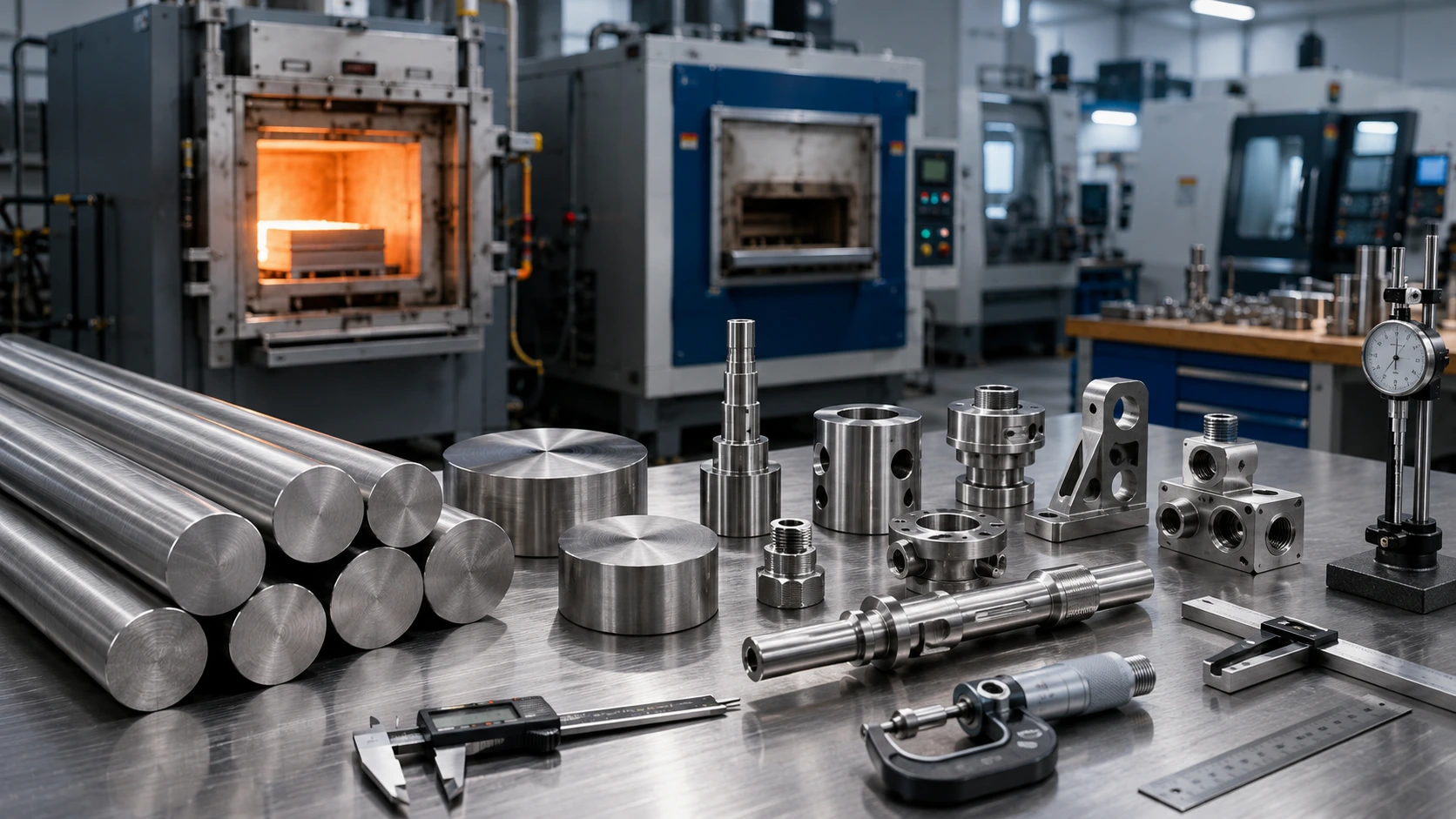
What Are 17-4PH Heat Treatment Conditions?
17-4PH precipitation-hardening stainless steel, also designated UNS S17400 or Type 630, combines useful corrosion resistance with mechanical properties that can be adjusted through solution treatment and aging.
Copper-rich precipitates form during aging and strengthen the martensitic matrix. Changing the aging temperature changes the precipitate structure and the amount of reverted austenite, producing a trade-off between strength, hardness, ductility, and toughness.
The current ASTM A564/A564M specification for age-hardening stainless steel bars and shapes covers Type 630 in solution-treated and age-hardened conditions. ASTM notes that these steels can be machined in the solution-annealed condition and subsequently aged to achieve specified mechanical properties. Different standards apply to plate, sheet, forgings, castings, and aerospace material, so the drawing must identify the applicable document rather than citing the alloy alone. ASTM Store
For the four conditions discussed here, the number represents the nominal aging temperature in degrees Fahrenheit:
- H900: 900°F or approximately 482°C
- H1025: 1025°F or approximately 552°C
- H1075: 1075°F or approximately 579°C
- H1150: 1150°F or approximately 621°C
H900 commonly uses a one-hour aging cycle. H1025, H1075, and H1150 commonly use four-hour cycles after the material has reached the specified temperature. The heat treater should follow the drawing standard, not a generic internet schedule.
17-4PH H900 vs H1025 vs H1075 vs H1150 Comparison
The following values provide a useful comparison for commercially produced material. They should not replace the requirements for the selected product form, section size, test orientation, or purchasing standard.
| Condition | Typical aging schedule | Yield strength, minimum | Tensile strength, minimum | Elongation, minimum | Brinell hardness |
|---|---|---|---|---|---|
| H900 | 482°C for 1 hour | 1,170 MPa | 1,310 MPa | 10% | 388 HB |
| H1025 | 552°C for 4 hours | 999 MPa | 1,068 MPa | 12% | 349 HB |
| H1075 | 579°C for 4 hours | 861 MPa | 999 MPa | 13% | 328 HB |
| H1150 | 621°C for 4 hours | 723 MPa | 930 MPa | 16% | 292 HB |
A 2023 academic paper reproduced these ASTM A564 reference values while comparing conventionally manufactured and additively produced 17-4PH. The conventional-material table shows that minimum tensile strength falls from 1,310 MPa in H900 to 930 MPa in H1150, while minimum elongation rises from 10% to 16%. That is the central selection trade-off: higher aging temperature generally sacrifices strength and hardness in exchange for greater ductility and toughness. Review the 2023 17-4PH mechanical-property study.
Values can change with bar diameter, plate thickness, forging size, test direction, and specification revision. Place the required minimum properties directly on the drawing when the component depends on them.
Choosing H900, H1025, H1075, or H1150
H900 for maximum strength and hardness
H900 provides the highest 17-4PH stainless steel hardness and tensile strength among the four conditions. It suits compact components where high static load capacity, wear resistance, or resistance to permanent deformation takes priority.
Common candidates include high-load shafts, fasteners, locking components, actuator parts, wear-resistant pins, and aerospace fittings.
The trade-offs include lower ductility, lower impact tolerance, greater machining difficulty, and increased sensitivity to notch effects. Deep threads, sharp internal corners, cross-holes, and abrupt section changes deserve careful fatigue review.
H900 should not become the automatic choice simply because its strength number is highest.
H1025 for a strength–toughness balance
H1025 retains high yield strength while offering more elongation and toughness than H900. It often suits precision brackets, hydraulic hardware, mechanical couplings, valve components, and structural parts that experience both steady and fluctuating loads.
This condition provides a practical compromise when H900 appears unnecessarily hard but H1075 would reduce strength too far.
H1075 for improved toughness
H1075 shifts the balance further toward ductility and resistance to crack propagation. It can suit machinery parts exposed to vibration, moderate impact, repeated loading, and local stress concentrations.
Designers may select it for pump components, structural links, thicker shafts, and components where some deformation before fracture is preferable to maximum hardness.
H1150 for the greatest toughness among these four
H1150 provides the lowest strength and hardness in this comparison but the greatest elongation and toughness. It can fit impact-loaded components, larger pressure-system parts, heavily loaded shafts, and environments where resistance to stress-corrosion cracking carries more weight than peak strength.
Special H1150M and H1150D treatments also exist, but they are separate conditions and should not be treated as interchangeable with standard H1150.
17-4PH Condition Selection by Application
The correct condition follows the part’s loading mode rather than the industry name alone.
| Application requirement | Starting condition | Selection logic |
|---|---|---|
| Maximum static strength in a compact part | H900 | Highest yield and tensile strength |
| High-strength bracket with cyclic loading | H1025 | Better toughness than H900 |
| Hydraulic valve or actuator component | H1025 or H1075 | Balance of strength, ductility, and stability |
| Vibration- or impact-loaded structural part | H1075 | Improved toughness and elongation |
| Large shaft with shock loading | H1075 or H1150 | Lower crack sensitivity |
| Wear-resistant pin or locking element | H900 or H1025 | Higher hardness |
| Pressure component with stress concentrations | H1075 or H1150 | Greater ductility |
| Corrosive service with SCC concerns | Application-specific overaged condition | Requires environmental and standards review |
Aerospace, medical, marine, and energy applications often impose separate material and process specifications. The same geometry may require a different condition when service temperature, cyclic loading, hydrogen exposure, saltwater, or sour-gas contact changes.
For example, H900 may fit a short, highly loaded actuator pin with generous radii and controlled alignment. The same condition could prove unsuitable for a long valve stem containing threads, cross-drilled holes, bending loads, and a corrosive process environment.
💡 Pro Tip: Select the condition after identifying the dominant failure mode. “Maximum strength” is not a complete requirement. The drawing should state whether yielding, wear, fatigue, impact, corrosion, or stress-corrosion cracking controls the design.
How Condition Affects 17-4PH CNC Machining
17-4PH CNC machining can follow two main process routes.
Machine in Condition A, then age
Condition A generally offers easier cutting than H900 or H1025. The machine shop can rough and semi-finish the part, send it for aging, and then grind or finish-machine critical features.
This route reduces tool load during heavy material removal. It also lets the final aging cycle establish the specified strength before the shop completes bearing fits, sealing diameters, flatness-critical faces, and high-accuracy bores.
Dimensional movement remains low compared with conventional quench hardening, but it is not zero. Thin walls, unbalanced stock removal, deep pockets, and residual stress can still cause measurable movement.
Purchase pre-aged stock and machine to size
Machining material already in H900, H1025, H1075, or H1150 removes the need for post-machining aging. This can simplify certification and reduce the risk of final dimensional change.
The harder conditions increase cutting forces and tool wear. H900 usually demands the most conservative cutting strategy, rigid workholding, sharp carbide tooling, positive chip evacuation, and stable coolant delivery.
Complex impellers, angled fluid passages, valve bodies, and multi-face aerospace components may benefit from five-axis CNC machining because fewer setups reduce accumulated positional error. Boona also supports material-specific process planning for custom stainless steel CNC-machined parts.
For a ±0.01 mm bearing fit or Ra 0.8 μm sealing surface, plan a finishing allowance after aging instead of assuming the rough-machined dimension will remain unchanged.
Application Example: Hydraulic Valve Spool
Consider a hydraulic valve spool with these requirements:
- Material: UNS S17400
- Overall length: 165 mm
- Maximum operating pressure: 28 MPa
- Sealing-land diameter tolerance: ±0.008 mm
- Total runout: 0.01 mm
- Surface finish on sealing lands: Ra 0.4 μm
- Cross-drilled flow holes near a diameter transition
- Repeated pressure and switching cycles
Selecting H900 would maximize strength and surface hardness. However, the spool contains cross-holes and transitions that create local stress concentrations. It also experiences cyclic loading rather than a single static load.
H1150 would improve toughness but might reduce yield strength more than the compact valve design allows. H1025 provides a more balanced starting condition.
A practical process plan could use Condition A bar stock, rough-turn the outside diameter, drill the flow passages, and leave grinding allowance on the sealing lands. After aging to H1025, the shop would verify hardness, finish-grind the functional diameters, inspect runout, and record the final dimensions.
This example does not prove H1025 is correct for every valve spool. A sour-gas valve, cryogenic component, or shock-loaded mining valve may require a different condition and an industry-specific corrosion review.
The lesson is procedural: select the condition from the combined load case, then build the machining and inspection sequence around that decision.
Drawing, RFQ, and Certification Requirements
A purchase order that says only “17-4PH” allows too much interpretation. A complete callout should define:
Material: UNS S17400, ASTM A564/A564M, Condition H1025, final hardness and mechanical properties per the applicable product-size requirements.
The exact standard may change with product form. Bars and shapes commonly reference ASTM A564/A564M. Plate, sheet, strip, forgings, castings, and aerospace products may require ASTM A693, ASTM A705, ASTM A747, or an AMS specification.
The RFQ should include:
- Alloy and UNS designation
- Product form and material standard
- Required aging condition
- Heat-treatment process specification
- Final hardness range
- Minimum tensile and yield properties
- Test orientation where relevant
- Corrosion or stress-corrosion environment
- Surface finish and passivation requirement
- Features completed before and after aging
- Final dimensional tolerance
- Material and heat-treatment certificates
Request traceability to the raw-material heat number and the heat-treatment batch. A hardness result alone does not prove that the supplier followed the required thermal cycle or achieved every mechanical property.
For aerospace or regulated products, distinguish between buying stock already certified in an aged condition and sending Condition A parts for processing under an approved heat-treatment specification. Both routes can produce similar hardness, but the documentation path may determine whether the finished part passes first-article review.
FAQs About 17-4PH Conditions
What is the strongest 17-4PH condition?
Among H900, H1025, H1075, and H1150, H900 generally provides the highest yield strength, tensile strength, and hardness.
Is H1025 better than H900?
Neither condition is universally better. H900 prioritizes strength and hardness. H1025 sacrifices some strength to gain ductility and toughness.
Which condition is easiest to machine?
H1150 generally cuts more easily than H900 because it is softer. Condition A is often selected for heavy rough machining before aging.
Does H1150 have better corrosion resistance?
Higher aging temperatures can improve resistance to certain stress-corrosion mechanisms, but corrosion performance depends on the environment. Chlorides, hydrogen, temperature, stress, surface condition, and industry standards still require review.
Can 17-4PH replace 316 stainless steel?
17-4PH can provide much greater strength, but 316 often performs better in aggressive chloride environments. The materials are not direct substitutes.
Can finished H900 parts be changed to H1150?
Re-aging or reconditioning may be possible under an approved heat-treatment procedure, but the material history and governing specification must support it. Do not authorize the change from hardness alone.
Should threads be machined before or after aging?
The answer depends on thread class, condition, geometry, tool access, and inspection requirements. Rough machining before aging and finishing critical threads afterward may provide better dimensional control.
Is H1150 the toughest 17-4PH condition?
H1150 offers the greatest toughness among the four conditions compared here. H1150M and H1150D use different multi-step treatments and may provide other property combinations.
Choosing 17-4PH H900 vs H1025 vs H1075 vs H1150
The 17-4PH H900 vs H1025 vs H1075 vs H1150 decision is a controlled trade-off rather than a hardness contest.
Choose H900 when maximum yield strength, tensile strength, and wear resistance control the design. Select H1025 when the component needs high strength with improved toughness and more forgiving behavior around local stress concentrations.
Move toward H1075 when vibration, cyclic loading, and impact resistance carry greater weight. Choose H1150 when toughness, ductility, and resistance to cracking matter more than peak strength.
The final drawing should identify the alloy, product standard, aging condition, hardness or mechanical-property requirements, heat-treatment documentation, and inspection sequence. It should also state which dimensions the supplier must finish after aging.
Request a 17-4PH Machining and Heat-Treatment Review
Preparing a shaft, valve component, aerospace fitting, hydraulic part, or high-strength stainless assembly? Send Boona your CAD model, drawing, product standard, required aging condition, tolerances, surface finish, and service environment through its stainless steel CNC machining service. The engineering team can review machining sequence, heat-treatment allowance, critical finishing operations, inspection requirements, and material traceability before quotation.