
A center-console review can pull a prototype in different directions. Packaging engineers want the bezel to locate against the switch pack. Designers want the approved grain. An ergonomics team wants to judge the edge beneath an occupant’s hand. One unfinished plastic model cannot answer all three questions reliably.
Prototyping Automotive Interior Parts starts with deciding what the build must prove. Choose CNC for controlled interfaces, frequent geometry changes, and evaluation in available stock materials. Choose polyurethane vacuum casting for repeated complex parts with an approved appearance. Combine them when cast bodies also need accurately machined mating features.
The purchasing decision should follow the intended test. Otherwise, teams can approve a convincing surface while overlooking a temporary attachment or material substitution that changes how the part behaves.
Define the Goal Before Prototyping Automotive Interior Parts
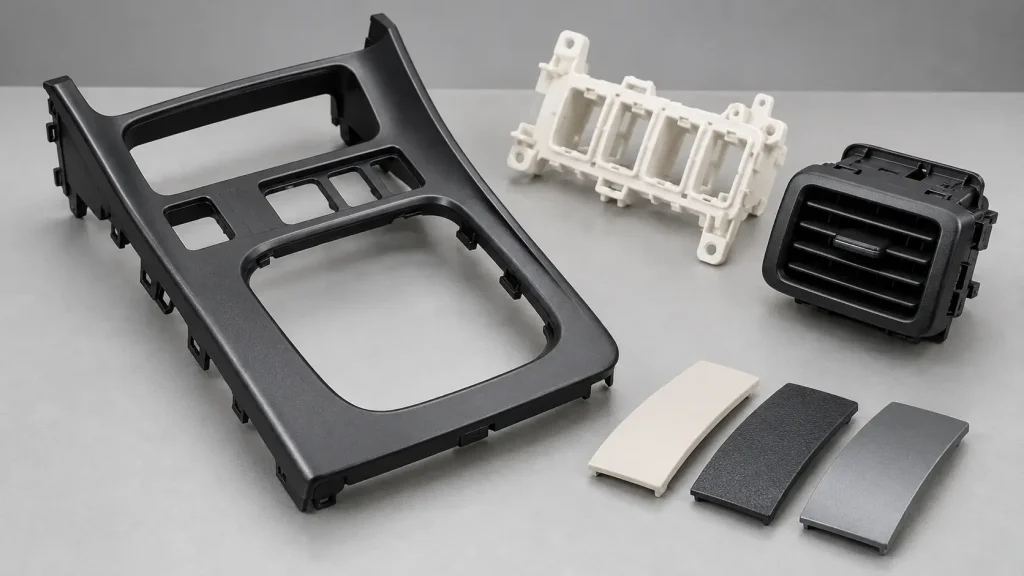
Appearance and Touch
Automotive trim prototypes can support reviews of proportions, grain, gloss, and accessible edges. Those reviews need a defined finish reference and realistic viewing conditions. A textured painted sample answers a different question from a bare machined part.
Soft-touch evaluation also requires the intended surface construction. A compliant casting, a soft-touch coating, and a wrapped rigid substrate can produce different indentation and friction behavior.
Assembly and Functional Evaluation
For assembly work, identify the actual mates and locating features. Check a vent or switch component throughout its intended travel, rather than at a single resting position. Temporary screws may support a packaging review; production-style clips may matter for installation access.
Use this process-selection matrix to compare the routes before requesting prices. It is a purchasing framework, rather than a capability specification or a fixed production-volume rule.
| Selection factor | CNC machining | Polyurethane vacuum casting | Buyer control |
|---|---|---|---|
| Location-critical interfaces | Machine accessible features directly | Inspect copies; consider secondary machining | Define datums and finished-state dimensions |
| Repeated appearance models | Machine and finish individual parts | Replicate an approved master | Approve grain, gloss, and visible parting lines |
| Frequent design revisions | Revise programs and setups as required | Changes may require another master and mold | Quote quantities by design revision |
| Concealed undercuts | Tool access may require split construction | Flexible tooling can help, subject to demolding limits | Identify permitted construction deviations |
| Material-sensitive testing | Use a specified available stock grade | Use a selected polyurethane formulation | Document differences from production material |
Neither route automatically reproduces injection-molding shrinkage, warpage, or clip fatigue. Record the prototype’s limitations alongside the review results so another team can interpret the same sample correctly.
When CNC Machining Is the Better Starting Point
Components That Benefit from Controlled Interfaces
CNC machining for automotive interiors suits switch bezels, knobs, mounting carriers, and assembly fixtures when tool access allows their geometry. Machining can also produce selected vent components, although deep blades and concealed features may require separate pieces.
Available stock materials give engineers another reason to choose this route. For an ABS-based evaluation, BOONA ABS CNC machining services provide a relevant starting point. Specify the required grade or acceptable substitute. A machined stock material still differs from an injection-molded part in processing history and potentially in formulation.
Tool Access, Datums, and Thin Features
Internal corners inherit the cutter’s radius. Deep recesses limit access, while thin walls need support against cutting and clamping forces. Features on opposite faces may require separate setups, so define which interfaces share a datum.
A hidden undercut can justify split construction for a visual model. That joint becomes a significant deviation if the same prototype will undergo stiffness or attachment testing. Keep any added seam away from a surface whose continuity matters to the review.
For a BOONA RFQ, our recommendation is to identify the review-critical interfaces before assigning tight tolerances across the entire part. Concentrating control on locating shoulders, mating bores, and mounting faces can reduce unnecessary machining and inspection. State whether those dimensions apply to the bare substrate or the finished component.
When Vacuum Casting Makes More Sense
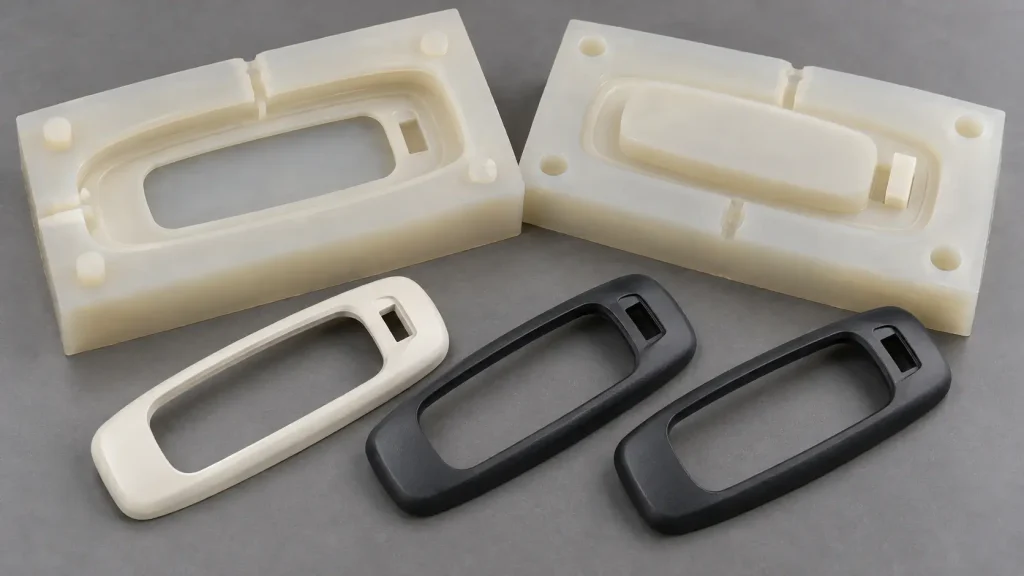
Replicate an Approved Master
Polyurethane vacuum casting uses a master to create a silicone mold, then produces resin copies from that tool. This discussion concerns polymer casting in silicone tooling, distinct from metal casting and liquid silicone rubber injection molding.
The route becomes attractive when teams need repeated complex shapes for appearance reviews or distributed assembly evaluations. CNC machining or suitable additive methods can create the master; the required geometry and surface quality should determine that choice. Approve the master before replication. Surface defects, incorrect edges, and unwanted tool marks can become recurring features in the copies.
Review parting lines, gates, and vents against the visible-surface map. Keep gate-removal work away from engagement edges where practical. Demolding also deserves attention: a flexible mold does not make every slender clip or deep undercut safe to extract.
Verify the Copies Independently
A precise master cannot establish the accuracy of every casting. A study of reinforced silicone molds, published online in 2025, illustrates the influence of tooling construction. Its Abstract reports that molds containing 19 vol% glass microspheres improved longitudinal and lateral fitting accuracy by up to 75% and 88%, respectively, compared with unreinforced molds.
These are relative results for the researchers’ process, rather than absolute tolerances for ordinary vacuum-cast trim. The research was not a BOONA project and does not demonstrate BOONA capability. Our engineering inference is to verify cast interfaces separately instead of transferring the master’s inspection report to its replicas.
Compare the chosen resin’s cure, demolding, and conditioning requirements before scheduling measurement. Document the condition of the part at inspection.
Choose Materials and Finishes Together
Match the Material to the Question
Selecting automotive prototype materials requires more than an “ABS-like” label. A polyurethane formulated to resemble ABS remains polyurethane. Its creep, impact response, or chemical resistance can differ from the intended production resin.
Machined ABS, polycarbonate, or acrylic can support different evaluations where their properties and available stock forms fit the task. Transparent material alone does not establish optical performance; surface preparation and geometry also affect what the reviewer sees.
Specify the Entire Visible Surface
Prototype surface finishing should follow a visible-surface map. Identify high-priority appearance areas, concealed surfaces, and permitted process marks. State whether grain comes from the master or a later coating; secondary machining and touch-up can interrupt the approved texture. Use a physical texture and gloss reference rather than photographs alone.
Paint can soften a sharp transition or build up around a locating edge. Across a gap between opposing coated edges, both coating layers affect the remaining clearance. Wrapped constructions add covering thickness and adhesive beneath the surface. Leave those additions out of the dimensional plan and the substrate inspection may describe the wrong fit.
For BOONA DFM review, our recommendation is to separate cosmetic surfaces from locating surfaces on the drawing. If a painted edge also sets the gap to an adjacent panel, include the finish in that interface’s acceptance condition.
Evaluate color under the agreed lighting, especially beside existing cabin parts. Keep a retained approved sample so later batches have a physical comparison.
Design Clips, Bosses, and Interfaces for the Intended Test
Distinguish Engagement from Retention
A clip can engage successfully without demonstrating adequate retention over repeated removal or temperature exposure. Its behavior depends on geometry, material response, and the mating feature. Compare the actual contact locations and deflection path before interpreting an assembly trial.
Slender machined clips may challenge tool access and handling. Cast clips introduce questions about resin behavior, filling, and damage during demolding. Where the prototype cannot represent the production clip faithfully, document the deviation and restrict the conclusions drawn from it.
Make Temporary Attachments Visible in the Build Record
Bosses and inserts should match the intended installation sequence. An adhesive-mounted insert or added screw can support a packaging demonstration, but it changes the load path compared with the intended molded construction.
Avoid quietly strengthening a review part after damage. A reinforced feature can make subsequent feedback difficult to compare with earlier builds.
💡 Pro Tip: Mark every temporary attachment on the prototype build record. Before an installation or removal review, confirm which clips, screws, and inserts represent the production design.
Inspect interfaces after finishing and any approved secondary operations. Check for coating bridges, trapped casting residue, or damage near engagement edges. Photograph critical features before distributing parts to separate review teams.
Combine CNC and Casting Without Creating Duplicate Work
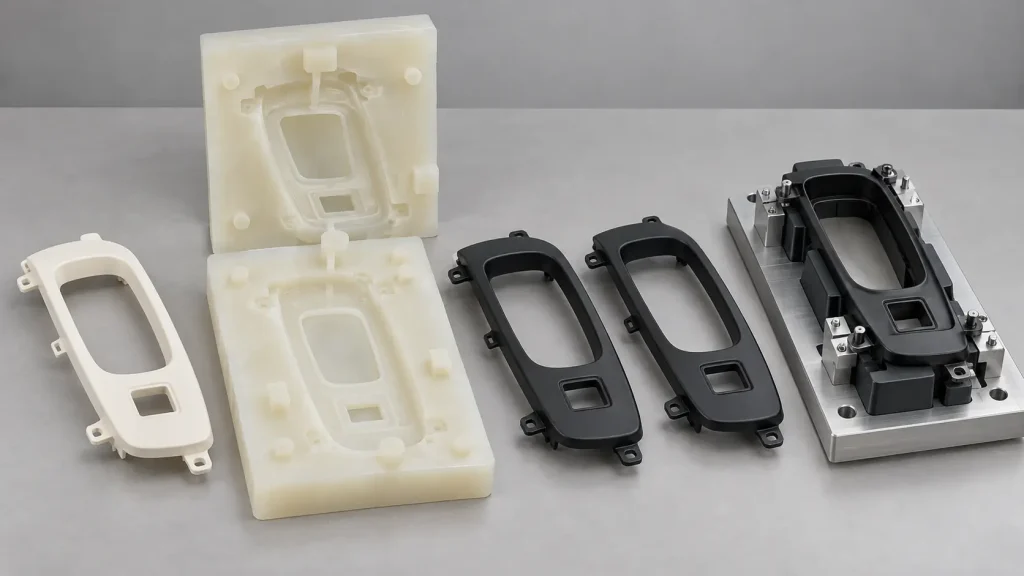
Plan the Handoffs and Revision Cost
A hybrid route can machine a master, cast repeated bodies, and finish selected interfaces by CNC. Agree machining allowances and accessible, repeatable locating datums before designing the mold. Support thin cast walls during secondary machining. Otherwise, each replica may require an improvised setup.
BOONA low-volume manufacturing services include vacuum casting alongside other routes. Compare total program cost: preparation, master and mold work, part production, finishing, inspection, and anticipated revisions. A lower replica price can lose its advantage if every review requires new tooling. Quote the likely revision sequence as well as the quantity.
Application Example: Flexible Surgical Planning Models
A 2024 multicenter study of patient-specific heart models shows why hybrid builds need explicit validation. Section 2.4 and Figure 2 document stereolithography patterns, silicone tooling, and vacuum-cast polyurethane. The workflow used printed masters rather than CNC masters. Its validation risk concerned hidden internal geometric error in models used for cutting and suturing simulations.
The Abstract identifies 19 pediatric cases and reports a product error of 0.54 ± 0.21 mm within 90% of the combined external and internal surface area. This is the study’s specific surface-error metric, rather than a general casting tolerance or the mean error over every surface point.
The study was not a BOONA project and provides no evidence of BOONA capability. Our engineering inference for interior development is to validate geometry and physical interaction explicitly. Automotive heat aging, emissions, and clip durability remain outside that medical study’s scope.
Acceptance Criteria for Prototyping Automotive Interior Parts
Separate the Acceptance Gates
Dimensional inspection, appearance approval, and assembly evaluation should have separate criteria. A part might satisfy one gate while remaining unsuitable for another. Specify whether inspection occurs before finishing, after finishing, or in the installed condition.
Material acceptance needs its own record. Identify substitutions and review their effect on the intended test. Odor, fogging, emissions, and flammability evaluations require the defined material construction and applicable customer requirements. Paint, adhesive, and coverings can affect that construction.
Prepare a Comparable RFQ
Include the following in the request:
- CAD revision, drawing, and relevant mating geometry.
- Review purpose and the conclusions the prototype must support.
- Production-intent material and permitted prototype substitutes.
- Critical datums, interfaces, and inspection condition.
- Visible-surface map and approved finish reference.
- Clip requirements and permitted temporary attachments.
- Quantity by revision, including samples reserved for testing.
- Ownership of assembly-level and production-material validation.
For an assembled trim set, identify which component controls alignment and which can float. Requiring every attachment to locate rigidly can create an overconstrained prototype assembly.
Protect approved appearance surfaces during transport. Separate mating hardware from painted parts, and identify samples intended for destructive testing before they reach the review room.
Frequently Asked Questions
Is CNC or vacuum casting better for automotive interior prototypes?
CNC is useful for controlled interfaces and selected stock-material evaluations. Vacuum casting suits repeated complex shapes and approved appearance models. A hybrid route can combine cast bodies with machined interfaces. Choose according to the review purpose, geometry, and likely revisions.
Can polyurethane replace ABS for functional testing?
Only where the selected resin adequately represents the property being tested. “ABS-like” describes a resemblance, rather than material identity. Assess the relevant resin data and test conditions. Production durability or environmental approval needs representative materials and processing.
Can CNC produce snap-fit clips?
Some clips are machinable, depending on tool access and feature geometry. Thin sections and concealed undercuts can complicate the build. Even an accurate machined clip may behave differently from its molded counterpart, so distinguish engagement checks from retention and fatigue testing.
Can casting reproduce leather grain or soft-touch surfaces?
Casting can reproduce suitable master texture, subject to tooling and process limits. Soft touch may require a flexible resin, coating, or wrapped construction. Specify which construction the prototype should represent and approve a physical finish sample.
Should gap and flush be checked before or after finishing?
Check the condition relevant to the review. Bare-part inspection supports machining control; finished-part and installed checks capture coating or covering effects at interfaces. Record the inspection condition so different teams compare equivalent measurements.
Do prototype parts establish production cabin compliance?
A prototype appearance or fit review cannot establish production cabin compliance. Relevant emissions, fogging, flammability, and durability tests need the specified construction and acceptance requirements. Component supply also does not establish approval of a complete vehicle interior assembly.
Move from Design Review to a Controlled Build
Choose the manufacturing route after identifying what the next review must decide. A location-critical carrier may justify direct machining, while repeated appearance models may favor casting from an approved master. Keep production-material questions on a separate validation plan.
Before releasing the build, assign a reviewer to each acceptance gate and identify the permitted deviations. Preserve the CAD revision, finish reference, and inspection condition with the samples. These details help another team interpret the prototype without assuming that every feature represents the final production construction.
Turn the Review Plan into a Buildable Prototype
Prototyping Automotive Interior Parts becomes more useful when the build route, material choice, and acceptance criteria support the same engineering decision. Send BOONA your CAD, mating geometry, finish references, and intended tests to discuss precision CNC machining services and complementary vacuum-casting options. BOONA offers no minimum order quantity and a free DFM review. Ask for a route comparison that addresses critical interfaces, finishing allowances, and the revisions you expect before committing to the build.