
An equipment cabinet has a new service panel beside its original door. Both carry the same RAL color callout, yet the seam makes the difference obvious: one surface reflects the overhead lights sharply, while the other looks softer and flatter. Ordering the same color again may reproduce the mismatch.
Selecting RAL powder coating starts with the shade: 7035 is light grey, 9005 is jet black, and 9016 is traffic white. A usable specification also defines the powder product, gloss, texture, surface preparation, and protected interfaces. Choose the appearance first, then coordinate the coating with fits and acceptance criteria. Otherwise, suppliers can satisfy the color instruction while delivering visibly different finishes.
RAL powder coating: What the Three Codes Specify
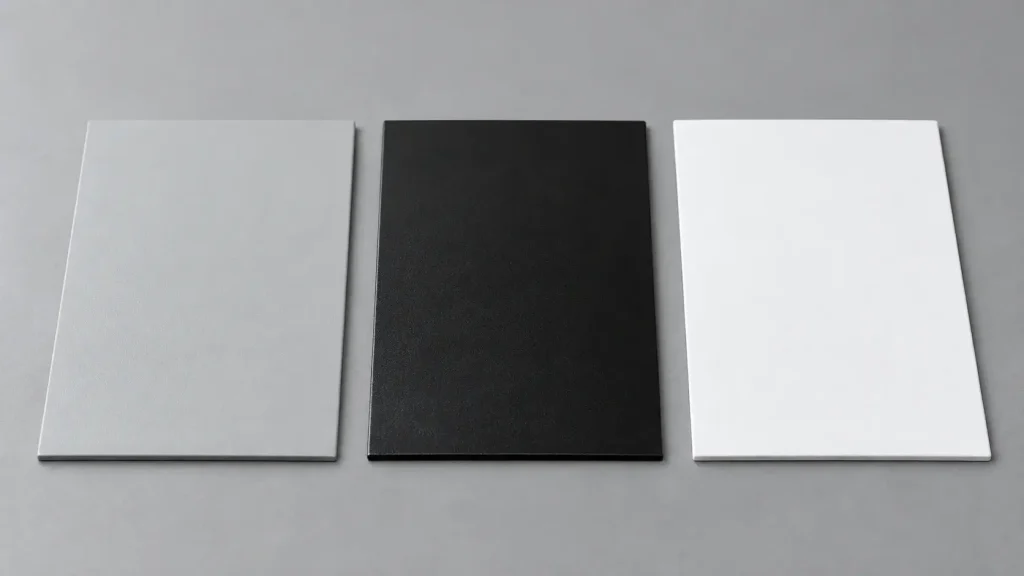
Official Color Names
The official RAL color directory, under its RAL CLASSIC entries, identifies RAL 7035 as Light grey, RAL 9005 as Jet black, and RAL 9016 as Traffic white. These references communicate a target shade across drawings and purchasing documents.
They do not select a particular coating formulation. RAL 7035 powder coating from an indoor hybrid range and a weather-resistant polyester product can share a color designation while serving different requirements.
What a Color Code Leaves Undefined
A color callout leaves gloss and texture open unless the drawing specifies them separately. It also leaves coating thickness, pretreatment, cure requirements, and functional masking unresolved.
Build the specification in this order: color reference, coating system, appearance requirements, functional boundaries, and acceptance method. Each addresses a different question. The powder product establishes the formulation; the approved sample establishes appearance; the drawing identifies surfaces that must remain usable after finishing.
For components developed through sheet metal fabrication services, include the finish requirements before releasing the formed geometry. A return flange, narrow recess, or concealed joint can change coating access and inspection options.
Compare Light Grey, Jet Black, and Traffic White
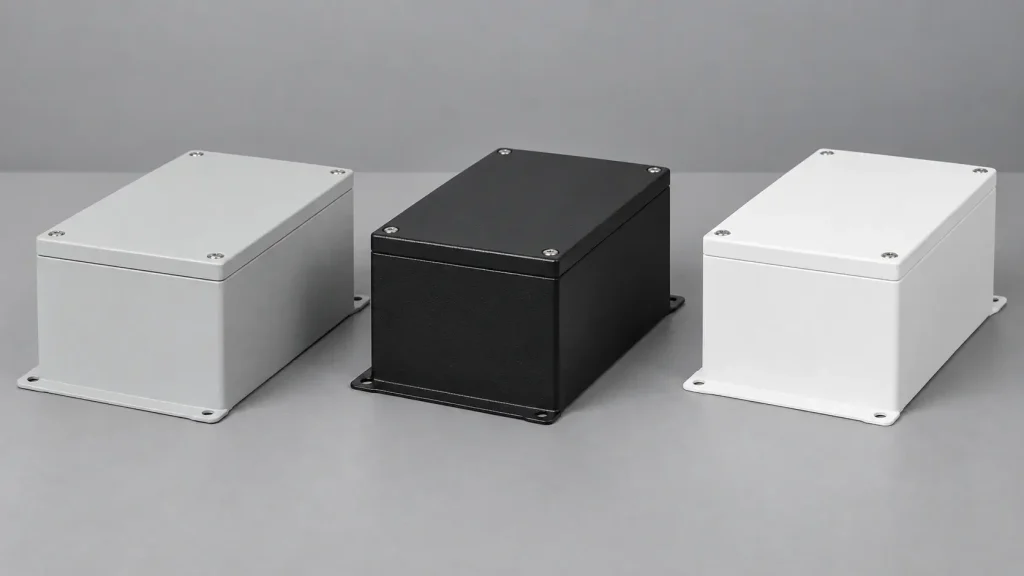
RAL 7035: A Neutral Equipment Appearance
Light grey is a practical candidate for equipment cabinets, machine covers, and control housings when the design calls for a restrained exterior. Evaluate it beside handles, labels, and adjacent panels rather than judging a small swatch alone.
For replacement components, the reference should include the existing equipment’s condition. Matching a new color standard does not necessarily reproduce an aged surface.
RAL 9005: Dark Surfaces and Strong Contrast
Jet black can establish contrast around light-colored panels or create a consistent dark housing. Its appearance depends heavily on surface finish. Check fingerprints, rubbing marks, and reflected lighting on the actual powder-coated sample.
Do not specify black as a substitute for an optical-performance requirement. A dark finish has no automatic qualification for stray-light absorption, conductivity, or electrostatic discharge control.
RAL 9016: Bright Panels and Clear Visual Contrast
Traffic white suits designs seeking a bright exterior or clear contrast with dark hardware. Assess cleaning marks and visible contamination under the intended lighting.
White does not establish cleanroom suitability, sterility, or antimicrobial performance. Those requirements need their own materials and assembly evaluation.
| Selection consideration | RAL 7035 | RAL 9005 | RAL 9016 |
|---|---|---|---|
| Visual direction | Neutral light grey | Deep black | Bright white |
| Candidate applications | Equipment cabinets and machine covers | Dark housings and contrasting trim | Bright equipment panels and covers |
| Sample review priority | Adjacent-panel consistency | Reflections and handling marks | Visible contamination and cleaning marks |
| Functional performance | Verify the coating system | Verify the coating system | Verify the coating system |
| Final approval | Agreed physical reference | Agreed physical reference | Agreed physical reference |
This is an appearance-selection framework, not a durability ranking or a claim that one shade universally hides defects.
Choose Gloss and Texture Before Approving Color
Matte, Satin, Glossy, and Textured Finishes
Words such as “satin” and “matte” communicate intent but need an agreed evaluation method. Where gloss matters, specify the measurement geometry and acceptable range. Define texture separately; a textured surface should not inherit an inspection method intended for smooth coatings without review.
The current ISO 2813:2014 gloss-measurement standard is identified as current in ISO’s publication-status notice. Its Abstract limits the method to non-textured coatings on plane, opaque substrates. A curved housing or coarse texture therefore needs an appropriate agreed approach.
A 2022 study of pigmented powder-coating preparation illustrates why gloss alone cannot settle appearance. Section 3.4, Table 14 reports almost identical 60° specular-gloss readings for samples E2 and H2: 91.63 and 91.80. The same table reports distinctness-of-image values of 55.20 and 38.77, respectively. This measure describes the clarity of reflected images.
The study compared preparation methods, not these RAL shades. It was not a BOONA project and does not establish BOONA capability. The engineering inference is to assess color, gloss, and surface appearance separately instead of assuming a similar gloss reading guarantees a visual match.
Approve a Physical Reference
In the section “What should be considered when working with digital RAL colour libraries?”, RAL’s guidance on digital color representations explains that screen images approximate physical samples and recommends a physical sample for the final color decision.
Use an approved powder-coated panel to establish the intended gloss and texture alongside the color reference. Agree on inspection lighting and viewing conditions. If instrumental color evaluation is required, identify its method and limit; different color-difference formulas should not be treated as interchangeable.
Pro Tip: Approve adjoining panels together under the agreed inspection lighting. Separate approvals can miss a visible mismatch at their seam.
Match the Coating System to the Environment
Indoor and Outdoor Exposure
Select powder chemistry against the operating environment. Epoxy-based systems, polyester products, and hybrids offer different combinations of properties. Consult the exact product’s technical data for UV exposure, cleaning chemicals, and service conditions.
An indoor product should not become an outdoor specification simply because the supplier can supply it in RAL 9005. Similarly, a light exterior does not establish acceptable solar heating or weathering performance. Pigmentation and formulation both matter.
Define the required evidence before selecting a coating. Accelerated exposure results describe the tested coating system and substrate preparation; they do not directly predict a complete enclosure’s service life.
Substrate Preparation and Cure
Coordinate cleaning and pretreatment with the substrate. Aluminum and steel can require different preparation routes. Oils, weld contamination, and inaccessible recesses can undermine an otherwise suitable coating.
For a BOONA DFM review, our decision rule is to identify retained hardware before planning the finishing sequence. If an insert, adhesive, or attached component cannot tolerate the specified preparation and cure conditions, plan its installation afterward or revise the route. A color change cannot resolve that sequencing conflict.
Cure requirements must follow the selected powder’s data and actual part-temperature conditions. The oven setting alone does not show that a heavy bracket and a thin cover received the same thermal history.
Protect Fits, Threads, and Electrical Interfaces
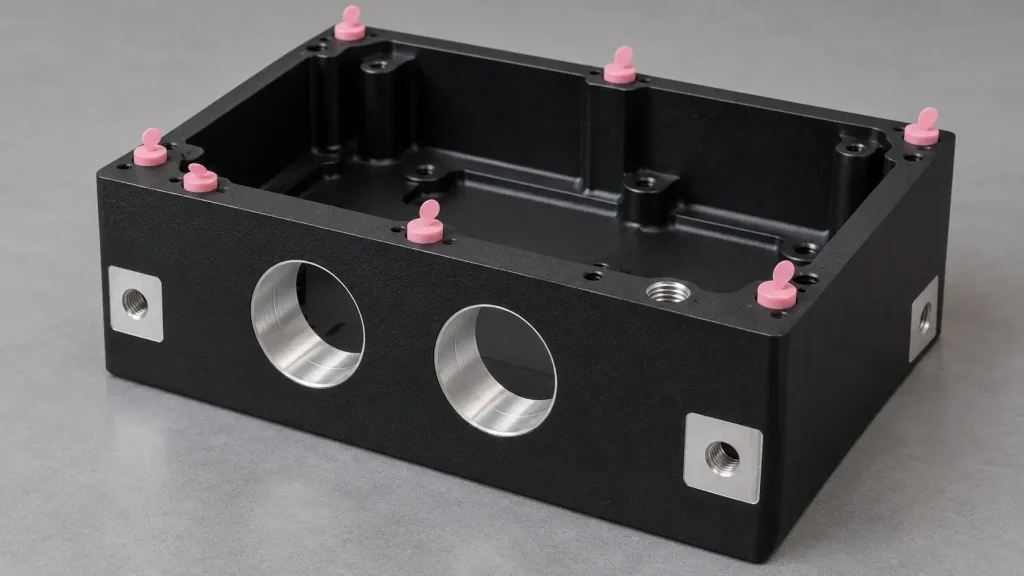
Plan Final Dimensions
Powder coating adds material. It can reduce slot clearance, obstruct threads, and alter how mating faces seat. Specify whether critical dimensions apply before or after finishing.
Our DFM recommendation at BOONA is to review the full contact footprint when a bonding interface must remain bare. Masking a fastener hole alone leaves the surrounding pad unresolved. Define the pad boundary and mating hardware contact area on the interface drawing.
Avoid relying on routine re-tapping as the default solution to coated threads. Removing coating can expose metal and leave debris; agree on that operation and its consequences before production.
Create a Surface-Priority Map
Use this matrix to assign requirements by function rather than applying a single finish note indiscriminately:
| Surface or feature | Drawing instruction | Acceptance check |
|---|---|---|
| Visible exterior | Color, gloss, texture, and appearance zone | Compare with the approved reference |
| Precision bore or thread | Masking boundary or finishing allowance | Verify final fit or dimension |
| Electrical bonding pad | Defined exposed-metal area | Check mask boundary; validate the assembled bond separately |
| Gasket land | Required coated or uncoated condition | Inspect continuity and the specified surface condition |
| Rack-contact area | Permitted location and mark condition | Check against the agreed non-cosmetic zone |
This is a purchasing and inspection framework, not a coating standard.
A rack location that works for processing may sit directly on a customer’s visible face. Resolve that conflict before approving samples. Likewise, a coating transition across a sealing land can introduce a step that the nominal color requirement never addresses.
Component finishing does not establish an enclosure’s IP rating, EMC performance, or high-voltage insulation qualification. Those depend on the completed assembly and relevant validation.
Manage Batch Consistency and Fixture Cost
Why Color Alone Does Not Determine Price
The actual powder product and its availability matter more than a simple grey-versus-black comparison. Small orders can also carry preparation, color-change, masking, and hanging work that does not scale directly with surface area.
Separate reusable fixtures from consumable masking when comparing quotations. Include sample approval and packaging. A cosmetically demanding cover may need protection against rubbing even when its coating meets the drawing at inspection.
Keep the approved powder product and finish reference under revision control. A supplier substitution should trigger review of appearance and required performance evidence, even if the RAL designation stays unchanged.
Application Example: High-Voltage Machine Insulation Research
A documented application goes beyond decorative cabinets. A 2023 study of powder-coated high-voltage insulation investigated conductors for rotating electrical machines. Section 2.3 identifies the commercial RAL 7035 epoxy/polyester hybrid powder. Section 4, “Materials,” specifies copper tubes measuring 800 mm long and 30 mm in outside diameter.
The researchers addressed electrically active defects that can initiate partial discharge and progressively damage insulation. Section 2.4.2, Figure 4 describes repeated coating to target a 1.5 mm insulation build. Section 2.5, Figure 6(d) reports no significant partial-discharge increase through an electric field strength of 10 kV/mm for the illustrated powder-coated specimen.
This was specialized multilayer insulation research, not an ordinary cabinet finish or a BOONA project. It does not establish BOONA capability or qualify every RAL 7035 product for high voltage. The engineering inference is that the formulation, controlled build, and defect assessment determine functional performance; the color code cannot replace them.
Specify RAL powder coating in Your RFQ
A finish-ready RFQ connects the drawing, powder product, and acceptance reference. Include:
- Color: the RAL designation and reference used for approval.
- Appearance: gloss requirement, texture, and visible inspection zones.
- Coating system: specified powder product or an approval procedure for alternatives.
- Preparation: substrate, pretreatment requirements, and relevant contamination restrictions.
- Thickness: permitted range and measurement locations appropriate to the geometry.
- Functional boundaries: mask map for threads, fits, bonding pads, and sealing surfaces.
- Dimensional state: critical requirements that apply after coating.
- Acceptance: sample approval, appearance conditions, and required coating evidence.
- Delivery: protection against rubbing or impact, plus identification of approved revisions.
Attach the interface drawing where mating parts determine masking boundaries. A colored CAD rendering communicates appearance but cannot define every functional surface.
For repeat orders, identify whether the reference is a new physical standard, an approved production sample, or an installed panel. Those targets can differ after exposure and handling. If replacement-panel matching matters, agree on the target before manufacturing.
Also identify who approves deviations. A last-minute powder substitution or moved rack mark should have a clear review path. Keep component inspection separate from assembled-equipment testing so each party knows what the delivery documentation demonstrates.
FAQs
What colors are RAL 7035, RAL 9005, and RAL 9016?
They are Light grey, Jet black, and Traffic white, respectively. Each provides a color reference; gloss, texture, and coating performance require separate specifications.
Does RAL 9005 mean matte black?
No. RAL 9005 specifies jet black. Matte, satin, glossy, and textured versions can differ in appearance. Define the finish and approve a representative sample.
Is RAL 9016 the same as RAL 9010?
No. They are separate RAL CLASSIC color designations. Avoid approving a substitute from a screen image or the description “white.” Compare physical references.
Why can coatings with the same RAL code look different?
Gloss, texture, surface preparation, and application conditions affect appearance. Lighting also changes how adjoining surfaces are perceived. Agree on a physical reference and inspection conditions.
Does powder coating affect holes and threads?
Yes. Deposited coating can change clearance and thread fit. Identify masking requirements or suitable allowances, then inspect critical features in their final delivery condition.
Which color is best for outdoor equipment?
The color code cannot answer that alone. Select a coating system suited to UV, moisture, and the intended environment, then evaluate the chosen shade within that system.
Turn the Color Choice into a Manufacturable Finish
Successful RAL powder coating selection connects the shade with a defined coating system, usable interfaces, and an agreed acceptance reference. Send BOONA your CAD, substrate details, and finish requirements to discuss surface finishing services. With no minimum order quantity and a free DFM review, you can resolve masking, final dimensions, and sample approval before committing to production.