
A sourcing team requests 40 black controller housings in an “ABS-like” material. Three vacuum-casting suppliers recommend three different polyurethane systems, yet every quotation uses the same label. One formulation prioritizes stiffness, another offers greater elongation, and the third provides better heat resistance.
Selecting by label alone can lead to cracked snap clips, flexible panels, split screw bosses, yellowed clear windows, or test results that do not represent the intended production thermoplastic.
PU casting resins for vacuum casting should be selected according to the part’s expected failure mode, geometry, operating environment, and validation plan. Terms such as ABS-like, PP-like, and PC-like describe broad property targets rather than identical chemistry or guaranteed long-term performance.
This guide compares the main polyurethane resin families used for vacuum casting and explains how engineering teams can evaluate datasheets, specify testing requirements, control production variables, and prepare a quotation request that suppliers can interpret consistently.
What Are PU Casting Resins?
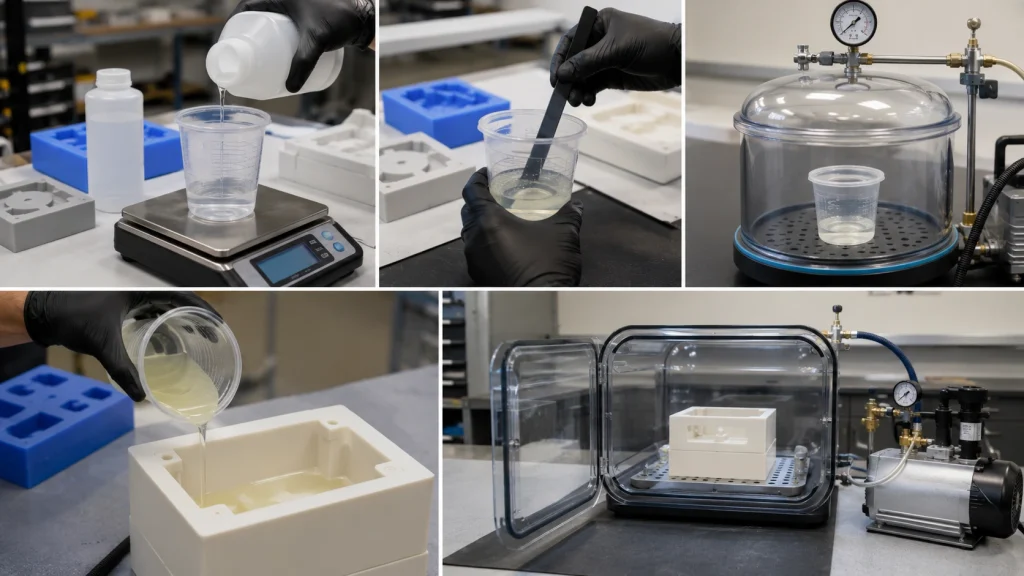
Most polyurethane casting resin types used in vacuum casting consist of two reactive liquid components. The casting team mixes them in a controlled ratio, removes trapped air under vacuum, fills a silicone mold, and cures the part at room temperature or in an oven.
The cured polyurethane becomes a thermoset. Unlike injection-molded ABS, polypropylene, or polycarbonate, it cannot simply be melted and processed again. Manufacturers instead formulate polyurethane systems to imitate selected characteristics of production plastics.
Common labels include:
- ABS-like for rigid housings and general-purpose parts
- PC-like for toughness, transparency, or higher heat performance
- PP-like for semi-rigid clips and flexible covers
- PMMA-like for transparent windows and lenses
- TPE- or TPU-like for soft grips, seals, buttons, and bumpers
The vacuum casting FAQ from BOONA describes a process in which PU resin fills a silicone mold under vacuum and then cures in an oven. It also lists rigid, transparent, flexible, high-temperature, and flame-retardant material options.
The suffix “-like” should begin the technical discussion rather than finish it. Buyers still need the exact resin designation, datasheet, cure schedule, color, surface finish, and acceptance criteria.
Quick Comparison of PU Casting Resins for Vacuum Casting
A useful vacuum casting resin comparison starts with what the prototype must prove. A cosmetic display housing requires a different property balance from a snap-fit cover, transparent lens, soft keypad, heated duct, or electrical enclosure.
| PU resin family | Intended simulation | Typical applications | Main selection risk |
|---|---|---|---|
| Rigid ABS-like | General-purpose ABS | Housings, covers, appearance models | Brittle clips or screw bosses |
| Tough PC-like | PC or PC/ABS | Impact-loaded enclosures | Creep and fatigue may differ from PC |
| Semi-rigid PP-like | PP or PE | Clips, lids, flexible covers | Panels may feel too soft |
| Clear PU | PMMA or clear PC | Windows, lenses, light covers | Haze, tint, bubbles, yellowing |
| Flexible PU | TPE or TPU | Grips, seals, buttons, bumpers | Hardness alone cannot define performance |
| High-temperature PU | Heat-resistant plastic | Ducts, fixtures, thermal prototypes | HDT confused with service temperature |
| Flame-retardant PU | FR enclosure material | Electrical prototypes | Rating depends on grade and thickness |
These categories do not have universal mechanical-property values. Two suppliers may both quote an ABS-like resin while offering different tensile modulus, elongation, impact resistance, color stability, and heat performance.
Request a named resin grade and compare values generated under matching test standards, specimen dimensions, conditioning methods, cure schedules, temperatures, and units. A fully post-cured laboratory specimen may not represent an early-demolded, pigmented, thin-walled casting.
How to Compare PU Casting Resins for Vacuum Casting by Datasheet
The strongest resin is not automatically the most suitable one. Engineers should connect every datasheet parameter to a feature, load case, or acceptance test.
Tensile Strength, Modulus, and Elongation
Tensile strength indicates the stress reached during a tensile test. Tensile modulus better represents stiffness, while elongation indicates how far the material can deform before fracture.
A high-strength resin with low elongation may support a thick cover but crack at a thin snap clip. A more ductile formulation may survive assembly but allow a broad housing panel to flex excessively.
Flexural Properties
Flexural modulus often provides a better comparison for enclosure stiffness. The official ISO 178:2019 plastics flexural-test standard covers flexural strength, modulus, and stress-strain behavior for rigid and semi-rigid plastics under defined conditions. ISO also warns that different specimen dimensions, preparation conditions, test speeds, and conditioning can produce results that are not directly comparable.
Impact Performance
Request the impact test method, specimen thickness, notch condition, temperature, and failure mode. “High impact” without these details has limited engineering value.
Thermal Data
Separate glass-transition temperature, heat-deflection temperature, short-duration exposure, and continuous operating temperature. Each describes a different limit.
Cure Condition
Confirm whether the published values require a full oven post-cure. An incomplete cure can reduce strength, heat resistance, and dimensional stability.
ABS-Like, PC-Like, and PP-Like Resins Compared
An ABS-like casting resin commonly provides balanced stiffness, cosmetic quality, paintability, and general mechanical performance. It often suits housings, covers, control panels, assembly models, and moderate functional testing.
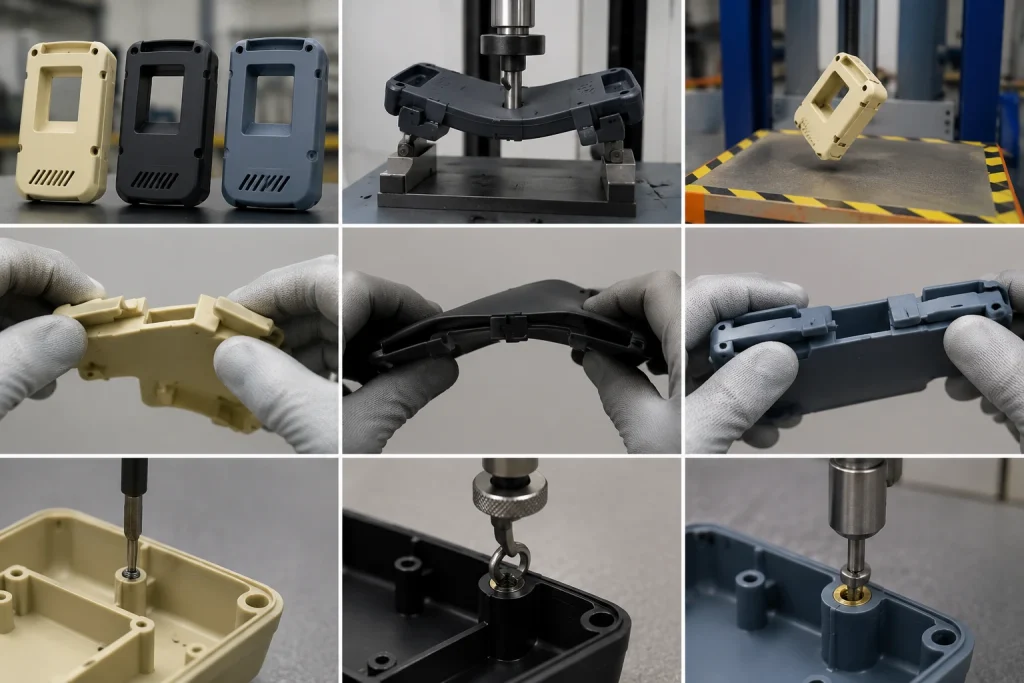
Choose an ABS-like grade when the project mainly needs:
- A rigid production-style appearance
- Ordinary ribs and screw bosses
- Cosmetic painting or integral color
- Fit and assembly validation
- Moderate mechanical loading
A tough PC-like or PC/ABS-like resin may suit thin walls, protective covers, or enclosures used in controlled drop tests. The label does not prove identical performance to production polycarbonate in creep, fatigue, environmental stress cracking, transparency, or flame behavior.
A PP-like vacuum casting resin generally prioritizes elongation and flexibility over panel stiffness. It may work better for clips, flexible lids, or covers that must bend during assembly.
| Design feature | Recommended starting family | Verify before approval |
|---|---|---|
| Large cosmetic panel | ABS-like | Flexural modulus and warpage |
| Drop-tested enclosure | Tough PC-like | Impact method and wall thickness |
| Snap clip | PP-like | Elongation and assembly cycles |
| Screw boss | Tough rigid PU | Crack resistance and torque |
| Flexible lid | PP-like | Permanent deformation and stiffness |
A PP-like polyurethane can demonstrate a hinge concept, but it should not validate the long-cycle fatigue life of an injection-molded polypropylene living hinge.
Clear and Flexible PU Casting Resins
A clear polyurethane casting resin requires more than a “transparent” designation. Final clarity depends on master-pattern polishing, silicone-mold cleanliness, resin tint, wall thickness, vacuum control, cure conditions, and secondary coating.
Define:
- Required transparency or visual clarity
- Acceptable haze and bubbles
- Permitted natural tint
- Wall-thickness range
- Surface gloss
- UV and heat exposure
- Whether polishing or clear coating is allowed
Clear PU can suit display windows, indicator covers, fluid-visualization models, and cosmetic lenses. It should not replace optical-grade PMMA or PC when refractive performance, long-term UV stability, scratch resistance, or a regulated optical specification controls the design.
A flexible PU resin also needs more than a hardness number. A Shore A polyurethane casting specification should include tear strength, rebound, compression set, abrasion resistance, flex-fatigue expectations, and chemical contact.
BOONA currently publishes selected flexible resin capability from approximately Shore A 30 to Shore A 90. Treat this as an available capability range rather than proof that one formulation can cover every hardness or application.
💡 Pro Tip: Approve a physical feel sample for flexible parts. Two formulations with the same Shore A hardness may show different rebound, tear resistance, surface friction, and compression behavior.
For clear parts, approve one unfinished casting and one fully polished or coated sample so the finishing process does not conceal the resin’s original haze or color.
High-Temperature and Flame-Retardant PU Resins
A high-temperature casting resin can support short thermal trials for ducts, electronic enclosures, lighting components, fixtures, and under-hood concepts. The RFQ should define the exposure profile rather than request “high heat resistance.”
Specify:
- Maximum temperature
- Exposure duration
- Continuous or intermittent heating
- Mechanical load during exposure
- Permitted deformation
- Number of thermal cycles
- Required post-cure
BOONA currently lists selected grades with datasheet heat resistance up to approximately 130°C. This figure should not be interpreted as the continuous service temperature of every cast component. Suitability depends on the named formulation, cure schedule, wall thickness, load, and exposure duration.
A flame-retardant vacuum casting resin requires even tighter control. Request the exact resin designation, test classification, specimen thickness, color limitations, and supporting report.
Current UL Solutions guidance states that UL 94 vertical testing evaluates burning time, afterglow, and flaming drips. For V-0, each specimen must have a burning time of no more than 10 seconds after each flame application, while the total for ten applications must not exceed 50 seconds. V-1 and V-2 allow up to 30 seconds per application and 250 seconds in total; V-2 also permits flaming drips that ignite the cotton indicator.
A resin’s material classification does not certify the complete assembled product.
Processing Variables and Conservative Production Planning
Selecting the right resin does not guarantee the right part. Mix ratio, moisture, pigment, working time, mold temperature, vacuum control, section thickness, post-cure, and mold condition can all change performance.
Key variables include:
- Component ratio and mixing quality
- Resin and silicone-mold temperature
- Moisture contamination
- Degassing time and vacuum level
- Fill time before gelation
- Pigment concentration
- Wall-thickness variation
- Cure and post-cure schedule
- Demolding time
- Mold-release residue
- Silicone-mold age
BOONA current published guidance states that one silicone mold typically produces 15–25 castings, that casting capacity may reach approximately 4–6 parts per day per mold, and that a 20-part batch often requires about 7–10 days.
For conservative quotation planning, treat 15–20 acceptable parts as the normal target, with approximately 25 as an upper-end result for favorable geometry and a compatible resin. Clear, abrasive, high-temperature, highly detailed, or difficult-to-demold parts may reduce mold life. This planning range is an engineering recommendation based on the broader published capability, not a guaranteed yield for every project.
The quotation should state the proposed number of silicone molds. Otherwise, later castings may not match the approved first parts in gloss, edge definition, or dimensions.
Application Example: Multiple PU Resins in One Handheld Device
Consider an order for 40 functional prototypes of a handheld diagnostic device. The design includes 2.2 mm housing walls, four snap clips, a transparent display window, a flexible keypad, and a controlled indoor drop-test program.
The first RFQ specifies one black ABS-like polyurethane for every component. That request cannot meet the transparency requirement, and the rigid resin may provide poor keypad feel or insufficient clip elongation.
A revised material plan separates the functions:
| Component | Starting resin family | Selection reason |
|---|---|---|
| Main housing | Tough ABS/PC-like PU | Panel stiffness and impact resistance |
| Snap regions | PP-like PU or revised rigid geometry | Greater assembly deformation |
| Display window | Clear PU | Transparency and polishability |
| Keypad | Shore A 60–70 flexible PU | Tactile response and rebound |
The validation plan includes:
- Dimensional inspection of the housing
- Screw-boss torque checks
- Repeated assembly and disassembly
- Defined drop height and orientation
- Window haze review under controlled lighting
- Keypad hardness and return-force evaluation
This prototype program does not claim that the cast materials equal the eventual injection-molded polymers. Each formulation answers a specific development question.
The same approach can support automotive controls, laboratory instruments, smart-home products, wearable devices, and electronic enclosures. One assembly may require several PU formulations rather than one generic resin.
What to Include in a Vacuum-Casting RFQ
A complete RFQ reduces substitutions and makes supplier quotations easier to compare. Include:
- 3D CAD and marked 2D drawings
- Quantity and batch schedule
- Intended production thermoplastic
- Preferred PU resin family
- Exact resin grade after approval
- Color standard and acceptable variation
- Gloss, texture, and painting requirements
- Tensile, flexural, impact, or hardness targets
- Temperature profile and applied load
- Chemical, fluid, or UV exposure
- Flame classification and required thickness
- Critical dimensions and tolerances
- Cure and post-cure requirements
- Inspection reports and certificates
- Golden-sample and change-control procedure
Ask suppliers to separate master-pattern, silicone-mold, casting, finishing, and testing costs. The quotation should also identify how many molds support the requested quantity.
The guide Vacuum Casting: Low-Volume Parts with Production Quality provides more context on silicone molds, typical batch sizes, master patterns, and bridge production.
Do not accept “equivalent to ABS” as a complete specification. Replace it with measurable requirements such as modulus, elongation, impact method, temperature exposure, color, hardness, and defined acceptance tests.
Common PU Casting Resin Selection Mistakes
The most common mistakes include:
- Specifying only “ABS-like”
- Comparing tensile strength without checking elongation
- Treating Shore hardness as a complete elastomer specification
- Comparing Shore A directly with Shore D
- Confusing HDT with continuous service temperature
- Assuming clear PU will remain colorless outdoors
- Treating PP-like PU as proof of production-PP hinge life
- Requesting V-0 without a grade, thickness, or report
- Treating laboratory datasheet values as guaranteed part values
- Ignoring pigment and post-cure effects
- Changing resin between batches without written approval
- Using a PU simulant to validate final thermoplastic compliance
Another error involves testing a prototype outside its intended validation scope. An ABS-like casting may verify appearance, assembly, ergonomics, and moderate handling, but it may not support decisions about ten-year fatigue life, long-term creep, aggressive solvents, continuous outdoor exposure, or final regulatory approval.
The article Why Vacuum Casting Is Ideal for Low-Volume Plastic Parts explains how the process fits between one-off 3D printing and production injection molding.
Define what the prototype must prove before selecting the resin. That decision prevents expensive testing that produces convincing-looking but technically inconclusive results.
FAQs About PU Casting Resins for Vacuum Casting
Are Vacuum-Casting Resins Real ABS, PP, or PC?
No. Most are polyurethane thermosets formulated to simulate selected characteristics of production thermoplastics. They may approximate stiffness, impact resistance, flexibility, transparency, or appearance, but they do not share identical chemistry or long-term behavior.
Which PU Resin Is Best for a Rigid Housing?
Start with an ABS-like resin for balanced stiffness and appearance. Consider a tougher PC-like formulation for thin walls or impact-loaded enclosures. Compare modulus, elongation, impact data, thermal exposure, and screw-boss performance.
Which Resin Works Best for Snap Fits?
A PP-like formulation may provide greater elongation during assembly. Clip thickness, root radius, undercut, strain, and required cycle count still control performance, so test the actual feature.
Can Clear PU Replace Optical-Grade PMMA?
Clear PU can suit cosmetic windows, light covers, and visual-flow models. It may not match optical-grade PMMA in haze, refractive performance, scratch resistance, or outdoor stability.
How Many Parts Can One Silicone Mold Produce?
For planning, use approximately 15–20 acceptable castings as a conservative target. Favorable geometry and resin conditions may approach 25, while complex, clear, abrasive, or high-temperature parts may shorten mold life.
Should the RFQ Name the Exact Resin Grade?
Yes. Approve the exact formulation before the full batch begins and require written approval for substitutions. This improves consistency between quotations, pilot samples, and later production.
Final Recommendation
Labels such as ABS-like, PP-like, PC-like, clear, flexible, high-temperature, and flame-retardant provide useful starting categories. They do not define a complete material specification.
Compare PU casting resins for vacuum casting according to the prototype’s intended failure mode and validation test:
- Use ABS-like grades for balanced rigidity and appearance.
- Consider PC-like systems for impact-loaded housings.
- Evaluate PP-like formulations for clips and flexible assembly.
- Specify haze, tint, finish, and exposure for clear parts.
- Add tear, rebound, fatigue, and compression requirements for flexible parts.
- Separate short-term heat resistance from continuous service temperature.
- Require grade- and thickness-specific evidence for flame claims.
Then confirm the exact resin, cure schedule, pigmentation, part geometry, inspection plan, mold quantity, and approved sample.
Vacuum casting delivers the greatest value when the engineering team defines what each prototype must prove—and recognizes which properties still require validation in the final production thermoplastic.
Preparing a vacuum-casting RFQ? Send BOONA the CAD files, quantity, intended production material, color, finish, mechanical tests, temperature exposure, Shore hardness, clarity requirements, and compliance criteria through its low-volume manufacturing service. BOONA can review the application and recommend a suitable rigid, semi-rigid, clear, flexible, heat-resistant, or flame-retardant PU system before the master pattern, silicone mold, and casting batch enter production.