
A drawing calls the material “surgical stainless steel.” The purchase order references ASTM F899. Another note requires passivation, yet the drawing says nothing about final hardness, heat-treatment condition or whether critical dimensions apply before or after finishing.
Every instruction sounds reasonable on its own. Together, they leave the machining supplier with several unanswered questions.
That gap is where surgical instrument machining problems usually begin. A precise component must still perform as part of a cutting, clamping, retracting, measuring or guiding instrument. Material chemistry, heat treatment, tool wear, burr removal, surface treatment and assembled inspection all affect that function.
Titanium reduces weight and offers useful corrosion characteristics, although its lower stiffness and difficult cutting behavior complicate thin features. Stainless steel provides more choices for hardness, stiffness and edge retention, but the term “surgical stainless” does not identify a complete material requirement.
A reliable manufacturing plan connects the drawing to the instrument’s final use.
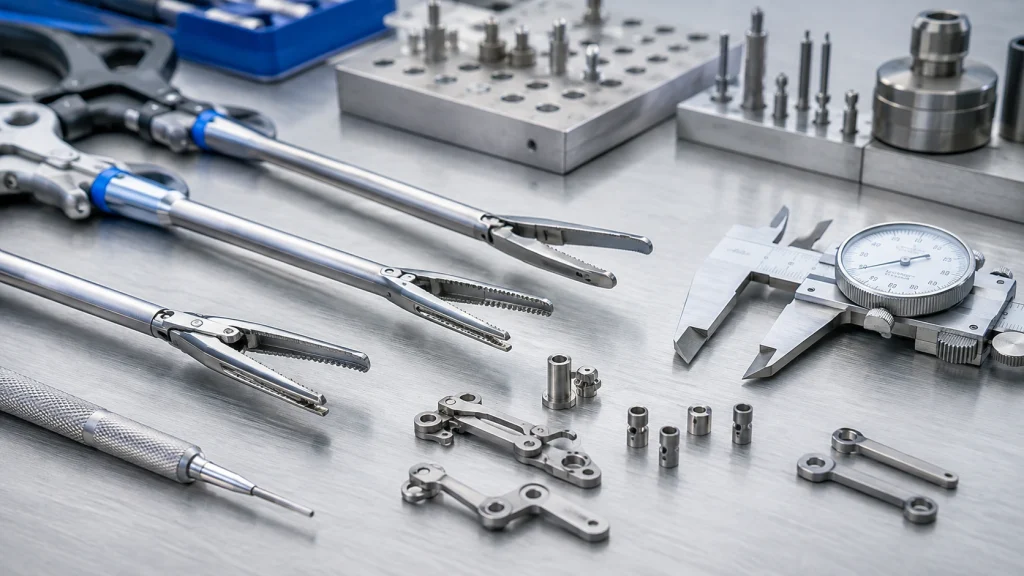
Why Surgical Instrument Machining Requires Functional Planning
A surgical instrument component may contain a long flexible arm, a precision pivot bore, small serrations, a narrow slot and a polished gripping surface. Each feature responds differently to cutting forces, heat treatment and finishing.
Thin sections can move as residual stress is released. A pivot hole may change after hardening. Polishing can soften a sharp transition, while aggressive deburring can round the top of a gripping tooth. Two matched jaws may pass individual dimensional inspection and still contact unevenly after assembly.
The ISO 7153-1 standard for surgical-instrument metals covers materials commonly used for standard instruments in general surgery, orthopaedics and dentistry. ISO reviewed and confirmed the 2016 edition in 2022. Its scope also explains that instruments for special applications, including implantology and minimally invasive surgery, may require additional requirements.
For CNC machining medical instruments, that distinction matters. A material standard establishes part of the specification. The product drawing must still define final condition, functional geometry, surface treatment and acceptance criteria.
Inspection may therefore include jaw registration, cutting-edge overlap, pivot movement, shaft straightness, spring force and internal burr condition alongside conventional dimensions.
Titanium vs Steel for Surgical Instrument Machining
The correct surgical instrument material selection depends on the instrument’s dominant mechanical function.
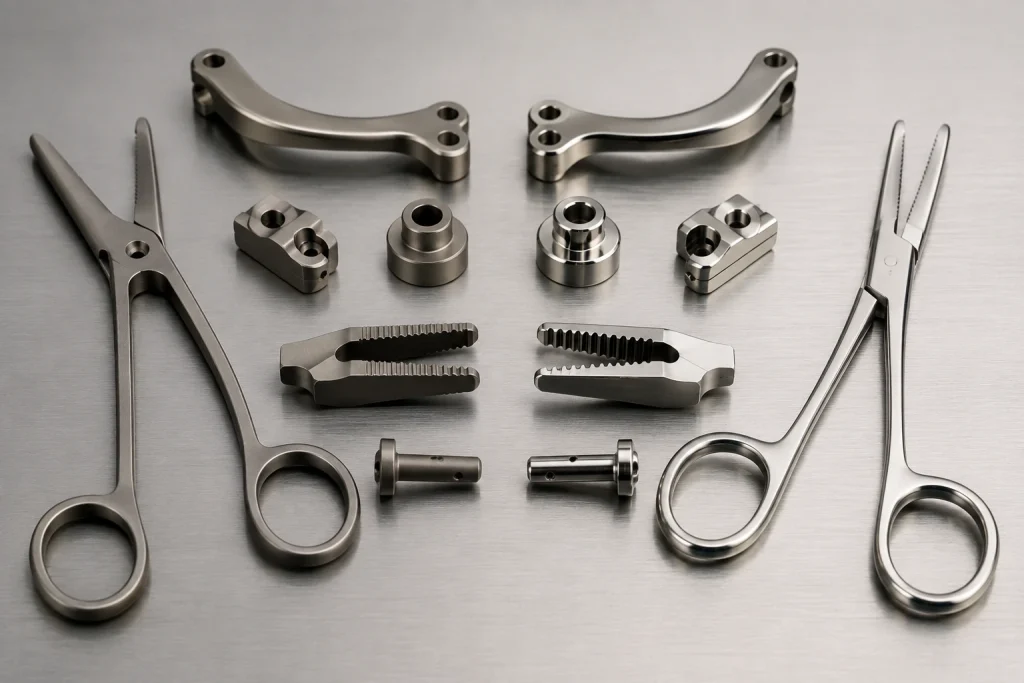
| Selection factor | Titanium | Stainless steel |
|---|---|---|
| Relative weight | Lower | Higher |
| Stiffness at equal geometry | Lower | Higher |
| Hardened cutting edges | Limited suitability for many designs | Martensitic grades are commonly considered |
| Primary machining concern | Heat concentration, adhesion and deflection | Work hardening, burrs and heat-treatment movement |
| Corrosion performance | Strong with the correct alloy and surface condition | Depends on grade, heat treatment and finishing |
| Magnetic response | Generally low | Varies by alloy family and condition |
| Common instrument roles | Handles, retractors and lightweight shafts | Jaws, scissors, clamps, pivots and cutting parts |
| Typical finishing route | Polishing and controlled surface finishing | Passivation, polishing or electropolishing |
Titanium is useful when a large steel handle or retractor would create unnecessary mass. That weight advantage comes with lower elastic stiffness. A titanium shaft built to the same dimensions as a steel shaft will generally deflect more under an equivalent load.
Steel offers a broader material range. Austenitic grades may suit corrosion-focused, non-cutting parts. Martensitic grades support hardened edges and gripping features. Precipitation-hardening steels can serve compact structural parts that require strength.
The final decision should account for geometry, mating materials, sterilization environment, finishing and inspection.
Selecting Stainless Steel for Surgical Instruments
The phrase “surgical stainless steel” does not tell a machining supplier which alloy to purchase, how to heat treat it or what hardness to inspect.
The ASTM F899-23 specification for wrought surgical-instrument steels covers the chemical requirements for austenitic, martensitic, precipitation-hardening and ferritic stainless steels used in surgical-instrument manufacturing. ASTM states that the hardness values and heat-treatment cycles shown in the standard are reference information. Mechanical properties, heat treatment and final hardness must come from another applicable material standard or an agreement between the purchaser and supplier.
Austenitic stainless steel
Austenitic grades may suit handles, tubes, housings and other non-cutting features. They resist corrosion well in appropriate conditions but can work harden rapidly during machining. Sharp tools and a positive chip load help prevent rubbing.
Martensitic stainless steel
Martensitic grades are relevant to stainless steel surgical instruments that require cutting edges, serrated jaws or wear-resistant contact features. The process plan must anticipate movement during hardening and tempering.
Precipitation-hardening stainless steel
PH stainless steels may support strong shafts, joints and compact load-bearing features. Drawings should specify the grade, starting condition, aging treatment and condition at final inspection.
When Titanium Is the Better Instrument Material
Titanium surgical instrument machining usually begins with a weight, corrosion or magnetic-response requirement.
A large retractor, handle or instrument body can weigh considerably less in titanium than in stainless steel. Lower mass may improve instrument balance and reduce fatigue during repeated handling. Titanium also supports applications where a low magnetic response is desirable, subject to the complete instrument design.
The design must compensate for lower stiffness. Long shafts, narrow probes and thin jaws may need thicker sections, reinforcement ribs or shorter unsupported lengths. A geometry copied directly from steel may feel too flexible when produced in titanium.
Sliding and threaded interfaces require additional attention. Titanium surfaces can gall when they rub under pressure, particularly when both mating components use similar alloys. Designers may need different mating materials, revised clearance, an approved lubricant or a suitable surface treatment.
The drawing should identify the exact titanium alloy and condition. An implant material standard should only be used when the product owner has confirmed its suitability for the instrument application.
Cosmetic surfaces and functional surfaces should also be separated. A polished handle has different acceptance needs from a sliding slot, pivot bore or gripping tip.
Machining Fine Titanium Features
Titanium’s low thermal conductivity keeps much of the cutting heat close to the tool edge. Adhesion, accelerated tool wear and chip recutting can then affect surface quality and dimensional consistency.
Fine titanium features require controlled tool engagement, effective chip evacuation, stable coolant delivery and predetermined tool-life limits. High-pressure coolant can help move chips away from the cutting zone, while stable tool entry reduces sudden changes in cutting force.
Micro-features make the process more sensitive because the tool-edge radius may become significant relative to the chip thickness. A 2025 study of ultrasonic-assisted Ti-6Al-4V micro-milling reported a 20.09% reduction in cutting forces under its experimental conditions.
That result should not be applied as a universal production improvement. It shows how strongly small-feature machining responds to engagement and vibration control.
A practical process plan may use separate roughing and finishing tools, predetermined tool-life limits, short tool overhangs and broad fixture support beneath thin areas. Critical features should be checked before a flexible part is released from the fixture.
Machining Surgical Stainless Steel
Stainless steel families respond differently to machining. Austenitic grades tend to work harden, while hardened martensitic steel shifts the challenge toward tool wear, heat and cutting-edge damage.
Rubbing creates particular risk. A worn tool or an excessively light cut can harden the surface instead of removing a stable chip. The following pass then encounters greater resistance, which increases heat and burr formation. Maintaining a positive chip load and replacing tools before edge breakdown helps control this cycle.
Heat-treatment sequence should be decided before CNC programming. Machining martensitic components in a softer condition may improve tool life, but the hardening cycle can move thin arms, closely spaced slots or asymmetric jaws.
Final grinding, reaming, lapping or wire EDM may be needed after heat treatment. Critical drawing dimensions should identify the inspection stage clearly:
- Before heat treatment
- After hardening and tempering
- After passivation or electropolishing
- After final assembly
For precision machining surgical tools, component dimensions cannot always predict instrument performance. A pivot bore may meet diameter while the completed joint still drags because of misalignment, blade pressure or surface condition.
DFM for Jaws, Serrations and Pivot Features
Serrated jaws need controlled tooth pitch, depth, root shape and alignment between mating patterns. A deburring method that cleans the tooth roots can also round the working peaks and reduce grip.
Deep serrations may limit tool access. A form cutter, wire EDM or another process may be required when a milling tool cannot reach the root without leaving excessive radius or taper.
Pivot joints combine hole size, position, concentricity, clearance and final surface condition. Heat treatment can alter alignment, while polishing may enlarge a hole or round a locating edge. Final reaming or lapping may provide better control for joints requiring smooth motion with limited lateral play.
Spring arms and thin handles need balanced material removal. Heavy cutting from one side can release stress and change free-state geometry. Fixtures should support the part without forcing it into a position that disappears after unclamping.
💡 Pro Tip: Inspect matched jaws both separately and after assembly. Two components can meet their individual dimensions while the closed instrument still shows tip mismatch or incomplete serration contact.
Complex multi-face features can be reviewed through BOONA 5-axis CNC machining service.
Burr Control, Cleaning and Contamination
Cross-holes, cannulations and intersecting slots can retain burrs that remain invisible from the exterior. Deburring must remove them without opening a precision hole, changing a working edge or rounding a fine instrument feature.
A 2025 peer-reviewed study of Ti-6Al-4V microchannel deburring compared abrasive processing, large-pulsed-electron-beam treatment and a hybrid process. Under the reported test conditions, the hybrid method achieved a minimum burr height of 16.25 µm and an error area of 49.97 µm². Those values represented reductions of 78.26% and 59.34% compared with abrasive deburring alone.
The study evaluated a specific process for microchannels. Its results demonstrate why burr height, residual area and feature damage should be inspected separately rather than judged only by visual appearance.
Cleaning must remove coolant, abrasive residue and embedded contamination. Titanium components should be protected from ferrous blasting media and shared tools that could transfer iron. Stainless steel parts need controlled handling after final passivation or electropolishing.
A machined and cleaned component should not be described as a sterile finished device unless the validated cleaning, packaging and release processes are included in the approved scope.
Surface Finish in Surgical Instrument Machining
Surface treatment affects corrosion behavior, fit, edge condition and appearance. Polishing may expose machining defects, but it cannot restore an incorrect pivot location or a damaged serration. Excessive material removal can also round a sharp edge or change a precision fit.
The ASTM A967/A967M-25 passivation specification covers nitric-acid, citric-acid and electrochemical treatments for stainless steel parts. It also provides alternative tests for confirming treatment effectiveness. The purchase order should identify the required process and acceptance method rather than state only “passivate.”
ASTM B912-26 covers passivation of 200-, 300- and 400-series stainless steels and precipitation-hardening alloys through electropolishing. The current edition was published in 2026.
For finished instruments, ASTM F1089-24 provides corrosion-test procedures and evaluation criteria for new and reusable stainless steel surgical instruments. It recommends passivation, electropolishing or both before corrosion evaluation.
Final surface roughness, cosmetic requirements and dimensional acceptance should apply after the selected finishing process.
Application Example: A Reusable Orthopedic Depth Gauge
Consider a common reusable depth-gauge architecture with a long body, a sliding indicator and a small distal hook. The body may use titanium to reduce weight, while the hook or contact feature uses hardened stainless steel for wear resistance.
For DFM discussion, assume an illustrative design with a 180 mm shaft, a 1.2 mm longitudinal slot and 0.03 mm running clearance around the sliding component. These values are examples rather than universal instrument requirements.
The most serious manufacturing risk may be measurement drag. A small burr inside the slot, slight shaft bow or uneven polishing can cause the indicator to hesitate. The instrument may still look undamaged, yet friction can prevent the slider from reaching its true position.
The process plan should therefore control shaft straightness, slot width, internal burrs and sliding resistance after finishing. The titanium body and steel hook also need compatible joining, cleaning and surface-treatment requirements.
This architecture shows why a mixed-material instrument can be practical. Titanium addresses weight, while steel handles localized wear. Final inspection focuses on smooth motion and repeatable measurement rather than component dimensions alone.
Quality Controls for Surgical Instrument Machining
The FDA’s Quality Management System Regulation became effective on February 2, 2026. It amended the device current good manufacturing practice requirements in 21 CFR Part 820 and incorporated ISO 13485:2016 by reference.
Finished-device manufacturers remain responsible for their regulatory obligations. Machining suppliers support those systems through controlled drawings, traceable materials, documented inspections and managed special processes.
A purchase order may require:
- Material certificates and heat or lot identification
- Approved drawing and revision level
- Heat-treatment records
- Passivation or electropolishing certificates
- First-article inspection results
- Defined sampling and acceptance criteria
- Nonconformance controls
- Supplier-change notification
- Identification of matched component sets
A general quality certificate does not define the requirements for one surgical instrument. The drawing, purchase order and quality agreement should establish responsibilities and required records.
BOONA supplies precision-machined surgical instrument components. Finished-device assembly, validated cleaning, sterile packaging and regulatory release are included only when they are covered by a separately approved project scope.
Example Surgical Instrument Drawing Notes
A titanium component note may follow this structure:
MATERIAL: TITANIUM ALLOY PER CUSTOMER MATERIAL SPECIFICATION.
REMOVE ALL BURRS AND UNCONTROLLED SHARP EDGES.
CRITICAL DIMENSIONS APPLY AFTER FINAL MACHINING.
NO FERROUS BLAST MEDIA OR FERROUS CONTAMINATION PERMITTED.
A stainless steel component note may read:
MATERIAL: STAINLESS STEEL PER ASTM F899 AND
APPLICABLE CUSTOMER MATERIAL SPECIFICATION.
FINAL HARDNESS: PER CUSTOMER DRAWING AND APPROVED HEAT-TREATMENT SPECIFICATION.
PASSIVATE PER ASTM A967/A967M.
CRITICAL DIMENSIONS APPLY AFTER HEAT TREATMENT
AND FINAL SURFACE FINISH.
These examples show how requirements can be organized. They do not establish a universal alloy, hardness, roughness or passivation process.
The instrument owner should define the exact material grade, starting condition, final hardness, surface finish, burr limit and verification method.
Functional requirements may also cover jaw alignment, cutting-edge overlap, pivot torque, shaft straightness, spring force or sliding resistance. The drawing should state whether those controls apply to individual parts, matched components or the completed assembly.
FAQ
Is titanium better than stainless steel for surgical instruments?
Neither material is universally better. Titanium offers lower weight and generally low magnetic response. Stainless steel provides greater stiffness and a wider range of hardness and cutting-edge options.
Which stainless steel is used for surgical instruments?
ASTM F899 includes austenitic, martensitic, precipitation-hardening and ferritic steel classes. The instrument function, required hardness and customer specification determine the appropriate grade.
Why is titanium difficult to machine?
Titanium retains heat near the cutting edge, can adhere to tools and may deflect in thin sections. Stable engagement, sharp tooling, coolant delivery and chip evacuation are central to process control.
Should stainless steel surgical instruments be passivated?
Passivation or electropolishing is commonly specified after machining and finishing. The drawing or purchase order should identify the applicable standard, treatment and verification method.
Can implant titanium standards be used for instruments?
They may be used only when the product owner confirms that the material standard fits the instrument application. An implant specification should not be applied automatically to a reusable tool.
What should a surgical instrument drawing include?
It should identify the material grade, condition, hardness, final dimensions, burr requirements, surface treatment, inspection criteria, traceability and any assembled-function controls.
Conclusion: Plan Surgical Instrument Machining Around Function
Successful surgical instrument machining begins with a complete material and functional specification.
Titanium can reduce weight in handles, retractors and selected shaft designs. Its lower stiffness, galling risk and cutting behavior must be addressed through geometry, mating-material selection and process planning.
Stainless steel provides more options for hardened edges, jaws and wear-resistant joints. The drawing must define the steel family, final condition, hardness and finishing requirements rather than rely on the phrase “surgical stainless.”
Fine serrations, pivots, slots and internal passages require controlled tool wear, deliberate deburring and inspection after heat treatment and finishing. The completed component must also remain within the quality and traceability system established by the medical-device manufacturer.
Send BOONA your instrument drawing, material specification and surface-finish requirements through our CNC machining service. An early DFM review can identify tool-access, distortion, burr-control and inspection risks before production.