
A robot part can look perfect after machining and still create problems during motion testing. A wrist adapter flexes under tool load. A gripper base loses repeatability after repeated clamping. A lightweight arm link passes visual inspection but vibrates when the robot accelerates. These problems often start before CNC machining begins — at the material selection stage.
For robotics engineers and sourcing teams, 6061 vs 7075 aluminum is not simply a stronger-versus-weaker comparison. The better decision is where each alloy creates measurable value in the robot assembly. 6061 aluminum usually gives the best balance of machinability, corrosion resistance, surface finish, lead time, and cost. 7075 aluminum becomes valuable when strength, compact geometry, or deformation resistance matters more than raw material price.
Industrial robot adoption remains at a historically high level. According to the International Federation of Robotics, 542,000 industrial robots were installed worldwide in 2024, keeping annual installations above 500,000 units for the fourth consecutive year. Asia accounted for 74% of new industrial robot deployments in 2024.
For manufacturers developing robot parts, this growth creates more demand for lightweight, stable, and repeatable CNC machined robotics components. Teams that are planning multiple robot brackets, joints, housings, and end-effector parts can also review Boona guide to CNC machining for robotics to understand how material choice, tolerance control, and production strategy work together in custom robot hardware.
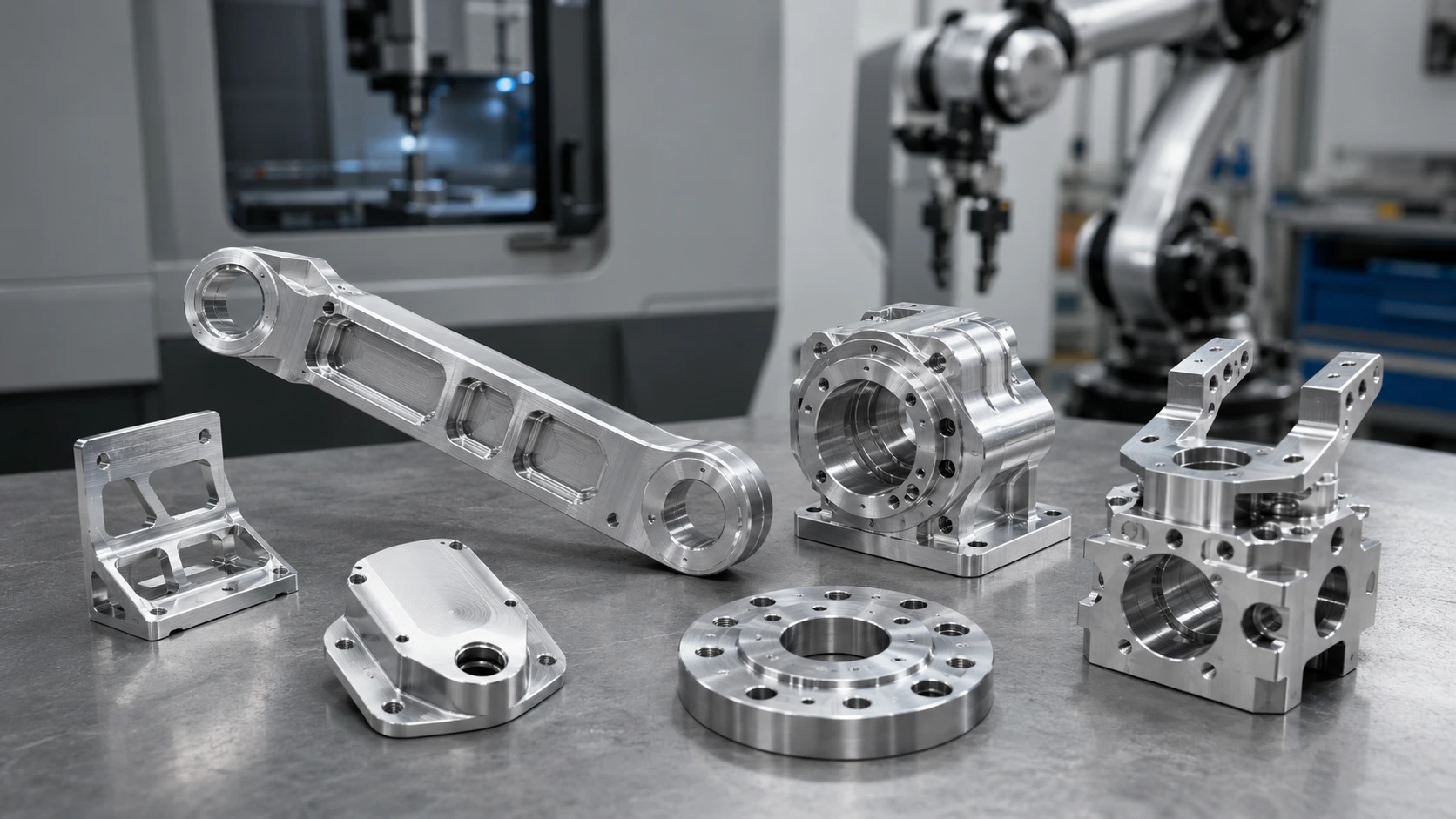
6061 vs 7075 Aluminum: Quick Engineering Comparison
6061 and 7075 are both common choices for CNC machined aluminum parts, but they solve different engineering problems. 6061-T6 is the practical starting point for many robot brackets, housings, covers, sensor mounts, adapter plates, and prototype frames. It cuts cleanly, accepts anodizing well, and keeps development cost under control.
7075-T6 or 7075-T651 provides much higher strength. ASM/MatWeb 6061-T6 data lists 6061-T6 at about 310 MPa ultimate tensile strength and 276 MPa yield strength. ASM/MatWeb 7075-T6 data lists 7075-T6/T651 at about 572 MPa ultimate tensile strength and 503 MPa yield strength. That difference matters when a part must resist torque, bending, clamping force, or permanent deformation.
| Selection Factor | 6061-T6 Aluminum | 7075-T6 / 7075-T651 Aluminum |
|---|---|---|
| Typical yield strength | About 276 MPa | About 503 MPa |
| Typical tensile strength | About 310 MPa | About 572 MPa |
| Density | About 2.70 g/cm³ | About 2.81 g/cm³ |
| Elastic modulus | About 68.9 GPa | About 71.7 GPa |
| Machinability | Easier, faster, lower tool wear | Good, but harder and more expensive |
| Corrosion resistance | Better general corrosion resistance | Lower; coating is often recommended |
| Best robotics use | Brackets, covers, housings, plates, prototypes | Joints, arm links, actuator mounts, high-load adapters |
| Cost position | Lower | Higher |
For most robotics projects, 6061 should get the first review. 7075 should enter the discussion when a specific feature needs higher yield strength or better resistance to deformation.
Why 6061 Aluminum Works for Many Robot Parts
6061 aluminum works well because many robot parts do not need aerospace-level strength. They need stable dimensions, clean threaded holes, smooth surfaces, predictable anodizing, and reasonable cost. That description fits a large share of robot hardware.
Typical 6061 robot parts include camera brackets, LiDAR mounts, electronics covers, battery housings, sensor plates, cable routing blocks, lightweight frames, test fixtures, and general adapter plates. These components usually support alignment or assembly rather than carrying the highest load in the system.
For early-stage development, 6061 helps teams move faster. Robotics projects often change hole patterns, sensor angles, cable slots, bearing clearances, and cover geometry after the first assembly test. Using 6061 for the first CNC prototype keeps machining practical while still giving the team real metal behavior. Plastic prints can check shape, but aluminum prototypes reveal thread quality, stiffness, surface finish, and assembly fit more realistically.
6061 also performs well when the final part needs a clean appearance. Clear anodizing, black anodizing, bead blasting, and brushing all work well for visible robot parts. For teams ordering prototype or low-volume components, Boona precision CNC machining services can support aluminum parts with functional tolerances, surface finishing, and inspection requirements.
Why 7075 Aluminum Matters in High-Load Robotics
7075 aluminum earns its place when a robot part has little room for deformation. A compact joint plate, wrist adapter, gearbox housing, or actuator mount may look small, but it can carry large loads. Torque from a servo, bending from an arm link, impact from a legged robot, or clamping force from a gripper can expose weak material choices quickly.
The biggest advantage of 7075 is yield strength. A robot component does not need to snap to become a problem. A small amount of permanent deformation can shift a bearing bore, reduce dowel pin accuracy, misalign a motor face, or create repeatability drift. In those situations, 7075-T651 can give a stronger safety margin than 6061-T6.
Common 7075 robot applications include high-strength robot arm links, joint side plates, actuator brackets, end-effector adapters, high-force gripper bases, and lightweight structural frames. For robot arms in particular, material selection should also consider joint load, bearing support, bracket stiffness, and repeatability, which Boona discusses in more detail in its guide to robot arm components machining.
7075 does bring trade-offs. It costs more than 6061, may require more controlled machining, and usually needs better surface protection in humid, outdoor, or industrial environments. Treat it as a performance material, not a default material.
Strength, Stiffness, and Weight: What Actually Changes?
The strength difference between 6061 and 7075 is real. The stiffness difference is much smaller. This point matters because many teams expect 7075 to automatically make a robot part stiffer or lighter. Material selection helps, but geometry still does most of the work.
6061-T6 and 7075-T6 have similar elastic modulus values, roughly 69–72 GPa. That means a part with the same geometry will not become dramatically stiffer just because the alloy changes. If the robot link flexes too much, engineers should review wall thickness, rib layout, pocket depth, bearing support, bolt spacing, and load path before relying only on an alloy upgrade.
Density also stays close. 6061 is about 2.70 g/cm³, while 7075 is about 2.81 g/cm³. 7075 is not lighter by density. Its benefit comes from higher strength, which may allow thinner walls, deeper pockets, or smaller cross-sections while keeping enough yield strength.
A good design keeps material around bearing bores, dowel holes, motor seats, threaded holes, and tool interfaces. Remove weight from low-stress regions. Add fillets where loads change direction. Avoid deep narrow pockets that add machining cost but do little for real robot performance.
6061 vs 7075 Aluminum in CNC Machining
The 6061 vs 7075 aluminum choice also affects machining risk. 6061 is easier to cut, easier to deburr, easier to finish, and more forgiving during prototype changes. It supports efficient feeds and speeds, stable chip control, and clean surface quality on many 3-axis and 5-axis CNC parts.
7075 machines well compared with many high-strength materials, but it needs more attention. Its higher strength can increase cutting forces, tool wear, and workholding demands. Thin-wall 7075 parts may still move after roughing if the machining strategy removes material unevenly. Deep pockets, tight internal corners, and long-reach tools can also raise cycle time.
Robotic components often include several functional features on different faces: bearing bores, dowel holes, motor mounting patterns, wire channels, sensor pockets, and flat mating surfaces. When these features must stay aligned, 5-axis CNC machining can reduce setups and improve access to complex geometry.
DFM review should happen before quoting, especially for parts with ±0.02 mm to ±0.05 mm functional tolerances, reamed dowel holes, bearing seats, or tight true position callouts. Over-tolerancing every pocket increases cost. Under-tolerancing the real alignment features creates assembly problems.
Corrosion, Anodizing, and Surface Finish
Surface finish is not only cosmetic in robotics. It can affect corrosion resistance, wear behavior, camera reflection, part marking, cleaning, and assembly fit. 6061 usually gives a more forgiving path for visible aluminum parts. It anodizes well and offers better natural corrosion resistance than 7075.
7075 can also be anodized, but the process needs more control. Because 7075 contains more zinc and copper, color consistency may be less predictable than 6061. That may not matter for an internal joint plate, but it can matter for visible robot covers, customer-facing devices, or parts that must match a brand color.
Hard anodizing can help both alloys when the part needs better wear resistance. Robot wrist adapters, sliding contact areas, gripper structures, and high-use tooling plates may benefit from a harder surface. The team must still review dimensional change after anodizing because coating thickness can affect holes, slots, and close-fit surfaces.
For robot grippers and end effectors, finishing becomes even more application-specific. A smooth contact surface may protect a cosmetic workpiece. A textured surface may improve grip. A vacuum sealing face may need flatness and surface finish control. Boona guide to CNC machining for robot grippers and end effectors covers those contact and EOAT details in more depth.
Cost and Procurement: Where 7075 Is Worth It
Material cost rarely tells the whole story. 6061 usually costs less, machines faster, and supports easier sourcing. That makes it the better choice for many development cycles, especially when the design may still change.
7075 increases raw material cost and may increase machining cost. It can also add finishing requirements if corrosion resistance matters. These costs are easy to justify for a joint plate that protects a precision reducer or a wrist adapter that holds tool alignment. They are harder to justify for a simple cover plate or sensor bracket.
This is especially true for humanoid robots, where different components may need very different material strategies. Covers and sensor mounts may work well in 6061, while leg joints, actuator interfaces, and compact load-bearing frames may need 7075 or another high-strength material. For more application-specific examples, see Boona article on humanoid robot parts machining.
Procurement teams should connect material choice to function. Does the part carry torque? Does it hold bearing alignment? Does it see impact? Does it support a high-force gripper? Does it need to stay flat after repeated assembly? If the answer is yes, 7075 may deserve the extra cost.
If the part only provides mounting, enclosure, cable protection, or moderate support, 6061 often gives better total value. A mixed-material strategy usually works best: 6061 for general hardware, 7075 for compact load-bearing parts, and stainless steel or engineering plastics where wear, friction, insulation, or thermal behavior matters. Boona CNC machining material options can help teams compare practical metal and plastic choices before RFQ.
Application Example: Lightweight Robot Wrist Adapter
A common material decision appears in robot wrist adapters and tool interface plates. During early testing, a team may machine the first adapter from 6061-T6 because the geometry is still changing. That is usually the right move. 6061 keeps prototype cost reasonable and allows quick updates to bolt patterns, cable slots, dowel holes, and clearance pockets.
After motion testing, the adapter may show no visible damage, but the robot still behaves inconsistently. In typical prototype projects, this often appears as small alignment drift, uneven contact at the tool interface, or position variation after high-speed movement. A 0.03–0.08 mm change at a tool interface may not look dramatic on a bench, but it can affect picking accuracy, inspection repeatability, or fixture loading.
The better fix is not always to make everything thicker. A stronger revision may keep the same interface size, add local ribs around the bolt pattern, reduce unnecessary pocket depth near the load path, and move the final functional part to 7075-T651. The design changes improve stiffness where the load travels. The material change improves resistance to permanent deformation.
💡 Pro Tip: Use 6061 for early robot prototypes when geometry is still changing. Move selected parts to 7075 only after testing shows load, deflection, clamping, or alignment problems that justify the higher material and machining cost.
This pattern shows how alloy choice should follow test evidence. 6061 helps teams learn quickly. 7075 belongs in the final design when load, deflection, or service-life requirements justify the cost.
Design Tips for CNC Machined Aluminum Robot Parts
Good aluminum robot parts come from material selection and geometry working together. Even 7075 can perform poorly if the part has sharp internal corners, weak load paths, poor thread engagement, or over-aggressive pocketing.
Start with internal radii. Small cutters increase machining time and leave weaker corners. Larger fillets reduce stress concentration and allow more stable cutting tools. Around bearing bores, motor faces, and mounting bosses, keep enough material to support load transfer.
Thread planning also matters. Aluminum threads can wear after repeated service. For parts that will be assembled and removed many times, consider threaded inserts, steel bushings, or longer engagement length. This is especially useful for prototype frames, gripper adapters, and modular test platforms.
Tolerance strategy should match function. Bearing bores, dowel pin holes, motor mounting faces, reducer seats, and tool interface patterns deserve tighter control. Cosmetic pockets, cable slots, clearance holes, and outside profiles can often use general tolerances.
For complex aluminum robot components, early DFM review should cover material temper, blank size, machining sequence, workholding marks, anodizing allowance, and inspection method. These details help prevent expensive rework when a prototype moves from first sample to functional testing.
6061 vs 7075 Aluminum: Final Recommendation for Robot Parts
For most robotics projects, 6061 aluminum should be the practical default. It offers enough strength for many brackets, covers, housings, plates, mounts, and prototype structures. It also keeps machining cost reasonable, supports clean anodizing, and allows faster design iteration.
7075 aluminum should be selected with intent. Use it when the part must resist bending, torque, impact, high clamping force, or permanent deformation. It is a strong choice for robot joints, compact arm links, actuator mounts, gearbox housings, wrist adapters, high-force gripper bases, and humanoid robot load-bearing structures.
Do not expect 7075 alone to solve every stiffness or weight problem. Geometry, load path, wall thickness, ribs, fillets, fastener layout, and machining strategy still decide much of the final performance. The best engineering decision often uses both alloys in the same robot: 6061 for practical general hardware and 7075 for the parts that truly carry load.
When comparing 6061 vs 7075 aluminum, the strongest answer is not always the most expensive alloy. The best answer is the alloy that matches the part’s function, tolerance needs, finishing requirements, and test data.
FAQs
Is 7075 aluminum stronger than 6061 aluminum?
Yes. 7075-T6 aluminum is significantly stronger than 6061-T6 aluminum. Typical data shows 7075-T6/T651 at about 503 MPa yield strength, while 6061-T6 is about 276 MPa. This makes 7075 better for high-load robot joints, compact actuator mounts, structural links, and parts exposed to torque or repeated stress.
Is 6061 aluminum strong enough for robot parts?
6061 aluminum is strong enough for many robot parts, especially brackets, sensor mounts, camera mounts, covers, housings, adapter plates, and moderate-load structures. It is often the more practical choice when the part needs good machinability, corrosion resistance, anodizing quality, and cost control.
When should robot designers choose 7075 instead of 6061?
Choose 7075 when the part must resist bending, permanent deformation, impact, high clamping force, or repeated mechanical stress. Typical examples include robot arm joints, humanoid robot leg components, actuator mounts, gearbox housings, high-force gripper bases, and thin lightweight structural links.
Can 7075 aluminum be anodized?
Yes, 7075 aluminum can be anodized, but the finish may require more process control than 6061. Because 7075 contains more zinc and copper, color consistency and corrosion resistance can be less predictable. For functional robot parts, hard anodizing or protective coating may matter more than cosmetic color matching.
Which aluminum alloy is easier to CNC machine, 6061 or 7075?
6061 is generally easier and more cost-effective to CNC machine. It cuts cleanly, supports good surface finish, and works well for prototypes and low-volume production. 7075 also machines well, but its higher hardness and strength can increase tool wear, machining time, and workholding requirements.
Is 7075 aluminum lighter than 6061 aluminum?
Not in a meaningful density-based way. Both are lightweight aluminum alloys, and their densities are close. The benefit of 7075 comes from higher strength, which may allow engineers to design thinner or more compact parts while maintaining load capacity.
Get CNC Machined Aluminum Robot Parts Made with the Right Alloy
[IMAGE SUGGESTION: CNC machined aluminum robotic joint, wrist adapter, gripper base, and arm link arranged for final inspection, with CMM or inspection tools in the background, no text.]
If your team is choosing between 6061 and 7075 for robot joints, arm links, grippers, actuator mounts, wrist adapters, or lightweight structural parts, Boona can help review material selection, tolerances, surface finish, DFM risks, and inspection requirements before machining starts. Send your CAD files, drawings, and application notes to Boona CNC machining for robotics team to get practical feedback and a quote for custom aluminum robot parts.