
A machine-vision manufacturer orders a large aluminum calibration plate with deep pockets, precision bores, and a tight free-state flatness requirement. The part measures correctly while clamped to the machining fixture, then bows after the operator releases it.
The mill certificate says 6061-T6, so the buyer assumes the correct aluminum was supplied. A second quotation proposes 6061-T651 plate. Both options use the same 6061 alloy chemistry, and their listed strength values may appear almost identical.
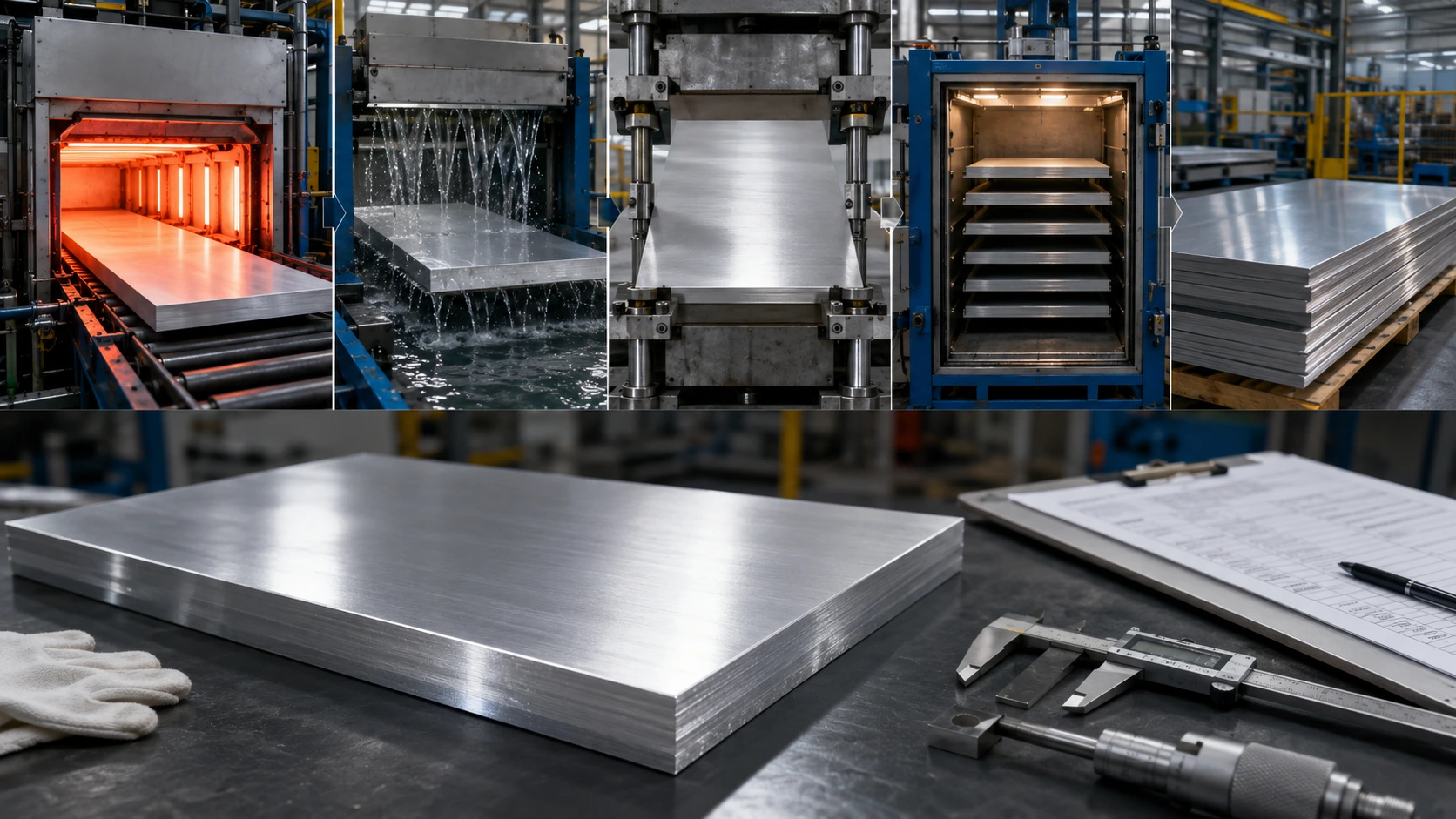
The practical difference in 6061-T6 vs 6061-T651 lies in the temper suffix. T651 includes a controlled stress-relief operation that reduces quench-related residual stress before extensive machining begins. That extra processing can improve dimensional predictability for thin floors, large pockets, asymmetric material removal, and precision plate components.
It does not guarantee a distortion-free finished part. Stock form, machining sequence, workholding, cutting heat, and free-state inspection still determine whether the component meets its drawing.
What Do T6 and T651 Mean?
The current ANSI H35.1/H35.1M-2024 aluminum designation standard governs the alloy and temper naming framework used for wrought aluminum products. The 2024 edition supersedes the 2017 version.
The alloy number and temper suffix describe different things:
6061identifies the alloy composition family.T6identifies a solution-heat-treated and artificially aged condition.T651identifies a T6-family condition that also receives mechanical stress relief by controlled stretching.
6061-T6
The mill solution heat treats the product, quenches it, and artificially ages it to develop the precipitation-hardened properties associated with T6.
Quenching is necessary for the strengthening response, yet rapid cooling can leave a self-balanced internal stress field through the stock thickness.
6061-T651
T651 follows the same general solution-treatment and aging route while adding controlled stretching for stress relief. The stretching occurs before final artificial aging under the applicable production route.
The suffix therefore describes processing history rather than a different aluminum alloy.
A buyer should avoid treating the aluminum temper designation as a marketing grade. It communicates how the mill processed the product and helps determine which material specification, mechanical-property limits, and product forms apply.
6061-T6 vs 6061-T651 Quick Comparison
The following table summarizes the practical distinction for CNC sourcing and drawing review.
| Selection factor | 6061-T6 | 6061-T651 |
|---|---|---|
| Alloy chemistry | 6061 | 6061 |
| Basic strengthening condition | Solution heat treated and artificially aged | Same T6-family strengthening route |
| Additional stress relief | Not identified in the suffix | Stress relieved through controlled stretching |
| Residual-stress condition | Can retain more quench-related stress | Reduced, though never completely eliminated |
| Main purchasing advantage | Broad general-purpose use and availability | Better starting condition for precision plate machining |
| Typical machining risk | Greater movement after deep or asymmetric removal | Lower initial distortion risk |
| Strength relationship | High-strength 6061 condition | Often comparable under the applicable specification |
| Best use case | Compact, stiff, moderately machined components | Large pockets, thin floors, plates, frames, and fixtures |
| Common misunderstanding | T6 automatically means low-stress stock | T651 automatically means stress-free stock |
| Required verification | Product form, specification, certificate | Exact T651 designation, product form, certificate |
The active ASTM B209/B209M specification for aluminum sheet and plate covers flat sheet and plate in listed alloys and tempers. Its guidance for stress-relieved tempers warns that characteristics beyond the explicitly specified properties may differ from the corresponding basic temper.
Mechanical-property limits also vary by product form, thickness, specification, and test direction. A generic online value should never replace the applicable standard and mill certificate.
Why Quenching Creates Residual Stress
The source of 6061-T651 residual stress begins during rapid cooling after solution heat treatment.
A thick aluminum plate does not cool uniformly. Its surface loses heat faster than its core. The outer material contracts and yields while the hotter center still has a different temperature and volume. As the center eventually cools, incompatible plastic strains remain locked inside the plate.
These tensile and compressive stresses balance one another while the original stock remains intact. CNC machining changes that balance.
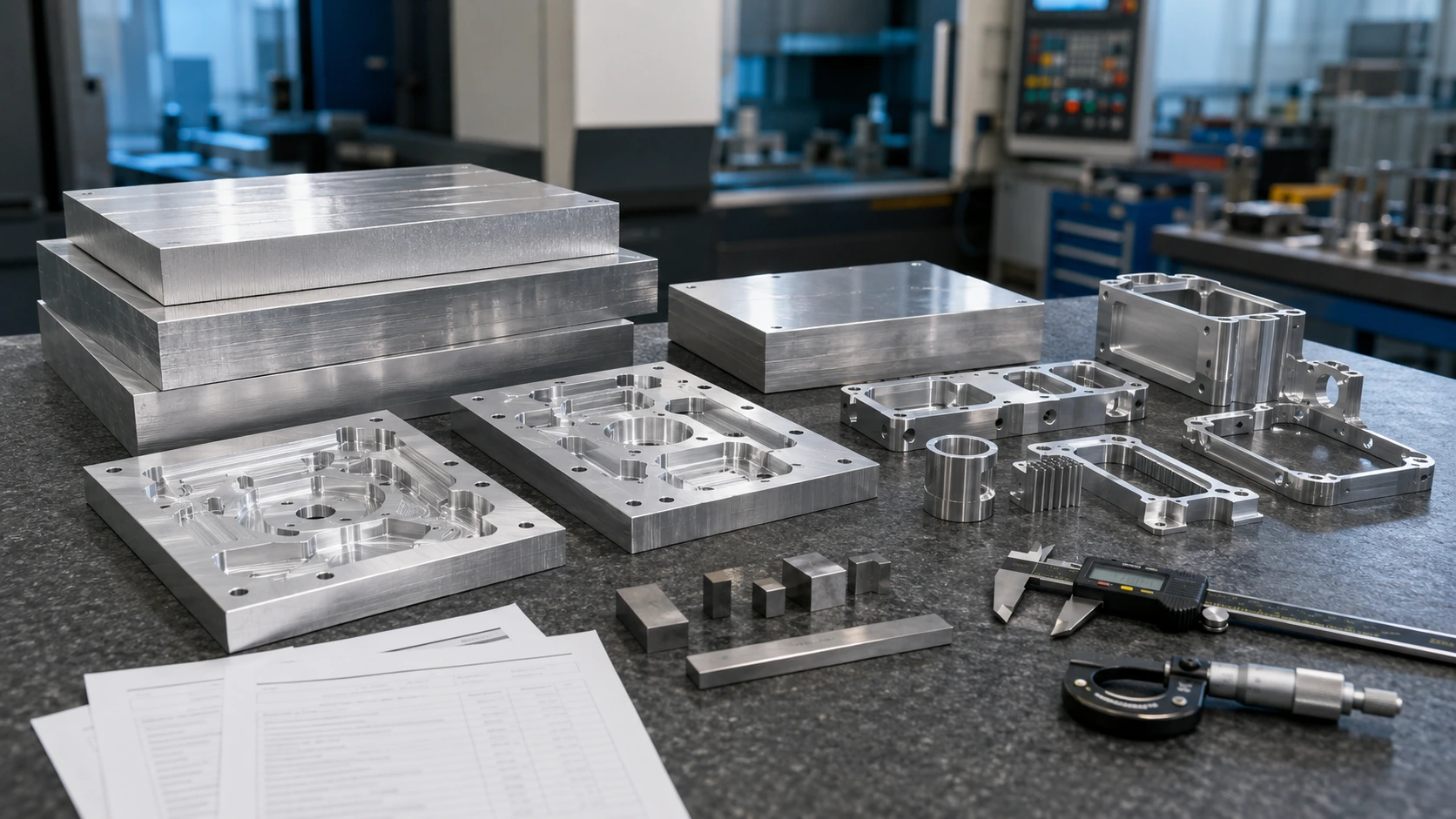
When a cutter removes a deep pocket from one face, the remaining cross-section can no longer support the original stress distribution. The part responds by bending, twisting, or changing length. Movement may become visible during roughing, after unclamping, after finishing the opposite face, or after anodizing.
The active ASTM B909 guide states that thermal quenching can introduce significant residual stresses into precipitation-hardened aluminum products. It also identifies stretching and compression as common mechanical stress-relief methods for suitable product shapes, while noting that complete relief is not always possible.
Distortion risk rises with:
- Deep one-sided pockets
- High material-removal percentages
- Thin floors and tall walls
- Long unsupported spans
- Asymmetric geometry
- Tight flatness or parallelism
- Stock removed mainly from one plate face
T651 reduces the starting stress level, but cutting heat, clamping pressure, and an unbalanced machining sequence can still create 6061-T6 machining distortion or movement in T651 stock.
Is 6061-T651 Stronger Than 6061-T6?
T651 should not be selected on the assumption that it provides a major strength increase over T6. The main manufacturing benefit is its lower residual-stress condition.
Both tempers use the same alloy chemistry and belong to the T6 precipitation-hardened family. Depending on the product specification, thickness, and test orientation, their required tensile and yield properties may be identical or closely aligned.
The purchasing question should separate four engineering characteristics:
| Requirement | Governing characteristic |
|---|---|
| Resistance to permanent deformation | Yield strength |
| Maximum static load before fracture | Tensile strength and design margin |
| Elastic deflection under service load | Elastic modulus and geometry |
| Movement after unclamping | Residual stress and machining sequence |
| Panel or baseplate flatness | Stock condition, geometry, workholding, inspection state |
A higher yield value does not automatically produce a flatter machined plate. Elastic modulus also remains essentially a property of the 6061 alloy system rather than the T651 suffix.
The best evidence comes from the material certificate. Review the alloy, exact temper, governing standard, product form, thickness range, heat or lot identity, and mechanical-property results where required.
For safety-critical, aerospace, or customer-controlled designs, the supplier should never substitute T651 for T6, or T6 for T651, solely because the nominal properties appear similar. The drawing owner must approve the change.
When 6061-T651 Matters Most in CNC Machining
A stress-relieved aluminum plate is most valuable when the machining plan significantly changes the stock cross-section.
T651 is a strong starting choice for:
- Machine-vision calibration plates
- Optical bases and breadboards
- Semiconductor equipment fixtures
- Electronics chassis
- Vacuum-chamber interface plates
- Battery cooling plates
- Robot bases and actuator plates
- Precision test fixtures
- Large monolithic housings
- Aerospace trays and structural frames
These components often combine deep pockets with thin floors, long datums, bearing bores, and tight parallelism. Even a small amount of post-machining movement can shift an optical axis, preload an assembly, change a sealing surface, or misalign a precision guide.
T6 can remain appropriate when the component is compact and stiff, material removal is modest, flatness requirements are moderate, or the finished shape closely follows an extrusion profile.
Product form may also control the decision. An extrusion that already approximates the final geometry can require less machining than a thick plate blank. In that case, an extrusion-specific temper and standard may offer better cost and material utilization.
BOONA supports plate, bar, and extrusion projects through its aluminum CNC machining services and can review stock selection together with material removal, datum strategy, and inspection requirements.
T651 vs T6511: Why Product Form Matters
The T651 vs T6511 distinction creates frequent purchasing errors because both suffixes indicate stress relief by stretching.
Their application depends on how the mill produced the stock.
T651 commonly appears on rolled plate and applicable rolled or cold-finished products. T6510 and T6511 commonly apply to extruded rods, bars, profiles, and tubes.
The Aluminum Association’s temper-designation interpretation explains that T651 and T6511 refer to different product forms and processing parameters. It also warns that receiving a different temper from the one specified can affect whether the product meets the required minimum properties.
The practical distinction between the extrusion suffixes is:
- T6510: stress relieved by stretching, with no further straightening after stretching.
- T6511: stress relieved by stretching, with minor straightening permitted to meet standard tolerances.
A purchasing specification should identify the complete combination:
| Product being ordered | Common governing route |
|---|---|
| Rolled sheet or plate | 6061-T6 or 6061-T651 under ASTM B209/B209M |
| Extruded bar or profile | T6, T6510, or T6511 under ASTM B221/B221M |
| Rolled or cold-finished bar | Applicable temper under ASTM B211/B211M |
| Forging | Forging-specific temper and material standard |
Never order “6061-T6511 plate” casually or accept a T6511 extrusion as T651 plate without engineering review.
Machining Strategy Still Controls the Result
T651 gives the machining team a more predictable starting condition. Process planning still decides the final geometry.
Balance Material Removal
Remove stock from opposing faces where practical. Machining one side to final depth while leaving the other side untouched can release the stress field unevenly.
Separate Roughing and Finishing
Leave controlled finishing allowance after roughing. Release or reduce fixture force, allow the component to stabilize, re-establish the datum, then finish the critical surfaces.
Control Workholding
Distributed clamping, soft jaws, vacuum fixtures, sacrificial supports, and custom nests can reduce local bending. Excessive clamping may temporarily force a bowed component flat and hide the problem until release.
Manage Heat
Sharp tools, stable chip evacuation, suitable coolant, and balanced toolpaths reduce localized thermal expansion. Thin walls should not receive extended high-load cutting after their surrounding support has disappeared.
Inspect in the Free State
Flatness and parallelism should be checked after unclamping and after the component reaches a stable temperature. A measurement taken while the fixture forces the part against a flat base does not establish free-state conformance.
💡 Pro Tip: Ask the supplier to describe the roughing, unclamping, re-datuming, and free-state inspection sequence before approving a highly pocketed plate. The material certificate alone cannot control machining distortion.
BOONA precision machining services can support projects where material selection and process sequencing must work together.
Research Example: A Long AA6061-T651 Beam
A 2023 peer-reviewed study of machining distortion in an AA6061-T651 long beam demonstrates why stress-relieved material still needs a controlled process.
The researchers examined a long U-shaped aerospace beam and optimized a temporary transition structure used before final machining. The paper notes that machining monolithic aerospace components can remove up to 90% of the original blank material. Such a high removal ratio changes stiffness and releases a large portion of the original residual-stress field.
The optimized model predicted:
- Maximum transition-structure distortion of approximately −0.174 mm
- Maximum final-part distortion of approximately −0.1782 mm
- A relative difference of 2.9% between the two predictions
Machining experiments produced values of roughly −0.20 mm and −0.21 mm for the corresponding stages.
These figures belong to the study’s beam geometry, stock condition, residual-stress model, fixtures, and process sequence. They should not become a universal tolerance allowance for 6061-T651.
The broader lesson is more useful: pre-stretched plate can still move when the machining process removes most of the blank. Temporary stiffness, stock orientation, roughing strategy, finishing allowance, and datum recovery influence the final result alongside the temper suffix.
What to Put on the Drawing and Purchase Order
Writing only “6061 aluminum” leaves too much room for substitution. The drawing and purchasing documents should identify the product that the engineering analysis assumed.
A suitable plate callout may read:
Aluminum 6061-T651 plate, ASTM B209/B209M, mill certification required.
Add project-specific requirements where applicable:
- Product form
- Minimum stock thickness
- Rolling direction
- Heat or lot traceability
- Mechanical-property certification
- Ultrasonic inspection
- Critical dimensions
- Free-state flatness
- Parallelism
- Inspection temperature
- Surface finish
- Anodizing allowance
- Prohibition on unauthorized temper substitution
The mill test report should confirm the alloy, temper, governing specification, product form, heat or lot identification, dimensions, and required test results.
Common specification mistakes include:
- Ordering only 6061
- Calling out T6 while expecting stress-relieved plate
- Accepting T6511 extrusion as T651 plate
- Using a generic property chart instead of the mill certificate
- Assuming T651 eliminates all movement
- Inspecting the component while clamped
- Omitting the required free-state condition
- Ignoring welding effects on the heat-treated condition
- Failing to define whether anodizing occurs before final acceptance
The related guide to 6061 vs 7075 aluminum for robot parts covers alloy selection. This article addresses the separate temper and stock-form decision.
FAQs About 6061-T6 vs 6061-T651
Is 6061-T651 Stronger Than 6061-T6?
T651 is not selected primarily for a large strength increase. Depending on the governing specification and product dimensions, the required tensile properties may be identical or closely related. T651’s main machining advantage is its reduced residual-stress condition.
Is T651 Better for CNC Machining?
It is often preferable for deeply pocketed plate components, thin floors, long spans, and tight flatness requirements. General parts with modest, balanced material removal may perform well in T6.
Does 6061-T651 Eliminate Warping?
No. It reduces initial mill-product residual stress. Unbalanced removal, cutting heat, weak geometry, excessive fixture force, and poor sequencing can still distort the finished component.
Can T651 Replace T6 on a Drawing?
The design authority should approve the substitution. Certified or safety-critical applications may tie the drawing to a specific temper, product standard, mechanical-property range, and qualification basis.
What Is the Difference Between T651 and T6511?
T651 commonly applies to rolled or cold-finished products such as plate. T6511 commonly applies to extrusions and permits minor straightening after the stress-relief stretching operation.
What Should a 6061 Material Certificate Show?
The certificate should identify the alloy, exact temper, product form, governing specification, heat or lot, dimensions, and required mechanical or chemical test results.
Final Recommendation: Choosing 6061-T6 vs 6061-T651
When comparing 6061-T6 vs 6061-T651, begin with the part geometry and the stock form.
T6 suits many general-purpose components where material removal remains moderate, the section stays stiff, and dimensional movement carries limited risk. T651 offers a better starting condition for plate-based parts with deep pockets, thin floors, asymmetric machining, long datums, or demanding free-state flatness.
The suffix does not replace process control. A successful project still needs balanced stock removal, appropriate workholding, separated roughing and finishing, temperature control, datum recovery, and unclamped inspection.
The purchase order should identify the exact alloy, temper, product form, governing standard, and certificate requirements. Extrusion-specific tempers such as T6511 require separate review.
Selecting stock for a thin-wall housing, optical base, machine fixture, electronics chassis, or deeply pocketed plate? Send BOONA your CAD model, drawing, required temper, stock thickness, material-removal strategy, flatness, parallelism, finish, and certification requirements through its 5-axis CNC machining services. BOONA can review the material form, temper callout, workholding risks, machining sequence, and free-state inspection plan before production begins.