
A power-electronics team needs a compact aluminum cooling manifold with branching passages, eight threaded ports, and a flat sealing interface. One supplier proposes machining two 6061 halves, drilling straight channels, installing plugs, and sealing the assembly. Another proposes printing one AlSi10Mg body, then machining the ports and sealing face.
The printed route removes joints and enables curved internal flow paths. It also adds build orientation, powder removal, heat treatment, porosity control, support removal, leak testing, and finish machining.
That is the real decision behind AlSi10Mg DMLS vs 6061 CNC. The comparison involves two alloys, two material structures, and two production systems. Printing becomes valuable when geometric freedom improves thermal performance, reduces assembly count, lowers mass, or removes leakage paths. CNC machining remains the safer choice when accessible geometry, wrought-material predictability, tight tolerances, fatigue performance, or surface quality controls the design.
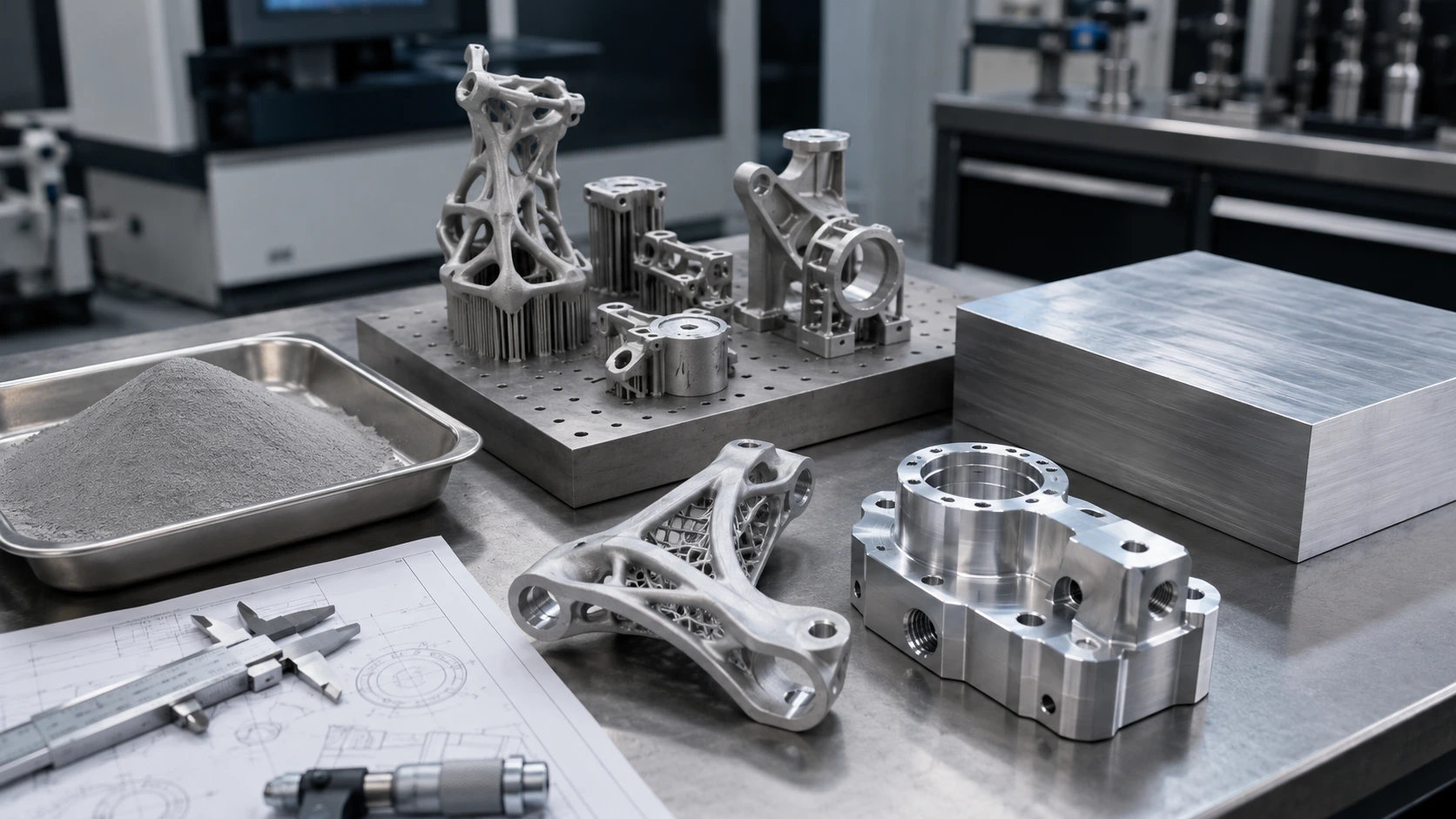
What Are We Actually Comparing?
AlSi10Mg is an aluminum-silicon-magnesium alloy widely processed through laser powder bed fusion. “DMLS” remains common commercial terminology, although technical standards often describe the process as powder bed fusion using a laser beam.
The ASTM F3318 specification for AlSi10Mg laser powder bed fusion covers finished AlSi10Mg parts manufactured through this additive route. It treats the result as an additively manufactured AlSi10Mg product, rather than a printed version of wrought 6061.
6061 CNC parts begin as wrought plate, bar, or extrusion. Milling and turning remove material while retaining the stock’s certified alloy and temper condition, except where welding or later thermal treatment changes that condition.
A valid DMLS aluminum vs CNC aluminum comparison must therefore consider:
- Alloy chemistry
- Wrought versus additively solidified microstructure
- Build orientation and stock direction
- Surface condition
- Internal defects
- Heat treatment
- Inspection requirements
- Post-machining
- Complete delivered-part cost
Selecting AlSi10Mg because someone calls it “similar to 6061” creates an incomplete material specification. Select the printed route when the additive geometry creates measurable value that a conventional 6061 blank cannot deliver efficiently.
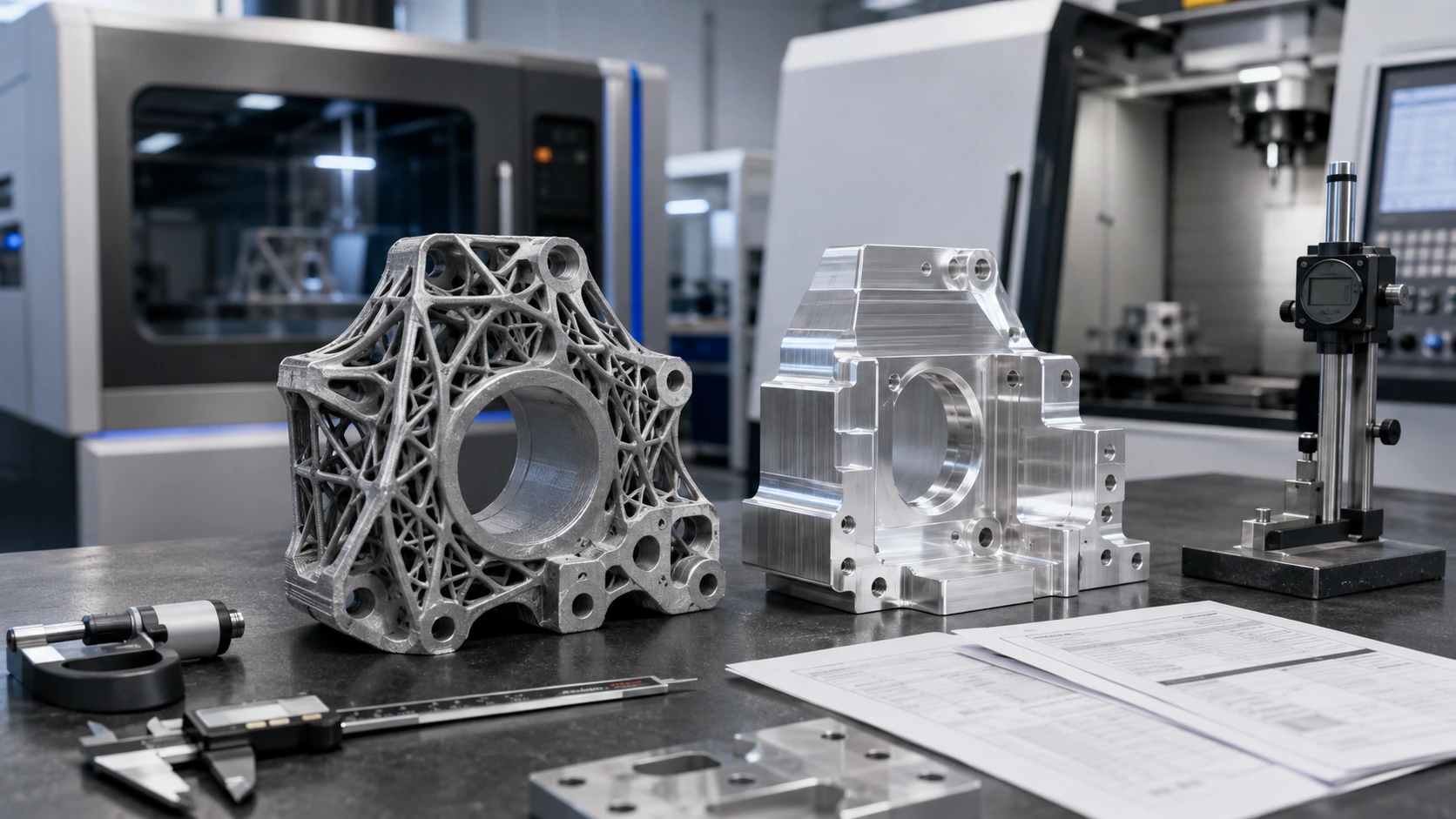
AlSi10Mg DMLS vs 6061 CNC Quick Comparison
The following table summarizes the main engineering differences.
| Selection factor | AlSi10Mg DMLS | 6061 CNC |
|---|---|---|
| Starting material | Aluminum alloy powder | Wrought plate, bar, or extrusion |
| Manufacturing route | Layer-by-layer laser fusion | Subtractive cutting |
| Best geometry | Internal channels, lattices, organic forms | Tool-accessible prismatic geometry |
| Material structure | Parameter- and orientation-dependent AM structure | Established wrought structure |
| Surface condition | Rougher in the as-built state | Smooth machined finish |
| Tight interfaces | Usually require machining allowance | Machined directly from stock |
| Internal cavities | Major design advantage | Limited by drill and cutter access |
| Fatigue control | Sensitive to roughness and internal defects | More predictable with certified stock |
| Part consolidation | Strong potential | Often requires separate pieces |
| Inspection burden | May need CT, coupons, density, or leak testing | Conventional dimensional and certificate review |
| Main cost drivers | Build height, supports, powder, finishing, inspection | Stock, setups, cutting time, material removal |
| Typical best use | Integrated, complex, low-volume components | Precise, repeatable, accessible components |
Published AlSi10Mg mechanical properties cannot be separated from the machine platform, parameters, layer thickness, orientation, heat treatment, specimen geometry, and surface condition. The same caution applies to 6061 values, which depend on temper, product form, thickness, and governing material specification.
When AlSi10Mg DMLS Creates Real Engineering Value
DMLS earns its cost when geometry improves the product rather than merely changing the manufacturing method.
Curved internal passages can route coolant around fasteners, electronics, sensors, or structural features. Branching manifolds can distribute flow more evenly than a network of intersecting drilled holes. Lattices and cellular structures can reduce weight, increase heat-transfer area, absorb energy, or tune stiffness.
Part consolidation creates another source of value. A printed body may replace:
- Two machined housings
- Brazed covers
- Pressed-in tubes
- Threaded plugs
- Internal fittings
- Fasteners
- Multiple seals
Removing interfaces can reduce assembly labor, tolerance stack-up, and potential leakage paths. Organic ribs and topology-optimized load paths may also lower mass without leaving the rectangular geometry associated with a conventional billet.
A 2024 review found that reported aluminum LPBF costs ranged from approximately 2 to 120 times those of traditional processes, depending strongly on part complexity. The same review reported that LPBF powder can cost roughly 10 to 30 times as much as ingot material. These ranges are too broad for quotation formulas, but they show why additive manufacturing needs geometry-driven value to justify its process cost. 2024 review of aluminum LPBF processes and costs
A simple solid bracket rarely provides that value. An integrated thermal or fluid component often can.
When 6061 CNC Is the Lower-Risk Choice
CNC machining should remain the default when the design does not depend on additive-only geometry.
Choose 6061 CNC when the component requires:
- Tight free-state flatness
- Precision bearing or dowel bores
- Fine threads
- Smooth sealing surfaces
- Optical mounting datums
- Predictable anodized appearance
- Conventional material certification
- Straightforward dimensional inspection
- High-cycle loading with accessible geometry
- Repeat production with stable setups
Electronics housings, optical bases, machine-vision frames, motor mounts, robot plates, sensor brackets, heat spreaders, and fixture plates often fit this profile.
The stock shape also matters. A 6061 extrusion that closely follows the finished cross-section may require little material removal. A plate-based part with open pockets can often be machined efficiently without metal powder, supports, stress-relief processing, depowdering, build-plate separation, or CT inspection.
BOONA aluminum CNC machining services support plate, bar, and extrusion projects where conventional tool access and precision features dominate the design.
Low quantity alone does not make printing the better route. When nearly every feature is accessible to a cutter and the drawing emphasizes tolerances and surface finish, CNC usually offers a simpler qualification path.
Strength, Fatigue, Porosity, and Qualification
A tensile-strength table cannot settle the metal 3D printing or CNC machining decision.
Printed AlSi10Mg performance can change with laser parameters, powder history, platform temperature, part orientation, wall thickness, stress relief, heat treatment, machining, and internal defect population. Wrought 6061 also varies by temper and product form, but mill standards and certificates provide a familiar procurement framework.
Fatigue demands even more caution. A 2024 peer-reviewed study tested PBF-LB AlSi10Mg in the as-built condition and after treatments at 265°C for one hour and 300°C for two hours. Researchers found no clear fatigue improvement from those treatments because gas porosity and manufacturing defects remained dominant in the tested specimens.
Engineering teams should request data that matches the final condition:
| Design question | Evidence to request |
|---|---|
| Static load capacity | Yield and tensile data for the approved condition |
| Repeated loading | Fatigue data matching surface and defect condition |
| Directional loading | Horizontal and vertical build results |
| Thin-wall performance | Geometry-representative coupons or test parts |
| Pressure containment | Defined leak or proof-pressure test |
| Safety-critical function | Traceability, NDT, witness coupons, and acceptance limits |
As-built roughness can initiate fatigue cracks, while internal porosity can remain after stress relief. HIP may reduce selected internal defects, but it adds cost and does not automatically correct rough external surfaces.
Surface Finish, Tolerance, and Hybrid Manufacturing
A printed metal part is rarely finished when the build ends. Typical aluminum LPBF post-processing may include stress relief, build-plate separation, support removal, powder evacuation, blasting, heat treatment, CNC finishing, threading, leak testing, and dimensional inspection.
Drawings should divide features into three groups:
As-Built Features
Suitable for noncritical exterior surfaces, internal lattices, and geometry where roughness does not affect fit, sealing, fatigue, or flow.
Printed Features With Machining Allowance
Typical examples include sealing faces, datum pads, bearing bores, threaded ports, precision holes, and optical interfaces.
Fully Machined Features
Used where tight tolerance, low roughness, positional accuracy, or repeatable assembly controls acceptance.
This combination creates hybrid DMLS CNC machining. DMLS supplies inaccessible geometry, while CNC establishes the functional interfaces.
A practical hybrid workflow includes additive-oriented redesign, build-orientation selection, support planning, stress relief, internal inspection, and final machining. BOONA 5-axis CNC machining services can finish multi-face ports, sealing lands, and datum structures after printing.
💡 Pro Tip: Mark every printed surface as as-built, blasted, or CNC-finished. A note such as “machine where necessary” leaves the supplier guessing which surfaces control fit, sealing, and inspection.
Cost Crossover: Why Quantity Alone Does Not Decide
DMLS cost depends heavily on build height, occupied volume, support structure, orientation, packing efficiency, machine time, powder handling, heat treatment, post-machining, and inspection.
CNC cost follows a different model:
- Stock size
- Removal percentage
- Number of setups
- Fixturing
- Tool access
- Cutting time
- Tool wear
- Batch quantity
- Inspection time
This is why rules such as “print below ten parts” or “machine above twenty parts” are unreliable. A dense rectangular AlSi10Mg block may cost far more to print than to machine, even as a one-off. A complex internal manifold may justify printing at a higher quantity because CNC would require several bodies, plugs, joining, and leak testing.
Use the complete delivered-part cost:
| Part characteristic | Likely cost direction |
|---|---|
| Simple rectangular bracket | CNC favored |
| Tall printed component | DMLS build cost rises |
| Internal channels replacing an assembly | DMLS gains value |
| Heavy post-machining requirement | DMLS advantage shrinks |
| Many identical prismatic parts | CNC setup amortization helps |
| Customized geometry variants | DMLS avoids new fixtures |
| Multiple brazed or sealed joints | Consolidated printing may reduce system cost |
The correct comparison includes finishing, inspection, assembly, leakage risk, rejection, and maintenance, rather than print price versus machine time alone.
Real-World Application: A Printed Microchannel Heat Sink
A 2023 peer-reviewed heat-transfer study demonstrates why engineers print aluminum parts even when conventional machining remains available.
Researchers produced a monolithic AlSi10Mg manifold-microchannel heat sink through laser powder bed fusion. The component measured 30 × 15 × 9 mm and supported a heated area of 10 × 10 mm. Its internal channels measured approximately 0.2 mm wide and 2 mm high, geometry that would be difficult to create as one closed 6061 CNC component.
During testing, the heat sink dissipated an effective heat flux of up to 240 W/cm² at a mass flow rate of 395 g/min. The reported pressure drop was approximately 1.7 kPa, and total thermal resistance reached about 0.21 K/W. 2023 AlSi10Mg manifold-microchannel heat-sink study
The lesson is broader than the exact performance figures. Printing enabled a tapered three-dimensional flow manifold directly above narrow microchannels in one body. A conventional 6061 route would likely require separate layers, covers, joining, or plugs.
This case represents a strong additive application because the inaccessible geometry directly supports thermal performance. A flat aluminum spreader with open milled channels would remain a stronger CNC candidate.
What to Include in the RFQ
A complete RFQ should allow the supplier to compare DMLS, CNC, and hybrid routes without guessing the acceptance condition.
Include:
- Controlled 3D CAD and 2D drawing
- Quantity and repeat-order expectations
- Intended function and load direction
- Temperature and duty cycle
- Internal-channel geometry
- Powder-removal openings
- Alloy and required material condition
- Build-orientation restrictions
- As-built, blasted, and machined surfaces
- Machining allowance
- Critical dimensions and datum structure
- Surface roughness
- Heat treatment
- Pressure or leak testing
- CT or NDT requirements
- Witness coupons
- Material and process certification
- First-article inspection
- Change-control requirements
Common mistakes include treating AlSi10Mg as printed 6061, printing a simple solid block, omitting powder exits, leaving no machining stock, expecting machined roughness inside closed channels, and quoting DMLS without support removal or inspection.
A useful RFQ statement is:
Supplier shall compare AlSi10Mg laser powder bed fusion, 6061 CNC machining, and a hybrid route. The quotation shall identify build orientation, supports, heat treatment, CNC-finished features, inspection methods, and acceptance criteria.
FAQs About AlSi10Mg DMLS vs 6061 CNC
Is DMLS AlSi10Mg Stronger Than 6061-T6?
No universal ranking applies. AlSi10Mg properties depend on the machine, parameters, orientation, heat treatment, surface condition, and defects. Compare certified values for the final delivered condition with the applicable 6061 temper and product specification.
When Is DMLS Cheaper Than CNC Machining?
DMLS becomes commercially attractive when internal channels, topology optimization, customization, or part consolidation remove enough machining, assembly, joining, or leakage risk. Quantity alone does not determine the crossover.
Do AlSi10Mg Parts Require CNC Finishing?
Critical sealing faces, datum pads, threads, bearing bores, and precision ports usually require machining allowance and post-build CNC finishing. Noncritical exterior and internal surfaces may remain as-built or blasted.
Can DMLS Aluminum Parts Hold Pressure?
They can, provided the process and acceptance plan address porosity, internal powder removal, heat treatment, sealing surfaces, and leak testing. Every pressure-containing design should define the test medium, pressure, duration, and permissible leakage.
Which Process Offers Tighter Tolerances?
CNC machining generally provides tighter direct tolerances and smoother surfaces on accessible features. DMLS can create inaccessible geometry, then use CNC finishing on critical interfaces.
Is DMLS Suitable for Fatigue-Loaded Parts?
It can be, but qualification should address build orientation, roughness, porosity, heat treatment, machining, inspection, and representative fatigue data. Simple high-cycle components often remain lower risk in wrought 6061.
Final Recommendation: AlSi10Mg DMLS vs 6061 CNC
When comparing AlSi10Mg DMLS vs 6061 CNC, start with the geometry and the product-level value it creates.
Print the part when internal channels, lattices, topology optimization, weight reduction, or part consolidation improve performance or remove costly assembly steps. Machine it from 6061 when conventional tool access, wrought properties, tight tolerances, fatigue predictability, anodized appearance, or straightforward inspection controls the project.
Many successful components combine both routes. DMLS creates the internal or organic structure, while CNC establishes datums, sealing faces, threaded ports, and precision bores.
The final decision should compare complete delivered-part cost, including heat treatment, support removal, machining, inspection, assembly, leak testing, and rejection risk.
Deciding whether to print or machine an aluminum component? Send BOONA the CAD model, quantity, internal geometry, loading, thermal requirements, tolerances, finish, pressure-testing needs, and certification requirements through its DMLS metal 3D printing services. BOONA can compare AlSi10Mg DMLS, 6061 CNC machining, and a hybrid print-and-machine strategy before production begins.