
Most engineers do not compare PEEK and Vespel at the beginning of a project.
The first material choice is usually something easier: POM, nylon, PTFE, aluminum, stainless steel, or a standard engineering plastic. PEEK and Vespel enter the discussion when those common options start to look risky.
Maybe the part sits near heat. Maybe it slides against another component. Maybe it must stay stable inside semiconductor equipment. Maybe metal is not acceptable because the part needs electrical insulation or lower contamination risk. Or maybe the part is small, but a failure would stop an expensive machine.
That is when the PEEK vs Vespel question becomes important.
PEEK is often the more practical high-performance plastic. It gives a useful mix of strength, heat resistance, chemical resistance, insulation, and machinability. Vespel is usually brought in when the part faces more severe wear, friction, heat, vacuum, or long-term stability requirements.
So the question is not really, “Which plastic is better?”
A better question is: “What is the part doing, and what happens if it fails?”
That one question usually leads to a better material decision than comparing datasheets line by line.
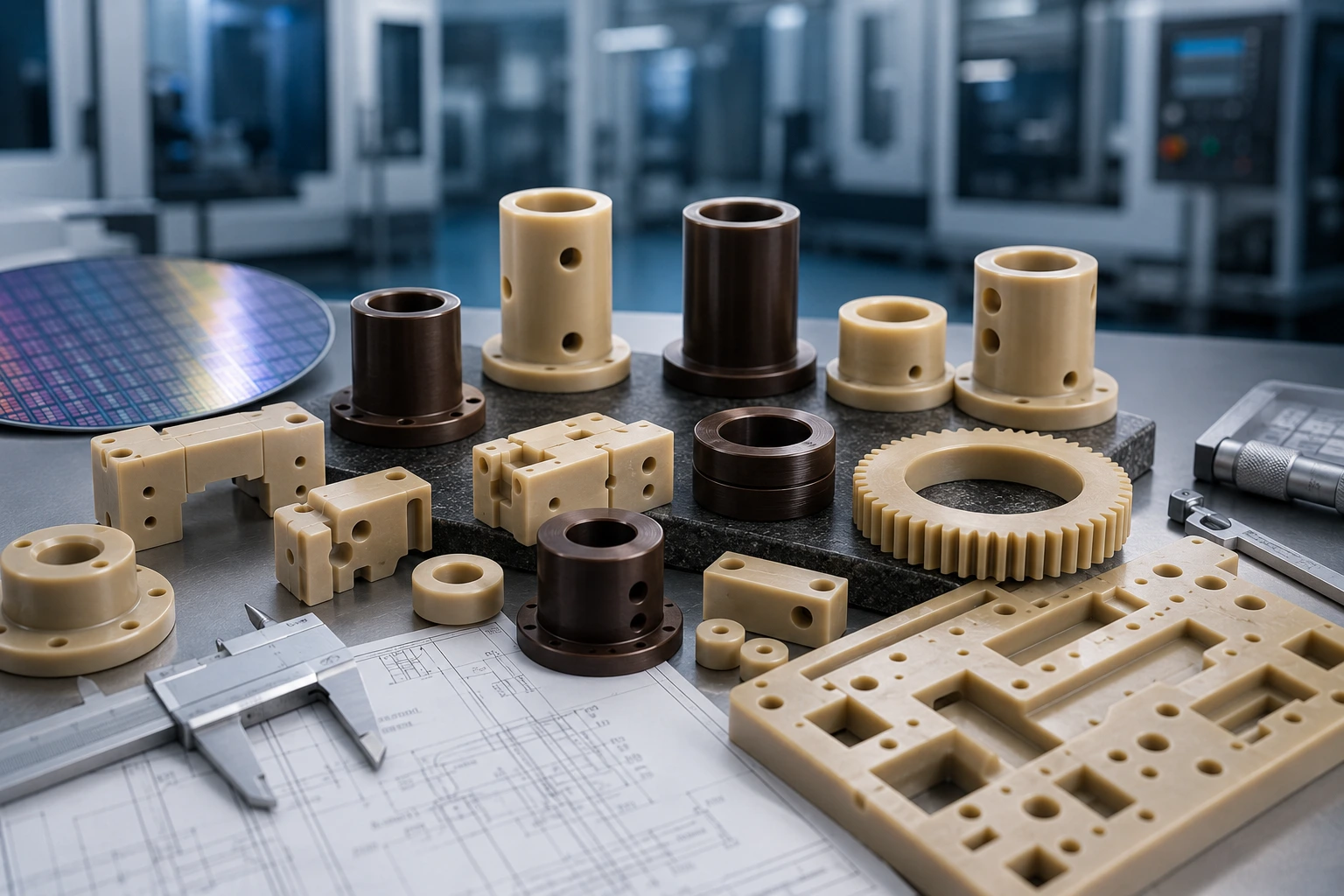
PEEK: The More Practical High-Performance Plastic in Many Cases
PEEK, or polyether ether ketone, is a high-performance thermoplastic. In custom manufacturing, it is often chosen when common plastics cannot handle the application but the part does not yet justify the cost of Vespel.
PEEK is strong for a plastic. It has good dimensional stability, strong chemical resistance, low moisture absorption, and good electrical insulation. It is also more familiar to many machine shops than Vespel, which can make quoting, machining, and sourcing more straightforward.
That does not mean PEEK is cheap. It is still an expensive material compared with POM, nylon, ABS, or PTFE. But in many B2B precision part projects, PEEK is the first serious material to evaluate before moving to a more costly polyimide option.
PEEK is commonly used for:
- electrical insulators
- semiconductor fixtures
- sensor holders
- medical device parts
- connector bodies
- test sockets
- bushings and guides
- high-temperature brackets
- precision plastic spacers
- low-volume custom plastic parts
For machined parts made from real stock material, PEEK CNC machining is often more practical than molding when the order quantity is low, the design is still changing, or the part needs accurate holes, pockets, slots, and threaded features.
A simple example: if the part is a static insulator inside a piece of equipment, PEEK may be more than enough. If that same part becomes a sliding contact part in a hot, dry, high-wear location, Vespel may start to make more sense.
Vespel: A Material You Choose When the Failure Cost Is High
Vespel® is a high-performance polyimide material family. It is known for low wear, low friction, high-temperature capability, and strong dimensional stability in demanding environments.
In practice, Vespel is not usually chosen for simple covers, basic brackets, or low-risk spacers. The material cost is too high for that. It becomes attractive when the part has a serious job: it slides, wears, runs hot, sits in vacuum-related equipment, touches sensitive surfaces, or operates where particle generation and downtime matter.
Common custom Vespel parts include:
- wear pads
- bushings
- washers
- wafer contact parts
- vacuum spacers
- high-temperature guides
- sliding supports
- precision replacement parts
- thermal isolation components
For Vespel CNC machining, the material price changes the way the job should be planned. A poor fixture, wrong blank size, or unclear tolerance note can turn into expensive scrap quickly. On Vespel jobs, it is worth slowing down at the quoting stage and confirming which features actually matter.
This is especially true for semiconductor, aerospace, and vacuum-related parts, where the part may be small but the working environment is unforgiving.
Quick Comparison: PEEK vs Vespel
The table below gives a practical comparison. It is not a replacement for a material datasheet, because grade selection matters a lot. But it gives a useful starting point for sourcing and design review.
| Factor | PEEK | Vespel |
|---|---|---|
| Material family | High-performance thermoplastic | High-performance polyimide |
| Typical cost level | High | Very high |
| Machinability | Good with sharp tools and proper heat control | Machinable, but scrap risk is higher |
| Heat resistance | Excellent for many precision parts | Often selected for more demanding heat conditions |
| Wear resistance | Good, especially with filled grades | Excellent in many sliding and wear applications |
| Friction behavior | Good | Usually stronger for dry sliding applications |
| Electrical insulation | Good | Good, grade-dependent |
| Vacuum-related use | Grade and application dependent | Often considered for demanding vacuum/inert-gas environments |
| Best-fit parts | Insulators, fixtures, holders, brackets, spacers | Wear pads, bushings, wafer contact parts, high-temperature guides |
| Main concern | Heat, burrs, thin-wall movement, cost | Material cost, grade selection, scrap risk |
The short version: choose PEEK when it meets the requirement. Move to Vespel when heat, wear, friction, vacuum behavior, or failure risk makes PEEK too close to the edge.
When PEEK Is Usually the Better Choice
PEEK is often the better choice when the part needs high performance, but the application is not extreme enough to justify Vespel.
This happens often in custom manufacturing. A customer needs a non-metallic precision part with good strength and insulation. The part may see heat, but not extreme heat. It may need chemical resistance, but not constant aggressive exposure. It may need wear resistance, but it is not a high-load sliding bushing running all day.
In those cases, custom PEEK parts are often the more balanced option.
PEEK is a good starting material for:
- static electrical insulators
- precision spacers
- semiconductor holders
- medical device prototypes
- sensor fixtures
- connector bodies
- test fixtures
- light-duty guides
- chemical-resistant brackets
- low-volume CNC machined plastic parts
PEEK also makes sense when cost control still matters. If a part needs 20, 50, or 200 pieces, the cost difference between PEEK and Vespel can become significant.
For early-stage development, plastic CNC machining also allows engineers to test real material behavior without mold tooling. That matters when the part needs to be assembled, heated, measured, or used in a functional test.
Where PEEK May Not Be Enough
PEEK has limits. Those limits usually show up in motion, heat, and wear.
A PEEK spacer may work perfectly. A PEEK sensor holder may also work. But a PEEK sliding pad in a hot, dry, high-wear environment may not last long enough. A PEEK wafer contact part may not be the best choice if particle generation, surface wear, or repeated motion is the main concern.
PEEK may need careful review if the part has:
- constant sliding contact
- high surface pressure
- dry friction
- heat plus motion
- vacuum-related requirements
- very low particle requirements
- critical wafer contact
- long service life expectations
- downtime cost higher than material cost
This does not mean PEEK will fail in all of those cases. It means the design should be checked carefully. A filled PEEK grade may work. A geometry change may help. But sometimes the more honest answer is that Vespel is the safer material.
When Vespel Is Worth the Cost
Vespel is usually worth considering when the part is small, critical, and difficult to replace, or when wear and heat are the main problems.
A Vespel part is rarely chosen because someone wants to spend more. It is chosen because the part sits in a location where ordinary plastic wear, friction, creep, or particle generation would create a bigger problem.
Good Vespel applications include:
- high-wear bushings
- sliding pads
- wafer contact parts
- semiconductor wear components
- vacuum-related spacers
- high-temperature guides
- precision washers
- long-life equipment replacement parts
For example, if a small bushing wears out and causes alignment drift inside a machine, the real cost is not only the bushing. It is machine downtime, inspection work, maintenance labor, and possible damage to other parts. In that case, the higher material price of Vespel may be easier to justify.
This is why Vespel often appears in more critical positions, while PEEK is used more widely across general high-performance plastic components.
CNC Machining Differences That Matter in Real Quotes
Both PEEK and Vespel can be CNC machined, but the quoting conversation is not the same.
PEEK jobs are still expensive compared with standard plastics, but the material is more commonly used. Vespel jobs tend to make everyone more careful because the stock cost is higher and the part is often more critical.
For PEEK CNC machining, the common concerns are sharp tools, heat control, burrs around small features, and movement in thin walls or large flat sections.
For Vespel CNC machining, those same concerns still apply, but the tolerance strategy and workholding plan become even more important because scrap is costly.
| CNC Concern | What to Watch |
| Tool sharpness | Dull tools create heat, burrs, and poor edge quality |
| Clamping pressure | Plastic parts can move or distort under too much pressure |
| Thin walls | Deflection can change the final size after unclamping |
| Small holes | Heat, tool wear, and chip evacuation affect hole quality |
| Flatness | Large flat plastic parts may relax after machining |
| Deburring | Aggressive deburring can damage precision edges |
| Inspection timing | Some features should be checked after the part stabilizes |
For multi-face precision parts, precision machining is useful because setup control affects hole position, parallelism, flatness, and final assembly fit.
Tolerance: Do Not Treat Plastic Like Aluminum
One of the biggest mistakes in precision plastic parts is copying metal tolerances directly onto a plastic drawing.
PEEK and Vespel can both be machined accurately, but they still behave differently from aluminum, brass, or stainless steel. They respond more to heat, clamping, wall thickness, and internal stress. A thick round bushing is easier to control than a thin rectangular frame with long slots.
For precision plastic CNC machining, it is better to mark the critical features clearly and leave non-critical surfaces with realistic tolerances.
A practical approach:
| Feature | Suggested Tolerance Strategy |
| Bearing bore | Tight tolerance if function requires it |
| Mounting holes | Control diameter and position where needed |
| Outer non-contact profile | Use general tolerance |
| Thin wall | Avoid unnecessary tight tolerance |
| Large flat surface | Specify flatness only if needed |
| Sliding face | Define surface finish and wear condition |
| Threaded hole | Consider insert if assembled repeatedly |
If a surface is used for alignment, sliding, sealing, wafer contact, or electrical insulation, mark it clearly. If a feature is only a clearance pocket, do not make it carry the same tolerance burden as a precision bore.
Boona’s quality control page is relevant here because these parts often need more than a quick size check. Hole size, edge condition, burrs, flatness, and surface finish may all matter.
Heat Resistance: The Environment Matters More Than the Number
PEEK is well known for high-temperature performance. Many grades are used around the 250°C range for continuous service, and the melting point is around 343°C. That is much higher than most common engineering plastics.
But in actual part selection, the temperature number alone is not enough.
A static insulator at elevated temperature is different from a sliding guide at elevated temperature. A part that sees heat for 10 minutes during a test is different from a part that runs hot every day. Temperature combined with load, friction, chemicals, or vacuum can change the material decision.
This is where Vespel often enters the discussion. If heat is combined with sliding wear, dry friction, or long service life expectations, Vespel may be safer.
| Application Condition | Better Starting Point |
| Static high-temperature insulator | PEEK |
| General high-performance fixture | PEEK |
| Hot sliding guide | Vespel |
| Heat plus dry friction | Vespel should be reviewed |
| Short-term prototype heat test | PEEK or Vespel, depending on test goal |
| Vacuum plus friction | Vespel grade review is usually important |
Always check the exact material grade. “PEEK” and “Vespel” are families, not single universal materials.
Wear and Friction: The Area Where Vespel Often Wins
Wear is where Vespel often justifies itself.
PEEK has good wear resistance, especially in filled grades. For many guides, fixtures, and light-duty sliding parts, it can work well. But when the part is expected to slide repeatedly under load, run with little lubrication, or last longer in a high-value machine, Vespel is often the better candidate.
This is common in semiconductor equipment, aerospace mechanisms, and precision industrial assemblies.
For a static spacer, PEEK is usually more practical. For a moving wear pad, Vespel deserves a serious look.
| Part Type | More Practical Starting Material |
| Static spacer | PEEK |
| Electrical insulator | PEEK |
| Sensor holder | PEEK |
| Light-duty guide | PEEK or filled PEEK |
| High-wear bushing | Vespel |
| Wafer contact component | Vespel |
| Dry sliding pad | Vespel |
| Prototype fixture | PEEK |
Wear decisions should include the mating material, load, speed, temperature, lubrication, cleanliness, and expected service life. Without those details, a material recommendation is only a guess.
Semiconductor Equipment: Why This Comparison Comes Up So Often
Semiconductor tools are one of the places where PEEK vs Vespel for precision parts becomes a real purchasing decision.
A plastic part inside a semiconductor tool may need to insulate, guide, support, space, slide, or touch sensitive components. Burrs and particles matter. Surface scratches matter. A slightly unstable part can affect alignment. A worn contact feature can create maintenance problems.
Typical PEEK parts for semiconductor equipment include insulators, spacers, holders, brackets, sensor fixtures, and chemical-resistant support parts.
Typical Vespel parts for semiconductor tools include wear pads, bushings, wafer contact parts, vacuum spacers, high-temperature guides, and sliding supports.
For this type of application, the related Boona article on custom PEEK and Vespel parts for semiconductor equipment is a useful supporting page. It goes deeper into material selection, cleanliness, burr control, and RFQ notes for semiconductor tool components.
Cost: Do Not Compare Only the Raw Material Price
PEEK is expensive. Vespel is usually much more expensive.
That is the easy part.
The harder part is understanding total cost. If PEEK works reliably, choosing Vespel may be unnecessary over-engineering. But if PEEK wears too fast, creates particles, loses stability, or causes downtime, the cheaper material becomes expensive in another way.
A quote is affected by more than material grade:
| Cost Driver | Why It Matters |
| Stock size | Oversized blanks create expensive waste |
| Tight tolerance | Adds machining and inspection time |
| Thin-wall geometry | Raises deflection and scrap risk |
| Small holes | Requires sharper tools and careful inspection |
| Flatness requirement | May require staged machining or stress relief |
| Burr-free requirement | Adds controlled handwork |
| Clean packaging | Adds cleaning and handling steps |
| Material certificate | Adds traceability and documentation |
| Quantity | Setup cost spreads differently across 1, 10, or 100 parts |
A good supplier will not only price the drawing. They should also notice if the part is being over-toleranced, if a thin wall is risky, or if a material may be over-specified for the job.
Design Notes That Save Money Before Machining Starts
Good design is especially important when the material is expensive.
A larger internal radius can allow a stronger tool. A slightly thicker wall can reduce movement. A threaded insert can make repeated assembly more reliable. A clear burr-free note can prevent unnecessary finishing on every edge.
Before sending a custom PEEK part or custom Vespel part for quote, check these details:
- Are the critical dimensions clearly marked?
- Are tight tolerances only used where function requires them?
- Are thin walls really necessary?
- Can internal corners accept a larger radius?
- Does the part need inserts for repeated assembly?
- Which faces are sliding, sealing, or contacting sensitive parts?
- Is burr-free required everywhere, or only on key edges?
- Does the part need special cleaning or packaging?
- Is the exact material grade known?
For prototype and small-batch orders, low-volume manufacturing is often a better fit than tooling, especially when the design may still change after testing.
What to Send for a Better CNC Machining Quote
For these materials, a CAD file alone is not always enough.
If the part has critical features, send a 2D drawing. If the part is used in heat, friction, vacuum, semiconductor equipment, or medical equipment, share that information. The supplier does not need your full product design, but they do need to understand what the part must survive.
A useful RFQ should include:
- 3D CAD file
- 2D drawing
- material grade or material question
- quantity
- critical tolerances
- surface finish requirements
- operating temperature
- sliding or wear condition
- chemical exposure
- vacuum or low-outgassing requirement
- clean-use or packaging requirement
- threaded insert requirement
- inspection report or material certificate requirement
If you are not sure whether to use PEEK or Vespel, describe the application. A static support part and a dry sliding wear part should not be quoted with the same assumptions.
Final Recommendation
Choose PEEK when you need a strong, stable, high-performance plastic and cost still matters. It is often the right choice for insulators, fixtures, holders, brackets, spacers, medical prototypes, electronics parts, and many low-volume precision components.
Choose Vespel when the part works harder: high wear, dry sliding, heat plus motion, vacuum-related environments, wafer contact, or a location where failure is far more expensive than the material.
For PEEK vs Vespel, the better material depends on the part’s job. Temperature, load, motion, cleanliness, tolerance, service life, and failure cost all matter.
The safest decision is made before machining starts: define the operating conditions, mark the critical features, confirm the material grade, and let the machining supplier review the design for manufacturability.
FAQs
Is Vespel better than PEEK for precision parts?
Vespel is better than PEEK in some demanding applications, especially where high wear resistance, dry sliding performance, heat stability, or vacuum behavior is critical. PEEK is often the better choice when the part needs strong performance but cost control still matters.
When should I choose PEEK instead of Vespel?
Choose PEEK when the part is mainly used as an insulator, spacer, fixture, holder, bracket, or structural plastic component. It is a practical choice for many precision plastic CNC machining projects where heat, chemical resistance, strength, and dimensional stability are needed, but extreme wear or vacuum performance is not required.
When is Vespel worth the higher cost?
Vespel is worth considering when the part works in a high-wear, high-temperature, sliding, vacuum-related, or wafer-contact application. It is often used when machine downtime, particle generation, or part failure would cost more than the material itself.
Can PEEK replace Vespel?
PEEK can replace Vespel in some static or moderate-duty applications, especially when the part does not face severe wear, friction, heat, or vacuum conditions. For critical bushings, wear pads, dry sliding parts, or semiconductor wafer-contact components, Vespel may still be the safer option.
Can both PEEK and Vespel be CNC machined?
Yes. Both PEEK and Vespel can be CNC machined into high-precision custom parts. However, tool sharpness, heat control, workholding, burr removal, surface finish, and inspection must be managed carefully, especially because both materials are more expensive than standard plastics.
What should I provide when requesting a PEEK or Vespel machining quote?
Provide a 3D CAD file, 2D drawing, material grade, quantity, critical tolerances, surface finish requirements, operating temperature, chemical exposure, wear or sliding condition, vacuum or clean-use requirements, and inspection or material certificate needs. This helps the supplier recommend the right material and avoid unnecessary cost.