
A buyer sends out a drawing for a plastic part. The shape is not huge. It may only be a spacer, bushing, insulator, test fixture, or small housing. Then the quote comes back much higher than the same part in nylon, POM, ABS, or PTFE.
That is when the question usually comes up: why are PEEK parts so expensive?
The short answer is that PEEK machined parts cost more because almost every part of the job carries more risk. The raw stock is expensive. The blank size matters. Setup mistakes are costly. Tight tolerances take more care. Thin walls can move. Burrs cannot always be removed aggressively. Some parts need stress relief, inspection reports, or material certificates.
PEEK is not a low-cost plastic. It is a high-performance engineering material used when standard plastics are not reliable enough.
That does not mean every PEEK quote has to be expensive for the wrong reasons. Some costs are unavoidable. Others can be reduced with better design notes, smarter tolerance control, and early DFM review.
For buyers sourcing PEEK CNC machining, it helps to understand where the cost really comes from before comparing quotes only by price.
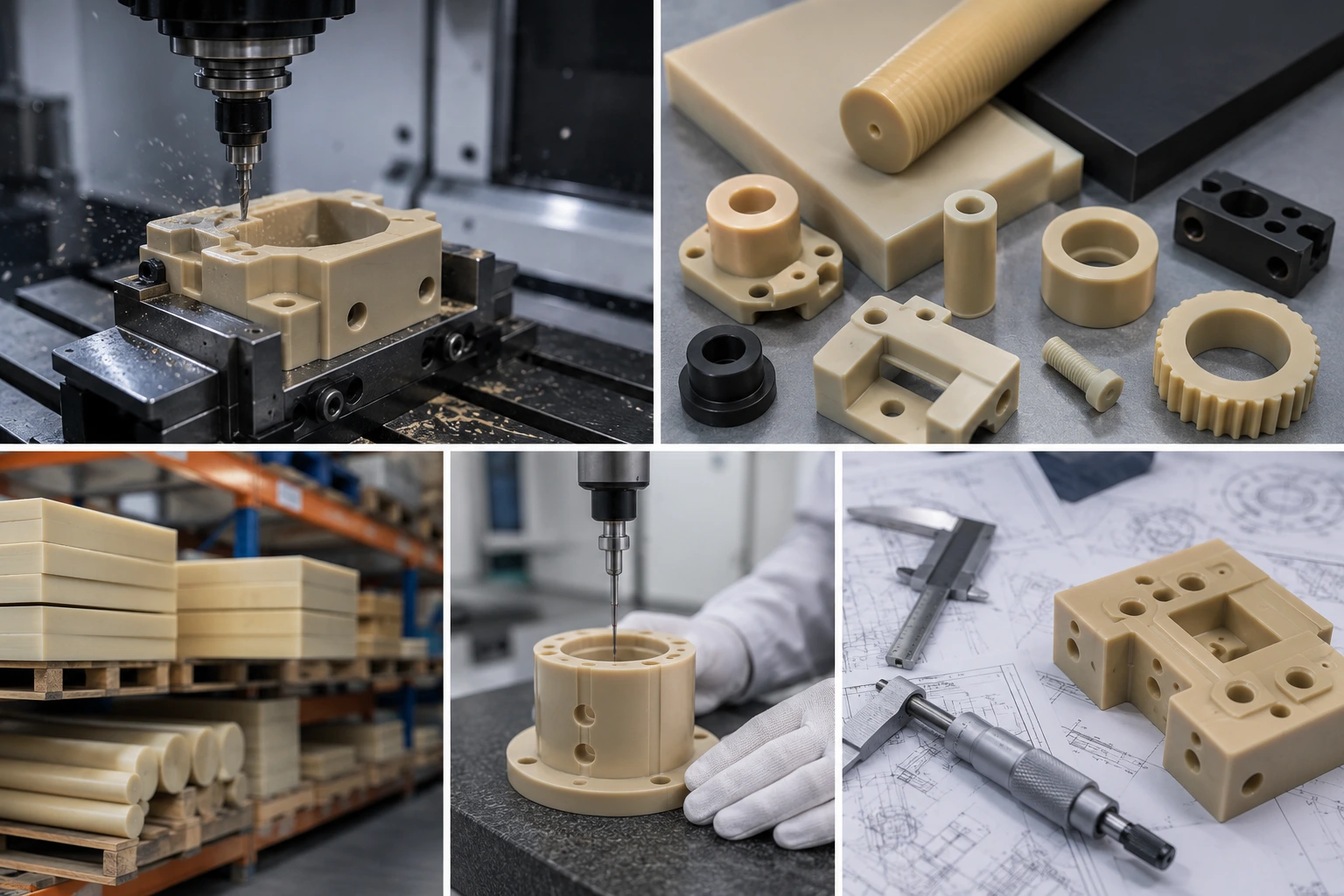
PEEK Is Usually Chosen After Cheaper Plastics Have Failed the Requirement
PEEK is rarely the first material people choose for a simple plastic part.
Most projects start with easier options. POM machines well. Nylon is tough and affordable. ABS is cheap for housings and appearance models. PTFE has very low friction. Polycarbonate is useful when toughness or transparency matters.
PEEK comes into the discussion when those materials start to look risky.
A nylon part may absorb moisture and change size. A POM part may not handle the heat. PTFE may be too soft for a tight bore or thread. ABS may not survive chemicals. A metal part may be too conductive, too heavy, or unsuitable for the assembly.
That is where PEEK earns its place. It offers heat resistance, chemical resistance, mechanical strength, dimensional stability, low moisture absorption, wear resistance, and electrical insulation in one material family.
| Material | Why Buyers Use It | Where It May Fall Short |
|---|---|---|
| ABS | Low-cost housings and prototypes | Lower heat and chemical resistance |
| Nylon | Tough bushings, rollers, simple wear parts | Moisture absorption can change dimensions |
| POM / Delrin | Stable, easy-to-machine precision plastic parts | Lower temperature capability than PEEK |
| PTFE | Low-friction seals and sliding parts | Soft, harder to hold precision features |
| PC | Tough or transparent parts | Not suitable for every heat or chemical condition |
| PEEK | High-performance precision parts | Higher raw material and machining cost |
This is why the PEEK vs standard plastics discussion should not start with price alone. It should start with the working condition of the part.
If the part is a simple cover, PEEK may be overkill. If it is a high-temperature insulator, semiconductor fixture, medical component, or chemical-resistant precision part, cheaper plastics may create more risk than savings.
Boona plastic CNC machining service can support different engineering plastics, but the right material depends on heat, chemicals, load, tolerance, cleanliness, and assembly requirements.
Raw Stock Is Often the First Cost Shock
Before any cutting starts, PEEK already costs more.
PEEK sheet, rod, and plate stock are far more expensive than standard plastics. If the material needs to be glass-filled, carbon-filled, bearing-grade, medical-grade, or supplied with certification, the price increases again.
There is another point buyers sometimes miss: the quote is not based only on the finished part volume. It is based on the stock required to hold and machine the part.
A part may finish at 80 mm long, but it may need a larger blank for workholding. A pocketed component may start from a thick block and lose most of that material as chips. A flat plate may need extra stock for facing and cleanup. With POM or nylon, that waste is annoying. With PEEK, it is expensive.
| Raw Stock Cost Driver | Why It Matters |
|---|---|
| Oversized blank | More expensive material is purchased before machining |
| Deep pockets | Much of the PEEK stock becomes chips |
| Thick plate or large rod | Stock cost rises quickly |
| Filled PEEK grade | Material may cost more and machine differently |
| Certified material | Adds traceability and documentation cost |
| One-piece order | Material waste is spread across only one part |
This is one reason a good supplier may ask questions before quoting. A small design change can sometimes reduce the blank size or avoid removing unnecessary material.
For custom PEEK machined parts, material-saving design is not about weakening the part. It is about avoiding expensive waste that does not improve performance.
PEEK Machines Well, But It Does Not Forgive Poor Process Planning
PEEK is not hard like steel. The challenge is not cutting force. The challenge is control.
A sharp tool can cut PEEK cleanly. A dull tool can rub, heat the surface, and leave burrs. A strong clamp can hold the part, but too much pressure may distort thin walls. A fast roughing pass can save time, but it may also introduce heat or stress that shows up later.
With cheaper plastics, the shop may have more room for trial and error. With PEEK, mistakes hurt.
The goal in high-performance plastic machining is usually not maximum material removal. It is stable machining with clean edges and predictable dimensions.
Common cost-related machining issues include:
| Machining Detail | What Can Go Wrong | Why It Adds Cost |
|---|---|---|
| Tool sharpness | Burrs, rubbing, poor finish | More deburring or rework |
| Heat buildup | Movement, surface marks, hole variation | Slower cutting and better chip control |
| Thin walls | Deflection during cutting or clamping | Extra fixture care |
| Small holes | Oversize, undersize, or burred holes | Tooling and inspection time |
| Threads | Weak or inconsistent threads | Controlled tapping, thread milling, or inserts |
| Flatness | Part relaxes after unclamping | Staged machining or stress relief |
For complex PEEK parts, precision CNC machining is not just about holding numbers on a drawing. It is about controlling the process so the part still measures correctly after it comes out of the fixture.
Tight Tolerances Should Be Used Carefully
PEEK can be machined to tight tolerances, but it should not be treated exactly like aluminum or brass.
Plastic moves differently. It reacts more to clamping pressure, temperature, wall thickness, and stress release. A thick round bushing is usually easier to control than a thin rectangular frame. A short spacer is easier than a large flat plate with pockets on both sides.
The mistake is putting tight tolerances everywhere because the drawing looks more “professional.” In reality, it can make the quote higher without improving the part.
For tight tolerance PEEK machining, mark the features that actually affect function.
A bearing bore may need tight control. A mounting hole pattern may need accurate position. A sealing face may need flatness. But a non-contact outside profile may not need the same level of control.
| Feature | Practical Tolerance Thinking |
|---|---|
| Bearing bore | Tight tolerance if fit matters |
| Mounting holes | Control diameter and position where required |
| Thin wall | Avoid unnecessary tight tolerance |
| Large flat face | Specify flatness only if needed |
| Clearance pocket | General tolerance is often enough |
| Threaded hole | Consider inserts for repeated assembly |
| Sealing surface | Define both flatness and finish if required |
If you are trying to control cost, do not remove the important tolerances. Remove the unnecessary ones.
This is one of the simplest ways to reduce PEEK CNC machining cost without lowering quality.
Annealing May Be Needed, But Not for Every Part
Annealing is often mentioned with PEEK, and for good reason. PEEK stock can carry internal stress. Machining can also release stress, especially when heavy material is removed from one side or when a part has thin walls and large flat sections.
Annealing or stress relief can improve dimensional stability, but it adds time, handling, and cost.
The key is to discuss it only when it matters.
A simple spacer may not need annealing. A thin precision frame, large flat plate, heavily pocketed component, or part used at elevated temperature may deserve a closer look.
| Part Condition | Annealing Discussion |
|---|---|
| Simple spacer or block | Usually not necessary |
| Thin-wall precision part | Worth discussing |
| Large flat plate | Often worth discussing |
| Heavy pocketing from thick stock | Worth discussing |
| High-temperature use | Often recommended to review |
| Tight flatness requirement | Important to discuss |
| Medical or semiconductor component | Depends on requirement and documentation |
The expensive mistake is not annealing itself. The expensive mistake is discovering after machining that the part moved and should have been stress-relieved earlier.
Workholding Can Be More Complicated Than the Part Looks
Some PEEK parts look simple on screen but are difficult to hold properly.
A thin frame cannot be clamped like a metal block. A long part with slots may flex. A large plate may need support across the full surface. A small cylindrical part may need soft jaws to avoid marks. A part with features on both sides may need careful locating between setups.
This setup time is part of the quote.
Even one prototype needs programming, tool setup, fixture planning, and inspection. That is why low-volume PEEK parts can have a high unit cost. The setup work does not disappear just because the order is small.
| Order Quantity | What Usually Happens to Unit Cost |
|---|---|
| 1 piece | Highest unit cost; setup is spread over one part |
| 5–10 pieces | Better, but still setup-heavy |
| 50–100 pieces | More efficient flow if the design is stable |
| 500+ pieces | CNC may still work, but molding may be reviewed |
For early development, low-volume manufacturing is often the practical route. The buyer gets real PEEK parts without paying for mold tooling, and the design can still be changed after testing.
Deburring and Surface Finish Take Time
PEEK does not always leave a perfect edge straight off the machine.
Small holes, pockets, slots, and thin features can produce fine burrs. Removing those burrs is not hard in the crude sense, but doing it without damaging the part takes care.
Aggressive deburring can round edges, scratch surfaces, or change small features. This is a bigger issue when the part is used in medical devices, semiconductor tools, electronics, or clean equipment.
A vague note like “smooth finish” does not help much. It is better to say exactly what matters: burr-free holes, chamfered edges, protected sealing face, no loose chips, clean packaging, or fine-machined surface on a specific face.
| Finish Requirement | What It Adds |
|---|---|
| As-machined finish | Lowest cost if acceptable |
| Fine-machined face | Additional finishing pass |
| Burr-free holes | Inspection and careful deburring |
| Chamfered edges | Added toolpath or manual work |
| Polished surface | Extra labor and handling |
| Clean packaging | Cleaning and protection steps |
| Cosmetic face | More careful machining and surface protection |
Boona surface finishing FAQ is a useful reference when a PEEK part needs controlled edges, surface finish, polishing, or cleaning.
Inspection and Paperwork May Be Part of the Price
Not every plastic part needs a formal inspection report. But many PEEK parts are ordered for higher-value applications.
A semiconductor fixture, medical component, aerospace plastic part, or high-temperature equipment part may need more than a quick visual check. The buyer may require dimensional inspection, material certification, batch traceability, thread gauges, flatness checks, or surface review.
That takes time.
| Inspection Item | Why Buyers Ask for It |
|---|---|
| Hole diameter | Assembly and fit |
| Hole position | Alignment |
| Flatness | Mounting, sealing, or contact |
| Thread quality | Assembly reliability |
| Burr check | Cleanliness and safety |
| Surface finish | Sliding, sealing, or appearance |
| Material certificate | Traceability |
| Dimensional report | Buyer quality records |
Boona quality control page is relevant for PEEK projects where inspection records, traceability, or critical feature checks matter.
Inspection adds cost, but it is often cheaper than finding a problem during assembly.
When PEEK Is Worth Paying For
PEEK is not always the right material. If POM, nylon, PTFE, ABS, or PC can meet the requirement, those materials may be more cost-effective.
PEEK becomes worth considering when the part has to deal with heat, chemicals, tight dimensional stability, electrical insulation, wear, sterilization, or clean-use requirements.
| Requirement | Why Standard Plastics May Struggle | Why PEEK May Help |
|---|---|---|
| High temperature | Softening, creep, or strength loss | Better heat resistance |
| Chemical exposure | Swelling or degradation | Stronger chemical resistance |
| Precision fit | Moisture or movement affects size | Better dimensional stability |
| Electrical insulation | Not every plastic meets the requirement | Reliable insulating behavior |
| Wear resistance | Faster wear or deformation | Better strength and wear performance |
| Medical or semiconductor use | Cleanliness and stability concerns | More suitable high-performance option |
The real reason why PEEK parts are expensive is also the reason buyers choose them: the material solves problems that cheaper plastics may not solve safely.
How to Reduce PEEK Machining Cost Without Making a Bad Part
There are smart ways to control cost.
The best approach is not to push the supplier to cut corners. It is to make the drawing clearer and the geometry easier to machine.
Start with these questions:
- Which dimensions are truly critical?
- Can any thin walls be thickened?
- Can sharp internal corners become larger radii?
- Are all pockets functional?
- Does every surface need a fine finish?
- Is annealing really required?
- Is an inspection report needed for every feature?
- Can threaded inserts improve long-term assembly?
- Is the exact PEEK grade already confirmed?
| Design or RFQ Change | Cost Benefit |
|---|---|
| Larger internal radius | Allows stronger tools and faster machining |
| Thicker wall | Reduces movement and scrap risk |
| Clear critical tolerances | Avoids unnecessary inspection |
| Realistic finish callout | Reduces polishing and rework |
| Correct PEEK grade | Avoids wrong stock and re-quoting |
| Early DFM review | Prevents expensive redesign later |
A good supplier should be able to point out the cost drivers. Sometimes the cost is material. Sometimes it is tolerance. Sometimes it is a feature that looks harmless but makes the part difficult to hold or inspect.
What to Send for an Accurate PEEK Quote
A 3D file is useful, but it is not always enough.
For custom PEEK machined parts, the supplier needs to know which features matter and how the part will be used. A simple spacer, a medical prototype, a semiconductor fixture, and a high-temperature bushing may all look like plastic parts, but they are not quoted the same way.
Send the following whenever possible:
- 3D CAD file
- 2D drawing
- PEEK grade
- quantity
- critical tolerances
- surface finish requirements
- thread or insert notes
- annealing requirement, if known
- working temperature
- chemical exposure
- medical, semiconductor, or clean-use requirements
- inspection report or material certificate needs
Application notes are not a waste of time. They help the supplier avoid guessing. They also make it easier to suggest changes that reduce cost without hurting function.
Final Thoughts
PEEK machined parts cost more than standard plastics because the material is expensive and the machining process needs more care.
The stock costs more. Scrap costs more. Thin walls, flatness, holes, threads, burrs, and inspection all add risk. Low-volume orders also carry setup costs that cannot be avoided.
But PEEK is not meant to compete with nylon or POM on price. It is used when cheaper plastics may fail under heat, chemicals, wear, moisture, sterilization, or precision requirements.
The best way to manage PEEK CNC machining cost is to be specific. Choose the right grade, mark the real critical tolerances, avoid unnecessary thin features, define surface finish clearly, and share the application before machining starts.
For demanding prototypes and low-volume production parts, an experienced PEEK plastic machining service can help reduce scrap, improve dimensional stability, and deliver parts that perform as intended.
FAQs
Why do PEEK machined parts cost more than standard plastics?
PEEK machined parts cost more because the raw material is much more expensive than nylon, Delrin, ABS, or PTFE. The machining process also needs better control of heat, workholding, burrs, tolerances, and inspection, especially for precision or low-volume parts.
Is PEEK always worth the higher price?
Not always. PEEK is worth using when the part needs high heat resistance, chemical resistance, dimensional stability, strength, wear resistance, or electrical insulation. For simple spacers, covers, or low-load parts, a standard plastic may be more cost-effective.
What increases PEEK CNC machining cost the most?
The main cost drivers are raw stock size, tight tolerances, thin walls, deep pockets, small holes, threaded features, flatness requirements, surface finish, annealing, inspection reports, and low order quantity. Expensive material waste can also raise the final price.
Can I reduce the cost of custom PEEK machined parts?
Yes. You can reduce cost by marking only critical tolerances, avoiding unnecessary thin walls, allowing larger internal radii, simplifying deep pockets, using realistic surface finish notes, and confirming the PEEK grade early. A DFM review before machining can also prevent expensive changes later.
Why does low-volume PEEK machining have a high unit cost?
Low-volume PEEK parts still require programming, setup, tooling, fixture planning, machining, deburring, and inspection. When only one or a few parts are ordered, those setup costs are spread across fewer pieces, so the unit price is higher.
What should I send to get an accurate PEEK machining quote?
Send a 3D CAD file, 2D drawing, PEEK grade, quantity, critical tolerances, surface finish requirements, thread or insert details, working temperature, chemical exposure, application notes, and any inspection or material certificate requirements. Clear information helps reduce quoting uncertainty and unnecessary cost.