
Silicone Tool Life determines how many acceptable vacuum-cast parts one soft mold can produce before surface replication, dimensional accuracy, or demolding reliability begins to decline.
A buyer orders 60 precision control knobs from one approved master pattern. Parts from the first production cycles show crisp position markings, consistent bore geometry, and a uniform matte finish. Later in the batch, inspectors find heavier flash, softened lettering, and increasing resistance during demolding.
The silicone mold still closes and holds polyurethane resin, so the buyer asks why production cannot continue.
This question reveals the real meaning of silicone mold life in vacuum casting. A silicone tool rarely changes from perfect to unusable at one exact cycle. Chemical exposure, repeated stretching, cavity wear, and parting-line distortion reduce its performance gradually.
The familiar 20-copy limit works best as a quality-planning threshold. It represents a practical target for conforming parts, rather than the cycle at which every mold physically tears. Geometry, resin chemistry, cure conditions, surface requirements, and drawing tolerances determine the actual usable life.
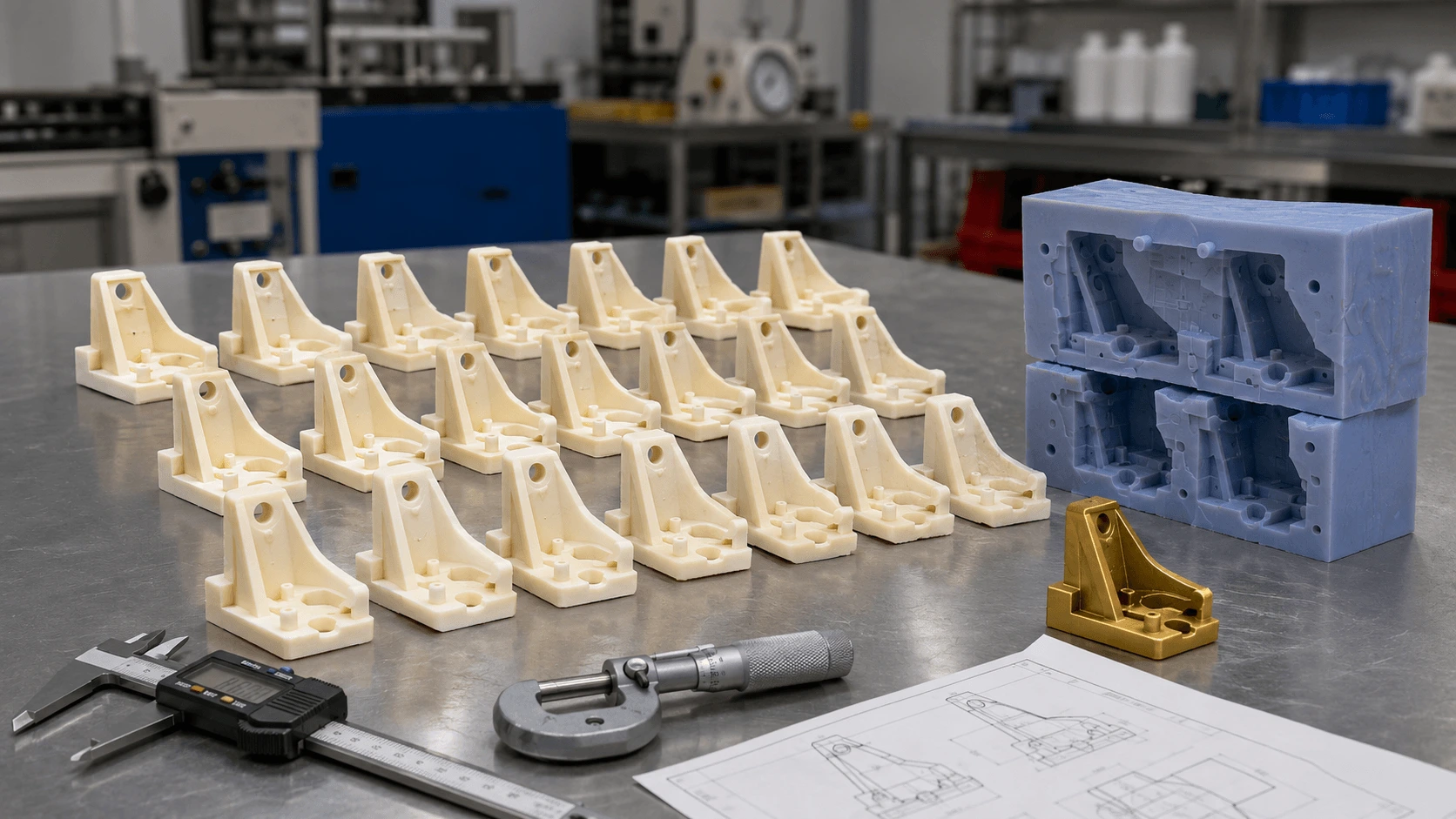
What Does Silicone Mold Life in Vacuum Casting Mean?
The term vacuum casting mold life can describe three separate limits. A purchasing team should identify which one controls the project before comparing quotations.
Physical Mold Life
The mold still closes, contains liquid resin, cures a casting, and releases it without catastrophic tearing. A tool can remain physically intact after its dimensional or cosmetic performance has declined.
Dimensional Mold Life
The cavity continues to reproduce critical features within drawing tolerances. Thin silicone cores, unsupported cavity walls, and damaged parting lines may change bore locations, wall positions, or exterior dimensions.
Cosmetic Mold Life
The mold still reproduces the gloss, texture, lettering, edge definition, and parting-line appearance established by the approved sample.
These limits rarely occur at the same shot count. A hidden internal bracket with broad tolerances may remain acceptable longer than a transparent light cover or high-gloss user interface.
A 2022 industrial-scale vacuum-casting review describes silicone tooling as a limited-life process for prototypes and small-series thermoset parts. The review reports casting cycles reaching approximately 90 minutes in the literature it examined and mold service life usually remaining below 50 casting cycles. Those figures describe a broad research range, not a recommended delivery target for every commercial project.
For quotation planning, 20 copies should mean approximately 20 accepted parts against defined requirements.
Why Polyurethane Causes Silicone Mold Degradation
The main mechanism behind silicone mold degradation combines chemical exposure with repeated mechanical stress.
Polyurethane casting systems typically contain a polyol component and an isocyanate component. During curing, isocyanate molecules can diffuse into the silicone near the cavity surface. Reactions involving residual moisture then form polyurea structures inside the silicone matrix.
Over repeated cycles, these chemical changes can alter:
- Surface roughness
- Hardness
- Tensile behavior
- Elongation
- Crack resistance
- Elastic recovery after demolding
The same 2022 review explains that polyurea-rich regions can contribute to cavity whitening and fissure formation. Demolding then stretches and bends the chemically affected silicone, allowing small defects to grow into visible cracks or local tears.
This mechanism also explains why technicians may notice changing mold behavior before complete failure. The cavity may release early parts easily, then require greater force after several casting cycles. Fine texture may soften, glossy surfaces may become less reflective, and flexible cores may stop returning fully to their original shape.
Temperature and exposure time influence diffusion and reaction rates, but heat alone does not explain the damage. Describing the resin as simply “burning” the mold overlooks the interaction among polyurethane chemistry, silicone structure, curing conditions, and cyclic demolding stress.
The chemical compatibility of the selected PU formulation can therefore affect tool life as much as the nominal hardness of the silicone.
How Geometry Changes Silicone Mold Life in Vacuum Casting
Part geometry often determines whether a silicone tool produces 12, 20, or more acceptable castings.
High-risk features include:
- Deep undercuts
- Reverse draft
- Narrow internal slots
- Tall ribs
- Thin silicone cores
- Sharp transitions
- Deep engraved lettering
- Large textured surfaces
- Long enclosed walls
- Features that require twisting during release
A simple open cover may require only light mold flexing. A small fluid-control rotor with curved channels and narrow internal cores can place much greater strain on the silicone during every demolding cycle.
Surface area also matters. A heavily textured cavity exposes more silicone to polyurethane than a smooth cavity with the same overall dimensions. The texture also creates greater mechanical engagement with the casting, increasing release force.
Mold cutting and parting-line design can either distribute or concentrate this stress. A poorly selected cut may force the operator to stretch one region repeatedly. Removable plugs or separate silicone cores can reduce deformation around internal openings and difficult undercuts.
Flexible tooling allows features that would require slides or lifters in a steel mold, but flexibility does not remove the cost of demolding strain. Reasonable draft, larger internal radii, supported mold walls, and carefully positioned cuts can extend silicone tool life without changing the product’s visible design.
Tool-life planning should therefore begin during DFM review, rather than after the master pattern has already entered mold making.
What Changes Before the Mold Completely Fails?
A torn silicone mold provides an obvious stop signal. Most production-quality problems begin earlier.
Surface and Gloss Changes
High-gloss areas may become hazy or less reflective. Fine matte textures can lose uniformity. Clear components reveal minor scratches, residue, and cavity roughness sooner than opaque parts.
Loss of Small Details
Embossed markings, grille openings, serial-number fields, knurling, and sharp edges may become softer. Small silicone fragments can also detach from narrow cavity features.
Parting-Line Deterioration
Repeated opening and closing may distort cut surfaces. Flash becomes heavier when the mold halves no longer align or seal consistently.
Dimensional Drift
Thin cores can lean, stretch, or take a permanent set. Broad flexible walls may move during filling and curing. These changes can affect hole locations, wall thicknesses, sealing widths, or exterior profiles.
Changing Release Behavior
Increasing demolding force often signals surface or geometry deterioration. Operators may observe drag marks, whitening, local part deformation, or small cavity fissures.
A mold can still produce visually acceptable components while critical dimensions drift. Another mold may remain dimensionally stable while losing the surface quality required for a cosmetic product.
Inspectors should compare late-cycle parts against both the drawing and the approved sample. The controlling limit is the last cycle that consistently produces conforming parts, rather than the last cycle that produces any recognizable casting.
Why 20 Copies Is a Practical Quality-Control Threshold
A 20-copy target gives suppliers a workable balance among output, consistency, and production risk. It also leaves room for setup parts, unexpected rejects, demolding damage, and replacement components required during final assembly.
Pushing one mold to its highest possible cycle count may save the cost of another tool. That saving can disappear quickly if late-cycle parts require sorting, rework, replacement, or delayed shipment.
The following table shows an example inspection plan. The actual frequency should follow the component’s risk level.
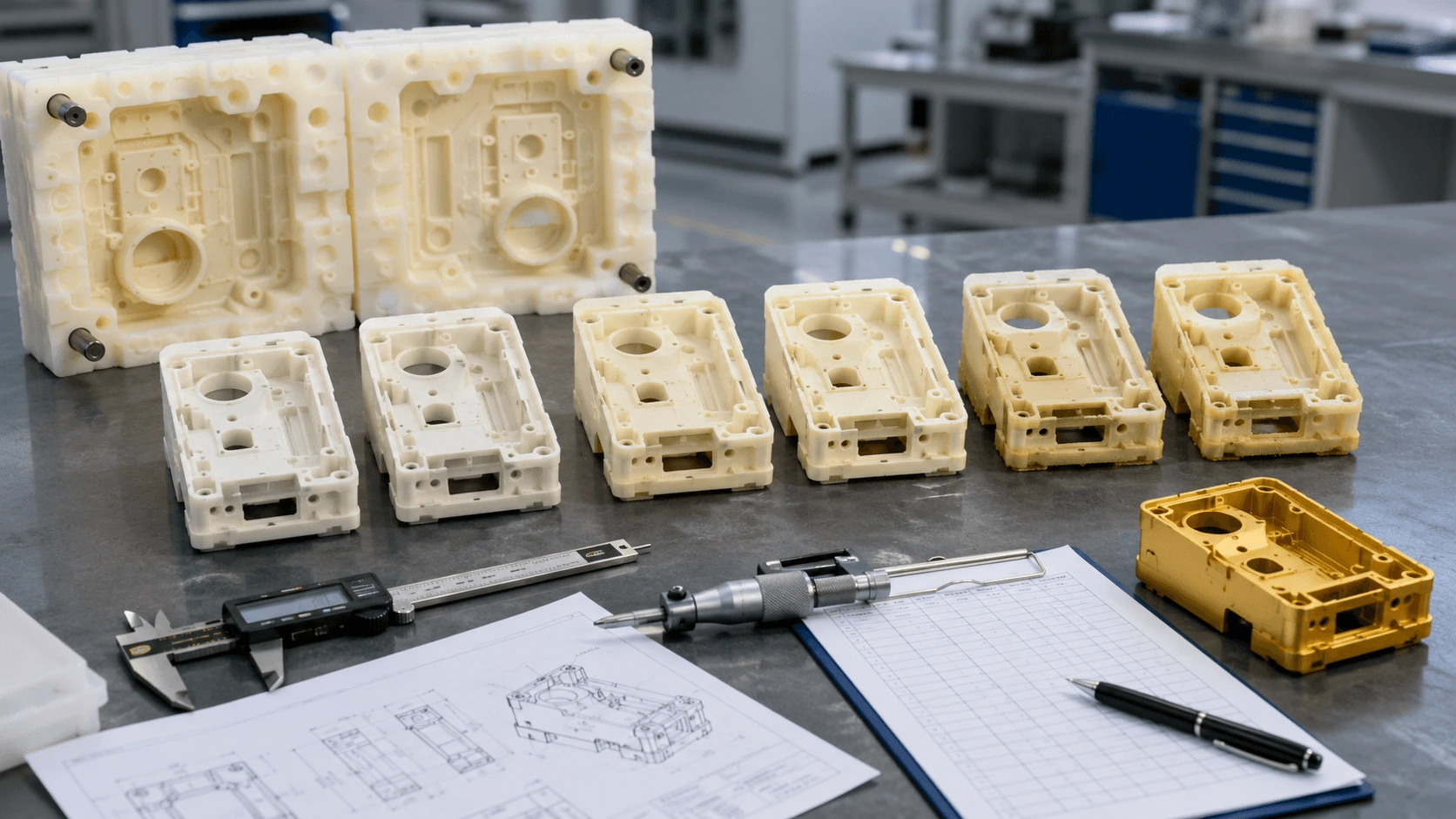
| Shot stage | Inspection priority | Main concern |
|---|---|---|
| Cycles 1–3 | Full first-article inspection | Cure, dimensions, color and surface |
| Cycles 4–10 | Routine dimensional and visual checks | Process stability |
| Cycles 11–15 | Increased detail and parting-line review | Early wear and flash |
| Cycles 16–20 | Defined late-cycle inspection | Drift, texture loss and release damage |
| Beyond planned output | Requalification before shipment | Match to drawing and golden sample |
💡 Pro Tip: Ask suppliers to quote accepted parts per mold, rather than theoretical pouring cycles. “Twenty conforming parts against these tolerances and cosmetic criteria” provides more value than “up to 25 shots.”
Transparent, high-gloss, heavily textured, or difficult-to-demold parts may reach their quality limit before cycle 20. Simple non-cosmetic components with broad tolerances may remain acceptable longer.
How Tool Life Affects Cost and Production Planning
Effective vacuum casting batch planning starts with the number of molds, accepted output per mold, and inspection strategy.
A 20-part order may use one production mold when geometry and acceptance requirements allow. A cosmetic order with no spare allowance may still justify contingency tooling.
A 40- or 60-part batch usually benefits from several silicone molds produced from the same retained master. Multiple molds offer several advantages:
- Lower dependency on one tool
- Parallel casting capacity
- Reduced late-cycle quality risk
- Faster recovery after accidental damage
- More predictable accepted output
They also create cross-mold variation. Every production mold should receive first-article approval for color, dimensions, parting-line appearance, and functional fit.
A complete quotation should state:
- Planned mold quantity
- Target accepted output per mold
- Whether molds will run in parallel
- First-article requirements for each mold
- Cross-mold inspection criteria
- Spare-part allowance
- Replacement-mold authorization
- Master-pattern retention
Master quality affects every silicone mold created from it. A dimensional error, visible layer line, or polishing defect can transfer into the complete batch. High-resolution SLA master-pattern production can support detailed surfaces and complex geometry, but the master still requires inspection and finish approval before silicone pouring.
For repeat orders, retain the approved master whenever possible. An old silicone mold may distort, collect contamination, or lose reliability during storage.
Real Application Evidence: Resin Gear Accuracy Across Cycles
A 2025 peer-reviewed study of resin gears made with silicone molds provides a useful functional example. The researchers varied two silicone materials, two casting resins, and two master-gear quality levels, creating eight silicone molds. They cast 10 gears from each mold, producing 80 resin gears in total, including 40 parts for each resin type.
The team measured tooth-profile deviation and helix deviation rather than relying on surface appearance alone. Pareto analysis ranked the resin type as the most influential tested variable, followed by the initial master-gear quality, silicone type, and casting number.
Casting number also affected the measured deviations, although the direction and magnitude varied among the resin, silicone, and master combinations. The study therefore supports cycle-based inspection without establishing one universal degradation rate.
This example offers several practical lessons:
- Resin chemistry can influence dimensional replication.
- Master quality affects every copy created from the tool.
- Silicone selection interacts with the casting formulation.
- Functional geometry can drift before the mold tears.
- One inspection characteristic cannot represent every product.
A gear project may monitor profile and helix deviation. A fluid-control component may prioritize bore position and sealing width. A light guide may focus on haze and surface replication.
Mold replacement should follow the product characteristic that controls function, assembly, or customer acceptance.
How to Extend Mold Life and Specify It in an RFQ
Tool-life improvement begins with product design and continues through mold storage.
During Part Design
- Add practical draft where geometry allows.
- Reduce unnecessary undercuts.
- Increase radii at deep transitions.
- Avoid fragile internal silicone cores.
- Separate difficult features into removable inserts.
During Mold Design
- Position parting lines to reduce stretching.
- Support broad flexible mold walls.
- Maintain sufficient silicone thickness.
- Use removable plugs around internal openings.
- Avoid concentrated closure pressure.
During Casting
- Follow the approved resin mix ratio.
- Control resin and mold temperature.
- Limit moisture contamination.
- Respect fill, gel, cure, and post-cure times.
- Use a repeatable demolding method.
- Clean the cavity without abrasive tools.
The 2022 review cites one experimental approach that reported a silicone-mold service-life improvement of up to 38.5%. The authors also describe practical limitations, so the result should not become a universal production claim. No single additive, coating, or process adjustment eliminates deterioration across every silicone-resin combination.
An RFQ should define mold life through accepted output and traceable inspection:
Supplier shall state the planned number of silicone molds and target accepted parts per mold. Parts produced beyond the planned threshold require dimensional and cosmetic requalification against the approved sample.
Also request shot-number traceability, first-article approval for every mold, cross-mold consistency checks, and a replacement-tool procedure.
Common Silicone Mold-Life Planning Mistakes
Several assumptions create avoidable cost and quality problems:
- Treating cycle 20 as a universal physical failure point
- Assuming an intact mold still produces conforming parts
- Quoting pours instead of accepted output
- Planning a cosmetic batch at the maximum theoretical life
- Ignoring undercuts and demolding strain
- Applying one tool-life estimate to clear, matte, and textured parts
- Skipping late-cycle inspection
- Mixing output from several molds without cross-mold approval
- Discarding the master before delivery closes
- Changing PU resin without reviewing mold life
- Reusing a stored mold without requalification
- Omitting contingency tooling from the production schedule
The phrase “up to 25 copies” provides little protection by itself. It does not identify the resin, geometry, surface standard, dimensional requirements, rejection allowance, or inspection frequency.
Buyers should also avoid comparing soft silicone tooling directly with steel injection molds. Silicone molds provide low initial investment, fast replication, and easier demolding of complex geometry. Their limited life defines the process’s practical production range.
Material selection remains part of that planning decision. The guide to PU casting resins for vacuum casting explains how resin stiffness, cure behavior, elongation, heat resistance, and formulation choice affect both the component and the casting process.
FAQs About Silicone Mold Life in Vacuum Casting
How Many Parts Can One Silicone Mold Produce?
For planning, many projects use approximately 20 acceptable parts per mold. The actual output depends on resin chemistry, undercuts, surface finish, geometry, cure conditions, and acceptance criteria. A mold may remain physically usable after its cosmetic or dimensional performance has declined.
Does a Silicone Mold Fail Immediately After 20 Cycles?
No. Deterioration usually develops gradually. Some molds require replacement earlier, while simple molds may continue producing acceptable parts beyond the planned threshold. Inspection results should determine the stop point.
Why Does Polyurethane Damage Silicone?
Isocyanate components can diffuse into the silicone near the cavity surface. Subsequent reactions alter the local material structure and mechanical properties. Repeated demolding then promotes surface fissures, deformation, detail loss, and tearing.
Do Undercuts Shorten Silicone Mold Life?
Deep undercuts often increase mold stretching and release force. Reverse draft, narrow slots, thin cores, and textured surfaces can concentrate stress and accelerate damage.
How Many Silicone Molds Are Needed for 60 Parts?
The supplier should calculate mold count from accepted output, spare requirements, geometry, and cosmetic risk. A plan targeting around 18–20 conforming parts per mold may require three or four molds.
When Should a Project Switch to Injection Molding?
Compare repeated silicone-mold and manual casting costs with production tooling when demand becomes predictable, quantities increase, or the final thermoplastic properties become mandatory.
Final Recommendation for Silicone Mold Life in Vacuum Casting
Silicone mold life in vacuum casting depends on chemical exposure, resin selection, geometry, surface area, demolding strain, temperature, and the project’s acceptance criteria.
Twenty copies provide a practical planning threshold because the supplier can reserve production capacity, increase late-cycle inspection, and avoid depending on the tool’s most optimistic possible lifespan. Cosmetic, transparent, deeply textured, and difficult-to-release parts may require earlier replacement. Simple components with broad tolerances may remain acceptable longer.
A reliable production plan should define:
- Accepted output per mold
- Total mold quantity
- First-article approval
- Late-cycle inspection
- Cross-mold consistency
- Spare quantity
- Master-pattern retention
- Replacement authorization
The goal is consistent delivered parts, rather than the highest possible number of pours from each silicone tool.
Planning a vacuum-casting order above 20 parts? Send BOONA your CAD files, required quantity, selected PU resin, undercuts, cosmetic zones, critical dimensions, and inspection criteria through its low-volume manufacturing services. BOONA can review the master-pattern method, accepted output per mold, tooling quantity, parallel casting plan, inspection checkpoints, and replacement-mold contingency before production begins.