
A plastic gear can run smoothly during dry assembly, then become noisy after several weeks in a humid factory. A machined bushing may pass dimensional inspection but wear rapidly once shaft misalignment, shock loading, or abrasive dust enters the mechanism.
These problems often begin with a material description that is too broad. “Nylon” covers several polyamide grades with different moisture, strength, and wear behavior. “Delrin” refers to a specific acetal homopolymer brand rather than every type of POM.
The nylon vs Delrin decision therefore depends on the failure mode the component must resist. Delrin and other POM grades usually provide better dimensional stability, cleaner machining, and more predictable running clearances. Nylon often performs better when a gear or bushing needs toughness, impact absorption, vibration damping, or heavy-duty abrasion resistance.
For engineers and buyers, the practical question is not which plastic looks stronger on a datasheet. The goal is to choose a specific grade that matches the load, speed, humidity, temperature, lubrication, mating surface, and tolerance requirements of the complete mechanism.
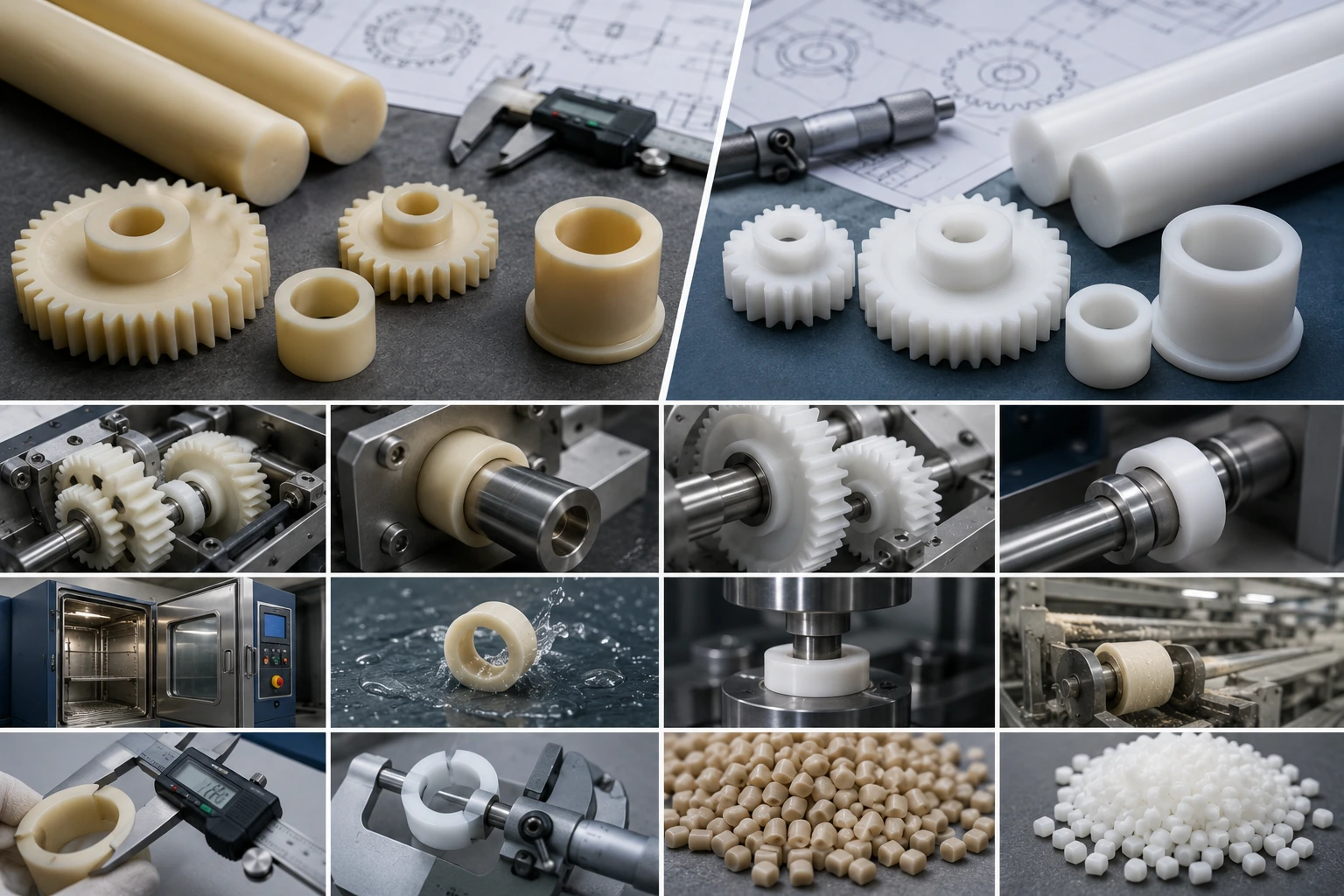
Nylon, Delrin, Acetal, and POM Are Not Interchangeable Names
Nylon describes a family of polyamides. Common engineering grades include PA6, PA66, cast PA6, oil-filled cast nylon, impact-modified nylon, and glass-filled nylon. The differences between these grades can change machinability, moisture uptake, stiffness, impact resistance, and shaft wear.
PA6 often provides good toughness and general wear resistance. PA66 usually starts with greater dry-state stiffness and higher heat capability. Cast nylon suits large gears, pulleys, rollers, and bushings because manufacturers can produce thick stock and large near-net shapes. Oil-filled grades add internal lubrication for demanding wear applications.
Delrin® is a branded acetal homopolymer, commonly classified as POM-H. The wider POM family also includes acetal copolymers known as POM-C. Delrin identifies gears as one of the material’s established applications because of its low friction, fatigue performance, stiffness, and dimensional control.
POM-H generally provides slightly greater hardness, strength, and stiffness. POM-C offers a balanced combination of wear resistance, chemical resistance, low moisture uptake, and dimensional stability. Porosity-free POM-C stock can also be useful for larger machined components.
An RFQ should identify the exact grade. Writing only “nylon” or “Delrin/POM” leaves too much room for substitution.
Nylon vs Delrin Quick Comparison
The table below provides a practical starting point for gears, bushings, sleeve bearings, rollers, and other moving components. It does not replace grade-specific testing.
| Selection factor | Nylon | Delrin / POM |
|---|---|---|
| Moisture absorption | Relatively high | Low |
| Dimensional stability | Changes with moisture condition | More predictable |
| Impact resistance | Generally strong | Good, but more rigid |
| Vibration damping | Better | Moderate |
| Sliding behavior | Good and grade-dependent | Consistently good in many grades |
| Abrasion resistance | Very good | Excellent in many precision applications |
| CNC machinability | Good, but may flex or form stringy chips | Excellent with clean chip formation |
| Tight-tolerance gears | Requires moisture allowance | Usually preferred |
| Shock-loaded gears | Often preferred | Suitable under controlled loading |
| Precision bushings | Clearance must allow for moisture | Usually preferred |
| Large heavy-duty bushings | Cast nylon can work well | Better for stable, close-clearance designs |
| Chemical exposure | Strongly grade-dependent | Generally good; POM-C often performs well |
POM is usually the safer first choice for small precision gears, consistent backlash, accurate bores, and tight running clearances. Nylon becomes more attractive for large gears, impact-loaded mechanisms, dirty industrial environments, and components that benefit from vibration damping.
The final selection still depends on the exact nylon or POM grade. Fillers and lubricants can improve one property while reducing another. Glass reinforcement raises stiffness, for example, but may make a bushing more abrasive against a soft metal shaft.
Moisture Absorption Can Change Gear and Bushing Fit
Moisture creates one of the clearest differences between nylon and POM.
Nylon absorbs water from the atmosphere. As the moisture content rises, the material can expand, lose stiffness, and gain toughness. A modest change may be harmless in a large wear pad, but it can alter gear backlash, bearing clearance, bore diameter, press fit, and tooth engagement.
BASF’s February 2026 product data sheet for Ultramid A3K—an unfilled PA66 grade used for bearings, gears, and other stressed technical components—reports equilibrium moisture absorption of 2.5–3.1% at 23°C and 50% relative humidity. It lists 8–9% water absorption at saturation in 23°C water. These figures apply to that specific PA66 grade, rather than every type of nylon, but they show why moisture condition belongs in the tolerance plan.
POM absorbs much less moisture and holds dimensions more consistently. Its combination of low moisture uptake, sliding performance, wear resistance, and machinability makes it a common material for precision mechanical parts.
For nylon components, the drawing should define the inspection condition:
- Dry as machined
- Conditioned at a specified temperature and humidity
- Measured after water exposure
- Inspected after stabilization for a defined period
A bushing that passes dry inspection can tighten on its shaft after conditioning. A gear can lose designed backlash. The operating environment matters more than the dimension measured immediately after machining.
💡 Pro Tip: Compare nylon properties in the condition expected during service. Dry-state strength and stiffness can overstate real operating performance when the component will run in a humid or wet environment.
Load, Toughness, Creep, Friction, and Wear
Nylon often handles shock, vibration, and temporary misalignment well. Its toughness can reduce the risk of sudden tooth damage, while its damping helps control noise and impact transmission through a gear train. Cast nylon also suits large mechanical parts where weight reduction and abrasion resistance matter.
POM behaves more rigidly and keeps its geometry more consistently. That stability supports accurate gear teeth, bearing bores, guide surfaces, and cams. POM-H stock also offers strong fatigue, creep, sliding, and machining characteristics for precision components.
A short tensile test does not predict the service life of a gear or bushing. Plastic can deform gradually under sustained stress. Creep depends on load, temperature, time, moisture, geometry, and material grade.
Friction and wear also belong to the complete tribological system. The result depends on:
- Shaft material and hardness
- Shaft roughness
- Contact pressure
- Sliding velocity
- Lubrication
- Alignment
- Operating temperature
- Dirt and abrasive particles
- Startup frequency
- Duty cycle
Published coefficients of friction should only be compared when the test conditions match. A material that performs well against hardened, polished steel may wear quickly against a rough aluminum shaft.
Glass-filled nylon illustrates the trade-off clearly. Fibers can improve stiffness and reduce deformation, but exposed glass can wear a softer mating surface. The stronger bushing may create the weaker overall mechanism.
Choosing Nylon or Delrin for Plastic Gears
POM is usually the better starting point for a small precision gear. Its low moisture absorption helps maintain tooth profile, backlash, bore size, and center distance. It also machines cleanly, which supports custom prototypes, replacement gears, and low-volume parts with fine teeth.
POM commonly suits:
- Instrument gears
- Encoder mechanisms
- Small actuator gears
- Precision gear trains
- Tight backlash requirements
- Variable-humidity environments
- Dry-running mechanisms
- Low-volume machined gear prototypes
Nylon deserves consideration when the drive experiences impact, vibration, or temporary overload. Larger cast nylon gears can reduce noise and rotating mass while absorbing shock that might damage a more rigid material.
Nylon commonly suits:
- Large industrial gears
- Conveyor systems
- Agricultural machinery
- Low-speed, high-load drives
- Shock-loaded mechanisms
- Metal gear replacements requiring damping
- Oil-filled or internally lubricated applications
| Gear requirement | Preferred starting material | Main reason |
|---|---|---|
| Tight backlash | POM | Better dimensional stability |
| Humid operating area | POM | Lower moisture absorption |
| Sudden impact load | Nylon | Greater toughness and damping |
| Small precision teeth | POM-H or POM-C | Clean machining and stable geometry |
| Large slow-moving gear | Cast nylon | Toughness and abrasion resistance |
| Quiet metal-gear replacement | Nylon or POM | Load and accuracy decide the choice |
A gear RFQ should state module or diametral pitch, pressure angle, face width, root geometry, backlash, bore fit, torque, RPM, duty cycle, temperature, humidity, and lubrication.
Choosing Nylon or POM for Bushings
POM is often the better choice for a small or medium bushing that requires a controlled bore and stable running clearance. It works well in guide bushings, sleeve bearings, rollers, spacers, thrust washers, and other moderately loaded precision mechanisms.
Choose POM when:
- Bore accuracy controls assembly
- Running clearance is tight
- Humidity changes during operation
- Friction must remain consistent
- The component has thin or detailed features
- Clean, concentric CNC turning matters
Boona POM CNC machining service supports custom gears, bushings, bearings, cams, guides, and other low-friction components.
Nylon can perform better in a large bushing exposed to shock, vibration, contamination, or high mechanical loading. Cast and oil-filled nylon grades often suit conveyor pivots, lifting equipment, agricultural systems, rollers, and heavy industrial machinery.
Choose nylon when:
- Impact or vibration is significant
- The bushing is large and heavily loaded
- Abrasive contamination is expected
- External lubrication is difficult
- Damping matters more than micron-level stability
- The design can accommodate moisture movement
The specification should include shaft diameter, installed bore, wall thickness, bearing length, interference, running clearance, radial load, velocity, lubricant, shaft hardness, and shaft finish.
For cylindrical parts, the article on how CNC turning achieves precise cylindrical components explains how turning controls concentric bores and outside diameters.
Grade, Temperature, Chemical, and Lubrication Requirements
Neither nylon nor POM should be selected from a generic family-level datasheet when the environment includes heat, chemicals, washdown, fuel, or aggressive cleaning agents.
Selected nylon grades can offer stronger high-temperature performance than standard POM. Moisture-conditioned nylon, however, becomes less stiff than dry nylon. POM usually maintains more predictable dimensions at moderate temperatures, but prolonged hot-water exposure and strong acids or alkalis can change the recommendation.
Modified grades extend the available performance range:
- Oil-filled cast nylon for large wear parts
- MoS₂-filled nylon for reduced friction
- Glass-filled nylon for higher stiffness
- Impact-modified nylon for shock loading
- PTFE-filled POM for sliding components
- Lubricated POM bearing grades
- Delrin AF for low-friction applications
Fillers do not improve every property simultaneously. Glass fibers may raise stiffness while increasing shaft wear and making fine machining more difficult. Lubricant-filled grades may reduce friction but alter strength, bonding, or dimensional behavior.
POM-H and POM-C also deserve separate review. POM-H typically offers slightly higher hardness and strength. POM-C provides excellent machinability, low moisture absorption, chemical resistance, and porosity-free stock options for larger components.
The RFQ should identify the exact commercial grade when possible. If the grade is unknown, describe the load, speed, temperature, humidity, chemicals, counterface, and lubrication conditions so the supplier can recommend a realistic starting material.
CNC Machining Nylon vs Delrin
POM is one of the cleaner engineering plastics to machine. It normally produces well-defined chips, smooth surfaces, accurate bores, and crisp gear teeth. These characteristics make it suitable for low-volume gears, precision bushings, bearing cages, rollers, spacers, and cams.
Heat and clamping still require control. Excessive fixture pressure can distort thin walls, while dull tools generate heat and poor edges. Large sections may need a staged roughing and finishing strategy.
Nylon presents different machining challenges. Its toughness and elasticity can cause the material to deflect away from the cutting tool. It may generate stringy chips, burrs, and heat. Thin walls can move during clamping or after material removal.
Useful machining controls include:
- Sharp, polished cutting tools
- Positive cutting geometry
- Controlled cutting heat
- Light, distributed clamping
- Support for thin walls
- Separate roughing and finishing operations
- Time for the part to stabilize before inspection
- Clear dry or conditioned measurement requirements
Boona nylon CNC machining service supports gears, pulleys, bushings, rollers, and wear parts. For mixed plastic components and complete prototype projects, its precision CNC machining service covers CNC milling and turning in a range of engineering materials.
When the design is still changing, CNC machining also lets engineers compare nylon and POM without investing in mold tooling. Boona guide to CNC machining for rapid prototyping explains how real production materials support early functional testing.
Application Examples Based on Common Failure Patterns
Precision gear in a humid production area
A compact automation mechanism uses a small PA66 gear. Dry inspection confirms the tooth geometry and backlash, but the machine operates in a humid processing area. After conditioning, the nylon expands enough to reduce clearance. Noise and operating torque increase during longer production cycles.
The engineering team keeps the same pitch and tooth count but changes the gear to POM-C. It adds a controlled backlash range, defines the shaft fit, and validates the assembly after humidity exposure.
POM-C works better in this case because dimensional stability controls performance. Nylon’s additional impact toughness offers little benefit to a lightly loaded precision gear.
Heavy-duty conveyor bushing
A POM bushing in a conveyor pivot wears faster than expected. Inspection shows shock loading, abrasive dirt, shaft misalignment, and insufficient bearing length.
The revised design uses a thicker oil-filled cast nylon bushing. Engineers improve shaft hardness and finish, increase the bushing length, adjust running clearance, and add contamination protection.
Nylon performs better here because the mechanism needs toughness, damping, and abrasion resistance more than a tight precision bore.
These examples show why material selection should follow the observed failure mode. POM does not automatically win every bushing application, and nylon does not automatically win every high-load gear application.
Final Selection Checklist
Use the real service environment to narrow the material choice:
| Design question | Usually favors nylon | Usually favors POM |
|---|---|---|
| High shock or impact? | Yes | Sometimes |
| Tight tolerance in humidity? | No | Yes |
| Need vibration damping? | Yes | Moderate |
| Small precision gear? | Sometimes | Yes |
| Large heavy-duty bushing? | Yes | Sometimes |
| Stable running clearance? | Requires allowance | Yes |
| Abrasive or dirty service? | Cast grades may help | Application-dependent |
| Fine machined features? | More difficult | Better |
| Thin precision geometry? | More difficult | Better |
| Variable atmospheric moisture? | Requires conditioning | Better |
Start with POM for precision gears, stable backlash, clean machined teeth, and tight-clearance bushings.
Start with nylon for shock-loaded gears, large wear components, vibration damping, and heavy industrial bushings.
Then test the chosen grade under realistic conditions. Include operating load, speed, humidity, temperature, shaft finish, lubrication, duty cycle, and contamination. A successful material selection should protect the complete mechanism rather than maximize one isolated datasheet value.
FAQs
Is Delrin better than nylon for gears?
Delrin or another POM grade is often better for small precision gears because it absorbs less moisture and holds tooth geometry and backlash more consistently. Nylon can perform better in larger or shock-loaded gears that need toughness and damping.
Is nylon or POM better for bushings?
POM is usually preferred for precision bushings with tight running clearances. Cast or oil-filled nylon may be better for large, dirty, shock-loaded, or heavily loaded bushings.
Does nylon swell in humid environments?
Yes. Nylon absorbs atmospheric moisture, which can increase its dimensions and reduce stiffness. The amount depends on the grade, humidity, temperature, wall thickness, and conditioning time.
Is Delrin the same as POM?
Delrin is a branded acetal homopolymer classified as POM-H. POM is the broader material family and also includes acetal copolymers known as POM-C.
Which plastic has lower friction?
Both materials can provide low friction. POM often offers predictable sliding behavior, while oil-filled and modified nylon grades can also perform well. Shaft material, pressure, speed, lubrication, and alignment determine the final result.
Which material is easier to CNC machine?
POM is generally easier to machine into clean edges, accurate bores, and fine gear teeth. Nylon can flex, form stringy chips, create burrs, and change dimensions as its moisture condition changes.
Nylon vs Delrin Final Recommendation
The nylon vs Delrin decision comes down to the risk the gear or bushing must control.
POM is usually the stronger starting point for tight tolerances, stable gear geometry, low moisture absorption, consistent friction, and precision-machined bores. It fits small gears, guide bushings, cams, bearing cages, and instrument mechanisms.
Nylon deserves stronger consideration when shock, vibration, contamination, edge loading, or heavy mechanical duty dominates the application. Cast and modified nylon grades can perform well in large gears, industrial rollers, pulleys, wear pads, and heavy bushings.
The polymer family alone does not define the result. PA6, PA66, cast nylon, POM-H, POM-C, and internally lubricated grades behave differently.
A complete drawing should define the material grade, moisture condition, gear backlash, bore fit, mating shaft, temperature, lubrication, and inspection state. Functional testing under realistic operating conditions provides the final confirmation.
Request Material and DFM Feedback
Choosing between nylon and POM for a custom gear, sleeve bushing, bearing, pulley, roller, or wear component? Send Boona your CAD files, quantity, operating load, speed, temperature, humidity, shaft material, lubrication conditions, and tolerance requirements through its precision CNC machining service for material-selection and DFM feedback.