
A low machining quote can become expensive after the parts reach assembly. A bearing bore runs tight after anodizing. A camera bracket matches its basic dimensions but misses the positional tolerance that controls optical alignment. The supplier machines the correct geometry from the wrong aluminum temper. By then, the buyer has already paid for material, machining, finishing, freight, customs clearance, inspection, and rework.
Companies planning to source custom robot parts from China need more than competitive unit pricing. They need a controlled procurement process covering RFQ preparation, supplier capability, material traceability, sample approval, inspection, revision control, intellectual-property protection, and international shipping.
China offers a broad manufacturing base for robot brackets, actuator housings, arm links, gripper components, precision shafts, sensor mounts, and low-volume assemblies. According to the International Federation of Robotics, China installed 295,000 industrial robots in 2024, accounting for 54% of global deployments. Its operational robot stock exceeded two million units, while Chinese robot manufacturers captured 57% of their domestic market.
That scale creates capability and supplier choice. It does not remove the need for disciplined sourcing.
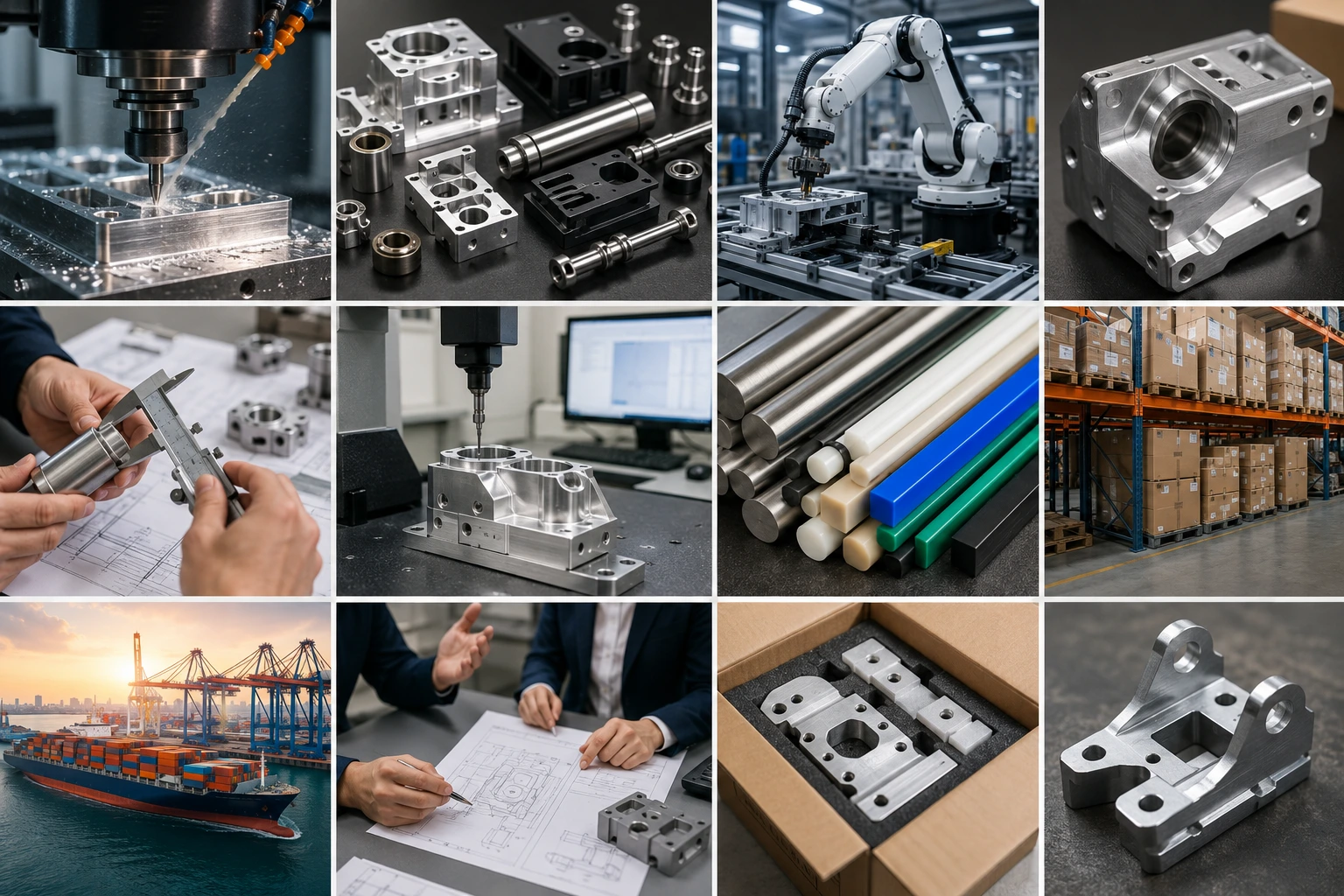
Why Source Custom Robot Parts from China?
China sourcing works best when buyers take advantage of its process range and manufacturing flexibility rather than treating it only as a low-cost option.
A single robotics project may require a five-axis aluminum actuator housing, turned stainless-steel locating pins, a POM cable guide, black anodizing, laser marking, and a dimensional inspection report. Coordinating these operations through one manufacturing network can simplify purchasing and reduce the number of separate vendors involved.
The model also suits robotics development because order volumes often increase gradually. An engineering team may need two prototype brackets, five revised housings, and then a 50-piece pilot batch. A supplier that accepts low quantities allows the team to test the design before committing to production inventory. Boona guide to no MOQ CNC machining for robot parts explains how this staged approach supports revisions and pilot builds.
China is not automatically the best location for every order. Local production may make more sense for emergency replacement parts, highly restricted projects, heavy low-value components, or designs requiring daily face-to-face engineering changes.
The sourcing decision should compare technical capability, communication, delivery risk, total landed cost, and the consequences of failure—not machining price alone.
Define the Parts and Their Functional Risk
A useful supplier search begins with the role each part plays in the robot. A cosmetic cover does not require the same sourcing controls as a bearing carrier that affects joint accuracy.
Group the components by functional risk:
- Motion-critical parts: bearing housings, shafts, reducer interfaces, actuator bodies
- Load-bearing parts: arm links, joint plates, gripper frames, structural brackets
- Alignment parts: sensor mounts, camera plates, dowel-located adapters
- Wear parts: bushings, pins, sliding guides, replaceable gripper contacts
- Non-critical parts: guards, covers, cable clips, cosmetic panels
Next, define the development stage. A concept prototype prioritizes speed and easy modification. An engineering-validation part should use production-representative materials and functional tolerances. A pilot batch requires repeatable machining, stable finishing, inspection documentation, traceability, and export-ready packaging.
Provide assembly context even when the supplier will machine only one component. An assembly model can expose tool-access problems, insufficient fastener clearance, cable interference, and unrealistic datum choices.
Boona overview of CNC machining for robotics covers common robot joints, housings, links, mounts, and end-effector components. Use that broader component map to decide which features need the strictest supplier controls.
How to Source Custom Robot Parts from China with a Complete RFQ
A STEP file communicates geometry, but it rarely defines everything required for a production-quality robot component. Send a neutral 3D model together with a controlled 2D drawing.
The RFQ package should identify:
- Material grade and condition
- Quantity by revision
- General tolerance standard
- Critical dimensions and geometric tolerances
- Datums and inspection references
- Thread classes and inserts
- Surface roughness requirements
- Heat treatment and finishing
- Masked or uncoated surfaces
- Required certificates and reports
- Packaging and marking requirements
Mark critical-to-function features clearly. A bearing bore may require a specific ISO fit. A camera-hole pattern may need 0.03 mm true position relative to defined datums. A cosmetic pocket can often use a standard machining tolerance.
Avoid vague material descriptions such as “aircraft aluminum” or “high-strength plastic.” Specify 6061-T6, 7075-T651, 304 stainless steel, 17-4PH, POM, PA12, or PEEK as required. The comparison of 6061 and 7075 aluminum for robot parts can help buyers choose between cost, strength, corrosion resistance, and anodizing performance.
A complete RFQ reduces hidden assumptions and makes quotations easier to compare.
Match Supplier Equipment to the Part Geometry
A long machine list does not prove that a factory can produce your component efficiently or inspect it correctly. Ask which machine, setup strategy, and inspection method the supplier plans to use.
Three-axis milling suits many plates, covers, and straightforward brackets. Multi-face actuator housings, compound-angle interfaces, lightweight arm links, and parts with tightly related features may benefit from 5-axis CNC machining. Reducing setups can protect positional relationships and limit handling error.
CNC turning works well for shafts, spacers, sleeves, pins, and cylindrical couplers. Mill-turn equipment may suit parts combining rotational geometry with flats, cross-holes, or milled interfaces. EDM can help with narrow slots, hardened materials, and internal features that standard cutters cannot reach.
Supplier type also matters:
| Supplier Type | Best Fit | Primary Risk |
|---|---|---|
| Small CNC job shop | Simple parts and price-sensitive work | Limited inspection or backup capacity |
| Prototype specialist | Rapid revisions and small quantities | Higher cost at production volume |
| Contract manufacturer | Stable recurring production | Less flexibility during frequent changes |
| Trading company | Broad access to several processes | Limited visibility into the actual factory |
| Integrated manufacturer | Multi-process parts and assemblies | Capability still needs project verification |
A capable supplier should discuss workholding, distortion, datum selection, coating allowance, tool access, and inspection before accepting the purchase order.
Verify Quality Systems with Evidence
ISO 9001 gives manufacturers a recognized framework for document control, monitoring, corrective action, process management, and continual improvement. More than one million ISO 9001 certificates have been issued across 189 countries. Certification remains useful, but it does not prove that a supplier can hold a specific bearing fit or manage your anodizing allowance correctly. Review the official ISO 9001 standard overview.
Request evidence related to your project:
- Sample dimensional or CMM reports
- Current calibration records
- Material certificates and batch data
- First-article inspection formats
- Coating or heat-treatment documentation
- Drawing-revision procedures
- Nonconformance and corrective-action examples
- Traceability rules for mixed production lots
Check the legal company name, certificate scope, expiration date, and certification body. A certificate issued to an affiliated company or unrelated production site may not cover the supplier handling your order.
A perfect prototype can receive special attention from an experienced machinist. Ask how the supplier will reproduce the same result during routine production.
💡 Pro Tip: Ask the supplier to identify the measurement method beside each critical drawing feature. This reveals whether it plans to use a caliper, micrometer, bore gauge, height gauge, optical system, profilometer, or CMM.
Start with a Controlled Sample Order
One sample shows that the supplier can produce one acceptable part. It does not reveal normal process variation. For alignment-critical, coated, or multi-component assemblies, order three to five samples when the budget allows.
Create a first-article approval checklist covering:
- Material and temper
- Critical dimensions
- Geometric tolerances
- Threads and inserts
- Surface finish and color
- Assembly fit
- Laser marking
- Inspection documents
- Packaging protection
Test the samples inside the actual robot assembly. Inspection reports cannot reveal every practical issue. A bearing may feel different after coating. A fastener may lack tool access. A camera bracket may affect calibration. A gripper plate may deflect under payload. A cable exit may interfere with motion.
Keep one approved sample or a complete inspection package as the production reference. Freeze the drawing revision before authorizing the pilot batch. Consolidate all sample feedback into one controlled document rather than leaving changes scattered across emails, WeChat messages, or screenshots.
The sample stage should end with a formal decision: approved, approved with documented changes, or rejected. Without that record, supplier and buyer may hold different views of what production should reproduce.
Control Materials and Surface Finishing
Material substitutions and finishing allowances cause frequent disputes in overseas machining projects. Put the exact material grade, condition, standard, and certification requirement in both the drawing and purchase order.
Surface treatments can affect dimensions and function. Anodizing builds an oxide layer. Nickel plating adds measurable coating thickness. Bead blasting changes texture and can soften sharp visual edges. Heat treatment may introduce distortion.
Review these areas before finishing:
- Bearing bores
- Dowel holes
- Precision threads
- Electrical grounding surfaces
- Sealing faces
- Sliding interfaces
- Cosmetic surfaces
- Laser-marking zones
Some features may require masking, dimensional compensation, or machining after coating. A dowel hole that meets size before anodizing may become too tight afterward.
Define appearance with objective standards. “Good black anodizing” does not establish an acceptance rule. Specify finish type, gloss level, acceptable shade variation, rack-mark location, scratch limits, protected faces, and an approved reference sample where appearance matters.
Packaging forms part of finish control. Use individual wrapping, thread protectors, foam separation, moisture barriers, and rigid trays as required. A supplier can machine a perfect component and still deliver an unusable cosmetic part if metal pieces strike each other during transport.
Compare Total Landed Cost, Not Machining Price
A unit price does not show the real cost of sourcing robot parts internationally. Compare the full landed cost:
- Raw material
- Machining and setup
- Fixtures or tooling
- Inspection and documentation
- Surface finishing
- Packaging
- International freight
- Insurance
- Import duties and taxes
- Banking charges
- Local inspection or rework
- Replacement-shipment risk
Read every quotation for exclusions. One supplier may include anodizing, material certificates, and inspection reports. Another may quote machining only. A low price may assume general tolerances, standard packaging, no documentation, and the cheapest locally available material source.
Specify the delivery term and named location clearly, such as FCA Shenzhen or DAP to the buyer’s address. The buyer should also confirm the HS classification, country-of-origin documents, applicable duties, and any product-specific controls with a customs broker.
Express air delivery often suits prototypes and urgent pilot batches. Consolidated air or sea freight may reduce shipping cost for stable production, but longer transit increases inventory and schedule risk.
The cost of one rejected batch can exceed months of savings from choosing the cheapest supplier. Include engineering time, assembly delays, sorting, re-machining, coating removal, and emergency replacements in the comparison.
Protect CAD Data and Revision Control
Share the information the supplier needs to manufacture and inspect the component, not the complete robot architecture.
Use secure file transfer, controlled revision numbers, and a formal release list. Remove unrelated assemblies, software details, customer names, and sensitive performance data when possible.
An NDA helps establish confidentiality, but practical controls matter just as much. Ask:
- Who can access the CAD files?
- Will files be shared with subcontractors?
- Where are drawings stored?
- How long are files retained?
- Can obsolete revisions be deleted?
- Who owns fixtures and inspection gauges?
- May the factory photograph or display the parts?
Clarify which processes stay in-house. CNC suppliers commonly subcontract anodizing, heat treatment, grinding, plating, or laser marking. Subcontracting is not automatically a problem, but the primary supplier should control the approved source, transport, documentation, and corrective action.
For many prototype orders, revision mistakes create a greater immediate risk than deliberate IP theft. A factory that machines an obsolete model accurately still delivers unusable parts. Formal file-release procedures and clear obsolete-file controls protect the project from this common failure.
Application Example: Robot Vision Mounting Assembly
A robotics company needs a vision mounting assembly for an automated inspection cell. The assembly contains an anodized aluminum camera plate, a smaller sensor bracket, two stainless-steel locating pins, and a POM cable-clamp block.
The buyer orders five sample sets. Basic dimensions pass inspection, but assembly reveals three issues:
- The camera-hole pattern shifts enough to affect optical alignment.
- Anodizing reduces the effective diameter of the dowel holes.
- The cable connector lacks removal clearance.
The revised drawing establishes datum A on the mounting face and datums B and C on the locating edges. Engineers apply a 0.03 mm true-position requirement to the camera-hole pattern. The supplier masks and finish-reams the dowel holes. The cable-clamp wall moves by 2.5 mm, and each component receives a laser-marked revision and batch code.
The buyer tests five revised sets through repeated assembly and calibration cycles. After approval, the supplier manufactures a 60-set pilot batch using the same material source, finishing instructions, inspection plan, and protective packaging.
The supplier’s machining equipment contributed to the result, but the controlled RFQ, functional testing, finish allowance, and revision records created repeatability.
Use a Weighted Supplier Scorecard
Price should form only one part of the decision. A weighted scorecard helps purchasing and engineering teams compare evidence rather than impressions.
| Evaluation Area | Suggested Weight | Evidence to Review |
|---|---|---|
| Machining capability | 20% | Equipment, capacity, similar geometries |
| Quality control | 20% | CMM, reports, calibration, traceability |
| Engineering support | 15% | DFM depth and technical responses |
| Sample consistency | 15% | Variation across several parts |
| Material and finish control | 10% | Certificates and approved processors |
| Communication | 10% | Clarity, speed, revision discipline |
| Logistics | 5% | Lead time, packaging, export process |
| Commercial terms | 5% | Payment, warranty, delivery terms |
Watch for common red flags:
- The supplier quotes before reviewing the drawing.
- Every difficult tolerance receives an immediate “no problem.”
- Material grade or temper disappears from the quotation.
- The factory avoids providing inspection evidence.
- Production pressure begins before sample approval.
- Subcontracted processes remain unclear.
- Drawing changes rely only on chat messages.
- Quality reports measure irrelevant dimensions.
- Communication becomes vague when a defect appears.
A supplier with a slightly higher price may create a lower total cost through stable assembly, fewer revisions, stronger documentation, and faster corrective action.
FAQs About Sourcing Custom Robot Parts from China
What files should I send for a quotation?
Send a STEP or Parasolid model, revision-controlled PDF drawing, quantities, exact material grade, surface finish, critical tolerances, inspection requirements, and relevant assembly information.
Should I order samples before production?
Yes. Samples allow you to verify material, dimensions, coating, assembly fit, documentation, and packaging. Three to five pieces provide more information about process variation than a single part.
How can I verify CNC quality remotely?
Request dimensional reports, CMM results, material certificates, coating documents, calibration evidence, photographs, and video reviews where helpful. Complete final approval through physical assembly testing.
What CNC tolerances can Chinese suppliers achieve?
Capability depends on part size, geometry, material, machine condition, workholding, finishing, and inspection. Selected features may achieve ±0.01 mm to ±0.05 mm, but tight tolerances should only be applied where function requires them.
How can I protect robot CAD files?
Use NDAs, limited file sharing, revision control, subcontracting restrictions, and written rules covering storage, access, photography, retention, and deletion.
How should I compare supplier quotations?
Normalize material, tolerances, finish, inspection, packaging, freight, duties, payment terms, and lead time. Quotes are not comparable until they cover the same requirements.
Source Custom Robot Parts from China with Better Process Control
China can support prototype brackets, complex actuator housings, arm links, gripper parts, sensor mounts, precision shafts, and pilot assemblies. The commercial advantage comes from combining this capability with disciplined supplier management.
When you source custom robot parts from China, begin with a controlled RFQ. Verify that the equipment and inspection methods match the part. Approve several samples where consistency matters. Specify materials and finishing allowances. Protect revision control. Compare total landed cost instead of machining price alone.
A good supplier relationship becomes clearer as the project progresses. Risks are identified early, drawing requirements become more precise, inspection becomes repeatable, and pilot production follows the approved sample.
Request a Quote for Custom Robot Parts
Preparing an RFQ for robot brackets, actuator housings, arm links, gripper components, sensor mounts, or precision shafts? Send Boona your controlled CAD files, drawings, quantities, material requirements, surface-finish specifications, and critical inspection features through its precision CNC machining service for DFM feedback and a manufacturing quotation.