
“Acetal” is often the only material note on a drawing. That single word leaves the supplier to resolve the polymer type, commercial grade, stock form, and approved equivalent. On a precision valve indexing plate, the ambiguity may survive incoming inspection and emerge later as detent relaxation under sustained load, shifting repeatability after assembly. The specification problem starts before machining: POM-H vs POM-C determines which molecular structure carries the load.
The distinction separates two members of the polyoxymethylene family, each with a different molecular architecture. POM-H generally offers greater strength, stiffness, creep resistance, and fatigue endurance. POM-C generally offers a wider chemical envelope, stronger hydrolysis resistance, and lower centerline-porosity risk in machined stock shapes. Once we connect those differences to load, environment, geometry, and manufacturing route, “acetal” becomes an engineering decision rather than a purchasing shortcut.
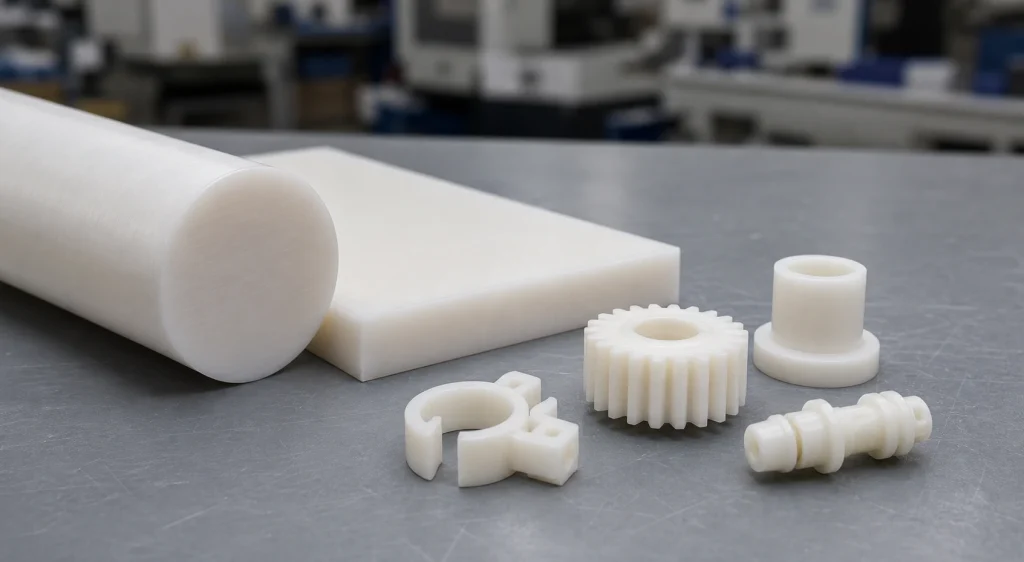
Start With the Correct Acetal Terminology
Acetal is the broad material family, while POM is its common chemical abbreviation. POM-H identifies an acetal homopolymer; POM-C identifies a copolymer. Delrin is a trademarked family of POM-H materials, so a Delrin vs acetal comparison must distinguish a commercial homopolymer portfolio from the broader resin family.
That distinction belongs on the drawing and purchase order. “Natural acetal” tells a supplier too little about polymer type, grade, additives, stock form, color, regulatory status, and traceability. A stronger callout names the exact resin or shape grade, its manufacturer, color, governing datasheet revision, and whether an approved equivalent is acceptable.
The structural difference is measurable. The 2024 Delrin Product Reference Guide reports roughly 55% to 60% crystallinity for its homopolymer, compared with about 45% to 50% for a typical copolymer. Those figures are manufacturer data, and individual formulations vary, yet they explain much of the usual performance split. Grade modifiers can shift the balance further: glass fibers raise stiffness, lubricants alter friction and wear, impact modifiers trade rigidity for toughness, and UV or medical packages address specific service requirements.
POM-H vs POM-C Starts With the Polymer Chain
POM-H has a highly regular backbone built mainly from repeating oxymethylene units. That regularity lets chains pack efficiently during solidification, forming larger crystalline regions. The structure supports high rigidity, spring recovery, creep resistance, and endurance under repeated loading.
POM-C introduces a small amount of comonomer along the backbone. The inserted units interrupt the regular sequence and limit crystal growth. This usually produces somewhat lower mechanical strength, paired with greater resistance to thermal-oxidative chain unzipping and alkaline or hot-water environments.
Neither architecture wins every requirement. A flexing latch asks different questions from a pump spacer exposed to warm cleaning solution. Engineers should translate molecular structure into allowable deflection, retained clamp force, fatigue life, fluid exposure, and dimensional drift. That makes the choice defensible across engineering, quality, and procurement.
POM-H vs POM-C Mechanical Properties
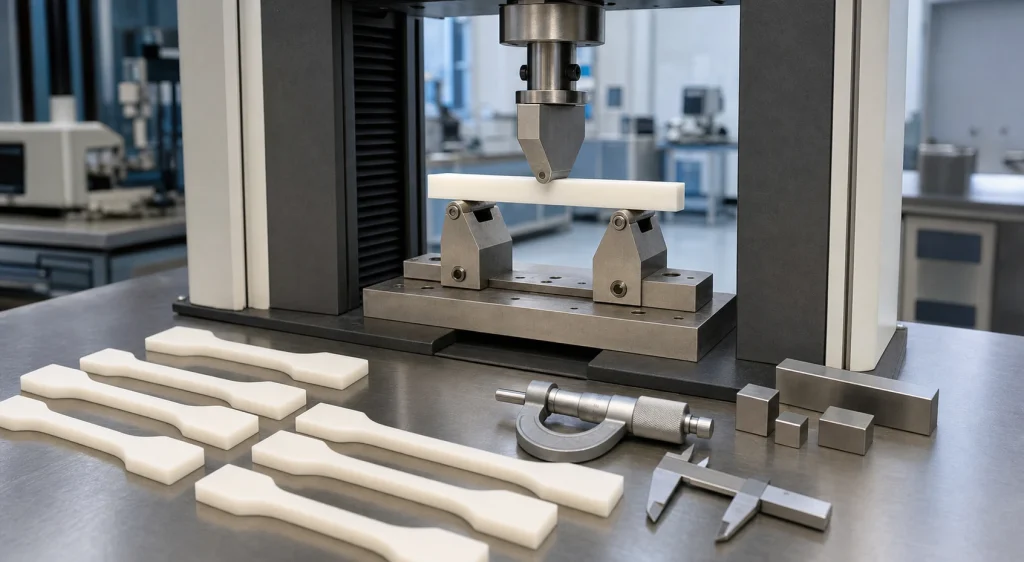
Comparable unfilled grades show a consistent directional pattern, although exact values depend on molecular weight, additives, test method, temperature, moisture conditioning, and production route. POM-H usually leads in tensile strength, modulus, hardness, creep resistance, and flexural-fatigue performance. POM-C remains a strong, rigid engineering plastic, with its most valuable advantages appearing in chemical stability and stock-shape consistency.
| Selection factor | Typical POM-H / Delrin behavior | Typical POM-C behavior |
|---|---|---|
| Tensile strength and stiffness | Generally higher | Generally lower, still high for an unfilled plastic |
| Creep under sustained load | Usually lower deformation | Good, with more grade dependence |
| Cyclic fatigue | Often the stronger choice | Suitable where stress and cycle count are moderate |
| Impact and toughness | Strong in suitable high-molecular-weight grades | Good; modified grades can change the comparison |
| Friction and wear | Excellent, with specialized low-wear grades available | Excellent, with specialized tribological grades available |
| Hot water and strong alkalis | More limited; validate carefully | Generally preferred after grade-level validation |
Compare published POM material properties under matched conditions. ISO 527 tensile results do not align automatically with values from another method or temperature. A high-flow molding grade may fill thin walls well while giving up toughness relative to a higher-molecular-weight grade. Molded-specimen values may also differ from an extruded rod or compression-molded plate. Compare exact grades, then test under the real load and environment.
Chemical, Moisture, and Temperature Performance
Both POM types absorb little moisture compared with nylon, which helps them retain dimensions in changing humidity. Their chemical resistance also covers many oils, fuels, solvents, and neutral aqueous solutions. The split becomes more consequential around hot water, steam, strong bases, strong acids, and oxidizing chemicals.
POM-C usually provides better resistance to hydrolysis and strong alkalis because its comonomer interrupts long sequences of oxymethylene units. A resin producer’s current Celanese acetal copolymer overview highlights resistance to fuels, solvents, strong alkalis, and stress cracking among the family’s core attributes. POM-H still performs well across many ordinary industrial fluids, but extended exposure outside the grade’s recommended pH and temperature window needs extra scrutiny.
Service temperature should never collapse into one “maximum” number. Designers need the fluid, concentration, stress, exposure time, cleaning cycle, and acceptable property retention. Heat-deflection temperature describes a standardized short-term response under load; it does not promise years of stability. Chemical charts may also reflect unloaded specimens. Request grade-specific immersion data, then test under combined chemical, thermal, and mechanical loading.
Dimensional Stability, Porosity, and Machined Stock
Both types machine well, hold close features, and absorb little water. Stock history still influences the result. Thick extruded POM-H rod can develop centerline porosity as the outside solidifies before the core. A bore, sealing land, or fluid passage that intersects this zone may expose a leak path or irregular surface.
POM-C stock shapes generally present less centerline-porosity risk, making them a frequent choice for thick, heavily machined components. They are not guaranteed void-free. Diameter, extrusion quality, annealing, and supplier controls still matter. Procurement should request the actual stock grade and applicable inspection documentation.
Residual stress creates a separate dimensional risk. Deep one-sided pockets, thin floors, and aggressive clamping can let a part bow after release. Balanced roughing, staged machining, stabilization time, low-pressure workholding, and finishing critical datums late can improve repeatability.
Processing POM by CNC Machining and Injection Molding
For POM CNC machining, sharp tools, controlled heat, chip evacuation, and supportive fixturing matter more than a universal recipe. Rubbing can raise local temperature, while thin walls can deflect or spring after unclamping. A 2025 peer-reviewed study of surface-roughness prediction in polymer machining reported POM turning results from Ra 0.56 to 1.88 μm across 90 to 180 m/min cutting speed, 0.1 to 0.5 mm/rev feed, and 0.5 to 1.5 mm depth of cut. Process parameters and geometry can outweigh the family name when finish is critical.
Injection molding adds melt residence time, gate design, packing, shrinkage, cooling, and venting. Overheating POM can accelerate decomposition and generate formaldehyde. Avoid incompatible barrel contamination and follow supplier purging procedures.
POM-H may enable thinner load-bearing walls, while POM-C can suit demanding chemical exposure. Both require grade-specific shrinkage data and mold trials. BOONA plastic injection molding service supports DFM review, tooling, and molded-part evaluation.
Pro Tip: Put the commercial grade, color, stock or resin form, critical environment, and approved-equivalent rule on the RFQ. “POM” alone invites a quote comparison built on different materials.
Real-World Example: A Dry-Running Beverage Conveyor
A beverage filling line presents an unusual combination of sliding friction, dust control, sanitation, energy use, and continuous operation. Conventional conveyor materials may rely on external lubricant to keep bottle movement smooth. Lubricant can attract dust, prompt additional washdown, and create wastewater, while unstable friction increases chain pull and bottle scuffing.
A 2023 Delrin and Regina conveyor case study documents a dry-running homopolymer formulation tested with 1.5-liter PET bottles at 85 m/min. The manufacturer reported up to a 40% coefficient-of-friction reduction versus standard acetal and PBT, plus energy-use and conveyor-life improvements of up to 40%. These vendor-reported results apply to the specialized formulation and tested system, so they should not be generalized to every natural POM-H grade.
The lesson reaches beyond the headline numbers. Material selection addressed friction drift and lubricant-dependent contamination. Sanitation, bottle contact, wear, and line energy all entered the specification. A POM-C grade could still suit a chemically aggressive washdown component elsewhere on the same machine. Component-level selection avoids forcing one architecture across unrelated functions.
How to Choose Between POM-H vs POM-C
Start with failure modes, then rank the material attributes that control them. Choose POM-H as the leading candidate when the part carries high static or cyclic load, must retain spring force, resists creep, or benefits from maximum unfilled stiffness. Consider POM-C first for prolonged hot-water contact, strong alkaline cleaning, thick machined stock, or geometry that exposes the center of a large rod.
Use this review sequence before releasing the drawing:
- Define load magnitude, direction, duration, impact, and cycle count.
- Record continuous and peak temperature at the component, including cleaning cycles.
- List every fluid, its concentration, contact time, and whether the part stays stressed during exposure.
- Identify critical fits, flatness, sealing surfaces, wear pairs, and allowable drift.
- Choose molded resin, extruded rod, plate, or another stock form deliberately.
- Compare exact grades under the same test standards and conditioning.
- Confirm food-contact, medical, electrical, flammability, or automotive documentation where applicable.
- Prototype and test the component under combined real-world loads.
Keep material choice linked to manufacturing route. A resin optimized for injection flow may differ from machining stock. Early prototypes can validate geometry and assembly; molded samples can validate shrinkage, weld lines, and production-grade behavior.
Cost, Availability, and Common Specification Errors
Price per kilogram rarely predicts part economics. POM-H may support a thinner molded wall or longer service interval. POM-C stock may reduce scrap risk where a central bore could reveal porosity. CNC time, inspection, certification, availability, and rejected assemblies can outweigh a modest material-price difference.
Several specification errors repeatedly distort quotations. Calling every acetal “Delrin” can exclude valid POM-C options or invite an unauthorized substitute. Calling every white POM grade equivalent ignores fillers, lubricants, stabilizers, viscosity, and regulatory status. Copying a tensile value without its test method and conditioning can create a false comparison. Applying tight tolerances to every surface increases process risk without improving function.
Prevent these errors with a controlled material note and short application summary. State whether alternates require written approval and define required traceability. For critical parts, make the first-article plan measure the dimensions and attributes tied to predicted failure modes. Qualified suppliers can then quote the same technical target.
FAQs
Is Delrin the same as POM-H?
Delrin is a trademarked POM-H family with grades covering different flow, toughness, wear, and regulatory needs. Use the exact grade where performance or compliance matters.
Which is stronger, POM-H or POM-C?
Comparable unfilled POM-H grades generally provide higher strength, stiffness, creep resistance, and fatigue performance. Modified grades can change the comparison, so review matched datasheets and test the application.
Which acetal is better for CNC machining?
Both machine well. POM-H suits demanding loads; POM-C often suits thick stock, deep bores, wet environments, or designs sensitive to centerline porosity. Geometry and stock quality also matter.
Is POM-C more chemically resistant than Delrin?
POM-C generally resists hot water, hydrolysis, and strong alkalis better. Compatibility still depends on concentration, temperature, exposure time, stress, and grade.
Can POM-H and POM-C be substituted one for one?
Sometimes. Recheck mechanical margins, chemical exposure, shrinkage, stock form, approvals, and wear. Test the substitute in the actual assembly before release.
Is POM-H or POM-C suitable for food-contact parts?
Polymer family alone does not establish compliance. Select a grade with the required declarations, control additives, and confirm cleaning chemicals and temperatures against supplier guidance.
Conclusion: Make the Material Callout Earn Its Place
The POM-H vs POM-C decision becomes straightforward once the team defines what the part must survive. POM-H, including Delrin grades, typically leads where stiffness, strength, fatigue, creep, and spring recovery control performance. POM-C usually gains the advantage in hot-water service, alkaline exposure, and thick machined components where centerline porosity deserves attention.
Family-level guidance remains the screening step. Final selection belongs at grade level, with comparable test data, the correct stock or molding form, and validation under combined load, temperature, chemical, and wear conditions. A precise drawing should identify the grade, color, documentation, and alternate-material policy. A precise RFQ should explain the component’s function and critical failure modes.
For a machined POM prototype or low-volume precision component, send BOONA your CAD file, drawing, target grade, quantity, operating environment, and critical tolerances through its CNC machining service. The resulting DFM discussion can resolve material, stock-form, porosity, fixturing, and inspection risks before cutting begins.