
Plastic warping is frustrating because it often appears late.
A part can look fine while it is still clamped in the fixture. The first inspection may even look acceptable. Then the part is released, cleaned, left on the bench for a few hours, packed for shipping, or assembled into the customer’s equipment. Suddenly the flat plate is bowed, the hole pattern is slightly off, or the sealing face no longer sits the way it should.
That is why warping is not just a cosmetic defect. For custom plastic CNC machined parts, it can affect assembly, flatness, sealing, sliding movement, hole alignment, thread engagement, and inspection results.
This problem is common with high-performance plastics too. PEEK, PEI, PPS, PTFE, POM, nylon, and polyimide materials such as Vespel can all move if the material, design, and machining strategy are not handled correctly.
The mistake is assuming that a premium plastic automatically stays stable. It does not. A high-performance plastic only gives you a better starting point. The final stability still depends on wall thickness, stock condition, machining heat, clamping pressure, material removal, annealing, deburring, and even how the part is packed.
For buyers using plastic CNC machining services, the best way to prevent warping in plastic parts is to treat warpage as a manufacturing risk from the start, not as something to fix after the first sample fails.
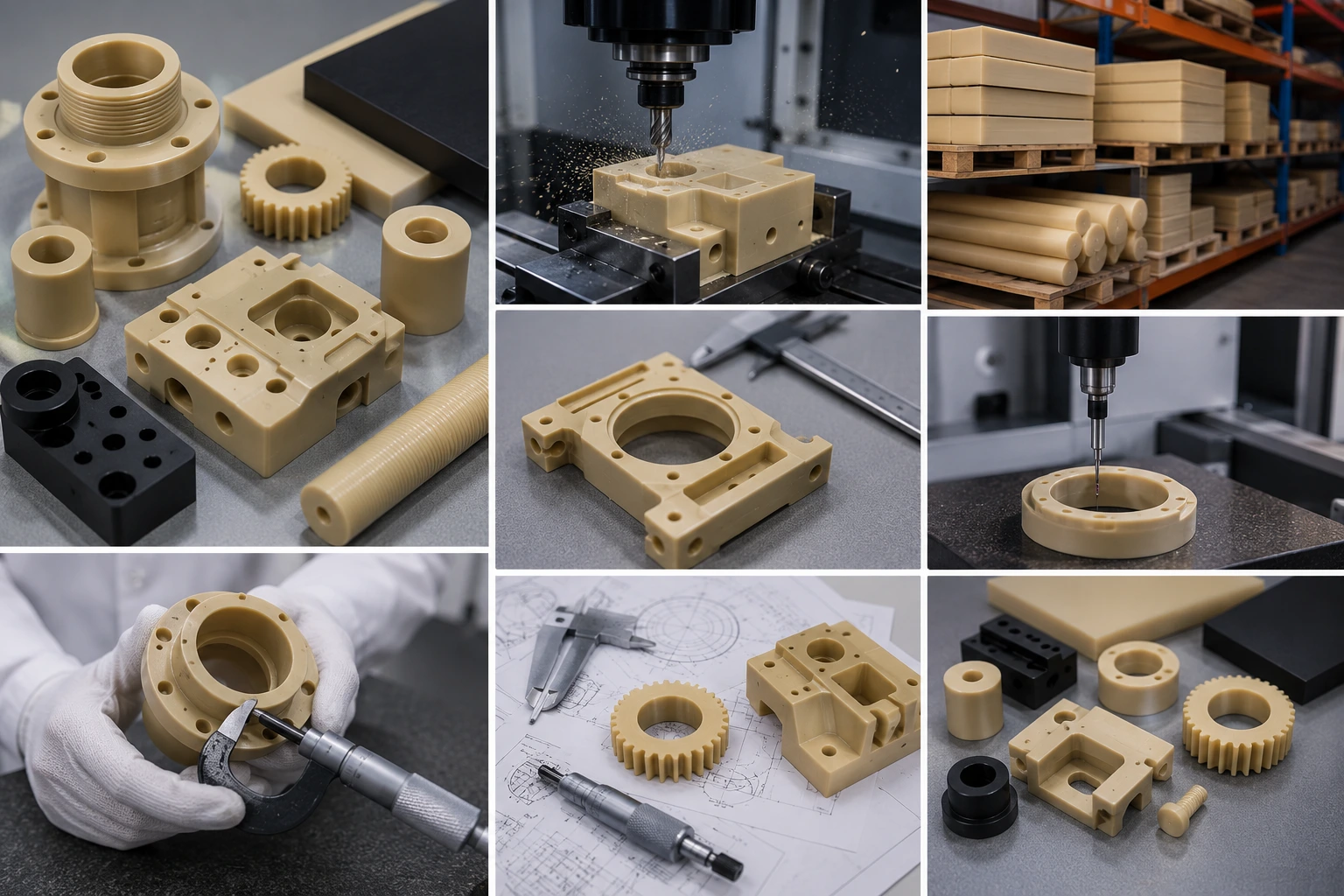
Why Plastic Parts Warp After Machining
Most warping problems come from a mix of three things: stress, heat, and geometry.
The raw plastic stock may already have internal stress. Machining removes material and releases some of that stress. If material is removed unevenly, the part may bend toward one side. If the cutter rubs or stays too long in one area, heat can build up and change local stress. If the part is thin, wide, or poorly supported, it does not take much force to move it.
A common example is a large plastic plate with a deep pocket on one side. It may look simple in CAD. In the machine, however, one side is being hollowed out while the other side stays solid. Once the part is unclamped, the stress balance changes and the plate can cup or twist.
Another example is a thin PEEK frame. If it is clamped too hard during machining, it may be held artificially flat. It measures well in the fixture, but after release, it returns to its natural shape and fails flatness.
| Cause | What Happens in the Shop | Possible Result |
|---|---|---|
| Internal stock stress | Stress releases after cutting | Bowing, twisting, cupping |
| Heavy one-sided machining | Material balance changes | Flatness loss |
| Dull tool or rubbing | Heat builds up | Size change, surface marks, stress |
| Thin-wall geometry | Low stiffness | Deflection during machining or assembly |
| Over-clamping | Part is forced into shape | Springback after release |
| Poor chip evacuation | Heat and surface damage increase | Burrs, marks, local distortion |
| Moisture-sensitive material | Size changes with humidity | Fit or flatness issues |
This is why plastic CNC machining warpage is rarely random. It usually has a cause that can be reduced with better planning.
Material Choice Helps, But It Does Not Solve Everything
Some plastics are more dimensionally stable than others. That is true. But no plastic is immune to warping.
PEEK is more stable than many standard plastics and is often selected for precision, heat resistance, and chemical resistance. But PEEK part warping can still happen if the part has thin walls, large pockets, poor clamping, or heavy material removal.
Vespel and other polyimide materials are often used where long-term stability, wear resistance, or temperature performance matters. Even then, Vespel machined parts dimensional stability still depends on grade selection, geometry, machining sequence, and inspection.
PTFE is chemically resistant but soft, so it can deform under clamping or load. Nylon is tough but moisture-sensitive. POM is generally stable, but large thin parts can still move. Glass-filled or carbon-filled plastics can reduce movement by adding stiffness, but they can also increase tool wear and may behave differently during finishing.
| Material | Stability Notes | Warpage Risk to Watch |
|---|---|---|
| PEEK | Strong dimensional stability for many precision parts | Thin walls, heavy pocketing, flatness requirements |
| Vespel / Polyimide | Very good stability in demanding uses | High material cost makes process planning important |
| PEI / Ultem | Good stiffness and heat resistance | Large flat parts may need stress control |
| PPS | Stable in many heat and chemical environments | Geometry still matters |
| PTFE | Excellent chemical resistance, low friction | Soft, easy to deform under pressure |
| Nylon | Tough and affordable | Moisture absorption can affect size |
| POM / Delrin | Good general stability and machinability | Large thin parts can still warp |
| Filled plastics | Higher stiffness | Tool wear and edge quality need attention |
The practical lesson is simple: choose the material for the application, then design and machine it as if movement is still possible.
For PEEK projects, PEEK CNC machining is often a good route for precision prototypes and low-volume parts, but the drawing still needs realistic tolerances and manufacturable geometry.
Design Is the First Warpage Control Step
Many plastic parts warp because the design gives the material no room to stay stable.
A wide flat plate with a thin cross-section is hard to keep flat. A part with deep pockets on one side may move after machining. A thin wall beside a large solid section may cool, clamp, and relax differently. Sharp internal corners often require smaller tools, longer cycle time, and more local heat.
These issues are easier to fix in CAD than on the machine.
A good DFM review for high-performance plastic parts should look at:
- wall thickness
- material balance
- pocket depth
- internal corner radius
- large flat surfaces
- thin unsupported ribs
- long slots
- tolerance callouts
- where the part will be clamped
- which faces are functional
For small precision plastic parts, walls below 1.0–1.5 mm should be reviewed carefully. For medium-size structural plastic parts, 2.0–3.0 mm or more is often safer, depending on the geometry and material. Large flat plates need a separate flatness discussion; thickness, stock form, machining sequence, and inspection method all matter.
| Design Feature | Warpage Risk | Better Practice |
|---|---|---|
| Very thin wall | Deflects during cutting or clamping | Increase thickness or add support |
| Deep one-sided pocket | Releases stress unevenly | Balance material removal where possible |
| Large flat plate | Bowing or cupping | Increase thickness or discuss stress relief |
| Sharp internal corner | Smaller tool, more heat, longer cycle | Add a practical internal radius |
| Long unsupported slot | Flexing and distortion | Add support or relax tolerance |
| Tight tolerance everywhere | Higher cost and higher risk | Mark only functional dimensions |
Good DFM does not mean weakening the part or making the design less precise. It means putting precision where it actually matters.
Stock Condition Can Decide the Result Before Cutting Begins
Two plastic parts can use the same material name and still behave differently.
Stock form matters. Rod, plate, sheet, extruded stock, compression-molded stock, and filled grades can carry different internal stress. The supplier, stock thickness, and production method can all affect stability.
A small turned bushing cut from rod may be stable. A large flat part machined from thick plate may need stress relief and staged machining. A filled material may hold shape better, but it may also wear tools faster and require different cutting conditions.
For dimensional stability in plastic parts, buyers should not treat stock as a minor detail when flatness or tight tolerance is important.
When sending an RFQ, state the exact material grade if known. If the grade is not fixed yet, explain the working conditions: temperature, chemical exposure, load, wear, moisture, cleanliness, and whether the part has flatness or alignment requirements.
Boona material list can help when comparing engineering plastics before the design is finalized.
Annealing Is Useful When Stress Is the Main Risk
Annealing is not a magic fix, and it is not needed for every plastic part. But when used correctly, it can help reduce internal stress before final machining.
For PEEK, PEI, and other high-performance plastics, annealing may be worth discussing when the part has heavy material removal, tight flatness, thin walls, large flat surfaces, or high-temperature service conditions.
The timing matters. If the part is already finished and warped, annealing may not save it. In many precision jobs, a better process is:
- rough machine the part
- leave finishing stock
- stress relieve or let the part stabilize if needed
- finish critical dimensions last
That way, if the material moves, it moves before final tolerance is cut.
| Part Condition | Annealing Discussion |
|---|---|
| Simple spacer or small block | Usually not needed |
| Large flat plate | Worth discussing |
| Thin-wall precision part | Worth discussing |
| Heavy pocketing from thick stock | Worth discussing |
| High-temperature application | Often worth reviewing |
| Tight flatness requirement | Strong reason to discuss |
| Semiconductor or medical fixture | Depends on function and documentation needs |
Annealing plastic parts before machining adds time and cost, but it can be much cheaper than scrapping a finished part that moved out of tolerance.
Machining Sequence Matters More Than Many Buyers Realize
Machining sequence can make the difference between a stable plastic part and a warped one.
If a shop cuts all the material from one side first, the part may move before the second side is machined. If the sealing face is finished early, later roughing may release stress and change that surface. If a thin frame is fully cut free too soon, it may lose support before final features are complete.
A more stable process uses staged machining.
For example, on a flat PEEK plate, the machinist may rough both sides first, leave stock, let the part rest, and then finish both sides. On a thin frame, tabs or support stock may be kept in place longer. On a pocketed block, the heaviest material removal may be balanced between setups.
| Part Type | More Stable Machining Approach |
|---|---|
| Flat plate | Rough both sides, then finish both sides |
| Thin frame | Keep support longer and finish critical features late |
| Deep pocketed block | Avoid removing all stock from one side first |
| Precision bore | Machine after roughing stress is released |
| Sealing face | Finish near the end and protect afterward |
| Long slot | Use controlled passes and avoid heat buildup |
For complex work, precision CNC machining is not only about machine accuracy. It is also about choosing the right order of operations.
Workholding Should Support the Part, Not Force It Flat
Plastic parts can lie.
If you clamp a thin plastic plate hard enough, it may look flat. You can machine it, inspect it while clamped, and think the job is good. Then you release it, and the plate bows.
That is not a material surprise. That is a workholding problem.
The fixture should support the part without forcing it into a false shape. For some parts, that may mean soft jaws. For others, a vacuum fixture, custom nest, low-pressure clamping, support blocks, or staged fixturing may be better.
| Workholding Issue | What Can Happen |
|---|---|
| Too much clamping pressure | Part springs back after release |
| Poor backing under a thin wall | Cutter pushes the wall during machining |
| No support under large flat part | Bowing, chatter, poor flatness |
| Hard jaws on soft plastic | Clamp marks or local deformation |
| Weak second setup location | Hole position or parallelism error |
Good fixturing adds setup cost, but it protects the part. For tight tolerance plastic machining, the fixture is often as important as the toolpath.
Heat Control Still Matters With PEEK and Other High-Performance Plastics
A common misunderstanding is that heat-resistant plastics do not care about machining heat.
PEEK can handle high service temperatures, but local machining heat can still affect edge quality, burrs, stress, and dimensions. Heat comes from dull tools, rubbing, poor chip evacuation, too much dwell, and aggressive cutting in weak areas.
The fix is not always to run slower. A tool that feeds too lightly can rub instead of cut. Rubbing makes heat and can make the finish worse.
Better heat control usually means:
- sharp tools
- enough feed to cut cleanly
- no long dwell in one area
- good chip evacuation
- air blast or compatible coolant when allowed
- lighter passes on thin features
- finishing critical surfaces after roughing stress is released
For clean-use, medical, or semiconductor components, coolant choice should be discussed before machining. Some parts can be machined with coolant and cleaned later. Others may require dry machining with air because of contamination concerns.
Tolerances Should Be Written Like Manufacturing Instructions
A drawing that applies tight tolerance everywhere makes the job harder and more expensive.
It can also increase warpage risk. The shop may need more setups, more finishing passes, more clamping, and more inspection on surfaces that do not affect function.
A better drawing tells the supplier what matters.
If a bore controls fit, tolerance it. If a mounting hole pattern controls assembly, call it out. If a face must seal, specify flatness and finish. If a pocket only provides clearance, do not treat it like a precision datum.
| Feature | Better Tolerance Strategy |
|---|---|
| Bearing bore | Tight tolerance if fit requires it |
| Mounting hole pattern | Control position when assembly needs it |
| Large flat surface | Specify flatness only if functional |
| Outer profile | General tolerance is often enough |
| Clearance pocket | Avoid unnecessary tight tolerance |
| Thin wall | Relax tolerance or increase support |
| Sealing surface | Define flatness and surface finish separately |
This is one of the simplest ways to reduce high-performance plastic parts warping and cost at the same time.
For critical components, quality control should focus on the features that decide whether the part works: flatness, hole alignment, bore size, thread quality, surface condition, and burr control.
Handling and Packaging Can Undo Good Machining
Warping can happen after machining too.
A thin plate can bow if stacked under heavy parts. A flat surface can be distorted if packed without support. A moisture-sensitive plastic can change size in a humid environment. A part can move slightly after cleaning or after it sits for a period of time.
For parts with flatness requirements, inspection should sometimes happen after the part has stabilized. The part should not be forced flat during measurement unless that is how it will be used in the final assembly.
Good handling practices include:
- let critical parts rest before final inspection
- avoid stacking thin parts under weight
- support large flat plates during packaging
- protect sealing and sliding surfaces
- control humidity-sensitive materials
- avoid heat exposure during storage or shipping
- measure thin parts without forcing them into shape
These details may feel small, but they matter when the part must fit into a tight assembly.
Deburring and Finishing Can Distort Thin Plastic Features
A part can survive machining and still be damaged during finishing.
Heavy hand deburring can bend thin walls. Polishing can remove material unevenly. Aggressive brushing can stress or mark soft surfaces. Heat-based finishing can distort small features.
This is why burr-free requirements should be specific. “Burr-free holes on mounting face” is useful. “Perfect finish everywhere” is vague and expensive.
Whenever possible, design small chamfers into the toolpath instead of relying on heavy manual deburring. A controlled CNC chamfer is usually more repeatable and less risky than handwork on a thin plastic edge.
| Finishing Step | Possible Risk |
|---|---|
| Heavy hand deburring | Bends thin features or rounds edges |
| Polishing | Changes flatness or dimensions |
| Aggressive brushing | Marks or stresses the surface |
| Heat-based finishing | Creates local distortion |
| Controlled chamfering | Reduces manual rework risk |
For edge quality, surface appearance, or cleaning requirements, Boona surface finishing FAQ is a useful reference.
Inspection Should Match the Real Use of the Part
A warped part can still pass some measurements.
Hole diameter may be correct, but the hole pattern may not align. Length may be correct, but flatness may fail. A caliper check may look fine, but the part may rock on a surface plate.
Inspection should match the part’s function.
If the part is a spacer, check thickness and parallelism. If it is a sealing plate, check flatness and surface finish. If it is a bushing, check bore size and roundness. If it is a fixture, check hole position and fit with mating components.
| Inspection Item | Why It Matters |
|---|---|
| Flatness | Confirms the part is not bowed |
| Parallelism | Important for plates, spacers, and fixtures |
| Hole alignment | Confirms assembly fit |
| Bore roundness | Important for bushings and rotating parts |
| Thread quality | Confirms assembly reliability |
| Surface condition | Finds marks from clamping or finishing |
| Fit test | Shows whether the part works in real assembly |
For some parts, final inspection should be done after the part has rested. This is especially useful for thin-wall parts, large flat plates, and parts machined from stressed stock.
Preventing Warpage Costs Money, But Scrap Costs More
Good warpage control may require better material stock, annealing, staged machining, custom fixtures, slower finishing, additional inspection, or careful packaging.
Those steps are not free.
But for parts used in semiconductor equipment, medical devices, aerospace assemblies, electronics test systems, or high-temperature machinery, rework and assembly failure can cost much more than prevention.
| Prevention Step | Added Cost | Why It May Be Worth It |
|---|---|---|
| Annealing | Time and process control | Reduces stress movement |
| Staged machining | More machine time | Improves stability |
| Custom fixture | Setup cost | Reduces clamping distortion |
| Extra inspection | QC time | Catches problems before assembly |
| Better packaging | Handling cost | Protects flatness during shipping |
The point is not to over-process every plastic part. The point is to apply the right controls where warpage would affect function.
What to Tell the Supplier Before Quoting
A supplier can prevent more problems when the RFQ explains the part’s real use.
A CAD file shows the shape. A good RFQ explains the risk.
Send:
- 3D CAD file
- 2D drawing
- material grade
- quantity
- critical tolerances
- flatness requirements
- thin-wall areas
- large flat surfaces
- operating temperature
- chemical exposure
- moisture or humidity concerns
- annealing requirement, if known
- surface finish requirements
- inspection report needs
- packaging requirements
Also explain what the part does. A display prototype, a semiconductor fixture, a medical component, and a simple spacer should not be machined with the same assumptions.
For buyers ordering custom plastic CNC machined parts, this information helps the supplier plan material, workholding, machining sequence, inspection, and packaging before the part is already at risk.
Final Thoughts
To prevent warping in plastic parts, you have to look at the full manufacturing path, not only the final dimension on the drawing.
Material grade matters. Stock condition matters. Wall thickness matters. Machining sequence matters. Workholding matters. Heat control matters. So do annealing, finishing, inspection, and packaging.
Warping usually happens when several small risks stack up. The best way to reduce it is to remove those risks early.
For high-performance plastic parts, the strongest approach is simple: choose the right material, avoid unstable geometry, use realistic tolerances, balance material removal, support the part correctly, and inspect it in the same condition it will be used.
That is how plastic parts stay flat, stable, and usable after they leave the machine.
FAQs
Why do high-performance plastic parts warp after machining?
High-performance plastic parts can warp because of internal material stress, uneven material removal, machining heat, thin walls, poor workholding, or stress release after unclamping. Even stable materials like PEEK or Vespel can move if the design and machining process are not controlled.
Can PEEK parts warp after CNC machining?
Yes. PEEK has good dimensional stability, but PEEK part warping can still happen with heavy pocketing, thin-wall geometry, large flat surfaces, poor clamping, or lack of stress relief. For tight-tolerance PEEK parts, staged machining and proper workholding are important.
Does annealing help prevent plastic part warping?
Annealing can help reduce internal stress in some high-performance plastics, especially PEEK, PEI, and large flat parts. It is most useful for thin-wall parts, heavily machined parts, tight flatness requirements, or components used at elevated temperatures.
How does part design affect plastic warpage?
Thin walls, deep pockets, uneven wall thickness, sharp internal corners, and large unsupported flat faces can increase warpage risk. Better DFM, such as balanced material removal, larger radii, thicker sections, and realistic tolerances, can reduce plastic part deformation.
How can CNC machining reduce warping in plastic parts?
CNC machining can reduce warping by using sharp tools, balanced roughing, staged finishing, low-stress workholding, heat control, proper chip evacuation, and final inspection after the part stabilizes. Critical flat faces and precision holes should usually be finished near the end.
What should I include in an RFQ to reduce warping risk?
Provide a 3D CAD file, 2D drawing, material grade, quantity, flatness requirements, critical tolerances, thin-wall areas, operating temperature, chemical or moisture exposure, annealing needs, inspection requirements, and packaging notes. This helps the supplier plan the right machining process.