
A drawing that specifies only “Inconel” does not give a machine shop enough information to prepare a reliable quotation. One supplier may assume annealed 625, while another prices aged 718. Both alloys resist heat and corrosion, yet they create different mechanical properties, cutting conditions, heat-treatment steps, and inspection requirements.
That ambiguity can become expensive. A buyer may pay for 718 strength that the product never uses, select 625 where the design needs greater fatigue resistance, or approve a quotation that underestimates tool consumption and machining time.
The Inconel 718 vs 625 decision should start with the component’s dominant failure risk and total manufactured cost. Inconel 718 machinability changes substantially with aging condition, while Inconel 625 machinability depends on annealing, cold work, geometry, and cutting strategy. Neither alloy behaves like ordinary stainless steel.
This guide compares strength, corrosion behavior, work hardening, tooling, cycle time, material condition, and application fit so engineers can specify the alloy more clearly before requesting an RFQ.
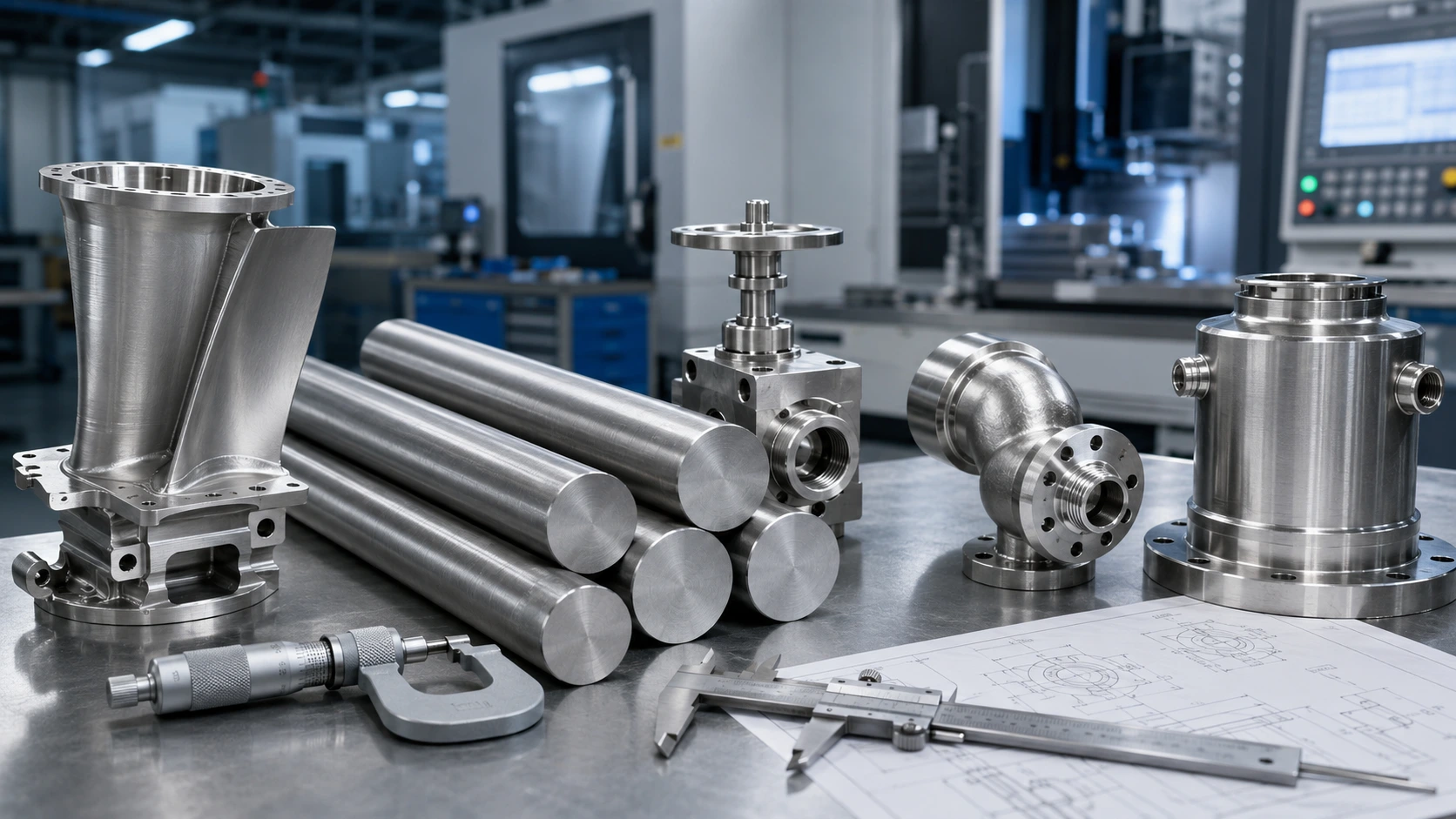
What Are Inconel 718 and Inconel 625?
Inconel 718, designated UNS N07718, is a precipitation-hardenable nickel-chromium alloy containing niobium and molybdenum. Solution treatment and aging develop its high yield strength, tensile strength, fatigue capability, and elevated-temperature mechanical performance.
The purchased condition matters. A shop may receive 718 in a solution-treated state for rough machining or as solution-treated-and-aged stock with its final strength already established. Aged material normally requires greater cutting force and creates higher tool-wear risk.
Inconel 625, designated UNS N06625, is primarily solid-solution strengthened through its nickel, chromium, molybdenum, and niobium content. It offers strong resistance to many corrosive environments and often suits welded, formed, marine, chemical-processing, and exhaust-system components.
Condition still affects 625. Annealed, solution-annealed, and cold-worked stock can have different strength, residual stress, and machining behavior.
For bar and forging products, engineers commonly encounter ASTM B637 for 718 and ASTM B446 for 625. Plate, sheet, pipe, tubing, castings, and aerospace products may require different specifications. The drawing should identify the alloy, UNS number, product form, condition, and governing material standard.
Inconel 718 vs 625 Quick Comparison
| Selection factor | Inconel 718 | Inconel 625 |
|---|---|---|
| UNS designation | N07718 | N06625 |
| Primary strengthening method | Precipitation hardening | Solid-solution strengthening |
| Strength potential | Higher after aging | Lower than aged 718 |
| Corrosion performance | Strong in many industrial environments | Often favored where corrosion dominates |
| Heat-treatment sensitivity | High | Lower for standard annealed fabrication |
| Typical machining difficulty | Extremely difficult, especially when aged | Difficult and strongly work-hardening |
| Cutting-tool consumption | Very high | High |
| Welded fabrication | Requires condition review | Often more straightforward |
| Dimensional planning | Aging sequence may affect final dimensions | Residual stress and cold work still matter |
| Common applications | Turbines, aerospace, high-load shafts | Marine, chemical, exhaust, welded parts |
| Main quotation risk | Condition, tool life, heat treatment | Product form, corrosion requirements, slow cutting |
This comparison assumes certified wrought material in a defined condition. Cast, forged, cold-worked, additively manufactured, annealed, and aged products should not share one generic property or machining assumption.
718 usually wins when mechanical loading, fatigue, compact section size, or strength at elevated temperature controls the design. Alloy 625 often provides the better starting point when seawater, chloride exposure, chemical attack, forming, or welding drives the project.
A stronger alloy does not automatically create a better part. Greater strength may raise machine time, tool usage, inspection cost, and difficulty modifying the component after heat treatment.
Inconel 718 vs 625 Machinability
Both alloys retain considerable strength at cutting temperatures and transfer heat poorly compared with many common engineering metals. Much of the heat remains near the cutting edge, accelerating flank wear, notch wear, adhesion, diffusion, and edge breakdown.
Work hardening creates another problem. A dull tool or excessively light feed may rub against the workpiece instead of shearing a clean chip. The compressed surface becomes harder, and the next cutting pass encounters a more difficult layer.
Aged 718 commonly presents the greater machining challenge because precipitation hardening raises its strength and hardness. Operations such as threading, deep drilling, interrupted milling, and finishing around cross-holes can consume tools quickly.
Solution-treated 718 usually offers a more practical route for heavy stock removal. The shop can rough-machine the part, age it, and then grind or finish-machine critical dimensions. Thin walls and tight geometric tolerances still require an allowance for thermal movement.
Annealed 625 may cut more predictably than aged 718, but it remains a difficult nickel alloy. Long chips, adhesion, burr formation, surface smearing, and dimensional movement can increase cycle time, especially in thin-wall valve, bellows, and fitting geometries.
💡 Pro Tip: Do not reduce feed until the tool starts rubbing. Maintain enough chip thickness to cut beneath the work-hardened surface while controlling engagement, heat, and cutting-edge load.
Tooling, Coolant, and Process Strategy
No universal speeds-and-feeds table can cover every 718 or 625 component. Stock condition, tool diameter, rigidity, cutting length, coolant pressure, interrupted engagement, and required finish all change the safe process window.
For general roughing, shops often use tough coated-carbide inserts with controlled edge preparation. Stable finishing may use a more wear-resistant grade and sharper geometry. Selected high-speed 718 operations can use ceramic tools, but they require rigid machines, predictable engagement, and a process developed specifically for that tool.
Effective milling strategies include:
- Constant radial engagement
- Reduced width of cut
- Stable axial depth
- Short tool overhang
- Climb milling where appropriate
- Separate roughing and finishing tools
- Avoidance of unnecessary full-width slots
- Tool replacement before severe wear damages the part
Complex impellers, angled ports, contoured housings, and multi-face aerospace components may benefit from 5-axis CNC machining for complex alloy parts because fewer setups improve tool access and reduce accumulated positional error.
High-pressure coolant should reach the cutting edge rather than merely flooding the enclosure. Reliable chip evacuation matters in deep pockets, internal bores, and drilling operations because recutting hot chips can damage the tool and surface.
A 2024 laser-assisted milling study on Inconel 718 reported a 47.4% reduction in surface roughness and a 25% reduction in cutting force under its optimized experimental conditions compared with conventional milling. Those figures apply to the tested laser-assisted process, not standard CNC milling generally.
Inconel 718 vs 625 Machining Cost
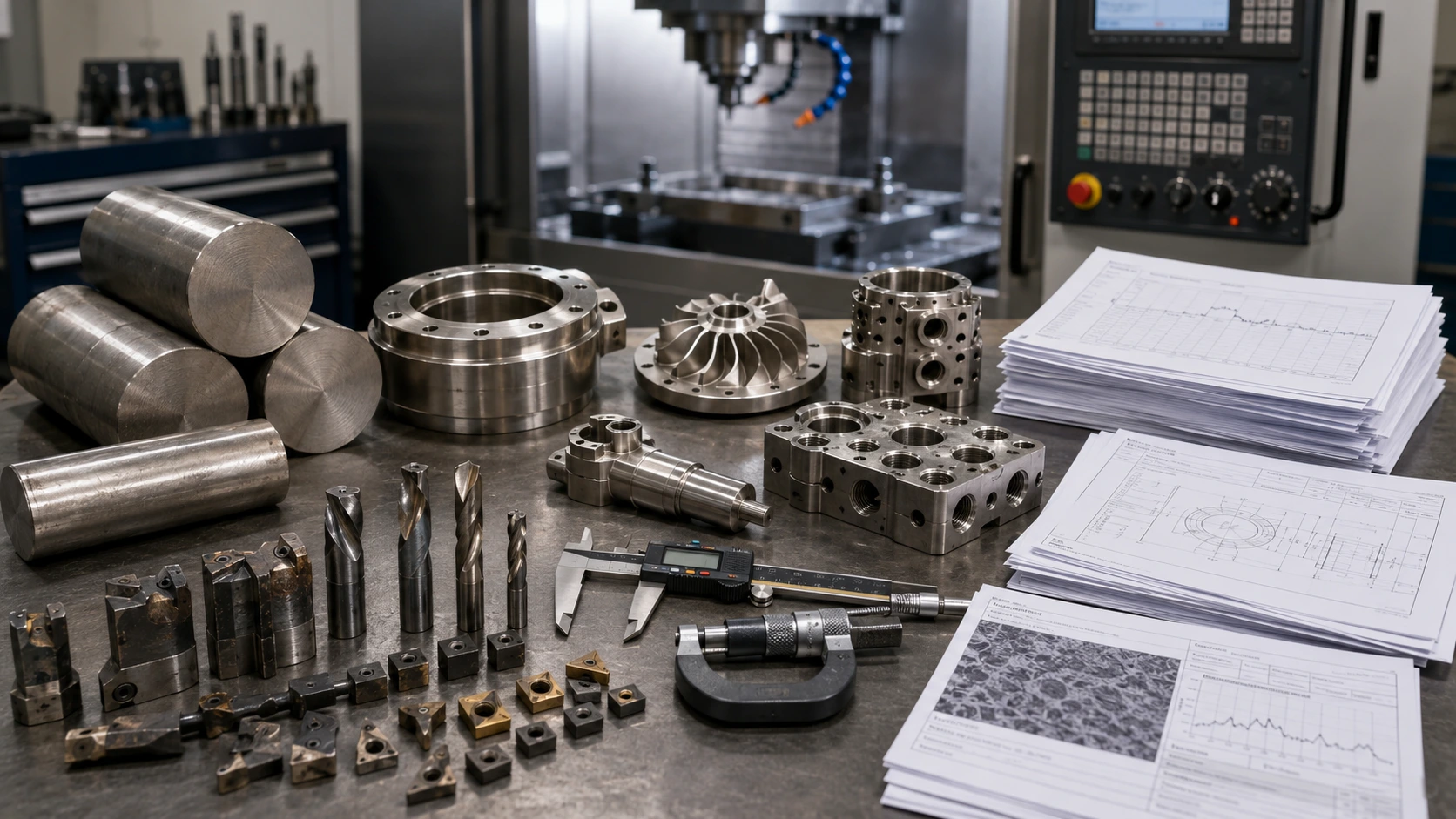
Inconel machining cost cannot be estimated accurately from billet price alone. The largest difference between quotations may come from machine hours, cutting tools, heat treatment, finishing, or scrap exposure.
| Cost factor | Inconel 718 | Inconel 625 |
|---|---|---|
| Raw stock | High | High |
| Rough-machining time | Especially high when aged | High |
| Tool consumption | Usually highest in aged condition | High |
| Heat treatment | Frequently part of the route | Usually less complex |
| Finish allowance | Often needed after aging | Geometry and condition dependent |
| Welding and fabrication | Application-specific | Often favorable |
| Scrap consequence | Very high | Very high |
| Quote accuracy depends on | Exact aging condition | Annealed or cold-worked condition |
A reliable quotation should include:
- Product form and minimum stock size
- Material certification
- Sawing and preparation
- Setup and programming
- Metal-removal volume
- Tool consumption
- Machine cycle time
- Heat treatment
- Grinding and finishing
- Dimensional and material inspection
- Documentation and traceability
- Scrap and replacement-stock risk
Aged 718 may cost more to machine even when stock prices appear similar. Alloy 625 can become the more expensive option when a large corrosion-resistant billet, extensive welding, special cleaning, or pressure-boundary documentation controls the project.
Geometry often matters more than part weight. A small component with deep threads, cross-holes, thin walls, and tight sealing surfaces may cost more than a heavier but simpler flange.
When to Choose Inconel 718
Choose 718 when the component needs a high mechanical-property level within a limited section size.
Suitable requirements include:
- High yield and tensile strength
- Fatigue resistance
- Creep or stress-rupture performance
- Strength retention at elevated temperature
- Compact high-load geometry
- High-strength threaded fasteners
- Pressure-containing components under severe load
- Shafts and fittings exposed to repeated mechanical cycles
Typical applications include turbine hardware, propulsion components, aerospace fittings, actuator shafts, high-load valve parts, pump components, and oil-and-gas equipment.
718 can also support weight or envelope reduction. If 625 would require a larger diameter or thicker wall to carry the same load, aged 718 may offset some machining expense by allowing a smaller component.
That benefit disappears when the design does not use the additional strength. A moderately loaded welded duct or corrosion-exposed fitting may gain little from the aging process while still carrying the higher machining and documentation burden.
The heat-treatment sequence should form part of the drawing review. Rough machining before aging reduces heavy cutting in the final hardened condition, but the shop must leave stock for post-aging finishing. Purchasing pre-aged material simplifies the thermal route while increasing cutting difficulty.
When to Choose Inconel 625
Choose 625 when environmental resistance, fabrication, or welding matters more than maximum precipitation-hardened strength.
Common selection drivers include:
- Seawater or chloride exposure
- Pitting and crevice-corrosion concerns
- Chemical-processing service
- Welded construction
- Forming and fabrication
- Exhaust and hot-gas systems
- Corrosion-resistant tubing and fittings
- Moderate strength without a standard aging cycle
Applications include marine fasteners and fittings, chemical valve bodies, bellows, exhaust ducts, heat-exchanger hardware, instrumentation components, and corrosion-resistant pressure-system parts.
625 does not eliminate machining risk. It work-hardens rapidly, can produce persistent chips, and may smear when the edge loses sharpness. Long internal threads, deep holes, narrow grooves, and thin-wall sections can still drive a high quotation.
A 2024 finishing-turning study on Inconel 625 compared three cutting inserts and multiple combinations of speed, feed, and depth of cut. Under one tested parameter set—100 m/min cutting speed, 0.077 mm/rev feed, and 0.1 mm depth of cut—the selected tooling produced surface roughness of about Ra 0.04 μm. That result demonstrates the value of validated tooling and parameters; it should not be copied as a universal production setting.
Application Selection Matrix
| Application requirement | Recommended starting alloy | Main reason |
|---|---|---|
| High-load aerospace shaft | 718 | Strength and fatigue capability |
| Turbine or propulsion part | 718 | Elevated-temperature mechanical performance |
| Compact high-strength fastener | 718 | Higher achievable strength |
| Seawater fitting | 625 | Corrosion resistance |
| Chemical valve body | 625 | Corrosion and fabrication |
| Welded exhaust duct | 625 | Welding and environmental performance |
| High-strength oilfield component | 718, application-specific | Mechanical loading |
| Corrosion-dominated oilfield part | 625, application-specific | Environmental exposure |
| Thin-wall welded bellows | 625 | Formability and welding |
| High load plus severe corrosion | Detailed engineering review | Both failure risks control |
Substituting one alloy for the other may require changes to section thickness, weight, fatigue margin, welding procedure, operating-temperature limit, corrosion allowance, and inspection plan.
Industry specifications can also override a general selection table. Aerospace, nuclear, sour-service, offshore, and pressure-boundary projects may restrict product form, heat treatment, mechanical properties, manufacturing route, and qualification testing.
The alloy should therefore follow a requirement hierarchy:
- Governing industry specification
- Service environment
- Mechanical load and fatigue
- Operating temperature
- Geometry and section size
- Welding or forming
- Machining route
- Total manufactured cost
Engineering Example: High-Pressure Actuator Shaft
Consider an engineering example with these requirements:
- Shaft diameter: 32 mm
- Overall length: 210 mm
- Bearing-journal tolerance: ±0.01 mm
- Surface finish: Ra 0.8 μm
- Cross-drilled lubrication holes
- Cyclic tensile and bending loads
- Moderate corrosive exposure
- Low annual volume
The initial material selection uses 625 because the assembly operates in a corrosive environment. During mechanical review, however, the available 32 mm envelope does not provide the desired load margin with the selected condition.
Increasing the shaft diameter would raise weight, stock volume, and machining time. Aged 718 provides greater mechanical strength within the existing envelope, so the team revises the material selection.
A practical manufacturing route may include:
- Purchase certified 718 stock
- Rough-turn the primary diameters
- Machine cross-holes before final finishing
- Complete the specified heat treatment
- Finish-grind the bearing journals
- Inspect hardness, runout, surface finish, and traceability
This example does not make 718 universally better for actuator shafts. More severe chloride exposure or lower loading could favor 625. It shows why corrosion, load, section size, and manufacturing cost must be evaluated together.
For cylindrical parts with journals, grooves, threads, and axial or radial holes, precision CNC turning services can combine turning-center operations with finishing and dimensional inspection.
Drawing and RFQ Requirements
An RFQ that says only “Inconel 718” or “Inconel 625” leaves several cost and quality decisions unresolved.
Include:
- Alloy and UNS designation
- Product form
- Applicable ASTM, AMS, or industry specification
- Supplied condition
- Required heat-treatment condition
- Minimum mechanical properties
- Hardness requirement
- Operating temperature
- Corrosion environment
- Welding or forming requirements
- Features machined before and after heat treatment
- Final tolerance and geometric controls
- Surface finish
- Cleaning or passivation requirements
- Material heat-number traceability
- Inspection and NDT requirements
A useful 718 callout might identify UNS N07718, the correct bar or forging specification, and the required solution-and-aging condition. A 625 callout should identify UNS N06625 and distinguish annealed, solution-annealed, or cold-worked material.
Do not apply one material standard to every product form. Bar, plate, sheet, tubing, forging, and casting specifications can impose different chemistry, heat treatment, testing, and dimensional requirements.
Quotations should also state which shop controls heat treatment, whether critical surfaces retain finishing allowance, and how hardness and material identity will be documented.
FAQs About Inconel 718 and 625
Is Inconel 718 harder to machine than 625?
Aged 718 is usually more difficult under comparable conditions because it has higher strength and hardness. Annealed 625 remains difficult and can work-harden rapidly.
Which alloy costs more?
There is no fixed winner. Product form, condition, diameter, order quantity, certification, machining time, tool consumption, and heat treatment determine the final part cost.
Is Inconel 625 more corrosion-resistant than 718?
625 often provides the stronger starting point for corrosion-dominated marine and chemical applications. The exact environment still requires engineering review.
Which alloy has higher strength?
Properly aged 718 generally achieves substantially higher mechanical strength than annealed 625.
Should 718 be machined before or after aging?
Heavy roughing often occurs before aging, followed by finish machining or grinding. Pre-aged stock may suit parts where avoiding post-machining heat treatment takes priority.
Can carbide tools machine both alloys?
Yes. Tool grade, edge geometry, coating, engagement, rigidity, and coolant delivery must match the operation.
Which alloy is better for welded components?
625 often suits welded and fabricated construction, while 718 requires closer review of condition and post-weld requirements.
Can one alloy replace the other?
Only after reviewing strength, fatigue, corrosion, temperature, section size, welding, heat treatment, and certification. They are not direct substitutes.
Inconel 718 vs 625 Final Selection
The Inconel 718 vs 625 decision should follow the component’s dominant failure risk and manufacturing route.
Choose 718 when high yield strength, fatigue resistance, compact geometry, elevated-temperature mechanical performance, or heavily loaded pressure components control the design. Confirm whether the shop will machine solution-treated material before aging or cut stock that already has its final aged properties.
Choose 625 when corrosion resistance, seawater service, chemical exposure, welding, forming, or fabricated construction carries more weight than maximum strength. Define whether the purchased material is annealed, solution-annealed, or cold-worked.
Expect both alloys to machine slowly compared with common stainless steel. Aged 718 usually creates the greater tool-wear and cycle-time challenge in comparable operations, while 625 can become expensive through difficult geometry, certification, welding, and corrosion-critical inspection.
Compare the finished-part cost—not the billet price. The most reliable RFQ defines the alloy, product form, condition, heat treatment, tolerances, surface finish, quantity, traceability, and inspection plan before suppliers calculate the quotation.
Request an Inconel Machining Review
Preparing an Inconel 718 or 625 RFQ? Send the BOONA engineering team your CAD model, drawing, UNS designation, product form, supplied condition, heat-treatment requirements, tolerances, surface finish, quantity, and inspection standard through its CNC machining services. The team can review machinability, workholding, cutting strategy, finishing allowance, material certification, and total manufacturing cost before quotation.