
The receiving plant already stocks guide bushings and ejector hardware. Meanwhile, the mold builder in China is preparing to order the base. Unless someone connects those decisions, the project can acquire a replacement-parts problem before machining begins.
DME vs HASCO vs LKM is therefore a question of approved systems, exact configurations and service arrangements. Choose the base around the receiving machine, the required plate construction and the components the maintenance team can obtain. Manufacturing location alone does not settle the choice.
Start by distinguishing genuine manufacturer supply from dimensional compatibility. Then compare equivalent materials, machining scope and acceptance requirements. A familiar brand name cannot replace a controlled assembly drawing or establish finished-part accuracy.
What DME, HASCO and LKM Actually Specify
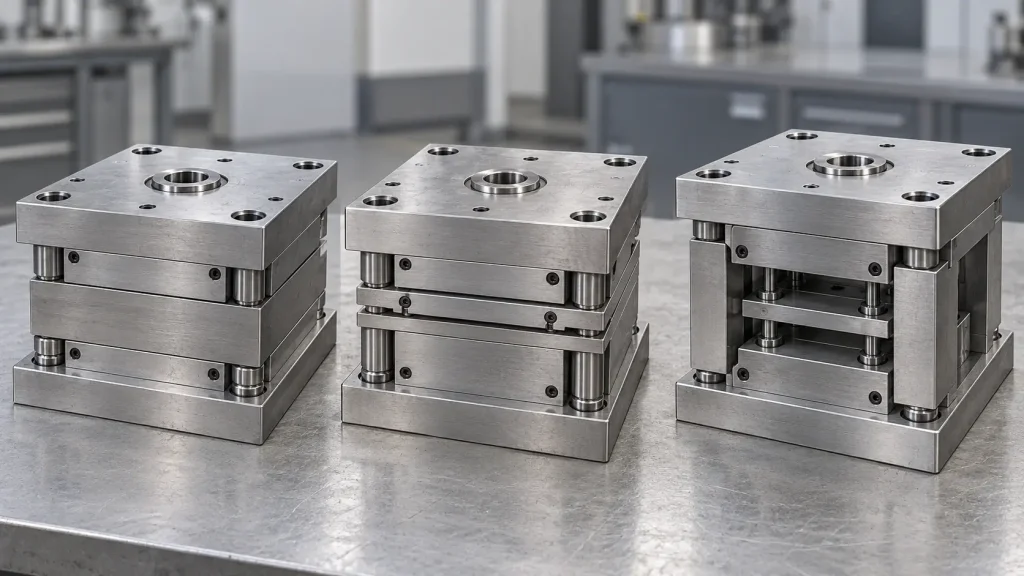
DME: Identify the Product Family and Dimensional System
DME includes U.S.-standard configurations and metric offerings. An order must identify the relevant catalog family and drawing; specifying the brand alone leaves construction details unresolved.
Even related families can differ in their plate arrangements. Confirm whether the design requires a separate support plate, floating plates or stripper-plate ejection. Converting displayed dimensions into another unit system does not change the underlying component standard.
HASCO: Define the Modular Configuration
HASCO distinguishes undrilled P plates from drilled K plates, with associated system components. These designations help describe the supplied configuration; they do not eliminate the need to specify plate dimensions, materials and additional machining.
Identify the complete assembly and component references. A plate category is only part of an injection mold base specification.
LKM: Separate Standard Bases From Custom Construction
LKM offers standard bases, additional machining of standard bases and custom construction. The chosen family must suit the gating and opening sequence.
For injection molds, identify the required plate arrangement and distinguish it from die-casting products. Neither “LKM” nor “LKM standard” independently specifies the steel grade, machining scope or actual manufacturer of a quoted compatible base. These catalog distinctions are starting points for selection, rather than exclusive capabilities or quality rankings.
DME vs HASCO vs LKM: Compare Equivalent Specifications
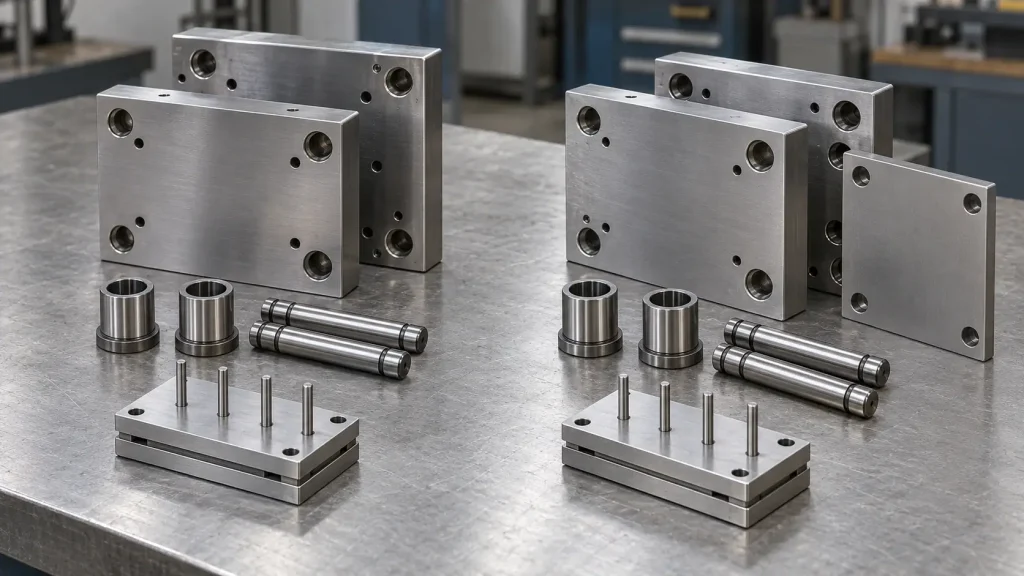
Build the comparison around the delivered assembly. Otherwise, a catalog base requiring substantial completion work can appear cheaper than an alternative that already includes it.
| Comparison item | What the quotation should identify | What acceptance should confirm |
|---|---|---|
| System identity | Manufacturer, catalog family and controlled configuration | Delivered assembly matches the approved reference |
| Plates and material | Plate schedule, grade and supplied condition | Material records and specified dimensions |
| Machining scope | Pockets, cooling holes, threads and allowances | Completed features and remaining work |
| Guidance and ejection | Exact component codes and installation details | Fit, movement and replacement references |
| Machine interfaces | Locating, clamping, nozzle and ejector requirements | Compatibility with the designated machine |
| Documentation | BOM, drawings, inspection records and spares | Records describe the final modified tool |
This is a purchasing framework, rather than a universal ranking of the manufacturers. Each proposal should answer the same questions.
Pay particular attention to machining allowances and assembly condition. A plate supplied for later finishing should not be evaluated against the same delivery-stage criteria as a finished mating surface. Ask who completes that work and which drawing controls the final dimension.
Check Interchangeability at the Interface Level
Plate Stack and Locating Features
Matching width and length is insufficient. Review plate thicknesses, guide-hole positions, shoulders and insert seating faces. Different stacks can change ejector space, opening travel and the relationship between moving components.
Identify the drawing datums used to locate critical holes. A replacement component must fit its mating geometry and occupy the correct position within the assembled tool.
Guide, Ejector and Fastening Components
Compare working diameters, fits, installed lengths and retaining details. Check head dimensions and thread forms as well. A bushing with a matching working diameter can still require a different counterbore or retention arrangement.
Our BOONA DFM recommendation is to freeze guide and ejector references before routing nearby cooling passages. A substituted component with a larger head or counterbore can intrude into a waterline. Changing the component label in the BOM does not resolve that geometric conflict.
Injection-Molding Machine Interfaces
Check locating-ring engagement, sprue-bushing interfaces and clamp access. Confirm mold height, available clearance and ejector connections against the designated machine.
Connect these requirements to the intended plastic injection molding process. A base can accommodate the inserts while still requiring changes to mount or operate correctly on the receiving press.
Specify Steel, Condition and Structural Requirements Separately
Structural Plates and Molding Inserts Have Different Jobs
Specify base-plate materials separately from cavity and core materials. The latter may require particular wear, corrosion or surface-finishing characteristics. A structural plate does not automatically need the same material as the molding insert.
State the supplied condition and required records. Where further treatment or substantial material removal is planned, agree the machining sequence and final inspection condition.
Assess the Sections Left After Machining
Plate thickness alone says little about the support remaining beneath a deep pocket or around intersecting channels.
A 2025 topology-optimization study of an injection-mold slider illustrates this distinction. Section 3.2.1, Figure 10 reports predicted maximum radial displacements of approximately 11 µm for original-design-space variants and 15 µm for modified-design-space variants, attributing the difference to remaining wall thickness. These were finite-element results for a slider, rather than measured steel-base deflections; Section 4 states that injection-molding trial validation remained pending.
This independent work was not a BOONA project and does not demonstrate BOONA capability. The engineering inference is to assess load paths and remaining sections after machining, rather than using a supplier name as a stiffness specification.
Verify Genuine Supply and Control Substitutions
Manufacturer-Supplied Versus Dimensionally Compatible
A base manufactured by the named supplier and a third-party base made to referenced dimensions are different purchasing propositions. Both require an explicit specification; the quotation should disclose which is offered.
For a BOONA RFQ, our recommendation is to quote a manufacturer-supplied base and any compatible alternative as separate options. Identify the actual manufacturer, reference drawings and proposed differences before ordering material. An unexplained “or equivalent” clause makes later acceptance difficult.
Keep Origin Records Separate From Inspection Evidence
Where manufacturer identification or order-linked verification is available, match it to the delivered base. Check that material and configuration details correspond to the order.
An origin or purchase record does not automatically establish final dimensions, heat-treatment condition or the quality of subsequent machining. Request those records separately when required.
After additional machining, update the assembly drawing and BOM. Clearly identify modified catalog parts and retain replacement drawings. A maintenance technician should be able to distinguish an untouched stock component from one shortened, relieved or otherwise altered during the build.
Compare Total Tooling Cost and Maintenance Exposure
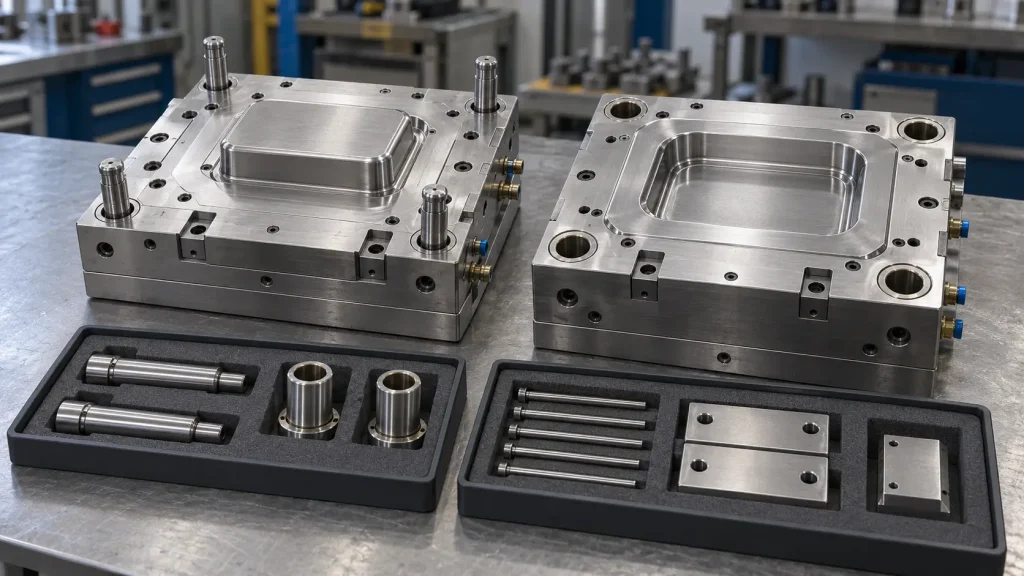
Include Completion Work in the Purchase Comparison
Compare the base price together with the machining, assembly and inspection required to reach the same delivery condition. Pocketing, additional drilling and interface adaptation belong in that calculation.
Avoid assuming that a particular brand is always cheaper or faster. Obtain project-specific quotations, availability and freight terms. A preferred catalog configuration may be economical until substantial modifications are added.
Examine Replacement and Repair Requirements
Determine which components the receiving plant expects to replace and where it will source them. A stocked replacement that needs regrinding or a modified retaining feature is no longer a straightforward maintenance item.
Define the spare-parts package before shipment. Include drawings for modified items and distinguish consumable wear components from structural plates that require a different replacement decision.
Also separate mold-base identity from tool-life commitments. Resin, insert materials and maintenance influence the production program. Any contractual life statement needs its own operating assumptions, acceptance endpoint and exclusions; it cannot be established from the base brand alone.
DME vs HASCO vs LKM: A Practical Selection Framework
Apply the following sequence: confirm customer acceptance, verify interfaces, establish replacement support, then compare total delivered cost.
| Program condition | Main priority | Selection approach |
|---|---|---|
| Receiving plant mandates a system | Specification acceptance | Follow the approved family and deviation process |
| Plant stocks established spare components | Maintenance continuity | Check exact replacement references and mating dimensions |
| Production stays near the mold builder | Supported local sourcing | Compare documented supply, service and completion scope |
| Mold will transfer between plants | Portability | Validate both machine interfaces and spare-part arrangements |
| Construction is extensively customized | Engineering suitability | Compare controlled custom designs, not catalog labels alone |
Pro Tip: Before approving the base, ask the receiving plant to identify replacement part numbers for the guide and ejector components. Any modified item should have a controlled replacement drawing.
Application Example: Microfluidic Tooling With Process-Dependent Results
A microfluidic-device study published in Wiley’s 2024 journal volume, first available online in 2023, demonstrates why base selection and tool qualification need separate acceptance criteria. Section 2.3 describes a slide-format device measuring 75 × 25 × 1.8 mm. Section 2.5 states that the same mold served injection molding and injection-compression molding.
Section 3.2, Figure 9 reports almost 30% height deviation for nominally 25 µm machined insert structures. Separately, Section 3.3, Table 5 records mean vertical displacements during stress release of 0.299 mm for injection-molded COC TOPAS 8007S-04 specimens and 0.102 mm for injection-compression specimens of that same grade. The accompanying Section 3.3 text specifies testing over 24 hours at 73 °C.
These are microfluidic insert and process findings, not a comparison of DME, HASCO or LKM bases. The research was not a BOONA project and does not evidence BOONA capability. The engineering inference is to qualify insert geometry and molding behavior separately: an approved base system cannot substitute for either check.
What to Include in a China-Built Mold RFQ
Prepare the RFQ around the tool’s destination and final configuration. Include:
- Receiving-machine information and installation interfaces.
- Approved manufacturer, catalog family and dimensional system.
- Plate schedule, materials and supplied condition.
- Component references and permitted substitutions.
- Included machining, treatment and inspection requirements.
- Acceptance responsibilities, delivery records and spare components.
Attach the receiving plant’s tooling specification where one exists. Resolve conflicts with the mold builder’s preferred construction before design approval.
Define approval stages. Base procurement can proceed only after the relevant configuration is approved; later changes need a documented impact review. The review should cover affected cooling passages, ejector travel, retaining features and spare-part references.
For delivery, request the final assembly CAD, controlled drawings and BOM. Inspection reports should identify the relevant drawing revision and delivery condition. Keep component verification separate from molding trials and production acceptance.
Specify corrosion protection, packaging and storage instructions appropriate to the shipment. Protect precision mating surfaces and organize loose components so the receiving plant can identify and inspect them without relying on undocumented assembly knowledge.
FAQs
Is DME always an inch-based mold system?
No. DME includes U.S.-standard and metric offerings. Specify the regional catalog, family, component references and units. A dimension converted into millimeters does not establish metric component compatibility.
Can HASCO components fit an LKM mold base?
Possibly, where the mating geometry and specifications match or are deliberately adapted. Check fits, retaining arrangements and installed lengths. Brand labels alone do not establish interchangeability.
Does “DME-compatible” mean genuine DME supply?
No. It describes a compatibility claim, whose scope must be defined. Identify the actual manufacturer and verify the relevant drawings and component interfaces before accepting the alternative.
Can an LKM mold base be used for an export mold?
Yes, if the customer accepts the specified configuration and it satisfies the receiving plant’s requirements. Confirm machine interfaces, material records and replacement support. Export destination alone does not establish acceptance.
Does the mold-base brand determine mold life?
No. The complete tool’s construction, resin, operating conditions and maintenance matter. Define any life commitment separately, including the components covered and the agreed service assumptions.
What documentation should accompany a China-built mold?
Request the final assembly drawing, BOM, required material records, inspection results and maintenance information. Include controlled drawings for modified components and the agreed trial records and spare-parts list.
Conclusion: Choose a Defined System and a Supportable Tool
DME vs HASCO vs LKM becomes a useful comparison once the specification identifies the exact system, delivered construction and maintenance requirements. Begin with the receiving plant’s acceptance criteria, verify the interfaces, and compare equivalent supply scopes.
Keep base inspection, insert qualification and production trials distinct. A supportable tool also needs accurate final documentation and a realistic replacement-parts plan.
Send BOONA your mold drawings, receiving-machine details and preferred component system for an injection mold tooling DFM review. BOONA offers no minimum order quantity and a free DFM review. Include production requirements and the receiving plant’s tooling specification so the proposed construction, machining scope and acceptance plan can be reviewed before procurement.