
A worn gate insert should not automatically retire an otherwise serviceable mold. Whether the insert can be replaced, accessed without extensive dismantling, and returned to production matters when purchasing tooling.
Using SPI Class 101 to 105 effectively starts with converting accepted-part demand into mold cycles. Then check the resin, proposed construction and maintenance plan against the supplier’s stated service-life assumptions. Annual order quantity alone cannot settle the decision, and a class label cannot replace a documented tooling specification.
We also need to distinguish estimated service life from a contractual guarantee. A mold classification does not independently establish the replacement interval of every component or the number of acceptable parts a production system will deliver.
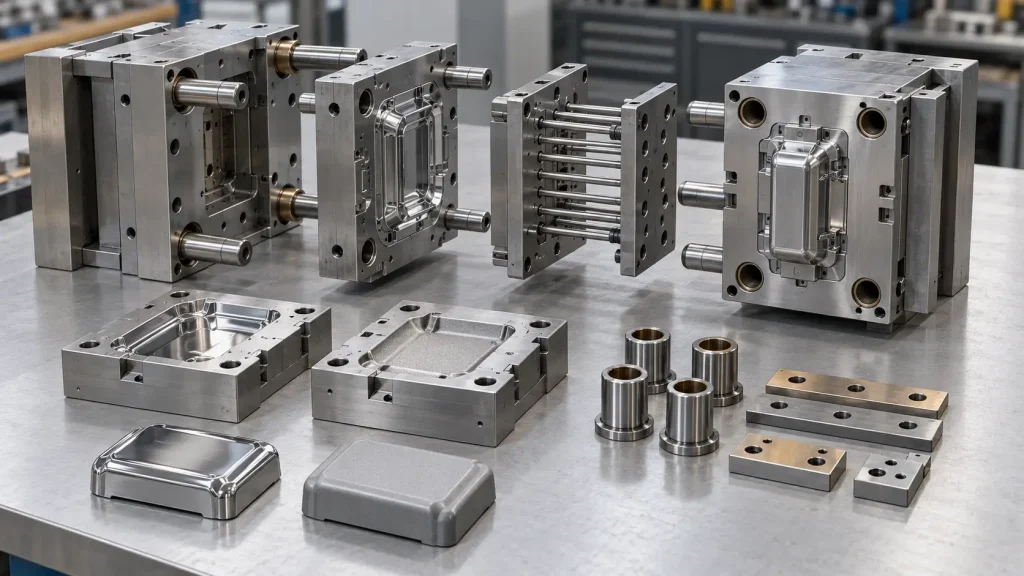
What Mold Classification Can and Cannot Tell You
The PLASTICS Industry Association’s AR-101 guide addresses mold purchasing and classification. Its public catalog section, “Customs and Practices of the Moldmaking Industry,” describes estimated lifespans and quotation guidance; the “Released/Revised” entry lists a May 2023 revision. The public listing establishes that scope and revision date, rather than publishing the class-by-class requirements.
That purchasing role explains why a class belongs alongside a detailed tooling specification. The number provides a starting point for discussing intended duty. The drawing, construction requirements and commercial agreement establish what the buyer receives.
Do not confuse mold classes with SPI surface-finish designations; those are covered in SPI A1 vs A2 vs A3. A polished cosmetic cavity requires its own finish specification. Likewise, mold classification does not replace dimensional acceptance criteria, process qualification or a written warranty.
A quoted life also needs an endpoint. Does it mean acceptable production before major refurbishment, operation with routine wear-component replacement, or retirement of the mold assembly? Those interpretations allocate costs differently.
For a BOONA tooling RFQ, our recommendation is to attach the selected classification reference to the construction schedule and define the service-life assumptions explicitly. An unexplained class label leaves too much of the purchase undefined.
SPI Class 101 to 105: A Procurement Comparison Framework
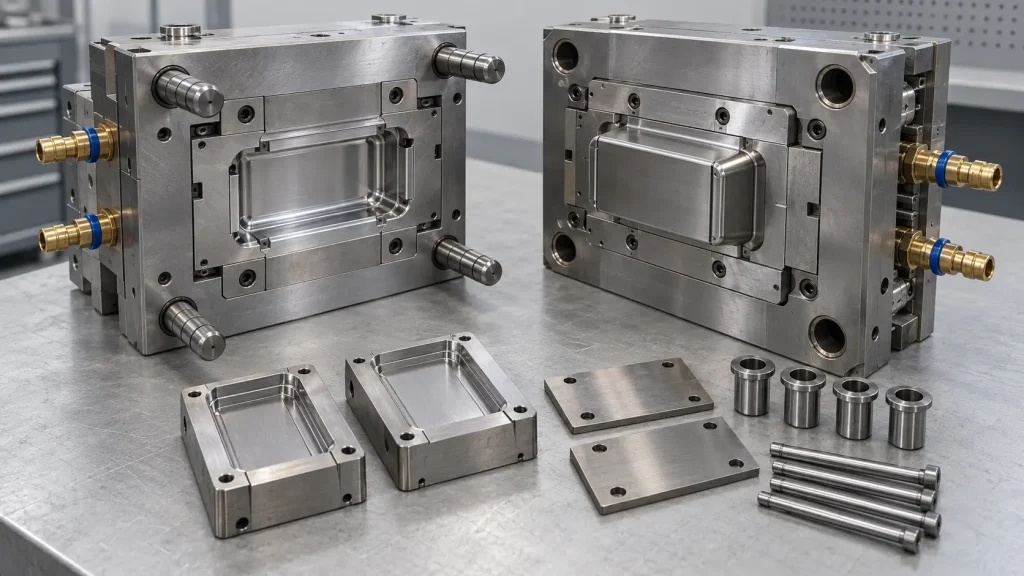
When comparing quotations for Classes 101–105, use the checklist below to connect your production forecast with the proposed tool specification. These are procurement questions, not a reproduction of AR-101 class definitions. Ask each supplier to identify the reference publication and edition, explain the requirements applicable to its proposed class, and disclose any exceptions.
| Decision point | What the buyer should specify | Evidence to request |
|---|---|---|
| Lifetime cycle demand | Accepted-part demand, active cavities, expected yield and additional trial cycles | A cycle-demand calculation with explicit assumptions |
| Resin and operating conditions | Exact compound, fillers, processing conditions and critical part requirements | Proposed materials and treatments with an application-specific rationale |
| Wear, maintenance and repair | Service responsibilities, spare parts and acceptable interruptions | A maintenance plan, replaceable-component list and repair terms |
| Cooling and production capacity | Output schedule, available hours, target cycle time and intended machine | Cooling and machine-compatibility reviews, capacity estimates and available trial results |
| Acceptance and warranty | Part acceptance criteria and any requested service-life commitments | An acceptance plan and written warranty conditions, exclusions and remedies |
A class should not become a substitute for investigating the application. An abrasive compound, delicate shutoff or demanding cosmetic surface may justify specialized construction even when the forecast is modest.
Conversely, a development tool may have little economic reason to outlast a product design scheduled for replacement. Evaluate the likely production program and the consequences of interruption before choosing the construction package.
Convert Product Demand Into Required Mold Cycles
For conventional single-shot molding with identical active cavities:
Required production cycles = accepted-part demand ÷ (active cavities × expected quality yield)
Round the result up. Then add separately budgeted setup or trial cycles if the yield assumption excludes those losses.
Consider a hypothetical program requiring 600,000 accepted parts. A mold operating with four identical cavities at an assumed 96% quality yield requires 156,250 production cycles. These are illustrative planning inputs, not BOONA capability figures.
The same demand requires more cycles if a cavity is disabled. Check whether temporary cavity loss is acceptable and whether the remaining cavities can run without compromising the process.
Family molds need a different calculation. Cavities producing different components do not necessarily satisfy demand in equal proportions. Base the schedule on the required component mix and identify any excess output.
Keep product-life demand separate from annual demand. Include service parts and realistic revisions. For multi-shot processes, define what the counter records because injection events and complete mold cycles may differ.
We recommend agreeing these assumptions with the team responsible for plastic injection molding production before selecting a tooling class.
Specify the Construction Behind the Class
Resin grade changes the duty imposed on a mold. Reinforcement can introduce abrasive wear; some processing environments require corrosion-resistant solutions. Identify the actual compound, including additives, rather than specifying only the polymer family.
Separate the mold base specification from the core and cavity materials. Heat treatment, local inserts and surface treatments deserve explicit requirements where they affect performance. A steel name alone cannot establish the classification of an entire mold.
Our DFM recommendation for a BOONA project is to identify likely service locations before finalizing insert boundaries. A replaceable gate or shutoff insert needs practical access. Its joint should also avoid creating an unacceptable witness line or forcing extensive cosmetic rework after replacement.
Production example: relay-component mold wear
A 2026 study of AlCrN-coated relay injection molds examined abrasive wear in electrical-component production using ELMAX mold steel. Section 3.7 describes a two-cavity mold and four repeated comparisons, using flash height of at least 0.1 mm as the failure criterion. Table 12 reports mean service lives of 128,070 cycles for coated specimens and 33,985 for uncoated specimens. Figure 8 shows pronounced glass-fiber plowing grooves on the uncoated surfaces.
This was an independent study, not a BOONA project or an SPI classification test. Its results do not establish BOONA capability or a transferable life guarantee.
The engineering inference is that local wear protection can materially affect service life within a particular application. Procurement should therefore examine the cavity’s wear strategy alongside the class designation.
Check Production Capacity Separately From Tool Life
A mold may have sufficient projected life while lacking the capacity to meet the delivery schedule. Calculate available production hours separately from cumulative cycles.
For a simplified planning model:
Required scheduled hours = production cycles × cycle time in seconds ÷ (3,600 × availability)
Here, availability accounts for downtime during scheduled production. Quality yield has already entered the cycle calculation; avoid counting it again through a composite efficiency factor.
Cooling deserves specific attention. Section 3.2, “Test Verification,” of a 2024 conformal-cooling study reports a measured cooling time of 6.9 seconds and a molding cycle of 23.2 seconds for the tested part and tool. The researchers manufactured and trialed a conformally cooled insert.
Those findings concern cooling and production speed. They do not measure long-term mold durability or prove that a particular class will run at that cycle. The study was independent of BOONA and does not evidence BOONA production capability.
The engineering inference is straightforward: retain separate quote fields for expected cycle time and intended service life. Confirm press compatibility, handling requirements and cooling utilities before accepting either assumption.
SPI Class 101 to 105: Compare Cost Across Demand Scenarios
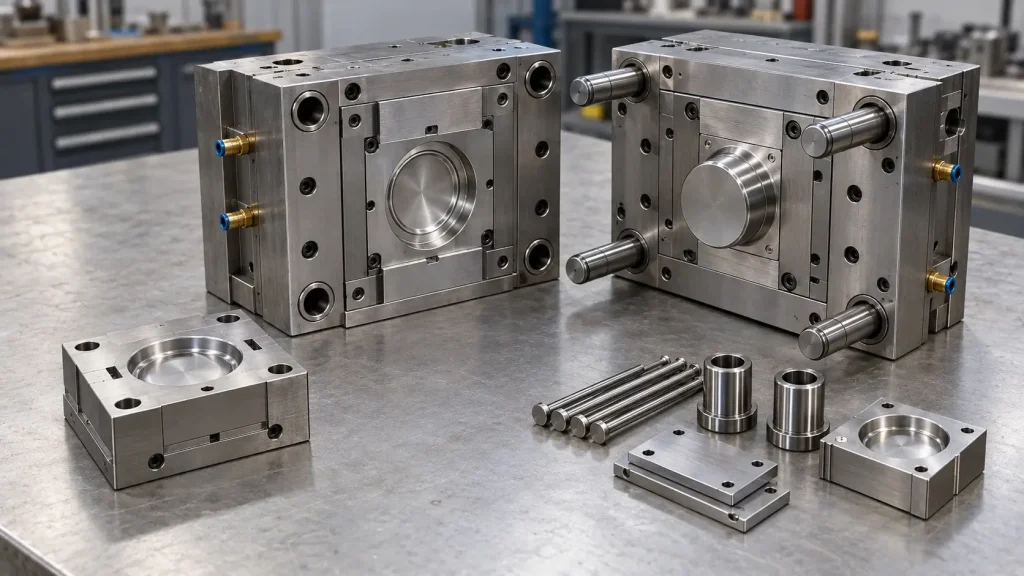
Evaluate tooling under low, base and high demand forecasts. Each scenario should pass three checks: sufficient cycles, sufficient scheduled capacity, and an acceptable tool-related cost per accepted part.
| Demand scenario | Main exposure | What to compare |
|---|---|---|
| Below forecast | Unused investment or early redesign | Initial tooling and modification provisions |
| Base forecast | Routine production and maintenance | Service cost, spares and achievable output |
| Above forecast | Accelerated wear or capacity shortfall | Refurbishment, replacement and additional tooling |
Calculate tool-related cost per accepted part using initial tooling, qualification and expected service expenditure. Add repairs or replacement tools where relevant. Include attributable downtime consistently across alternatives. Material and molding charges remain additional costs unless the comparison explicitly includes them.
A lower initial quote can become expensive if routine service requires shipping the whole mold away. A more elaborate tool can also be poor value when the product changes before its durability becomes useful.
Pro Tip: Separate the planned service intervals of wear components from the intended life of the mold assembly. Ask whether the quoted service-life assumption includes replacing those components and who pays for the work.
Put Tool-Life Assumptions and Service Responsibilities in the RFQ
An actionable RFQ connects demand to construction and acceptance. Provide the CAD revision, resin grade and expected production schedule. Identify critical features and cosmetic areas that could trigger tool repair or part rejection.
Request the following alongside the class designation:
- Classification reference and applicable revision, with departures identified.
- Active cavity count and assumptions used to calculate required cycles.
- Core, cavity and local wear-component specifications.
- Cooling provisions and machine-interface requirements.
- Trial conditions, cavity-specific inspection and acceptance criteria.
- Cycle-counting method and treatment of setup or trial cycles.
- Maintenance ownership, spare-part scope and repair responsibilities.
- Tool ownership, transfer documentation and separately agreed warranty terms.
Another BOONA RFQ recommendation is to retain mold-linked service records rather than relying exclusively on a machine counter. A transferred mold needs a history that follows the asset. Record cavity shutdowns and insert replacements alongside cycle totals.
For used tooling, inspect current condition instead of relying on its original class. Check cooling condition, moving interfaces and previous repair areas. Include replacement-insert drawings where ownership and contractual rights permit; the ability to order a spare should not depend on reconstructing a worn component.
FAQs
What is the difference between Class 101 and Class 103 molds?
They indicate different intended service categories. Compare the selected guide’s requirements and the proposed construction rather than treating the class number as a standalone life guarantee. Resin, part requirements and maintenance remain relevant to the purchase.
Are mold cycles, shots and finished parts the same?
No. A multi-cavity mold can produce several parts per cycle, and some will be rejected. Multi-shot molding adds another distinction between injection events and complete cycles. Define the counting convention before comparing quotations or recording service life.
Does aluminum tooling automatically mean prototype-only tooling?
No. Material choice alone does not determine the purpose or suitability of a tool. Evaluate the specific alloy, construction and application. If an RFQ requires a particular mold class, verify every applicable requirement rather than inferring compliance from material alone.
Does glass-filled resin require a different mold class?
It requires an application-specific wear assessment. Examine vulnerable gates, shutoffs and sliding interfaces, then specify suitable protection and replacement provisions. Selecting another class without corresponding construction detail may leave the actual wear mechanism unresolved.
Is an SPI mold class a warranty?
The classification itself is not a complete contractual warranty. Any guaranteed service commitment needs agreed operating conditions, maintenance obligations and acceptance criteria. Define repair remedies and exclusions separately so both parties understand responsibility when a component wears.
Is the longest-life tool always the cheapest option?
No. Its value depends on actual demand, design stability and the cost of disruption. Compare lifecycle expenditure under several forecasts. A shorter-service tool can be commercially appropriate when development changes or limited demand make further durability unlikely to be used.
Conclusion: Choose for the Production Program
Selecting SPI Class 101 to 105 works best when the class supports a documented production plan. Start with accepted-part demand and active cavities. Check the resin’s demands on the tool, then agree how wear components will be serviced and how acceptable production will be verified.
Keep capacity calculations and warranty terms distinct. That gives purchasing a clearer comparison and gives the molding team usable assumptions for scheduling and maintenance.
Send BOONA your CAD files, resin specification and expected lifetime demand for a custom injection mold tooling review. With no minimum order quantity and a free DFM review, we can help connect the proposed construction to your production needs. Ask the quote to state its cycle assumptions, maintenance scope and acceptance conditions so you can assess the investment before authorizing tooling.