
An autoinjector prototype activates on command, yet injection time varies from one unit to another. The drive spring is unchanged. Engineers eventually find that several small mechanical effects are adding together: the plunger rod runs slightly off-axis, guide friction changes through its travel, the cartridge sits at a different depth, and the latch releases from a different contact position.
Similar problems occur inside inhalers. A dose counter can index correctly during a single test and miss a step after repeated cycles. A nozzle insert may meet its dimensional limits while the assembled airflow path no longer aligns as intended.
These examples show why machining injector and inhaler precision components requires control of functional relationships as well as individual dimensions. Dose delivery remains a system-level responsibility, but precision components influence alignment, friction, actuation, airflow, indexing and repeatability.
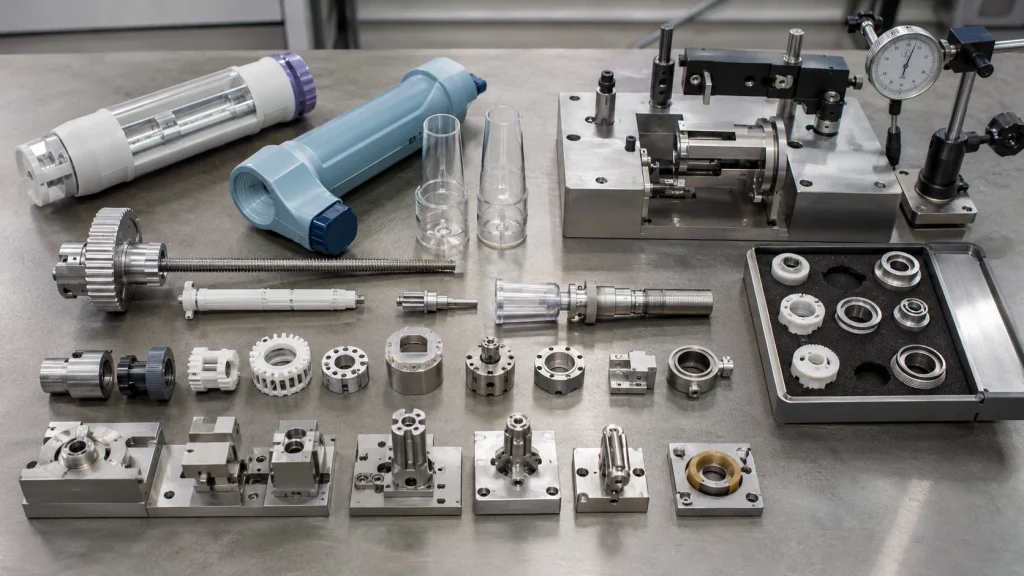
Which Injector and Inhaler Components Are Precision Machined?
The range of injector precision components extends from mechanical development hardware to production metal parts and test fixtures. Typical examples include drive rods, guide sleeves, cartridge locators, actuator shafts, latch components, dose-setting parts and alignment fixtures.
Inhaler systems create a different component family. Inhaler precision components may include development nozzle inserts, airflow blocks, indexing shafts, piercing mechanisms, dose-counter parts, alignment pins and controlled test hardware.
| Device subsystem | Example component | Functional concern | Machining risk |
|---|---|---|---|
| Injector drive train | Rod, sleeve, latch | Travel and release | Friction and coaxial error |
| Cartridge support | Locator, retainer | Container positioning | Stack-up and misalignment |
| Inhaler airflow | Nozzle or channel insert | Controlled flow geometry | Burrs and contamination |
| Metering mechanism | Shaft, index wheel | Repeated dose positioning | Backlash and wear |
| Dose counter | Ratchet, gear, carrier | Correct count progression | Cumulative indexing error |
| Verification hardware | Fixture, master, gauge | Repeatable testing | Datum-transfer error |
The machining supplier supports the mechanical component specification. Final dose accuracy, drug compatibility, combination-product validation and regulatory release remain responsibilities of the product manufacturer.
Materials for Machining Injector and Inhaler Precision Components
Material selection depends strongly on whether a component contacts the drug product, primary container, airflow path or only another mechanical component.
Stainless steels can suit pins, wear surfaces, shafts, guide parts and development hardware. Aluminum may be useful for structural components, fixture bodies, test hardware or lightweight development assemblies. Engineering polymers can support insulation, low friction or chemical-resistance requirements.
PEEK is one option for selected development and device components where the customer specification calls for it. BOONA guide to medical-grade PEEK components discusses why grade documentation and intended use need to be defined rather than relying on a generic “medical PEEK” callout.
For injection systems, ISO 11608-3:2022 specifies requirements and test methods for containers and integrated fluid paths used with needle-based injection systems. Amendment 1 was published in April 2026.
That distinction matters for drug delivery device machining. A material can machine cleanly and hold a dimension while still requiring separate compatibility, extractables, biological or container-closure evaluation before direct medicinal-product contact.
Injector Drive Trains and Fluid-Path Alignment
Autoinjector component machining often centers on the mechanical chain that transfers stored spring energy into controlled movement.
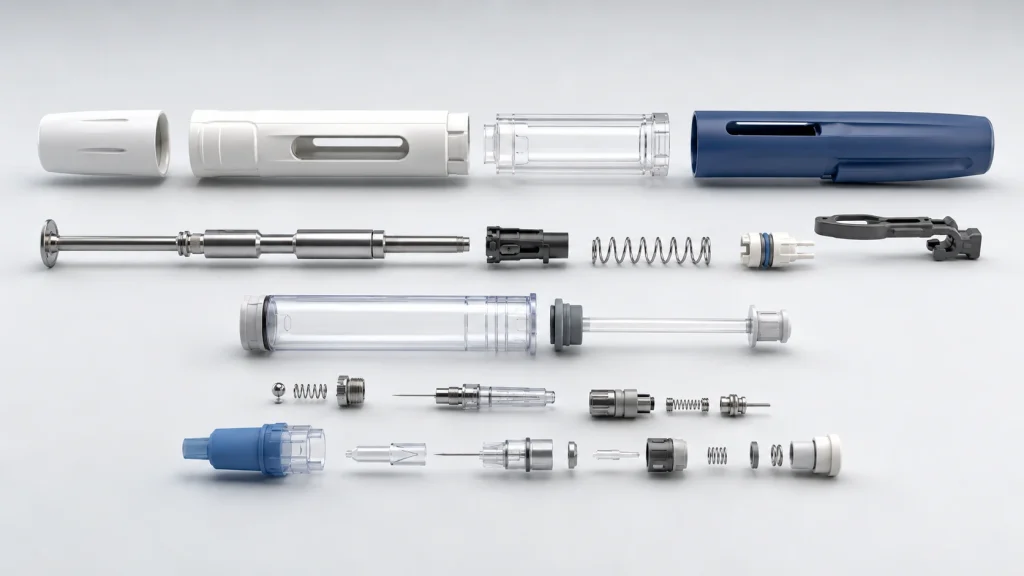
Relevant relationships include the drive-rod axis, guide bore, cartridge centerline, plunger interface, travel stops and latch geometry. Small changes in any one feature can alter sliding resistance or the point at which stored energy releases.
A drive rod that approaches the plunger off-axis can create lateral loading. Guide straightness and surface condition can also influence friction during travel. Latch geometry affects release position and may change with wear or edge rounding.
ISO 11608-1:2022 covers needle-based injection systems intended to deliver discrete medicinal-product volumes through needles or soft cannulas. Its Amendment 1 was published in April 2026. ISO 11608-5:2022 separately addresses automated functions.
A 2024 sensor-augmented pen-injector study involved 46 participants from healthy and dexterity-impaired groups. Each participant performed handling steps at both comfortable and maximum force levels, demonstrating that user capability and device geometry can influence the forces applied during operation. The full peer-reviewed study is available through PubMed Central.
Component-level force or travel requirements should therefore come from the device manufacturer’s validated design input rather than a generic injector value.
Inhaler Airflow, Metering and Dose-Counting Mechanisms
The critical geometry inside an inhaler can involve both airflow and repeated mechanical indexing.
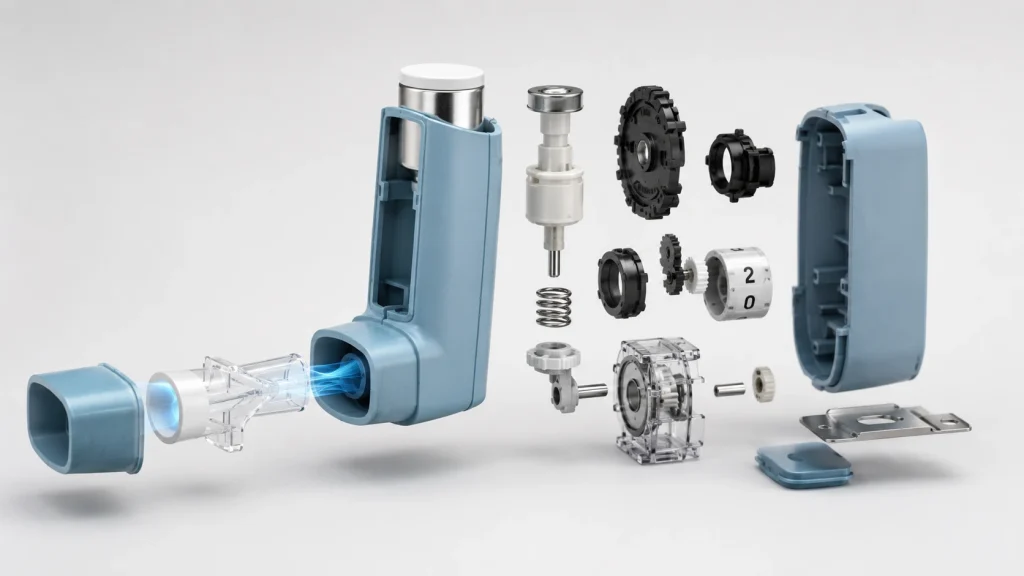
Potential inhaler mechanism components include nozzle inserts, airflow blocks, actuator interfaces, piercing parts, ratchets, counter wheels and indexing shafts. Small channels require particular attention to burrs, tool marks and retained debris because these features may be inaccessible after assembly.
FDA’s draft quality guidance for MDI and DPI drug products addresses development and manufacture of metered-dose and dry-powder inhalation products. The agency also maintains guidance on integrating dose-counting mechanisms into MDI drug products.
From a machining perspective, a dose counter introduces cumulative behavior. A small angular indexing error that appears harmless during one cycle may become significant after repeated actuation.
Engineers should therefore evaluate tooth profiles, pawl engagement, shaft clearance, backlash and travel stops as a mechanism. Static dimensions remain necessary, but functional cycling can reveal skipped engagement, incomplete return or progressive positional error that a one-time inspection cannot detect.
Miniature Features, Friction and Particle Control
Injectors and inhalers both contain features where a small burr or slight change in surface condition becomes functionally significant.
Common examples include miniature bores, guide pins, grooves, slots, small threads, ratchet teeth and sliding shafts. Deep cavities can increase tool overhang, while thin walls may distort under clamping. Cross-hole intersections and small airflow passages can hide burrs that ordinary exterior inspection misses.
Sliding behavior also depends on more than nominal clearance. Shaft straightness, bore alignment, roughness and edge condition influence friction throughout the full travel.
Lubricants and coatings require additional caution. Silicone oil or another substance used within a validated drug-container system should not be treated as an ordinary shop-floor friction solution. Any lubricant or surface treatment capable of contacting a medicinal product belongs within the manufacturer’s material-compatibility and device-validation program.
Particle risk deserves similar control. Metallic chips, abrasive residue, polishing media or dried cutting fluid may interfere with a small mechanism or airflow path.
For related cleanability and precision-component considerations, BOONA article on machining IVD and analytical instrument components provides a useful comparison with fluidic and measurement-sensitive medical hardware.
DFM for Machining Injector and Inhaler Precision Components
Many commercial injectors and inhalers ultimately rely heavily on injection-molded polymer components. CNC machining plays a different role during development.
It can support functional metal components, early mechanical prototypes, material trials, test fixtures, gauge masters and tooling inserts. A machined prototype may help engineers study alignment or mechanism travel before committing to production tooling.
However, the transition from CNC to molding requires deliberate DFM. A machined plastic part can use square internal corners, zero draft and locally thick walls that would be unsuitable for a molded component. Friction may also change when the production polymer, texture and mold parting strategy replace a machined prototype.
BOONA CNC machining service is relevant for development and precision-machined hardware, while injection mold tooling supports the later transition where the production design requires molded components.
💡 Pro Tip: Freeze functional datums before translating a CNC prototype into a molded design. Draft, shrinkage allowance and parting-line decisions should preserve the relationships that control alignment, travel and indexing.
DFM should also ask whether hidden features remain deburrable, cleanable and inspectable after the final manufacturing process.
Inspection and Functional Verification
Inspection for machining injector and inhaler precision components should follow component function.
Conventional dimensional tools can verify bore position, shaft diameter, flatness and datum relationships. Vision systems may be more appropriate for small ratchet features or nozzle geometry. Surface-roughness measurement can support sliding-interface control.
Functional verification adds another layer. For injector mechanisms, useful component or subassembly checks may include drive-rod travel, latch release position, cartridge seating and force-displacement behavior. For inhaler components, engineers may evaluate indexing angle, actuator travel, counter progression and mating alignment.
A dimensional report and a dose-delivery validation answer different questions. The machining supplier can verify the mechanical requirements placed on a component. The final product manufacturer establishes whether the complete assembled system delivers the intended medicinal product correctly.
ISO 20072:2009 remains the published and confirmed ISO standard for aerosol drug-delivery device design verification. ISO states that it focuses on laboratory verification of device functionality against manufacturer-defined specifications and is not a drug-product quality-assessment standard.
Inspection plans should therefore connect drawing requirements, component function and the later system-level verification strategy without confusing those different layers.
ISO 11608 and Drug-Delivery System Reliability
The current standards landscape reinforces the distinction between component precision and complete-system reliability.
ISO 11608-1:2022 addresses needle-based injection systems, ISO 11608-3:2022 covers containers and integrated fluid paths, and ISO 11608-5:2022 covers automated functions. The 2026 amendments to Parts 1 and 3 should be considered when a project controls standards by revision.
A newer reference is ISO/TS 4452:2025, published in November 2025. It addresses capability and system reliability for disposable single-use drug-delivery systems where there is a single opportunity to deliver a single dose. Its scope includes needle-based injection systems and aerosol drug-delivery systems.
For machining teams, these documents should not become generic claims such as “ISO-compliant CNC part” unless the applicable requirements and evidence actually support that statement.
The practical contribution of precision manufacturing is narrower and more concrete: consistent datums, controlled fits, defined surfaces, traceable drawing revisions and repeatable inspection results.
The finished system still needs the manufacturer’s risk-based design verification, reliability demonstration and drug-delivery performance testing.
Application Example: Reduced Fill Volume in a Spring-Driven Autoinjector
A 2026 peer-reviewed study provides a useful example of why mechanical starting conditions matter inside an autoinjector.
Researchers examined an existing spring-actuated platform containing three device variants designed for nominal fill volumes of 0.5 mL, 1 mL and 2 mL. They then evaluated reduced fill conditions reaching up to 50% below the nominal volume. The study measured dose accuracy and injection time and also considered needle dynamics, syringe integrity and drug-product quality. The published autoinjector study appears in Pharmaceutics.
Reducing fill volume changed the starting position of the plunger and increased the distance the driving rod traveled before contact. The researchers observed increased driving-rod acceleration and syringe stress under the lower-fill conditions, while the tested platform maintained consistent performance across the evaluated parameters.
The manufacturing lesson is not that every autoinjector can tolerate a 50% volume reduction.
It shows how apparently simple geometric relationships such as rod length, starting position, guide alignment and available travel influence the mechanical event experienced by the complete system. Device-specific performance requirements must still come from validated engineering studies.
Common Drawing and Supplier-Control Mistakes
A detailed CAD model can still leave critical manufacturing questions unanswered.
Common drawing problems include:
- No distinction between drug-contact and non-contact surfaces
- Missing functional datum axis
- Tight shaft diameter without straightness or position control
- Sliding clearance defined without surface-condition requirements
- No burr specification for airflow channels
- No pre-finish versus post-finish dimensional definition
- Dose-counter geometry without functional indexing criteria
- Injector travel defined from an unrelated datum
- No final cleanliness requirement
- Prototype material assumed to behave like production material
- Machined prototype friction assumed to equal molded-part friction
Supplier documentation should also match the development phase. Test fixtures may require calibration or revision control, while drug-contact hardware may require additional material documentation defined by the customer’s quality system.
Before release, engineers should identify which features slide, rotate, latch, meter, index or establish the fluid path. Those features deserve the clearest tolerances and inspection requirements.
The supplier should not be asked to create clinical dose limits or medicinal-product acceptance criteria. Those requirements must originate from the product manufacturer’s design and validation process.
FAQs
What injector components can be CNC machined?
Drive rods, cartridge locators, guide sleeves, actuator components, latch parts, metal chassis components, prototypes, fixtures and gauge masters can be CNC machined where the device design calls for them.
What inhaler components require precision machining?
Development nozzle inserts, airflow blocks, piercing components, indexing shafts, dose-counter mechanisms, precision fixtures and tooling inserts may require machining.
What ISO standard applies to autoinjectors?
ISO 11608-1:2022 covers needle-based injection systems generally, while ISO 11608-5:2022 addresses automated functions. The exact applicable parts depend on the product architecture.
Why does injector alignment matter?
The cartridge, plunger, drive rod, guide and needle-related features operate through connected axes. Misalignment can change friction, loading and travel behavior.
What is ISO 20072 used for?
ISO 20072 provides a design-verification framework for hand-held aerosol drug-delivery devices and focuses on functional verification against manufacturer-defined specifications.
What should an injector or inhaler component drawing include?
It should define material, drug-contact status, functional datums, critical fits, surface condition, burr limits, finishing state, cleanliness, inspection methods and any required functional tests.
Conclusion: Control the Mechanism Around Dose Delivery
Successful machining injector and inhaler precision components starts with understanding what each feature controls inside the mechanism.
Injector hardware depends on alignment, travel, sliding friction, cartridge position and consistent release geometry. Inhaler hardware adds airflow passages, nozzle relationships, indexing and dose-counter movement. Small burrs, positional errors or surface changes can affect these mechanical relationships even when basic dimensions remain acceptable.
Component inspection should therefore combine dimensional verification with appropriate functional checks. Final dose accuracy, medicinal-product compatibility, reliability and regulatory approval remain system-level responsibilities of the drug-delivery product manufacturer.
Send BOONA your controlled CAD files, material requirements, functional datums and inspection criteria through the CNC machining service for an early manufacturability review.