
Aluminum heatsinks are everywhere, and for good reason. They are light, cost-effective, easy to machine, and usually good enough for standard electronics cooling. But when the heat source gets smaller, hotter, or more concentrated, aluminum sometimes runs out of room.
That is when engineers start looking at custom pure copper heatsinks.
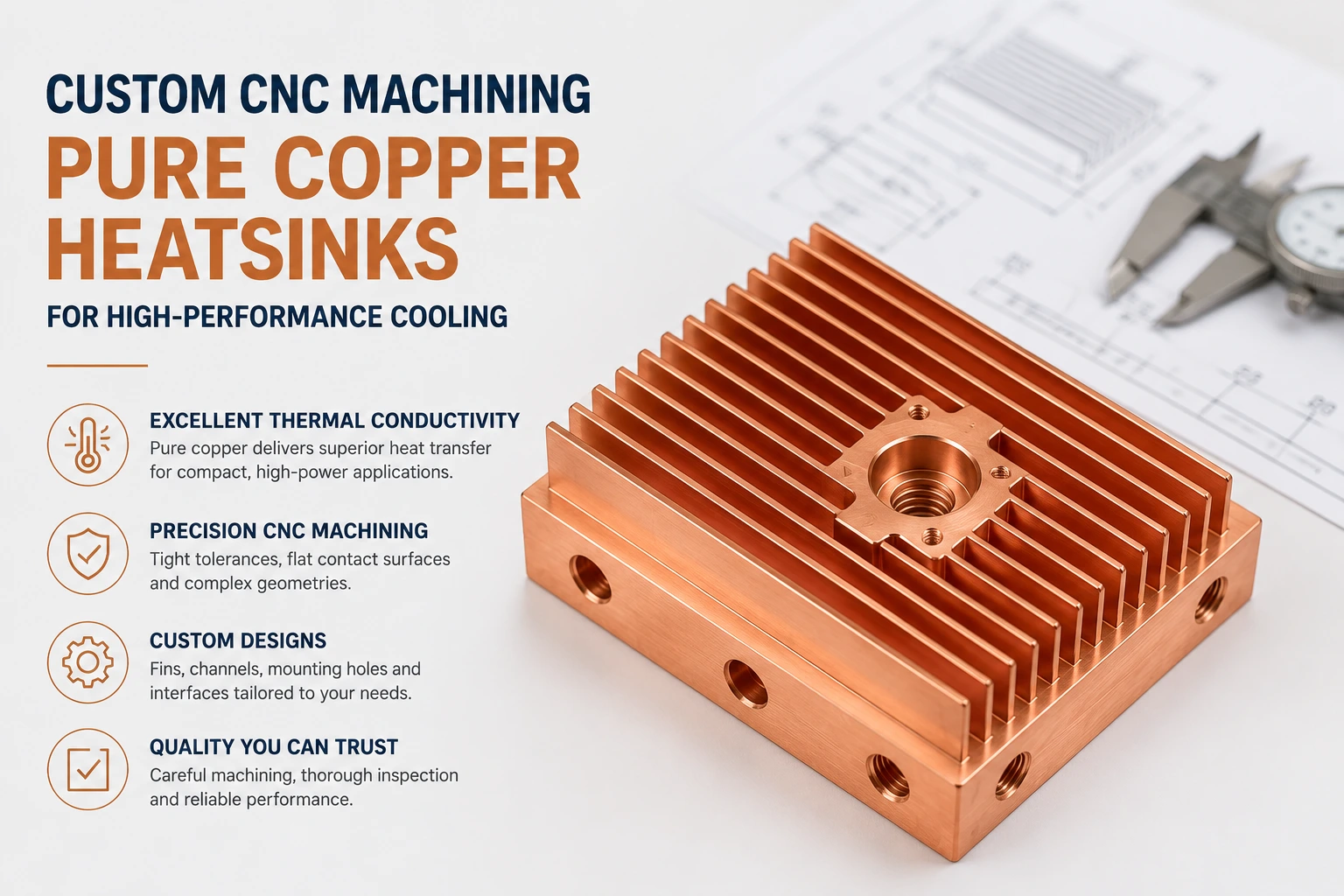
Pure copper is not chosen because it is cheap or easy to machine. It is chosen because it moves heat extremely well. For power modules, EV charging systems, RF equipment, laser components, compact medical devices, and high-power LED assemblies, copper can pull heat away from the hot zone faster than aluminum in the same footprint.
The trade-off is manufacturing difficulty. Copper is soft, heavy, expensive, and gummy under the cutting tool. Thin fins can bend. Deep channels can trap chips. Burrs appear easily around holes and edges. If the contact surface is not finished correctly, the thermal performance on paper may not show up in the real assembly.
That is why CNC machining copper heatsinks is not just about cutting a copper block into shape. The job needs a proper thermal design, realistic machining features, flat contact surfaces, and careful inspection.
For projects that require custom copper CNC machining, the right question is not only “Can this part be made?” A better question is: “Can this copper heatsink be machined cleanly enough to cool the assembly reliably?”
Copper or Aluminum: Which One Should You Use?
Copper is not automatically better for every heatsink. If the product needs to stay light, aluminum may still be the better choice. If the design needs very high surface area at low cost, extrusion or skiving aluminum may also make sense.
Copper becomes more attractive when heat needs to move quickly through a compact base or contact face.
| Design Factor | Pure Copper Heatsink | Aluminum Heatsink |
|---|---|---|
| Thermal conductivity | About 385 W/m·K | About 205 W/m·K |
| Weight | Much heavier | Lightweight |
| Machining difficulty | Higher, gummy chips and burrs | Easier and faster |
| Material cost | Higher | Lower |
| Best use | Compact, high-heat-density cooling | General electronics cooling |
| Contact face performance | Excellent when machined flat | Good, but lower heat spreading |
| Prototype flexibility | Good with CNC machining | Good with CNC machining or extrusion |
A useful way to think about it: aluminum is often the first choice; copper is the choice when heat density forces your hand.
If a power component is generating heat in a very small contact area, copper can spread that heat before it reaches the fins, liquid channel, or cold plate interface. That is why pure copper heat sink machining is common for high-power electronics and thermal prototypes.
Where Custom Copper Heatsinks Are Commonly Used
Most copper heatsinks are not standard catalog parts. They are usually designed around a specific heat source, PCB layout, mounting pattern, enclosure, or cooling path.
Typical applications include:
| Application | Why Copper Helps |
| Power electronics | Spreads heat from MOSFETs, IGBTs, converters, and inverters |
| EV battery and charging systems | Supports high-current and compact thermal assemblies |
| Laser diode modules | Handles concentrated heat near a small source |
| RF and telecom equipment | Helps stabilize sensitive electronics |
| High-power LED modules | Improves heat spreading near the light source |
| Medical equipment | Supports compact cooling parts where space is limited |
| Aerospace electronics | Useful when thermal reliability matters in small assemblies |
| Test fixtures | Provides repeatable heat transfer during validation |
Some projects only need a flat copper heat spreader. Others need a full copper cooling plate with pockets, channels, O-ring grooves, threaded holes, sensor slots, and mounting features. In early development, precision CNC machining services are often the practical route because design changes are still likely.
The Contact Face Is the Part You Should Not Ignore
Many heatsink discussions focus on fins and channels. Those matter, of course. But the most important surface is often the one that touches the heat source.
A copper heatsink with a poor contact face will not perform as expected. Raised tool marks, burrs around holes, uneven flatness, or small scratches can affect how the part sits against the component or thermal interface material. In a prototype, this may create confusing test results. In a batch, it can cause assembly problems.
For precision copper cooling plates, the contact area should be treated as a critical feature.
| Critical Area | Why It Matters | Practical CNC Note |
| Contact face | Controls heat transfer into the copper | Use a dedicated finishing pass |
| Mounting holes | Control clamping pressure | Keep hole position stable |
| Threaded holes | Affect assembly repeatability | Avoid unnecessary deep threads |
| O-ring groove | Important for sealing cold plates | Specify width, depth, and surface clearly |
| Burr-sensitive edges | Prevent assembly damage | Add small chamfers where possible |
| Surface finish | Affects fit and thermal interface | Do not over-polish critical dimensions |
One common mistake is calling tight tolerance on every dimension. That increases cost without improving cooling. It is better to mark the real functional areas: contact face, hole locations, sealing surfaces, and mounting features.
Design Rules That Make Copper Heatsinks Easier to Machine
A copper heatsink can look impressive in CAD but become painful on the machine. Tall thin fins, deep narrow slots, and sharp internal corners all increase machining time and risk.
A good design balances cooling performance with machinability. The table below gives practical starting points, not fixed rules.
| Feature | Practical Starting Point | Why It Matters |
| Base thickness | 3–10 mm, depending on heat load | Helps spread heat before it reaches fins |
| Machined fin thickness | 0.8–2.0 mm where possible | Thin copper fins can vibrate or bend |
| Fin spacing | 1.0–3.0 mm when tool access allows | Gives chips and cutters room |
| Internal corner radius | Use the largest radius the design allows | Allows stronger tools and faster machining |
| Contact face stock | Leave material for final skim cut | Improves flatness and surface finish |
| Chamfers | 0.2–0.5 mm on handled edges | Reduces burrs and sharp edges |
| Thread depth | Keep only as deep as needed | Reduces tapping risk in gummy copper |
| Deep channels | Avoid narrow dead-end pockets | Improves chip evacuation |
For CNC machining pure copper custom parts, these small design choices can decide whether the quote is reasonable or expensive. Copper is already a costly material; the design should not make the machining harder than necessary.
Thin Fins Are Good for Cooling, But Not Always Good for CNC
Thermal simulation often pushes engineers toward more surface area. That usually means thinner fins, taller fins, or tighter spacing. On paper, that looks better. On the machine, it may not.
Thin copper fins can chatter during cutting. They can also bend during deburring, inspection, packaging, or assembly. Very narrow gaps make chip evacuation difficult, especially because pure copper chips can be long and stringy.
Before finalizing a fin design, ask:
Can the cutter reach between the fins safely?
Can chips escape without packing between the fins?
Can the fins survive deburring and handling?
Does the performance gain justify the machining cost?
For early prototypes, it is often smarter to use a slightly more robust fin design, run the thermal test, and then optimize. A stable prototype gives better data than a fragile one that arrives with bent fins.
Copper Cold Plates and Cooling Channels Need Extra Planning
Not every copper cooling part is an air-cooled heatsink. Many custom copper parts are closer to cold plates, with machined liquid channels, O-ring grooves, inlet and outlet ports, and cover plate sealing areas.
For custom copper cold plates, the channel design affects both cooling and machining.
| Channel Feature | Better Practice |
| Sharp internal turns | Use smoother radii where possible |
| Narrow deep channels | Increase width if thermal design allows |
| Dead-end pockets | Avoid unless necessary |
| Sealing face | Keep flatness and surface finish controlled |
| O-ring groove | Define width, depth, corner radius, and tolerance |
| Cover plate holes | Keep pattern consistent for even clamping |
If sealing is involved, the machining plan needs to be more careful. A small burr in a channel or a raised mark on a sealing face can create problems later. The drawing should make it clear which surfaces are critical.
Why Pure Copper Costs More to Machine Than It Looks
A copper heatsink may look like a simple block with fins, but the cost often surprises buyers. The reason is not only copper material price.
Pure copper machines differently from aluminum. It smears. It forms burrs. It can stick to tools. It needs sharp cutters, good chip evacuation, and slower, more careful finishing in certain features.
| Cost Driver | Why It Increases Price |
| Copper material | Higher raw material cost than aluminum |
| Thin fins | Slower cutting and higher damage risk |
| Deep channels | More tool changes and chip-control work |
| Tight flatness | Requires finishing and inspection |
| Burr control | Copper edges often need careful hand work |
| Plating or polishing | Adds process steps |
| Small quantity | Setup cost is spread over fewer parts |
| Tight tolerance everywhere | Adds unnecessary machining and inspection time |
A well-prepared RFQ helps reduce this uncertainty. Send the 3D file, 2D drawing, copper grade, critical dimensions, required finish, quantity, and whether the part is for prototype testing or final assembly.
Machining Strategy: Sharp Tools, Clean Chips, Separate Finishing
Pure copper is not hard, but it does not forgive poor tooling. A dull cutter will rub and smear instead of cutting. A cutter with too many flutes may trap chips. A poor coolant direction may leave chips inside fins or channels.
For custom CNC copper cooling parts, a practical machining plan usually includes:
| Operation | Better Approach |
| Rough milling | Use sharp polished carbide tools and avoid full-width slotting |
| Fin machining | Use stable engagement and careful chip evacuation |
| Contact face finishing | Use a clean finishing tool and controlled final pass |
| Drilling | Use sharp drills with good chip clearance |
| Tapping | Use proper lubrication; consider form taps for ductile copper |
| Deburring | Remove burrs without bending fins or rounding critical edges |
| Inspection | Check flatness, holes, fin geometry, and surface condition |
For C110 or similar copper grades, the related Boona guide on C110 copper CNC speeds and feeds is a useful supporting topic. The exact speed is less important than the principle: keep the tool sharp, maintain a real chip load, and move chips away before they scratch the part.
Surface Finish: Not Every Copper Heatsink Should Look the Same
Raw copper will oxidize. Sometimes that is acceptable. Sometimes it is not.
A prototype used only for internal thermal testing may be fine as-machined. A part used near electrical contacts may need plating. A visible component may need polishing or anti-oxidation treatment. A cold plate may need a controlled sealing surface more than a cosmetic finish.
| Finish Option | Typical Reason |
| As-machined | Fast prototype testing |
| Polished contact face | Better interface or appearance |
| Electroless nickel plating | Oxidation and corrosion resistance |
| Tin plating | Solderability or electrical use |
| Silver plating | High-performance electrical contact |
| Anti-oxidation treatment | Preserve copper appearance |
| Laser marking | Traceability and part identification |
Before choosing a finish, check whether it changes the thermal interface, coating thickness, or tolerance. A finish that looks good can still be wrong if it affects assembly.
Boona surface finishing services are relevant when copper parts need plating, polishing, or appearance control after machining.
What Should Be Inspected Before Shipment?
For copper heatsinks, inspection should match the function of the part. A cosmetic check is not enough if the part is used for high-power cooling.
Important inspection items include:
| Inspection Item | Why It Matters |
| Contact face flatness | Affects thermal interface quality |
| Surface roughness | Affects contact and sealing areas |
| Mounting hole location | Controls assembly and clamping |
| Thread quality | Prevents assembly failure |
| Fin thickness and spacing | Confirms cooling geometry |
| Channel dimensions | Important for liquid flow |
| Burr level | Prevents assembly damage |
| Plating thickness | Important when coating is specified |
| Material confirmation | Confirms correct copper grade |
For high-value parts, ask for material certification, dimensional report, or first article inspection when needed. Boona
quality control page is a natural reference for projects where inspection and consistency matter.
When CNC-Machined Copper Heatsinks Are the Right Choice
CNC-machined copper heatsinks make the most sense when the design is custom, the quantity is limited, or the thermal interface needs careful control.
Choose CNC-machined copper when:
The heat source is compact and powerful.
The heatsink must fit into a tight space.
Flatness and mounting accuracy matter.
The design still needs prototype testing.
The part includes channels, pockets, threaded holes, or custom features.
Aluminum cannot spread heat fast enough.
The quantity is too low for tooling-based production.
The same part may combine thermal and electrical functions.
For simple high-volume cooling parts, other processes may be more economical. But for prototype, engineering validation, and low-volume thermal components, CNC machining gives engineers more design control.
Final Thoughts
Pure copper heatsinks are not the cheapest way to cool a product. They are used when the heat problem is serious enough to justify the material and machining cost.
A good custom pure copper heatsink starts with a clear thermal goal, but it also needs manufacturable fins, accessible channels, realistic tolerances, a controlled contact face, and proper finishing. The best designs are not always the most complex ones. They are the ones that move heat effectively and can still be machined, deburred, inspected, and assembled without unnecessary risk.
For engineers working on power electronics, EV systems, laser modules, RF devices, medical equipment, or compact high-performance assemblies, custom CNC copper cooling parts can be a practical way to test and improve cooling performance before moving into larger production.
FAQs
Why use pure copper instead of aluminum for heatsinks?
Pure copper is often used when a heatsink needs to move heat quickly from a small, high-power source. It has much higher thermal conductivity than aluminum, so it can improve heat spreading in compact power electronics, EV systems, laser modules, RF equipment, and high-performance cooling assemblies. Aluminum is still a good choice for lighter and lower-cost designs, but copper is better when thermal performance is the priority.
When should I choose CNC machining for a copper heatsink?
CNC machining is a good choice when the heatsink is custom, low-volume, or still in the prototype stage. It allows engineers to machine precise mounting holes, flat contact faces, cooling channels, pockets, fins, and threaded features without paying for extrusion dies or molds. This is useful for testing and improving a thermal design before larger production.
What copper grade is commonly used for custom copper heatsinks?
C110 copper is commonly used for many machined copper heatsinks because it offers excellent thermal and electrical conductivity. C101 copper may be selected when higher purity or oxygen-free copper is required. The right grade depends on thermal performance, electrical needs, cost, availability, and any special application requirements.
What design details affect the cost of CNC-machined copper heatsinks?
The biggest cost drivers are thin fins, deep narrow channels, tight flatness requirements, small internal radii, difficult deburring areas, surface finishing, and very tight tolerances. Pure copper is soft and gummy, so it usually needs sharper tooling, better chip control, and more careful finishing than aluminum. A design with realistic fin spacing, accessible channels, and clearly marked critical surfaces is usually easier and more cost-effective to machine.
Why is contact face flatness important for copper heatsinks?
The contact face is the surface that transfers heat from the component into the heatsink. If this surface is not flat, the thermal interface material must fill larger gaps, which can reduce cooling efficiency. For high-power components, the contact face should usually be finished separately and inspected for flatness, surface quality, and burrs around mounting holes.
What information should I provide when requesting a custom copper heatsink quote?
For a fast and accurate quote, provide the 3D CAD file, 2D drawing, copper grade, quantity, critical tolerances, contact face requirements, surface finish, plating needs, and application details. It also helps to explain whether the heatsink is for prototype testing, thermal validation, or low-volume production. Clear requirements help the manufacturer choose the right machining process and inspection plan.