
PEEK is usually not the first plastic a design team considers. It often appears after easier materials have already been questioned.
Maybe PC is not stable enough near heat. Maybe POM machines well but does not meet the cleaning requirement. Maybe nylon absorbs too much moisture. Maybe metal is too conductive, too heavy, or not suitable for the device layout.
That is when medical-grade PEEK parts become part of the discussion.
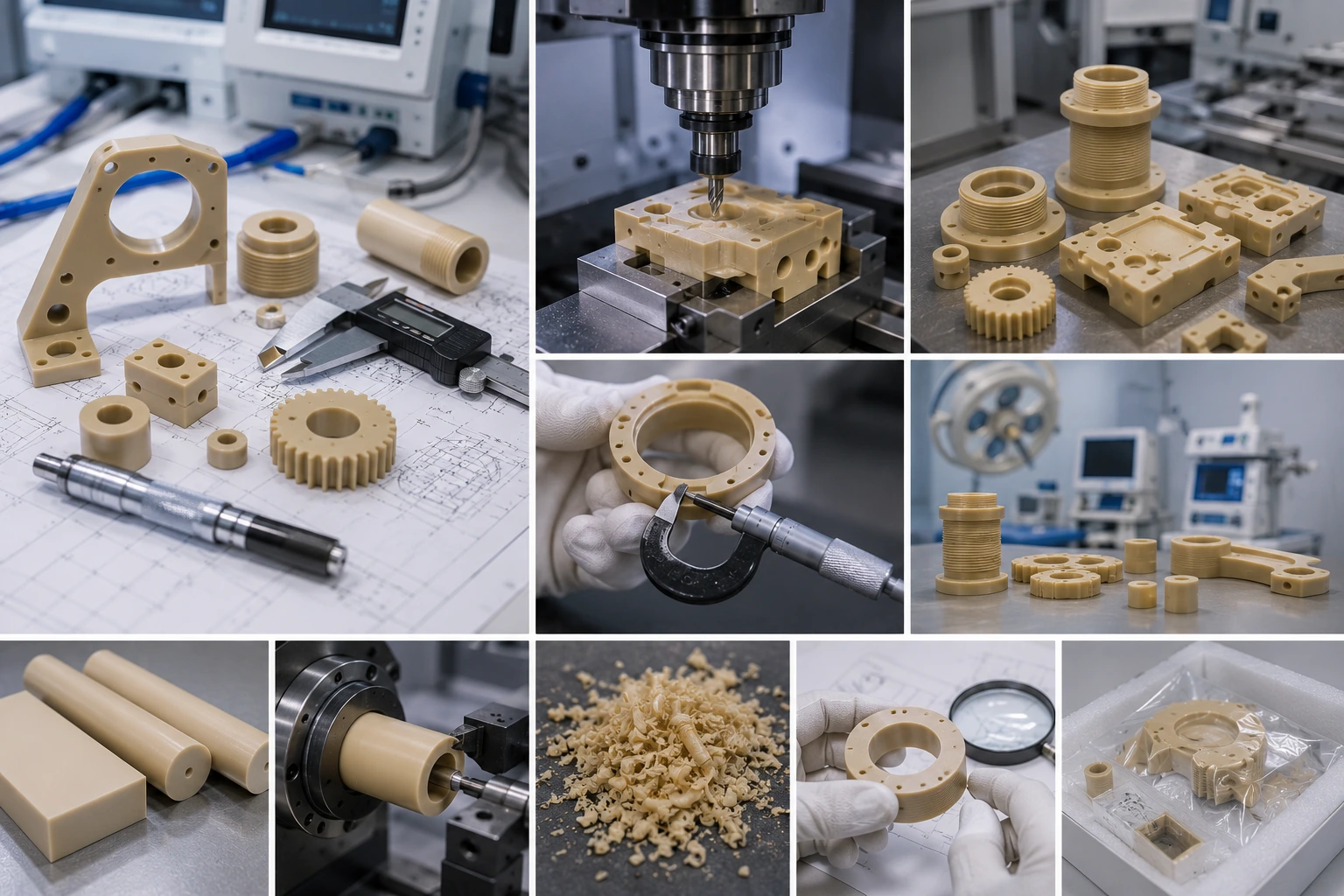
PEEK can be useful for surgical instrument components, diagnostic device housings, insulating blocks, sensor holders, endoscope-related spacers, trial parts, lab fixtures, and low-volume device components. It is strong for a plastic, stable in many precision applications, resistant to many chemicals, and suitable for CNC machining when the design needs accurate holes, pockets, threads, or mating surfaces.
But there is one point worth saying clearly: “medical-grade” does not automatically make a part approved for every medical use. A machined PEEK component still needs the correct material grade, documentation, cleaning process, sterilization review, inspection plan, and device-level validation. The machining supplier can make the component, but the medical device manufacturer must confirm final suitability for the intended use.
For prototype and low-volume work, PEEK CNC machining is often a practical way to test real material performance before committing to tooling.
“Medical-Grade PEEK” Needs a Clear Definition
In RFQs, one of the most common problems is the material note. A drawing may simply say “PEEK,” but that is not enough for many medical projects.
PEEK stands for polyether ether ketone. It is a high-performance thermoplastic known for heat resistance, strength, chemical resistance, low moisture absorption, and dimensional stability. Industrial PEEK and medical-grade PEEK may look similar as raw stock, but they are not handled the same way from a sourcing and documentation standpoint.
Medical-grade PEEK normally refers to a PEEK grade supplied for medical-related applications, with grade-specific documentation, traceability, and suitability information. The required grade depends heavily on the part’s use. A non-contact assembly fixture, a reusable surgical instrument component, a short-term contact part, and an implant-related component should not be treated as the same sourcing case.
| Item to Compare | Industrial PEEK | Medical-Grade PEEK |
|---|---|---|
| Typical use | Industrial fixtures, electronics, machinery parts | Medical device parts, surgical tools, trial components, selected implant-related uses |
| Documentation | Basic datasheet may be enough | Material certificate and traceability may be required |
| Biocompatibility | Not always specified | Grade-dependent and must be verified |
| Sterilization review | Usually application-specific | Often part of device validation |
| Cost level | High | Usually higher |
| Sourcing control | Standard engineering plastic stock | More controlled material sourcing may be needed |
For buyers, the lesson is simple: do not leave the material decision vague. If the exact grade is known, list it. If it is not known, explain the device environment and documentation requirement so the supplier does not quote the wrong material.
Where PEEK Fits in Custom Device Components
PEEK is useful when a component needs a mix of strength, stability, heat resistance, chemical resistance, and insulation. That combination is the reason it is used in higher-value medical device projects.
It is not always the cheapest or simplest option. For a basic non-critical cover, another medical plastic may be more cost-effective. But for a part that needs a tight fit, repeated cleaning, stable geometry, or non-metallic performance, custom medical PEEK components can be a strong choice.
Typical reasons engineers choose PEEK include:
- the part must be non-metallic but still strong
- the component needs electrical insulation
- the part must hold accurate holes or pockets
- the design needs real-material prototype testing
- the geometry is too custom or low-volume for molding
- repeated cleaning or heat exposure is part of the use case
- dimensional stability is more important than low material cost
| Requirement | Why PEEK May Help |
|---|---|
| Non-metallic design | Useful for insulation or avoiding metal contact |
| Tight mechanical fit | Better stability than many common plastics |
| Repeated cleaning | Better heat and chemical resistance than standard plastics |
| Small precision features | Suitable for CNC-machined holes, slots, pockets, and threads |
| Prototype validation | Allows real-material testing without mold tooling |
| Low-volume production | Avoids injection mold cost for small batches |
| Complex shape | Can be machined into custom device geometry |
For early-stage design work, plastic CNC machining gives teams room to revise the part after testing. That flexibility matters when the device design is still changing.
Typical Medical PEEK Machined Parts
The phrase medical PEEK machined parts covers a wide range of components. Some are used only in R&D or testing. Some are part of surgical tools or diagnostic equipment. Some may be related to patient-contact applications, where material control and validation become much more serious.
Common parts include:
- surgical instrument spacers, handles, guides, and supports
- diagnostic device housings and covers
- insulating blocks for electrical isolation
- endoscope-related holders, guides, and spacers
- sensor holders and positioning blocks
- lab and assembly fixtures
- trial parts for fit or evaluation
- wear-resistant guides
- low-volume device components
- selected implant-related components, only with the correct implantable-grade PEEK material and validation
| Component Type | Typical Use | Manufacturing Detail to Watch |
|---|---|---|
| Surgical instrument part | Handle, guide, spacer, support | Burr control and edge comfort |
| Diagnostic housing | Custom enclosure or cover | Fit, appearance, and dimensional stability |
| Insulating block | Electrical isolation | Hole accuracy and clean geometry |
| Endoscope-related part | Holder, guide, spacer | Small features and clean edges |
| Wear guide | Sliding or contact feature | Surface finish and wear behavior |
| Trial component | Fit check or evaluation | Accurate geometry and fast revision |
| Lab fixture | Test or assembly support | Repeatability and stability |
The closer a part gets to patient contact, repeated sterilization, or final device function, the more important it is to define grade, traceability, cleaning, packaging, and inspection from the beginning.
PEEK vs. Other Medical Plastics
PEEK is a premium material, but premium does not always mean necessary.
PPSU may be a better choice for some sterilizable components. PEI/Ultem is often used for housings, fixtures, and insulators. POM is easy to machine for non-critical fixtures. PTFE is useful for low-friction or sealing applications, although it is softer and harder to hold in tight-tolerance features.
PEEK becomes attractive when several requirements come together at once: strength, dimensional stability, heat resistance, chemical resistance, and precision machining.
| Material | Strength | Heat Resistance | Chemical Resistance | Machinability | Common Medical Use |
|---|---|---|---|---|---|
| PEEK | High | Excellent | Excellent | Good with proper tooling | Precision medical components |
| PPSU | Good | Good | Good | Good | Sterilizable device parts |
| PEI / Ultem | Good | High | Good | Good | Housings, fixtures, insulators |
| PC | Good impact resistance | Moderate | Moderate | Good | Housings and covers |
| POM / Delrin | Good | Moderate | Good | Excellent | Fixtures and guides |
| PTFE | Lower strength | Good | Excellent | More difficult for tight tolerance | Seals and low-friction parts |
| Nylon | Tough | Moderate | Moisture-sensitive | Good | Non-critical wear parts |
This is where PEEK plastic machining for medical applications needs a practical review. If a cheaper plastic meets the requirement, use it. If the part must stay stable under heat, cleaning, load, or close assembly conditions, PEEK may justify the cost.
Why CNC Machining Is Often Used Before Molding
Medical device development rarely moves in a straight line.
A prototype is assembled, then a hole moves 0.5 mm. A grip shape changes after a user test. A pocket needs more clearance. A wall needs to be thicker. A fixture needs one extra slot because a cable was not considered in the first version.
This is normal development work, and it is exactly where CNC machining helps.
With CNC machining services, teams can make real PEEK parts without waiting for mold tooling. CNC machining is especially useful for medical device prototype machining, validation parts, low-volume components, and functional samples that need real material behavior.
| CNC Machining Benefit | Why It Matters in Medical Device Development |
|---|---|
| No mold tooling | Useful during R&D and design changes |
| Real material testing | Better than shape-only printed prototypes |
| Fast revision | CAD changes can be machined without a new mold |
| Accurate features | Supports holes, slots, threads, and mating surfaces |
| Low-volume flexibility | Practical before production scale-up |
| Functional geometry | Good for fixtures, trial parts, and device components |
Injection molding may be reviewed later when the design is stable and quantity supports tooling cost. But early in development, CNC machining often saves time and avoids locking the team into a design too soon.
Machining PEEK Requires Control, Not Force
PEEK is machinable, but it should not be treated like ordinary plastic.
The raw material is expensive. Small burrs matter. Thin walls can move. Over-clamping can distort the part. Heat from rubbing can affect edge quality. Heavy material removal can release stress and change flatness.
For PEEK CNC machining for medical devices, the machining plan needs to protect the features that affect the device assembly.
| Machining Concern | Why It Matters |
|---|---|
| Expensive raw stock | Scrap and oversized blanks raise cost quickly |
| Tool sharpness | Dull tools can leave burrs and heat marks |
| Thin walls | Features may deflect during cutting or clamping |
| Small holes | Need sharp tools and careful inspection |
| Burrs | Can affect assembly, cleanliness, and handling |
| Threads | May need inserts if assembled repeatedly |
| Flatness | Requires good workholding and inspection |
For high-precision work, precision machining is important because the process is not only about machine accuracy. It is also about fixture support, machining sequence, finishing stock, and inspection timing.
Tolerance Planning: Put Precision Where It Matters
Over-tolerancing is a common reason PEEK medical parts become harder and more expensive to machine.
PEEK can hold tight dimensions on stable features, but it is still a plastic. Thin walls, long slots, large flat faces, and heavily pocketed shapes need realistic tolerance planning.
A good drawing tells the supplier what is functional.
A mating bore may need a tight tolerance. A sensor pocket may need accurate location. A sealing face may need flatness and surface finish. A non-contact outer wall usually does not need the same level of control.
| Feature | Better Tolerance Strategy |
|---|---|
| Mating bore | Tight tolerance if fit requires it |
| Mounting holes | Control position if assembly needs it |
| Sealing face | Specify flatness and surface finish |
| Non-contact outer profile | General tolerance is usually enough |
| Thin wall | Avoid unnecessary tight tolerance |
| Threaded hole | Consider insert for repeated assembly |
| Sensor pocket | Control only functional dimensions |
For high-precision PEEK medical components, a clear 2D drawing is still important. The 3D model gives shape, but the drawing tells the supplier what must be inspected and what can follow general tolerance.
Burr Control and Clean Edges Need Clear Notes
Small edges matter more than people expect.
A burr inside a hole can affect assembly. A sharp edge on a handled component can be a problem. A loose chip in a pocket may be unacceptable. A scratch on a sealing or sliding surface may affect function.
The phrase “smooth finish” is too vague. It is better to specify the actual need.
Good notes may include:
- burr-free holes
- light chamfer on exposed edges
- no loose chips or debris
- protect sealing face
- fine-machined surface on functional face
- clean packaging required
- no aggressive deburring on thin features
| Requirement | Practical Reason |
|---|---|
| Burr-free holes | Helps clean assembly |
| Chamfered edges | Improves handling and fit |
| Fine machined face | Useful for sealing or sliding |
| Clean packaging | Protects parts before use |
| Visual inspection | Finds marks, scratches, or chips |
| Controlled deburring | Protects small precision features |
Boona surface finishing FAQ is useful when the part needs controlled edge quality, polishing, cleaning, or cosmetic surface requirements.
Sterilization and Biocompatibility Need Careful Language
A machined PEEK part is not automatically approved for medical use just because it is made from medical-grade material.
The final suitability depends on the exact grade, intended use, contact type, sterilization method, cleaning process, device design, and validation work performed by the medical device manufacturer.
A non-contact assembly fixture does not need the same review as a patient-contact component. A prototype for fit testing is not the same as a production part used in a regulated device. A component made from implantable-grade PEEK material requires a much higher level of material and regulatory control than a lab fixture.
Before ordering biocompatible PEEK parts, the device team should clarify:
| Question | Why It Matters |
|---|---|
| Which PEEK grade is required? | Different applications need different material control |
| Is the part patient-contact or non-contact? | Affects documentation and validation |
| Is biocompatibility data required? | Depends on intended use and contact type |
| Will the part be sterilized? | Sterilization may affect dimensions or surface condition |
| Is it prototype or production? | Changes documentation expectations |
| Is traceability required? | Important for controlled medical programs |
The machining supplier can support manufacturing, inspection, and agreed documentation. The device manufacturer must verify final suitability for clinical or patient-contact use.
Documentation Is Part of the Job
For many medical projects, the part is only one part of the delivery. Documentation can be just as important.
Depending on the application, a buyer may need material certificates, lot traceability, dimensional reports, inspection records, or supplier quality information. These items add time and cost, but they also reduce risk during validation and sourcing review.
| Document / Record | When It May Be Needed |
|---|---|
| Material certificate | Controlled medical device programs |
| Lot traceability | Validation or production batches |
| Dimensional report | Tight-tolerance components |
| Inspection report | Incoming quality approval |
| Surface finish record | Functional sealing or sliding surfaces |
| Supplier quality records | Regulated sourcing review |
Boona quality control page is relevant for PEEK medical parts that require dimensional inspection, feature checks, or controlled documentation before shipment.
DFM Tips That Reduce Risk Before Machining
PEEK is expensive, so design issues should be fixed before the material is cut.
Thin unsupported walls, sharp internal corners, deep pockets, tiny threads, and tight tolerances everywhere can all increase machining risk. Sometimes a small change makes the part easier to machine without changing its function.
Useful DFM habits include:
- avoid very thin unsupported walls
- add internal radii based on tool access
- avoid deep pockets unless they are functional
- mark only the truly critical tolerances
- specify surface finish only where it affects function
- consider threaded inserts for repeated assembly
- avoid sharp edges that are difficult to deburr
- define cleaning and packaging needs
- discuss annealing for flatness-critical parts
| Design Issue | Better Practice |
|---|---|
| Thin wall | Increase thickness or add support |
| Sharp internal corner | Add radius based on tool size |
| Repeated thread | Consider metal insert |
| Large flat face | Discuss flatness and stress relief |
| Deep pocket | Reduce depth or improve tool access |
| Critical surface | Mark finish requirement clearly |
| Clean-use component | Define cleaning and packaging notes |
For early-stage or small-batch work, low-volume manufacturing can be useful before the device team commits to larger production tooling.
Cost Drivers for Medical-Grade PEEK Machining
Medical-grade PEEK parts cost more than ordinary plastic parts because both material and process control are more demanding.
The stock may cost more. Certified or traceable material adds cost. Tight tolerances add machining and inspection time. Burr-free notes require careful finishing. Thin-wall designs increase fixture risk. Clean packaging and documentation add handling time.
| Cost Factor | Why It Affects Price |
|---|---|
| PEEK grade | Medical-grade or implantable-grade stock usually costs more |
| Blank size | Material waste is expensive |
| Tight tolerance | Requires more careful machining and inspection |
| Thin-wall design | Increases workholding and scrap risk |
| Burr-free requirement | Adds controlled finishing time |
| Clean packaging | Adds handling and protection |
| Material certificate | Adds documentation |
| Low quantity | Setup cost spreads across fewer parts |
| Inspection report | Adds QC time |
For procurement teams, the lowest quote is not always the safest quote. It is better to compare whether the material grade, inspection scope, burr control, and documentation match the project requirement.
RFQ Checklist for Medical-Grade PEEK Parts
A clear RFQ saves time and prevents wrong assumptions.
For custom PEEK device components, send more than a CAD model when the application has medical requirements.
Include:
- 3D CAD file
- 2D drawing
- PEEK grade
- quantity
- prototype or production use
- critical tolerances
- surface finish requirements
- burr-free requirements
- thread or insert details
- sterilization method, if known
- patient-contact or non-contact use
- working temperature
- chemical exposure
- inspection report needs
- material certificate or traceability needs
- packaging requirements
A lab fixture, a prototype trial part, a surgical instrument component, and a patient-contact part should not be quoted with the same assumptions.
Final Thoughts
Medical-grade PEEK parts are useful when custom device components need a strong combination of precision, strength, stability, heat resistance, chemical resistance, and insulation.
The material is capable, but it is not a universal answer. Grade selection, intended use, machining strategy, burr control, sterilization review, inspection, documentation, and device validation all matter.
For prototypes, validation parts, and low-volume medical device components, CNC machining is often the most practical route. It gives teams real-material parts, fast design revisions, tight functional features, and a way to test the design before scaling up.
The best results usually come from clear communication before machining starts: define the grade, mark critical dimensions, explain the application, and confirm documentation needs early.
FAQs
What are medical-grade PEEK parts?
Medical-grade PEEK parts are custom components made from PEEK grades intended for medical-related applications. They may be used in surgical tools, device prototypes, fixtures, housings, insulators, or selected implant-related parts, depending on the material grade, documentation, and validation requirements.
Is PEEK suitable for medical device components?
PEEK can be suitable for many medical device components because it offers strength, dimensional stability, chemical resistance, heat resistance, and electrical insulation. Final suitability depends on the exact grade, contact type, sterilization method, and validation by the medical device manufacturer.
Can medical-grade PEEK be CNC machined?
Yes. Medical-grade PEEK can be CNC machined into high-precision custom parts, prototypes, fixtures, guides, insulators, and low-volume device components. CNC machining is useful when the design needs real-material testing, tight features, or fast design revisions before tooling.
What tolerances can be held on medical PEEK machined parts?
Tight tolerances are possible on stable PEEK features, but results depend on part geometry, wall thickness, hole size, flatness, material grade, and inspection requirements. Engineers should mark only the critical tolerances on the 2D drawing to avoid unnecessary cost and risk.
Do medical PEEK parts need special finishing or cleaning?
Many medical PEEK parts require controlled burr removal, clean edges, chamfers, protected functional surfaces, and proper cleaning or packaging. Surface finish requirements should be clearly marked only where they affect assembly, sealing, sliding, cleanliness, or device function.
What should I provide for a medical-grade PEEK machining quote?
Provide a 3D CAD file, 2D drawing, PEEK grade, quantity, critical tolerances, surface finish needs, burr-free notes, thread or insert details, sterilization method if known, contact type, inspection requirements, and material certificate or traceability needs.