
C110 copper can fool people at first. It is not a hard metal. It does not destroy cutters the way some stainless steels or nickel alloys can. It conducts heat well, machines quickly in the right setup, and is widely used for busbars, battery terminals, conductive plates, RF parts, grounding blocks, and heat-transfer components.
But once it gets on the CNC machine, the weak point shows up fast: C110 copper is soft, ductile, and sticky.
A tool that works fine in aluminum may start rubbing in C110. A drill that looks sharp enough may pull long spiral chips and smear the hole wall. A general-purpose turning insert may leave a shiny surface that still has burrs, tearing, or built-up edge. That is why C110 copper CNC tooling needs to be selected around cutting behavior, not just tool hardness.
For buyers sourcing custom copper CNC machining, tooling selection is not a small shop-floor detail. It affects surface finish, burr level, lead time, inspection results, and final part cost.
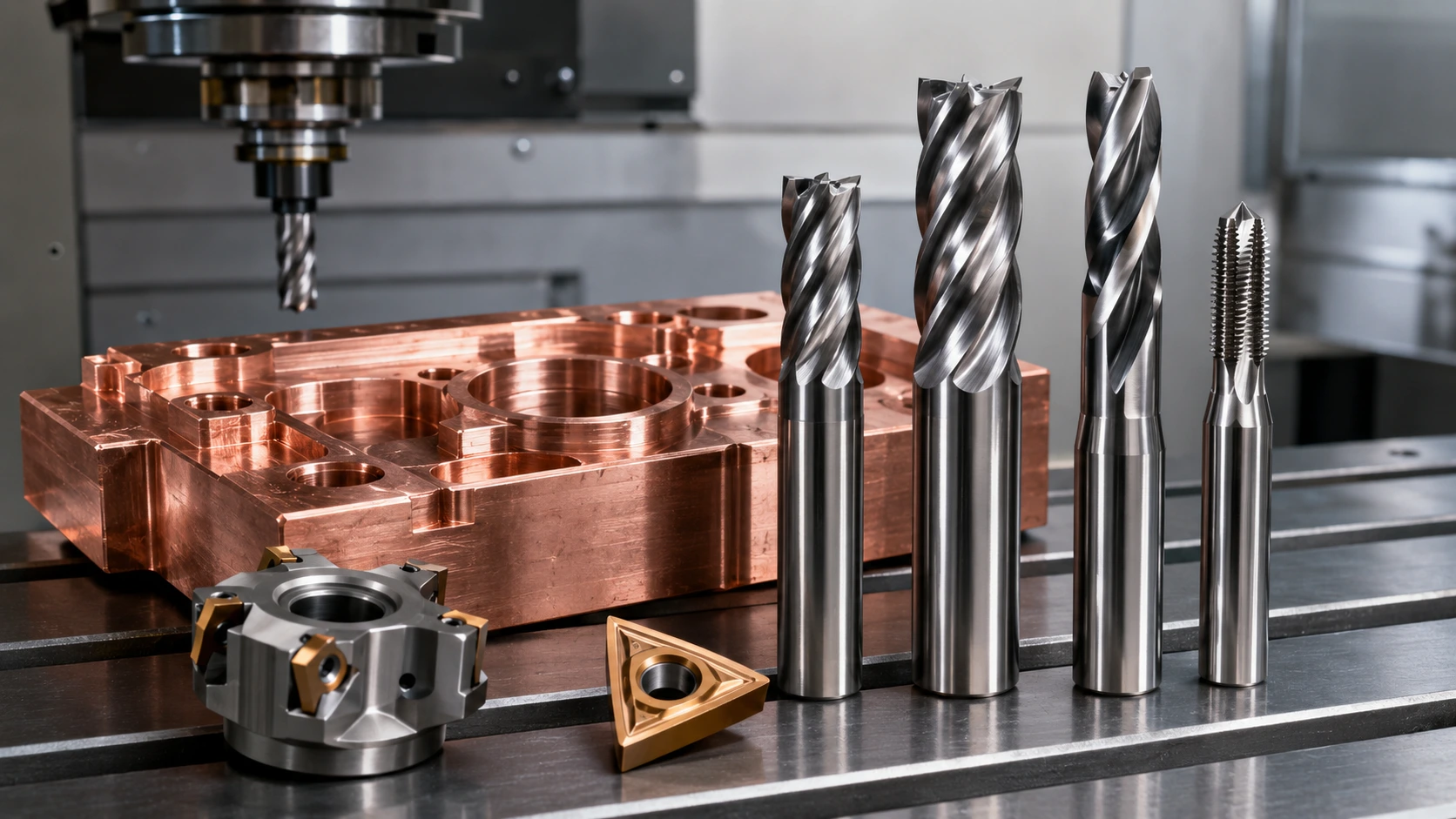
What Makes C110 Copper Hard on Tooling?
C110 copper is often chosen for its electrical and thermal performance. Boona’s copper machining resources list C110 as one of the available copper grades for high-conductivity CNC parts, alongside C101 and C103. That makes sense for electrical and thermal applications, but the same high-purity behavior also creates machining problems.
The issue is not that C110 is too hard. It is that the metal does not want to break cleanly.
When the cutting edge is not sharp enough, copper tends to smear. When the chip is too thin, it stretches. When coolant does not reach the tool, copper sticks to the edge. Once built-up edge starts, the cutter is no longer cutting with its real geometry; it is cutting with a lump of copper welded to the edge.
Here is the practical version most machinists care about:
| Problem on the Machine | What It Usually Means | Tooling Decision That Helps |
|---|---|---|
| Copper sticking to the flute | Friction and built-up edge | Polished carbide, DLC, or diamond-like coating |
| Long stringy chips | Chip cannot curl or escape | 2-flute or 3-flute end mill with open flute space |
| Heavy burrs | Tool is pushing instead of slicing | Sharp positive-rake cutting edge |
| Cloudy or smeared surface | Rubbing, not clean shearing | Lighter engagement but real chip load |
| Hole wall scratches | Chips trapped in the hole | Parabolic or through-coolant drill |
| Finish changes during the run | Edge loading or tool wear | Dedicated finishing tool and regular inspection |
A good copper tool should feel almost “too sharp” compared with tools used for tougher materials. For soft C110 copper, sharpness, flute polish, and chip clearance usually matter more than a heavy edge prep.
Start With the End Mill: 2-Flute and 3-Flute Tools Usually Win
For milling C110 copper, I would usually start with a polished carbide end mill made for non-ferrous materials.
Not every job needs an expensive PCD tool. For prototypes and small batches, a sharp polished carbide tool is often enough. What matters is the geometry: high positive rake, smooth flute surface, open chip space, and minimal edge hone.
A 4-flute cutter can work in some open cuts, but it is not always the safest choice for gummy copper. The extra flutes reduce chip room. If the cutter is working in a pocket or slot, copper chips can pack quickly, then the tool starts recutting them. That is when you see scratches, burrs, and poor finish.
For most C110 copper end mill selection, this is a better starting point:
| End Mill Choice | Where It Works Best | Shop-Floor Comment |
| 2-flute polished carbide | Pockets, slots, softer cutting | Best chip space, safer for gummy copper |
| 3-flute polished carbide | Profiling, roughing, finishing balance | Good mix of finish and evacuation |
| 4-flute carbide | Open side milling, rigid setups | Use carefully; chip packing is the risk |
| Ball end mill | 3D surfaces and radii | Needs sharp non-ferrous geometry |
| Corner-radius end mill | Edges that need tool strength | Good when a sharp corner tool is too fragile |
| PCD or diamond tooling | Repeat production, ultra-clean finish | Higher cost, useful when volume justifies it |
For deep pockets, I would rather reduce radial engagement than simply slow everything down. Copper does not always improve when you “baby” it. If the tool rubs, the surface gets worse. The goal is a clean chip that leaves the cut.
The related Boona guide on C110 copper CNC speeds and feeds is a useful internal reference here, because tool geometry and feed rate have to work together. A sharp tool with the wrong feed still gives problems, and the right feed with a dull tool also fails.
Coating Choice: Do Not Choose Coating Before Edge Quality
Many people ask whether coated or uncoated tools are better for C110 copper. The honest answer is: the coating matters, but the edge matters first.
A polished uncoated carbide tool can perform very well if it is sharp and made for non-ferrous metals. DLC-coated tools can help when copper starts sticking. Diamond-coated or PCD tools are excellent for repeat jobs or high-value finishing, but they are not always necessary for one-off prototypes.
What I would avoid is a general steel-focused coating with a dull edge or heavy hone. That type of tool may be strong, but it often pushes soft copper instead of slicing it.
| Tool Surface | Best Use for C110 Copper | Notes |
| Polished uncoated carbide | Prototypes, short runs, general milling | Good first choice when tool is sharp |
| DLC coating | Gummy copper, longer runs, better anti-sticking | Helps reduce built-up edge |
| Diamond-coated carbide | Repeat copper machining, cleaner wear resistance | Higher cost, better for production |
| PCD | High-volume finishing or premium surfaces | Excellent, but not always economical |
| Steel-focused coatings | Usually not first choice | May add friction or dullness at the edge |
For best tooling for machining C110 copper, do not buy only by coating name. Look at the edge, flute polish, rake angle, and chip room.
Drilling C110 Copper: The Drill Must Clear Chips, Not Just Make a Hole
Drilling soft copper is where many parts get damaged.
The problem is simple: chips are trapped inside the hole. If they do not move up the flute, they rub against the wall, score the bore, or grab the drill. In blind holes, the problem is worse because chips have nowhere to go.
For short, non-critical holes, a sharp HSS drill can work. For more consistent holes, carbide drills are better. For deeper holes, parabolic flute drills or through-coolant tools are often worth the cost.
| Drill Type | Best Use | Practical Note |
| Sharp HSS drill | Short holes and low-volume work | Keep it sharp; use lubrication |
| Carbide drill | Accurate holes and repeat jobs | Better rigidity and repeatability |
| Parabolic flute drill | Deeper holes | Helps pull long copper chips out |
| Through-coolant drill | Deep or critical holes | Best chip evacuation if machine supports it |
| Micro drill | Small precision holes | Runout control is critical |
For C110 copper drilling tools, flute finish matters. A rough flute gives sticky copper more places to hang up. A polished flute gives chips a better chance to move out of the hole.
Peck drilling can help, but too much pecking creates another problem: the drill keeps re-entering and rubbing the same copper wall. The peck cycle should clear chips, not polish the hole.
If the hole is tight tolerance, do not expect the drill to finish it perfectly. Drill undersize, then ream, bore, or machine the final size.
Tapping and Threading: Form Taps Are Often Worth Considering
Threads in C110 copper need care. Copper can tear with a poor tap, especially in small holes or blind holes. The tap style should match the hole, not just the thread size.
For ductile copper, form taps can be a strong option because they displace material instead of cutting chips. That avoids chip packing, but the pre-drill size must be correct. If the hole is too small, torque rises fast. If the hole is too large, thread strength drops.
| Threading Method | Good For | Watch Out For |
| Spiral flute tap | Blind holes | Pulls chips upward |
| Spiral point tap | Through holes | Pushes chips forward |
| Form tap / roll tap | Ductile copper | Needs correct drill size and lubrication |
| Thread milling | Expensive parts, larger threads, repair flexibility | Slower but safer |
| Single-point threading | Turned copper parts | Needs sharp non-ferrous insert |
For expensive copper parts, thread milling is sometimes the safer option. It is slower than tapping, but if something goes wrong, you are less likely to scrap a part because of a broken tap.
For conductive parts such as terminals, busbars, and grounding blocks, thread quality is not only cosmetic. It affects assembly pressure and long-term reliability.
Turning Inserts for C110 Copper: Avoid Heavy Steel Geometry
Turning C110 copper needs the same basic idea: sharp edge, positive rake, low friction.
A heavy-duty steel insert may survive the cut, but it often creates more pressure than needed. The surface may look shiny, but the chip can be long and uncontrolled, and burrs may form around grooves, shoulders, and threads.
For turned copper pins, sleeves, terminals, and conductive shafts, use polished inserts designed for non-ferrous metals.
| Turning Operation | Better Insert Choice | Reason |
| Rough turning | Positive-rake polished carbide | Cuts freely with less pressure |
| Finish turning | Sharp high-polish non-ferrous insert | Better surface and lower built-up edge |
| Grooving | Sharp ground grooving insert | Reduces tearing and burrs |
| Parting | Rigid sharp parting blade | Prevents grabbing and chatter |
| Threading | Sharp threading insert | Cleaner thread form |
For parts that combine milling and lathe features, Boona’s CNC turning services are a natural fit. C110 copper parts often need grooves, axial holes, radial holes, threads, and flat contact faces, so turning and milling strategy should be planned together.
Tool Holder Quality Shows Up Quickly in Copper
Tooling is not only the cutter. The holder matters.
Runout creates uneven chip load. One flute cuts too much, another flute rubs, and copper immediately shows the problem as chatter, burrs, or inconsistent finish. This is especially noticeable with small tools, finishing tools, and holes.
For precision C110 copper work, keep the tool stick-out short and use a stable holder.
| Holder / Setup Choice | Why It Matters |
| Precision collet holder | Practical for small and medium tools |
| Hydraulic holder | Helps vibration control |
| Shrink-fit holder | Strong concentricity and rigidity |
| Short tool stick-out | Less chatter and deflection |
| Clean collets and holders | Prevents hidden runout problems |
If the part needs ±0.01 mm-level tolerance or a clean contact surface, holder condition is not a detail to ignore. Boona’s precision CNC machining services are relevant here because copper work often needs both sharp tooling and stable machining conditions to hold finish and tolerance.
A Practical Tooling Setup for C110 Copper
For many C110 copper parts, I would start with a tool list like this:
| Feature on the Part | Tooling Choice |
| Open pockets | 2-flute or 3-flute polished carbide end mill |
| Deep pockets | Long-reach polished carbide, reduced radial engagement |
| Flat contact face | Dedicated sharp finishing end mill or non-ferrous face mill |
| Small holes | Carbide drill with low runout |
| Deep holes | Parabolic or through-coolant drill |
| Blind threads | Spiral flute tap, form tap, or thread mill |
| Through threads | Spiral point tap or form tap |
| Turned pins / sleeves | Positive-rake polished turning insert |
| Grooves | Sharp ground grooving insert |
| Burr-sensitive edges | Chamfer mill or controlled deburring tool |
A copper heat sink, a busbar, and an RF connector may all use C110, but they should not all use the same tooling plan. The feature matters as much as the material.
For CNC machining pure copper custom parts, the better approach is to choose tooling by feature: pocket, hole, thread, groove, contact face, thin wall, and cosmetic surface.
Common Tooling Mistakes That Make C110 Copper Worse
Most C110 copper tooling problems are not mysterious. They come from a few repeat mistakes.
| Mistake | What Happens |
| Using a dull general-purpose cutter | Smearing, built-up edge, poor finish |
| Choosing too many flutes | Chips pack in pockets and slots |
| Using steel inserts for soft copper | Too much pressure and burr formation |
| Finishing with the roughing tool | Surface marks and copper deposits |
| Ignoring coolant direction | Chips stay in the cut |
| Ignoring holder runout | Uneven chip load and chatter |
| Using the wrong tap style | Torn threads or packed chips |
| Forcing tiny corner radii | Small weak tools and longer cycle time |
The last point is worth mentioning. Tooling problems are sometimes design problems. If the drawing forces very small internal radii, the shop has to use smaller tools. Smaller tools are weaker, have less chip space, and need more passes.
A slightly larger corner radius can reduce cycle time, improve chip evacuation, and improve surface quality. That is a simple DFM change, but it can make a big difference in copper.
Tooling Also Affects Inspection and Deburring
C110 copper is soft, so burrs are easy to create and sometimes annoying to remove. Aggressive deburring can round edges, scratch surfaces, or change small features.
Good tooling reduces deburring before it starts. Sharp tools, correct exit paths, enough chip clearance, and clean finishing passes all help.
For copper parts with visible surfaces or contact faces, inspection should check more than dimensions. Surface scratches, burrs, edge quality, and tool marks matter too. Boona’s quality control page is a useful internal reference for this part of the process, especially when a copper part needs both dimensional accuracy and acceptable surface condition.
If a prototype later moves into small-batch production, tooling life becomes even more important. A tool that makes one clean sample may not hold the same finish across 50 or 500 parts. For that kind of transition, low-volume manufacturing services help connect prototype machining with repeatable production planning.
Final Thoughts
The best CNC tooling for soft C110 copper is not always the most expensive option. It is the tool that cuts cleanly, lets the chip escape, and avoids rubbing the material.
For milling, that usually means sharp polished carbide end mills with 2 or 3 flutes. For drilling, it means sharp drills with good flute clearance. For threading, it means choosing the right tap or using thread milling when the part is expensive. For turning, it means polished positive-rake inserts made for non-ferrous metals.
Most problems in machining soft C110 copper begin when the tool rubs instead of shears. Once rubbing starts, built-up edge, burrs, smearing, long chips, and unstable finish usually follow.
A good tooling strategy for custom C110 copper CNC machining should combine sharp geometry, low-friction flute surfaces, open chip space, stable holders, proper coolant direction, and a dedicated finishing plan. When those details are handled early, C110 copper becomes much more predictable—and the finished parts are cleaner, easier to inspect, and more reliable in real electrical or thermal applications.
FAQs
What is the best CNC tooling for machining soft C110 copper?
The best CNC tooling for soft C110 copper is usually sharp, polished carbide tooling designed for non-ferrous metals. For milling, 2-flute or 3-flute polished carbide end mills are often a good choice because they provide enough chip space and reduce copper sticking. For turning, polished positive-rake inserts work better than heavy-duty steel inserts.
Why does C110 copper stick to cutting tools?
C110 copper is soft, ductile, and gummy, so it can smear across the cutting edge instead of breaking cleanly. When the tool is dull, the feed is too light, or coolant is poor, copper may weld to the tool and create built-up edge. This causes rough surfaces, burrs, and unstable dimensions.
Should I use coated or uncoated tools for C110 copper?
Both can work, but the tool edge must be sharp. Polished uncoated carbide is a strong starting choice for prototypes and small batches. DLC-coated or diamond-coated tools can help reduce copper adhesion in longer runs. Avoid coatings mainly designed for steel if they add friction or make the edge less sharp.
Is a 2-flute or 4-flute end mill better for C110 copper?
For most C110 copper milling, a 2-flute or 3-flute end mill is usually better. C110 copper often creates long, sticky chips, so the cutter needs more flute space for chip evacuation. A 4-flute tool can work in open side milling, but it may trap chips in pockets or slots.
What drill type works best for C110 copper?
For short holes, a sharp HSS or carbide drill can work. For deeper or more critical holes, parabolic flute drills or through-coolant carbide drills are better because they help remove long copper chips from the hole. Poor chip evacuation can cause grabbing, wall smearing, oversized holes, or broken drills.
How can tooling reduce burrs when machining C110 copper?
Burrs can be reduced by using sharp positive-rake tools, avoiding dull cutters, keeping tool runout low, and using proper chip evacuation. A dedicated finishing tool, controlled exit path, and light chamfering pass can also improve edge quality on C110 copper CNC machined parts.